
 ,,
,,- University of Oxford, Department of Physics, Atmospheric, Oceanic, and Planetary Physics, Oxford, UK (duncan.lyster@physics.ox.ac.uk)
Introduction: Understanding surface temperatures on airless planetary bodies is crucial for interpreting thermal observations and constraining surface properties. We present TEMPEST (Thermal Evolution Model for Planetary Environment Surface Temperatures), a modular, open-source Python model that simulates diurnal and non-periodic thermal evolution on irregular bodies. Unlike traditional 1D periodic solvers, TEMPEST handles transient heating events such as eclipses, non-synchronous rotations such as tumbling asteroids, and seasonal variations. Key capabilities include surface roughness modelling via hemispherical craters, multiple thermal conduction schemes, and modular scattering using lookup tables (LUTs). TEMPEST has been used to analyse data from the Lucy mission and has been validated against the well-established Spencer 1D thermal model, thermprojrs [1].
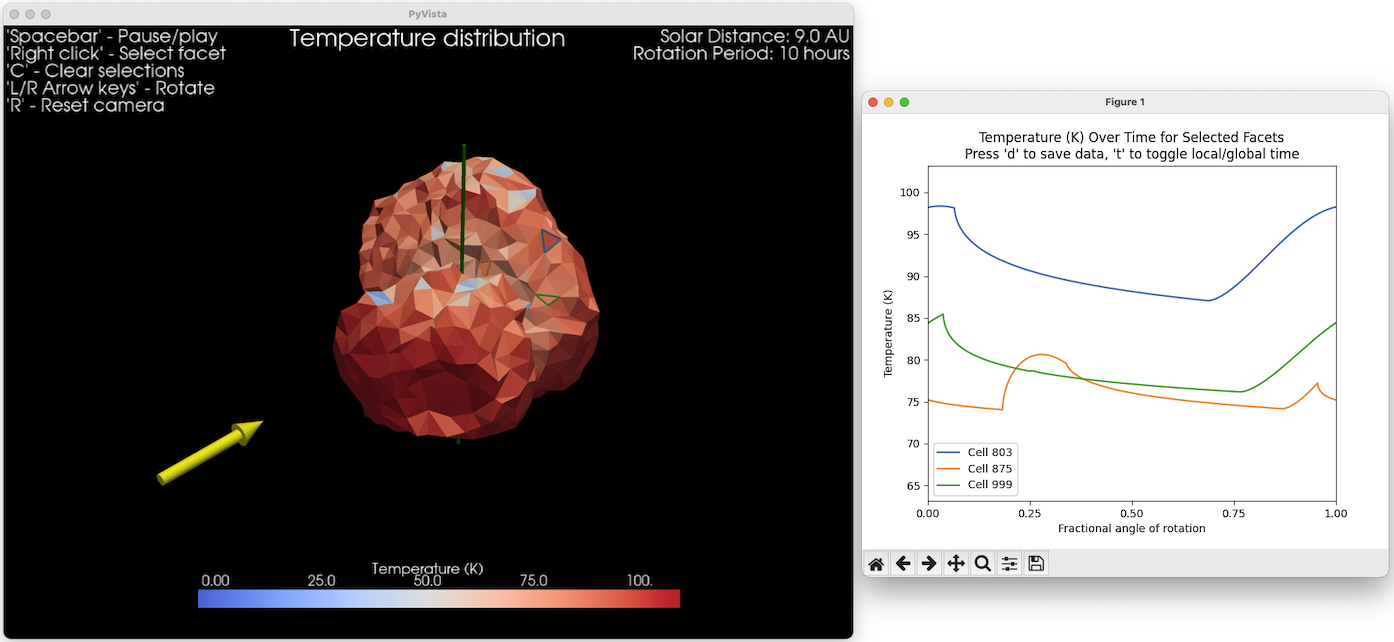
Figure 1: TEMPEST allows the user to select a facet to view any of its time varying properties including insolation, temperature and radiance. The diurnal temperature curves (right) are those of the corresponding outlined facets selected by the user in the interactive pane (left).
Methods: TEMPEST calculates surface temperatures by solving a surface energy balance that includes solar flux, thermal emission, vertical heat conduction, and (optionally) radiative self-heating. Figure 1 shows the user interface once the model has completed a run. Key components include:
- Thermal solvers: Includes a standard 1D periodic conduction scheme influenced by the widely used thermprojrs [1] and a non-equilibrium solver, designed for better performance and stability in non-periodic cases.
- Scattering treatments: Utilises precomputed LUTs for various scattering laws (e.g., Lambertian, Lommel-Seeliger). This structure allows users to incorporate empirical bi-directional reflectance function (BRDF) data (e.g., from goniometer measurements of lunar regolith) or test the impact of different scattering assumptions, which can be particularly important for investigating the temperature of shadowed regions, as shown in Figure 2. The modularity also facilitates user modification for specific research needs.
- Surface roughness: Implemented via hemispherical sub-facet craters with adjustable rim angle to match roughness with a specified RMS slope angle.
- Non-periodic and time-dependent conditions: Supports time-dependent boundary conditions, including periodic scenarios such as eclipses and seasonal variations due to orbital eccentricity, as well as non-periodic cases including tumbling rotation, endogenic heating, and, or other user-defined transient heating scenarios.
Designed for efficient parallel execution, the model runs effectively on multi-core personal computers and can efficiently simulate shape models with tens of thousands of facets. It has also been deployed on high-performance computing clusters for larger-scale models on the order of 1 million facets. Input configuration files are simple and flexible, allowing integration into larger analysis pipelines.
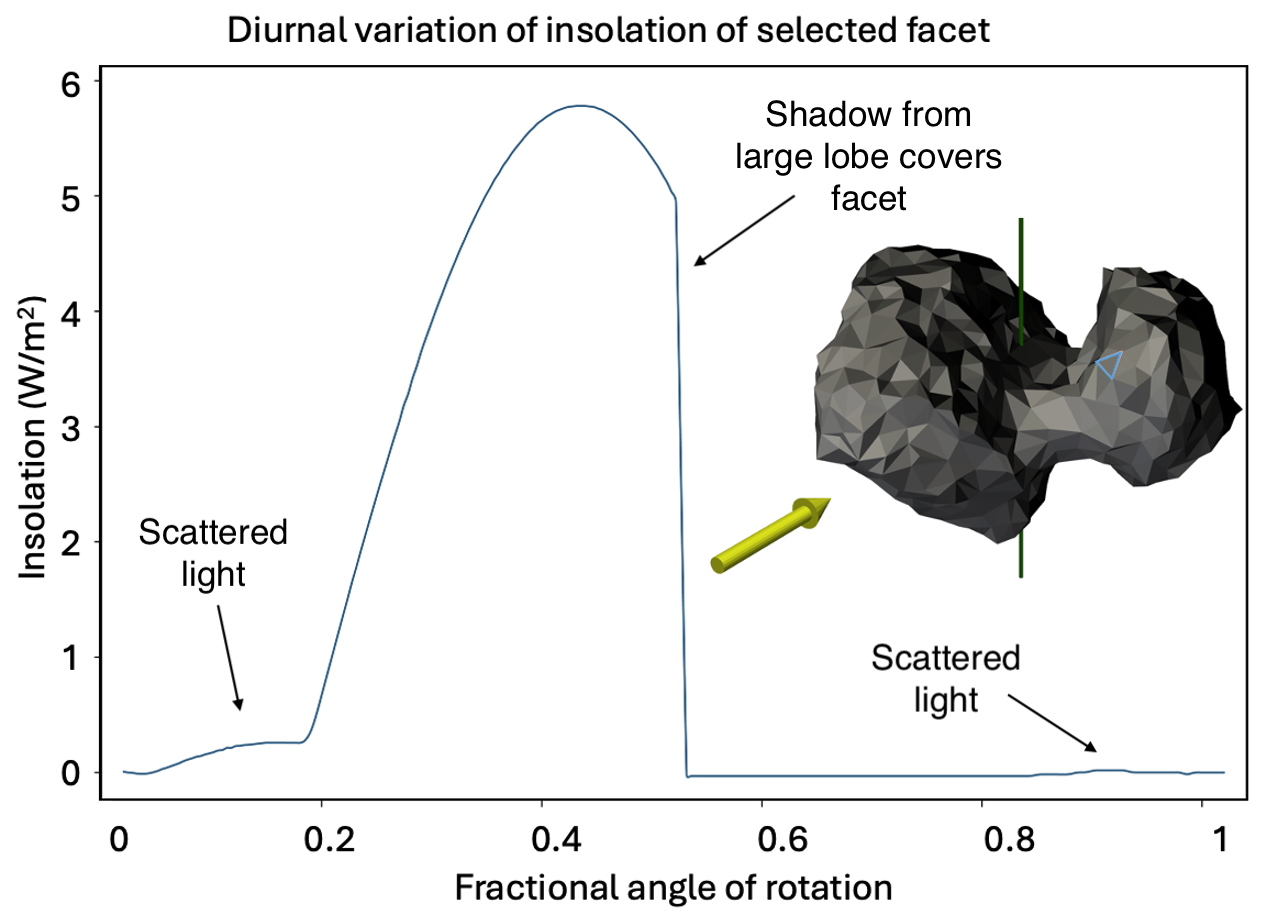
Figure 2: An example insolation curve from a 1666 facet model of the bilobate comet 67P. The effects of scattered light can be seen either side of the main peak, this is particularly important for permanently shadowed regions. The selected facet is shown with a blue outline; sunlight direction is shown with a yellow arrow.
Results: We validated TEMPEST by comparing temperature time series with Spencer’s 1D model thermprojrs [1] under idealised conditions, showing consistent results – see Figure 3. Applied to high-resolution shape models of 67P/Churyumov-Gerasimenko and 101955 Bennu, the model produces detailed temperature maps that reflect the significant influence of self-shadowing and local geometry, quantifying, for example, the temperature reduction in shadowed craters. Non-periodic simulations have been run to explore rotational transitions and eclipse effects, enabling new modes of comparison with observational datasets. The modular scattering and roughness components offer a powerful way to assess how sub-resolution scale parameters impact apparent thermal inertia and surface radiative behaviour. TEMPEST is already being used to interpret thermal data from recent missions, including Lucy, and can be adapted for upcoming datasets from targets like those of Comet Interceptor and Europa Clipper.
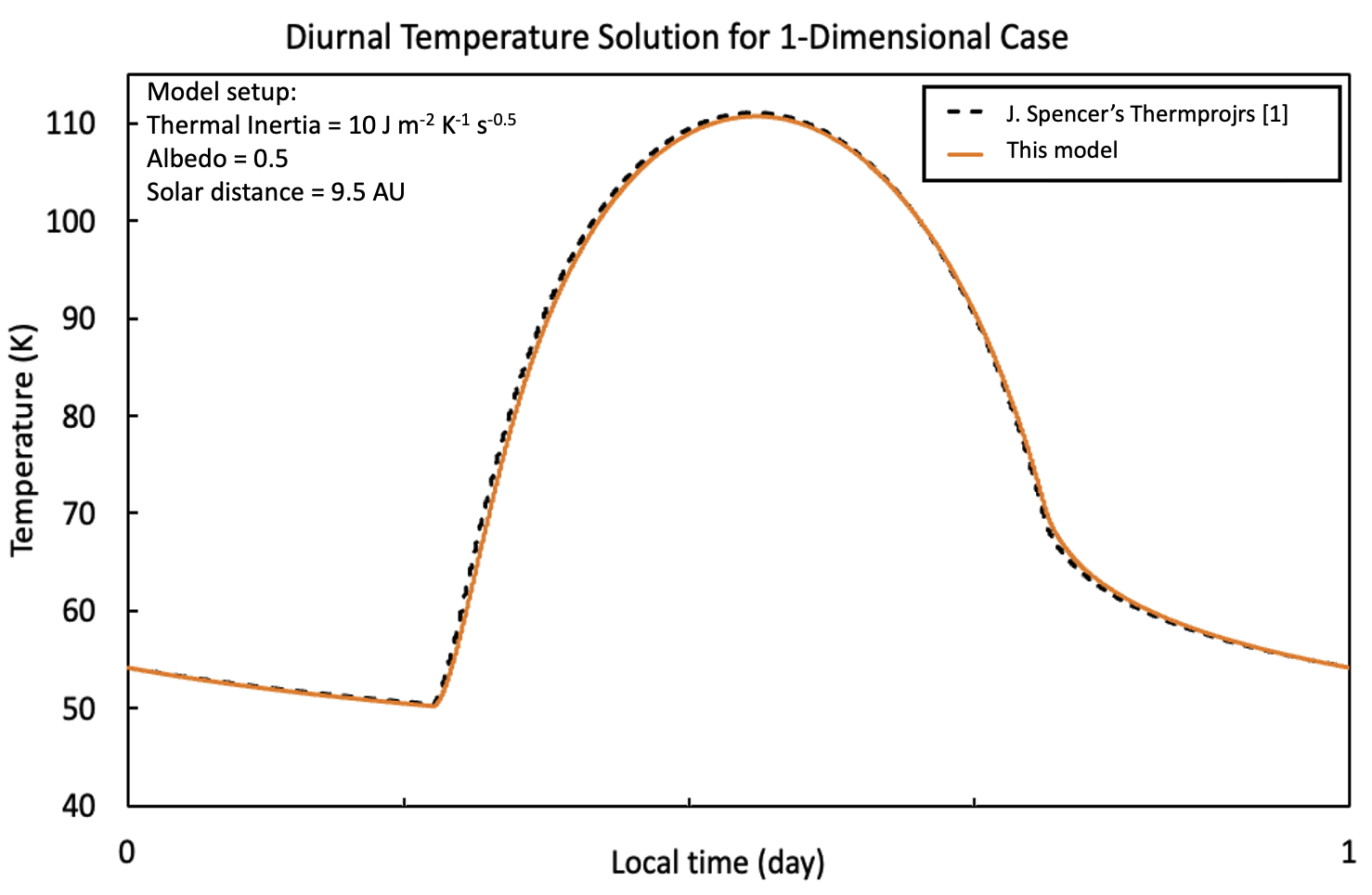
Figure 3: TEMPEST shows good agreement with ‘industry standard’ thermophysical models in 1 dimension.
TEMPEST is open-source and available at:
github.com/duncanLyster/TEMPEST/
Acknowledgement: This work was made possible by support from the UK Science and Technology Facilities Council.
References:
[1] Spencer, J.R., Lebofsky, L.A., and Sykes, M.V., 1989. Systematic biases in radiometric diameter determinations. Icarus, 78(2), pp.337-354.
[2] Lyster, D., Howett, C., & Penn, J. (2024). Predicting surface temperatures on airless bodies: An open-source Python tool. EPSC Abstracts, 18, EPSC2024-1121.
[3] Lyster, D.G., Howett, C.J.A., Spencer, J.R., Emery, J.P., Byron, B., et al. (2025). Thermal Modelling of the Flyby of Binary Main Belt Asteroid (152830) Dinkinesh by NASA’s Lucy Mission. Submitted to EPSC Abstracts, 2025.
How to cite: Lyster, D., Howett, C., and Penn, J.: TEMPEST: A Modular Thermophysical Model for Airless Bodies with Support for Surface Roughness and Non-Periodic Heating, EPSC-DPS Joint Meeting 2025, Helsinki, Finland, 7–12 Sep 2025, EPSC-DPS2025-1479, https://doi.org/10.5194/epsc-dps2025-1479, 2025.


