
 1,1,1,2,1,1,1,3,4,
- 1INAF-Osservatorio Astronomico di Padova, Padova, Italy (giovanni.munaretto@inaf.it)
- 2CISAS, Università degli Studi di Padova, Italy
- 3Physikalisches Institut, Sidlerstr. 5, University of Bern, CH-3012, Bern, Switzerland
- 4School of Physical Sciences, The Open University, Milton Keynes, UK
- 5Brown University, Department of Earth, Environmental and Planetary Sciences,180 Thayer St, Providence, RI 02912, USA
Introduction
Phobos and Deimos are the two moons of Mars. Despite decades of observations, their origin is still debated, with hypotheses proposing either capture scenarios involving primitive asteroid-like bodies [1,2] or in-situ formation from impact-generated debris around Mars [3-5]. Previous studies revealed that Phobos has a spectrally heterogeneous surface consisting primarily of a "Red" unit and a spectrally distinct "Blue" unit near the Stickney crater [6-9]. Initially, the Blue unit was considered Stickney’s ejecta, but an exogenous (external) origin cannot be ruled out [10,11]. Deimos, on the other hand, appears spectrally uniform and closely resembles Phobos’s red unit [8]. Photometric analyses of the Martian moons are largely focused on Phobos ([2] and references therein), while Deimos is less studied [12]. One photometric properties of particular interest is phase reddening, i.e. the increase in spectral slope with phase angle attributed to multiple scattering, surface roughness at the sub-micron level, and space-weathering [13-15]. Its investigation helps to constrain the physical properties, in terms of particle size and roughness, of the martian moons surfaces. The Colour and Stereo Surface Imaging System (CaSSIS) is a stereo-camera on board the ExoMars/TGO satellite [16]. It provides images of the Martian surface in 4 filters centered at 499.9 nm (BLU), 675.0 nm (PAN), 836.2 nm (RED) and 936.7 nm (NIR). We present the analysis of the CaSSIS observations of the Martian Moons, the first characterisation of the spatial distribution of phase reddening on Phobos and its variability among specific geological units. In addition, we provide the first estimate of the Deimos global phase reddening and perform a comparative analysis with Phobos.
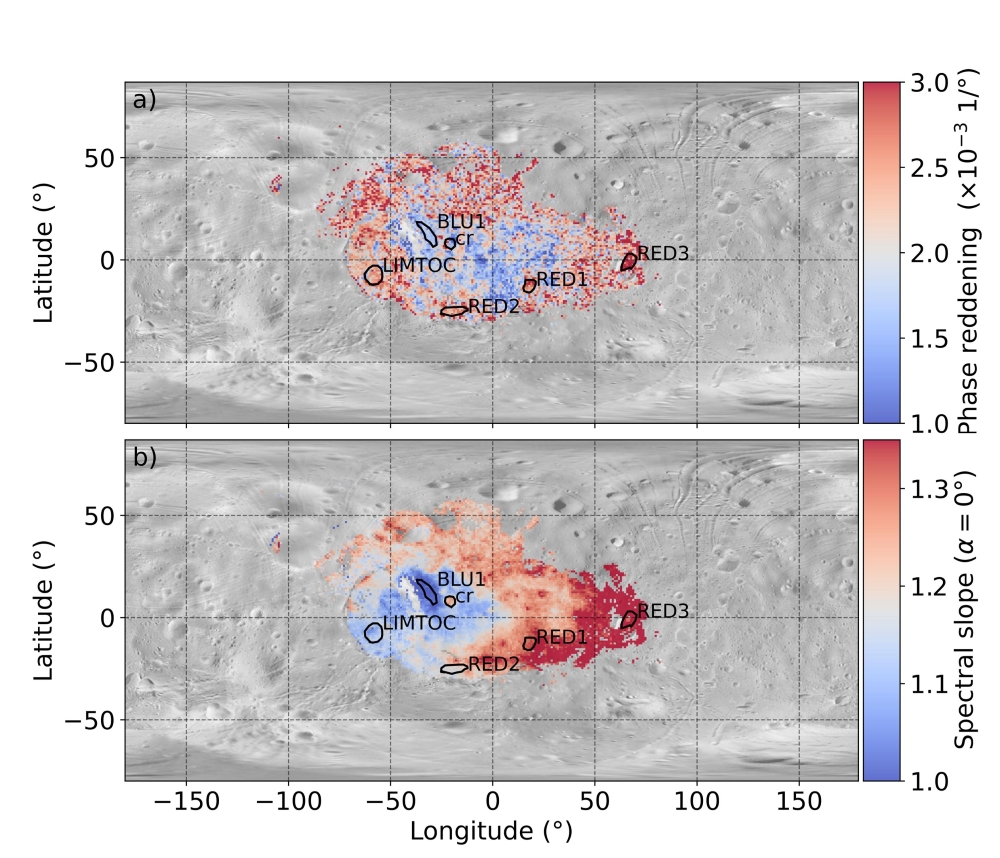
Fig. 1. a) Phase reddening and b) zero phase angle NIR/BLU spectral slope spatial distribution overlain on the Phobos Viking global mosaic. Black polygons labels indicate the name and position of the ROIs
Data & Methods
We analyse 35 CaSSIS 4 band observations of Phobos and 4 of Deimos, spanning phase angles of 0.8° − 83.0° and 14.2° − 49.5° and spatial resolution of ≈ 60-120 m/px and ≈ 200-300 m/px, respectively. Since Deimos has very small spectral variability we opted for a very simple and straightforward approach and collected the global average NIR/BLU filter ratio (as a proxy for spectral slope) and phase angle for all 4 observations and fitted this dataset with a linear model, which parameters allowed to estimate the global Deimos zero-phase angle spectral slope (model intercept) and the global Deimos phase reddening coefficient (model linear term). Instead, since for Phobos we have much more observations, we also analysed the spatial distribution of phase reddening and spectral slopes. This requires a different approach. We defined a 1°x1° resolution latitude-longitude grid with extent −90◦ + 90◦ and −180°+ 180°. For each grid point, we collected data (i.e., NIR/BLU and phase angle) from all the observations covering that location and fitted this dataset with a linear model, to obtain maps of phase reddening and zero phase spectral slope (Fig. 1). To analyse specific locations of Phobos with higher accuracy, we defined regions of interest (ROIs, Fig. 2) and repeated the fit with all data from such ROIs. In particular, we choose ROIs to represent different stages of regolith maturity, based on the high-resolution images and geologic map presented [10]. The "RED1" to "RED3" ROIs are picked on the Red Unit and represent the oldest and most mature surface of Phobos. "LIMTOC" and "BLU2" are relatively fresher and sample the Limtoc crater and the blue unit. The "cr" and “BLU1" ROI are the freshest units and post-date the Blue unit.
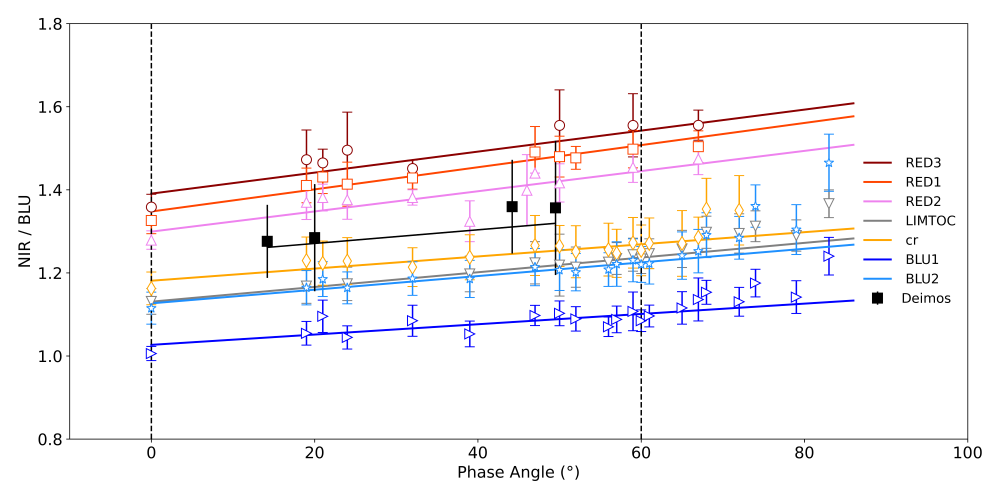
Fig. 2. Phase reddening model fits to the Phobos ROIs and Deimos. Vertical dashed lines indicate the range of phase angles used for the fit.
Results and Conclusions
Our spatially resolved phase reddening and spectral slope maps of Phobos and their comparison with the Deimos phase reddening highlight that:
- A broad region on Phobos, that includes the blue unit, is characterised by lower phase reddening surrounded by a higher phase reddening surface.
-Deimos and older Phobos units (“RED1” to “RED3“ ROIs) have the highest phase reddening. Younger units (“cr” and “BLU1” ROIs) have the lowest phase reddening. Intermediate age units, such as Limtoc, have intermediate phase reddening. This is consistent with phase reddening on Phobos originating from sub-micron roughness added by npFe0 particles added by space-weathering, as occurs at the Moon.
-We exclude either a Deimos or Stickney ejecta origin for the Blue unit. Instead, an exogenous nature is consistent with our results.
- We provide the first estimate of Deimos phase reddening, which is comparable to the Phobos Red unit.
Acknowledgements
CaSSIS is a project of the University of Bern and funded 240 through the Swiss Space Office via ESA’s PRODEX programme. The instrument hardware development was also supported by the Italian Space Agency (ASI) (ASI-INAF agreement no.2020-17-HH.0), INAF/Astronomical Observatory of Padova, and the Space Research Center (CBK) in Warsaw. Support from SGF (Budapest), the University of Arizona (Lunar and Planetary Lab.) and NASA are also gratefully acknowledged. Operations support from the UK Space Agency under grant ST/R003025/1 is also acknowledged. This work has been developed under the ASI-INAF agreement n. 2024-40-HH.0
References
[1] Pajola, M. et al. 2012, MNRAS, 427, 3230
[2] Fornasier, S. et al. 2024, A&A, 686, A203
[3] Rosenblatt, P. 2011, A&A Rev., 19, 44
[4] Craddock, R. A. 2011, Icarus, 211, 1150
[5] Hyodo, R. et al., 2017, ApJ, 845, 125
[6] Murchie, S. & Erard, S. 1996, Icarus, 123, 63
[7]Fraeman, A. A. et al. 2012, JGR:Planets, 117, E00J15
[8]Fraeman, A. A. et al. 2014, Icarus, 229, 196
[9]Pajola, M. et al. 2018, PSS, 154, 63
[10] Basilevsky, A. T. et al. 2014, PSS, 102, 95
[11] Takir, D. et al. 2017, AJ,153, 31
[12] Pang, K. D., et al. 1983, JGR:Planets,88, 2475
[13] Sanchez, J. A., et al. 2012, Icarus, 220, 36 300
[14]Sato, H. et al. 2014, JGR:Planets, 119, 1775
[15]Schröder, S. E. et al. 2014, Icarus, 239, 201
[16] Thomas, N. et al. 2017, SSR, 212, 1897
How to cite: Munaretto, G., Pajola, M., Beccarelli, J., Cremonese, G., Lucchetti, A., Re, C., Tullo, A., Almeida, M., Read, M., Mason-Piercy, K., Thomas, N., Patel, M. R., and Valantinas, A.: Phase reddening of Phobos and Deimos from TGO/CaSSIS observations , EPSC-DPS Joint Meeting 2025, Helsinki, Finland, 7–12 Sep 2025, EPSC-DPS2025-1483, https://doi.org/10.5194/epsc-dps2025-1483, 2025.


