
 1,2,4,5,
- 1IRAP, CNES, Université Toulouse III Paul Sabatier, CNRS, Toulouse, France (aurelien.stcherbinine@irap.omp.eu)
- 2LATMOS/IPSL, UVSQ Université Paris-Saclay, CNRS, Sorbonne Université, Guyancourt, France
- 3IAS, Université Paris-Saclay, CNRS, Orsay, France
- 4Space Science Institute, Boulder, CO, USA
- 5Space Research Institute (IKI), Moscow, Russia
Introduction
Water ice clouds play an important role in the Martian water cycle and climate as they are a major actor in the inter-hemispheric water exchange, and impact the atmospheric structure and temperature by absorbing and scattering the incoming solar radiation [1,2 and references contained within]. Thus, monitoring the spatial and temporal evolution of the Martian water ice clouds, along with their physical properties (crystal effective radius, opacity, and altitude) is of importance to improve our understanding and modeling of the current Martian climate.
Plus, we showed in [3] that the vertical structure of the clouds has a non-negligible impact on cloud optical depth retrievals performed from nadir measurements; and in [4] that the current climate models such as the Planetary Climate Model (PCM) [5] still tends to slightly underestimate the altitude of the water ice clouds. Thus, there is a need for a climatology of the vertical structure of the clouds to improve both the atmospheric models, and the nadir clouds surveys that are the main way to perform spatial and temporal surveys of water ice clouds on Mars [e.g., 6,7,8].
Data & Methods
The Atmospheric Chemistry Suite (ACS) Mid-InfraRed (MIR) channel is a high-resolution spectrometer dedicated to Solar Occultation geometry onboard the ExoMars Trace Gas Orbiter (TGO) ESA-Roscosmos spacecraft [9,10]. This observing geometry provides detailed vertical profiles of the atmospheric transmission. In this study, we use ACS-MIR observations acquired in the so-called position 12 of the secondary grating, which covers the 3.1–3.4 μm spectral range to retrieve the properties of the Martian water ice clouds from their 3 μm absorption band. Following the method described in [11,4], we extract the spectral continuum of the atmospheric transmission at each altitude observed by ACS-MIR (typical vertical resolution of ~2.5 km), then we perform an onion-peeling vertical inversion to retrieve the spectral extinction of each atmospheric layer, and we compare these spectra with models for water ice and dust particles of various sizes to identify the layers where water ice crystals are present, and get constraints on their effective radii.
At the time of the publication of [4] in 2022, we had a dataset containing 514 observations acquired between Ls=163° (MY 34) and Ls=181° (MY 36). Now, with two more years of data, we processed an extended dataset of ~1500 observations running until Ls=72° (MY 38). In addition, we use new data for ACS-MIR observations processed at LATMOS that provide better corrections from instrumental effects, which will help to strengthen again our results.
Results
The ACS-MIR clouds dataset now encompasses four Martian Years (MY 34 to 38), including the Global Dust Storm (GDS) event in the end of MY 34, and three "regular" years (i.e., without GDS) with several local dust storms. This allows us to monitor the behavior of the clouds as a function of season and latitude for several MY, and conduct inter-annual comparisons between the regular MY and the GDS of MY 34.
Figure 1 shows the vertical profiles of the water ice clouds obtained in the equatorial regions from Ls=163° (MY 34) to Ls=72° (MY 38). We can see that the altitude of the clouds typically varies by about 30–40 km over the year: they do not extend over 45 to 50 km around aphelion (Ls ~ 90°) but they can easily reach 80 km around perihelion (Ls ~ 270°). This pattern and altitudes are observed for MY 35 to 38, which highlights the unusual altitudes of the clouds during the GDS, where water ice crystals have been detected up to 100 km at Ls ~ 180°.
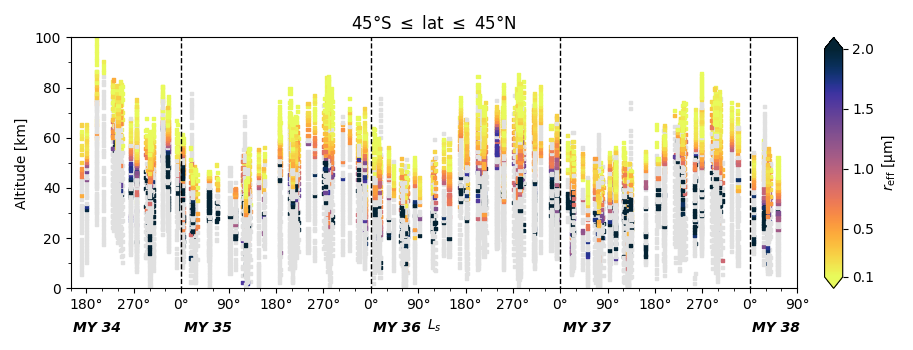
Figure 1 – Vertical profiles of water ice clouds in the Martian atmosphere as observed by ACS-MIR over mid-MY 34 (Ls=163°) to the beginnirg of MY 38 (Ls=72°) in the equatorial regions (latitudes between 45°S and 45°N), with their crystal size determined using the method described in [4]. Observations without water ice detections are in gray.
Conclusion & Perspectives
To conclude, we present here the results of the monitoring of the vertical distribution and properties of the Martian water ice clouds over more than three Martian Years by ACS-MIR, since the beginning of the science phase of TGO in April 2018. We now have access to a unique and rich dataset for the Martian clouds and climate science, which allows us to discuss the multi-annual evolution of the Martian water ice clouds, and to derive a new climatology of the vertical structure of the clouds in the atmosphere that will be of significant interest for helping to improve both the climate models and the retrievals performed using radiative transfer algorithm that currently relies on assumptions on the vertical distribution of the ice and aerosols in the atmosphere.
Acknowledgments
ExoMars is a space mission of ESA and Roscosmos. The ACS experiment is led by IKI Space Research Institute in Moscow. The project acknowledges funding by Roscosmos and CNES. Science operations of ACS are funded by Roscosmos and ESA. Science support in IKI is funded by Federal agency of science organization (FANO). Raw ACS data are available on the ESA PSA at https://archives.esac.esa.int/psa/#!Table%20View/ACS=instrument. ACS-MIR level 2B data are available on the LATMOS servers, as described at https://acs.projet.latmos.ipsl.fr/en/data. A. S. also acknowledges funding by CNES.
References
[1] Clancy et al. (2017) The Atmosphere and Climate of Mars, 76–105. [2] Montmessin et al. (2017) The Atmosphere and Climate of Mars, 338–373. [3] Stcherbinine et al. (2025) Icarus, 425, 116335. [4] Stcherbinine et al. (2022) JGR: Planets, 127, e2022JE007502. [5] Forget et al. (2022) 7th MAMO workshop. [6] Wolff et al. (2022) GRL, 49, e2022GL100477. [7] Smith et al. (2022) GRL, 49, e2022GL099636. [8] Atwood et al. (2024) Icarus, 418, 116148. [9] Korablev et al. (2018) SSR, 214(1), 7. [10] Trokhimovskiy et al. (2015) SPIE, 960808. [11] Stcherbinine et al. (2020) JGR: Planets, 125, e2019JE006300.
How to cite: Stcherbinine, A., Montmessin, F., Baggio, L., Vincendon, M., Wolff, M., Korablev, O., Fedorova, A., Trokhimovskiy, A., and Lacombe, G.: A three Martian years climatology of the vertical properties of Martian water ice clouds TGO/ACS-MIR, EPSC-DPS Joint Meeting 2025, Helsinki, Finland, 7–12 Sep 2025, EPSC-DPS2025-1495, https://doi.org/10.5194/epsc-dps2025-1495, 2025.


