
 2,3,5,6,5,5,7,7,1,1
- 1School of Physical Sciences, The Open University, Milton Keynes, United Kingdom (juan.alday@open.ac.uk)
- 2Instituto de Astrofísica de Andalucía, Granada, Spain
- 3NASA Goddard Space Flight Center, Maryland, USA
- 4Space Research Institute (IKI), Moscow, Russia
- 5Laboratory for Atmospheric and Space Physics, University of Colorado, Boulder, USA
- 6Computational Physics Incorporated, Springfield, Virginia, USA
- 7Royal Belgian Institute for Space Aeronomy, Brussels, Belgium
Introduction: The homopause defines the boundary between two distinct regions of the atmosphere: the homosphere and the heterosphere. In the homosphere, located below the homopause, strong turbulent mixing causes atmospheric gases to vary vertically according to a common scale height, determined by the mean molecular mass of the atmosphere. In contrast, above the homopause, in the heterosphere, molecular diffusion dominates, resulting in the diffusive separation of species and each gas varying vertically according to its own scale height, which depends on its own molecular weight.
In one-dimensional diffusion models, the altitude of the homopause is typically defined as the level at which the eddy diffusion coefficient equals the molecular diffusion coefficient. While the eddy diffusion coefficient is a useful parameterisation of turbulent mixing in these models, it remains largely unconstrained.
The homopause from the Mars PCM: The Mars Planetary Climate Model (PCM) enables simulations of the physical, chemical and dynamical processes in the atmosphere of Mars. In this work, we estimate the value of the homopause altitude using the Ar/N2 densities in the model. The ratio of these two species, which are largely chemically inert, is approximately constant in the homosphere, while it varies due to diffusive separation above the homopause, given the different molecular weight of these two species.
Figure 1 shows the climatology of the homopause altitude as predicted from the Mars PCM for Martian Years (MY) 34 and 35. The homopause altitude shows distinct seasonal variations, peaking close to the solstice periods (LS = 90 and 270˚) and finding relative minima during the equinoxes. Latitudinally, the highest homopause altitudes are found in the summer hemispheres (i.e, northern hemisphere for LS = 90˚ and southern hemisphere for LS = 270˚), while absolute minima are found in the winter hemispheres at these solar longitudes. Additionally, these simulations suggest that the presence of dust events such as the Global Dust Storm (GDS) in MY34 can produce a substantial increase of the homopause altitude.
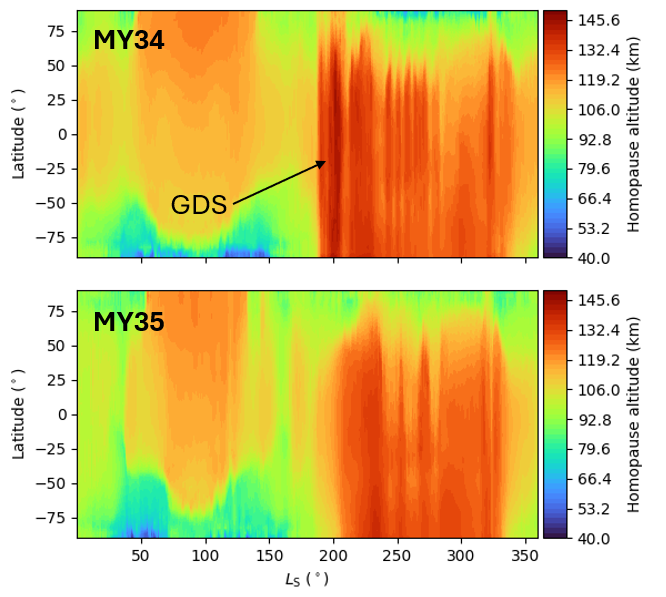
Figure 1: Climatology of the homopause altitude estimated using simulations of the Ar/N2 ratio from the Mars PCM for MY34 (top) and MY35 (bottom).
Estimation of the Eddy diffusion coefficient: Aiming to constrain the range of values suitable for parameterising turbulent diffusion in 1-dimensional models of the atmosphere of Mars, we use the predictions from the Mars PCM to estimate values for the Eddy diffusion coefficient (K) relevant for different times and locations. In particular, we build a 1-dimensional diffusion model and run simulations to find the value of K that provides a best fit to the Ar/N2 ratio profiles from the Mars PCM. We will present the results from this work, showing the range of values of the Eddy diffusion coefficient relevant for distinct seasons, locations, and dust loading scenarios.
How to cite: Alday, J., González-Galindo, F., Stone, S. W., Belyaev, D., López Valverde, M. Á., Thiemann, E., Evans, S., Jones, N., Fedorova, A. A., Gupta, S., Jain, S., Pilinski, M., Neary, L., Trompet, L., Patel, M., and Holmes, J.: The climatology of the homopause altitude from the Mars Planetary Climate Model, EPSC-DPS Joint Meeting 2025, Helsinki, Finland, 7–12 Sep 2025, EPSC-DPS2025-1508, https://doi.org/10.5194/epsc-dps2025-1508, 2025.


