
 ,,
,,- University of Bern, Space Research & Planetary Sciences, Bern, Switzerland (leander.schlarmann@unibe.ch)
Jupiter's satellite Io, the innermost Galilean moon, is subject to extreme tidal forces, making it the most volcanically active body in the Solar System. Io's tenuous atmosphere consists primarily of SO2, with the expected main source being the sublimation of SO2 surface frost. Furthermore, volcanoes and lava lakes can strongly impact the atmosphere and dominate locally [1]. Next to SO2, dissociation products (e.g., SO, S, O), along with compounds from volcanic eruptions, such as S2, NaCl, and KCl, have been detected in Io’s atmosphere.
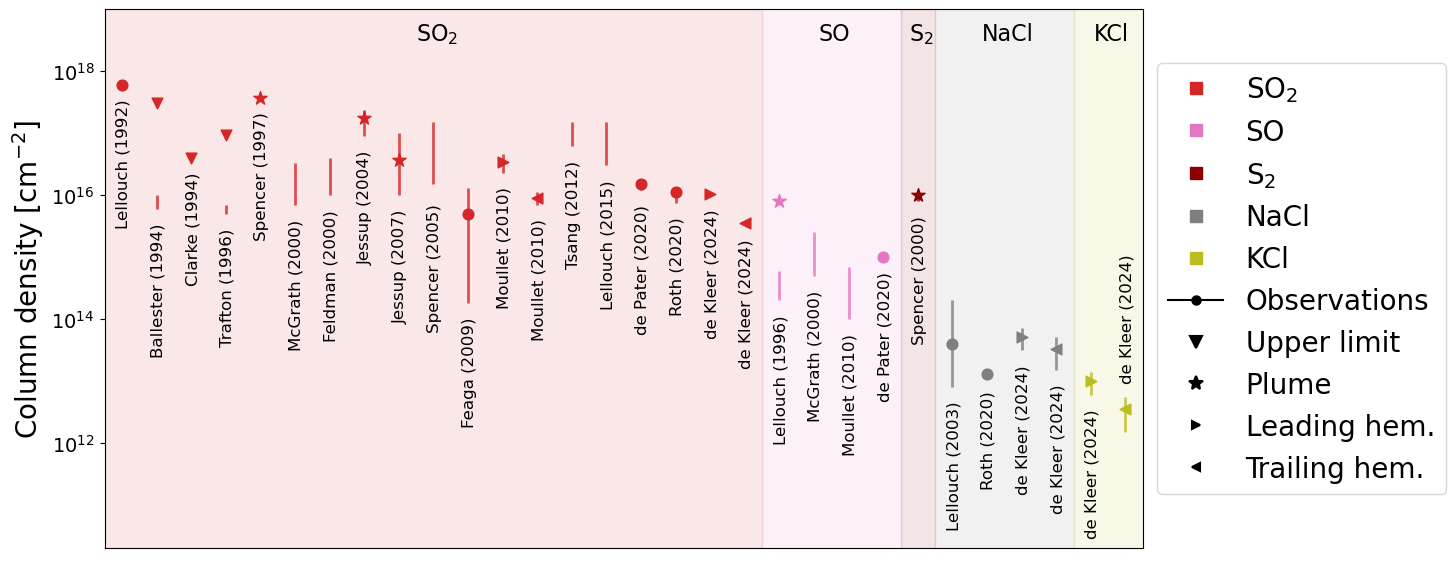
We use the Direct Simulation Monte Carlo (DSMC) model ultraSPARTS (Ultrafast Statistical PARTicle Simulation Package) [2, 3] to investigate the sublimation of SO2, with a thermal model applied to constrain the surface frost temperature on Io. The SO2 atmosphere is expected to collapse on the nightside and when Io moves through Jupiter’s shadow. However, non-condensable gases, such as O2 and SO, could survive and buffer atmospheric collapse.
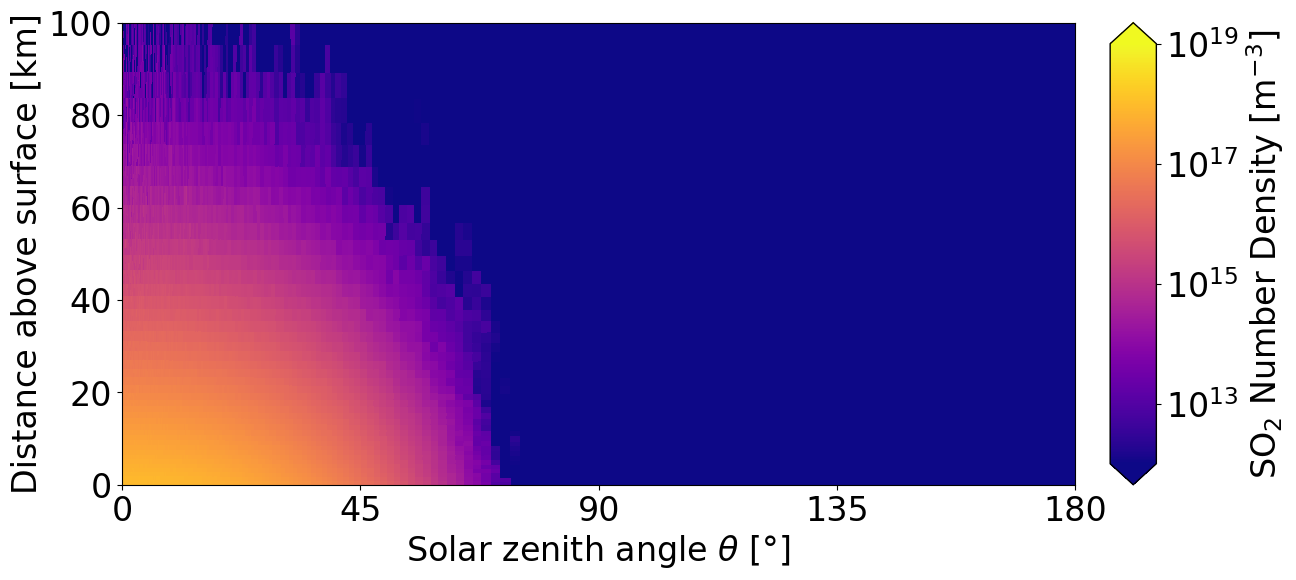
This study compares the influence and interaction of different processes on Io's atmosphere, such as outgassing from lava lakes and sublimation of surface frost. The DSMC method enables us to model the transition from regions dominated by intermolecular collisions to the free molecular flow and, therefore, is a powerful tool in modelling planetary atmospheres. With JUICE, Europa Clipper, and a possible future Io Volcano Observer (IVO), the atmospheres of the Galilean moons will be studied extensively with high-resolution mass spectrometry, which gives us an unprecedented opportunity to compare and verify our model with in-situ data.
Acknowledgements:
This work has been carried out within the framework of the National Centre of Competence in Research PlanetS supported by the Swiss National Science Foundation under grant 51NF40_205606. The authors acknowledge the use of ultraSPARTS from Plasma T.I., Taiwan.
References:
[1] Davies, A. G. & Vorburger, A. H. 2022, Elements: An International Magazine of Mineralogy, Geochemistry, and Petrology, 18, 379
[2] http://www.plasmati.com.tw/
[3] Klaiber, L. M. (2024). Three-dimensional DSMC modelling of the dynamics of Io’s atmosphere. PhD thesis, University of Bern.
How to cite: Schlarmann, L., Vorburger, A., Mosimann, T., Thomas, N., and Wurz, P.: Frost and Lava: Modelling Io’s atmosphere using the DSMC method, EPSC-DPS Joint Meeting 2025, Helsinki, Finland, 7–13 Sep 2025, EPSC-DPS2025-1520, https://doi.org/10.5194/epsc-dps2025-1520, 2025.


