
 1,2,1,3,
- 1STAR Institute, Université de Liège,Liège, Belgium
- 2Institut UTINAM (UMR 6213), OSU THETA, Université Marie et Louis Pasteur, CNRS, Besançon, France
- 3Laboratoire Interdisciplinaire Carnot de Bourgogne ICB UMR 6303, Université Bourgogne Europe, CNRS, Dijon, France
This study presents an updated fluorescence model for the NH radical and its isotopologues (14NH, 14ND, and 15NH) in cometary spectra, offering new insights into the isotopic composition of nitrogen-bearing molecules and, in particular, the deuterium-to-hydrogen (D/H) ratio in comets. NH is a photodissociation product of ammonia (NH₃), commonly detected in the visible spectral range of comets.
Scientific Context and Motivation
Comets are considered among the most primitive celestial bodies in the Solar System, preserving information from its early formation phases. Spectroscopic observations of comets allow researchers to probe their chemical compositions. The NH radical has been detected in cometary spectra as early as the beginning of the 20th century and originates from the breakdown of ammonia. Initial models of NH fluorescence spectra, such as those by Litvak & Kuiper (1982) and refined by Kim et al. (1989), enabled initial analysis of this molecule, but suffered from limited accuracy due to outdated atomic and molecular data and incomplete observational coverage.
In light of new Einstein coefficients made available by the ExoMol project (Perri & McKemmish 2024) and the availability of high-resolution cometary spectra from UVES at ESO's Very Large Telescope, this study aims to reconstruct and enhance the fluorescence models of NH and its isotopologues. Specifically, it investigates comets C/2002 T7 (LINEAR), C/2012 F6 (Lemmon), and 73P/Schwassmann–Wachmann, to both improve the NH model and derive isotopic ratios, including D/H, for nitrogen-bearing molecules in cometary comae.
Methods and Modeling Approach
The core methodology centers on building and applying detailed fluorescence models for the 14NH, 14ND, and 15NH radicals. These models incorporate new laboratory-derived Einstein coefficients and simulate the population distribution among molecular energy levels. The population distributions are calculated by solving a system of radiative transfer equations using a matrix-based method inspired by Zucconi & Festou (1985), which reduces computational complexity while ensuring accuracy.
The modeling included electronic transitions within the A³Πᵢ − X³Σ⁻ system, pure rotational and vibrational transitions within the ground electronic state. Intensity simulations for multiple rovibrational bands were performed, including (0-0), (0-1), and (1-1), under varying heliocentric distances and velocities to match specific observational conditions of the selected comets.
High signal-to-noise, high-resolution UVES spectra from the VLT were used to validate the modeled emission lines. Coaddition was employed to enhance signal detection of weak lines in the observational data. This approach was crucial for extracting isotopic signals from comets with low concentrations of 14ND and 15NH.
Results and Line Identification
The revised model accurately reproduced observed spectral lines of 14NH and identified the previously undetected (0-1) band around 3750 Å (Figure 1).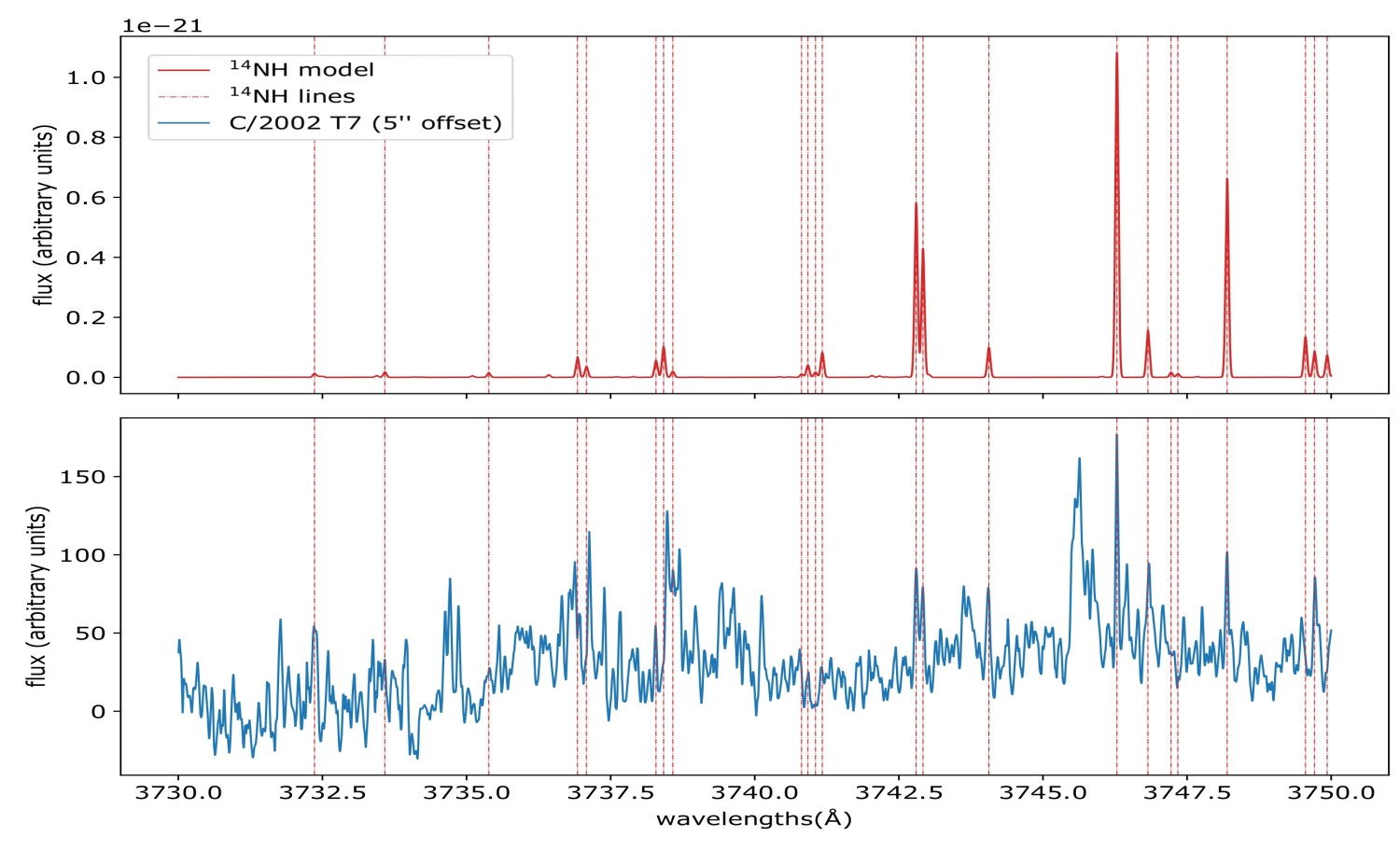
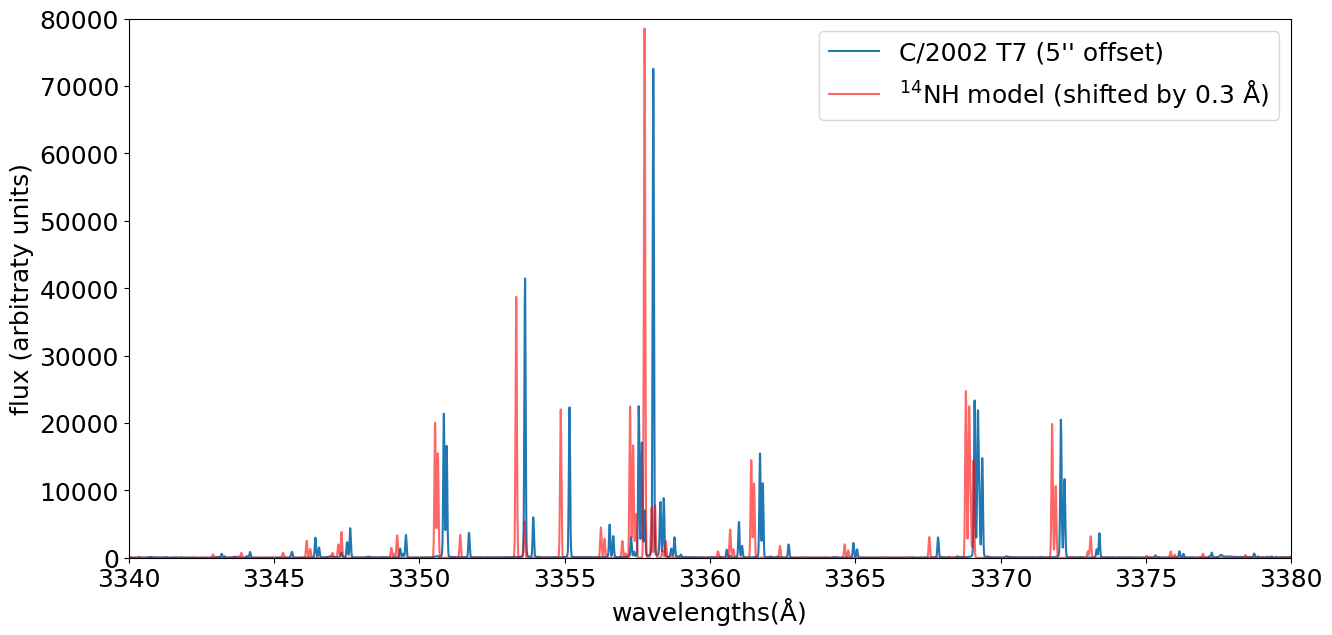
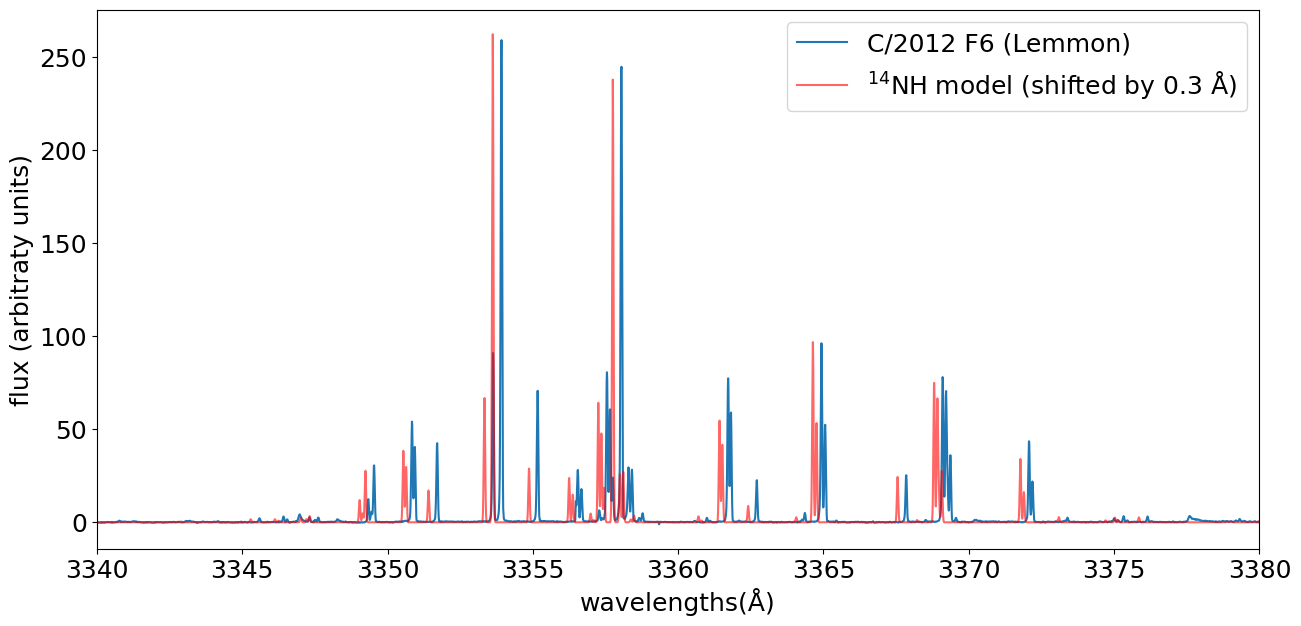
Comparison with observational spectra at different heliocentric distances (0.68 au for T7 and 1.175 au for F6) showed strong agreement, confirming the model's robustness (Figure 2 & 3). Fluorescence efficiencies (g-factors) derived from the models were found to be about 20% higher than in previous studies.
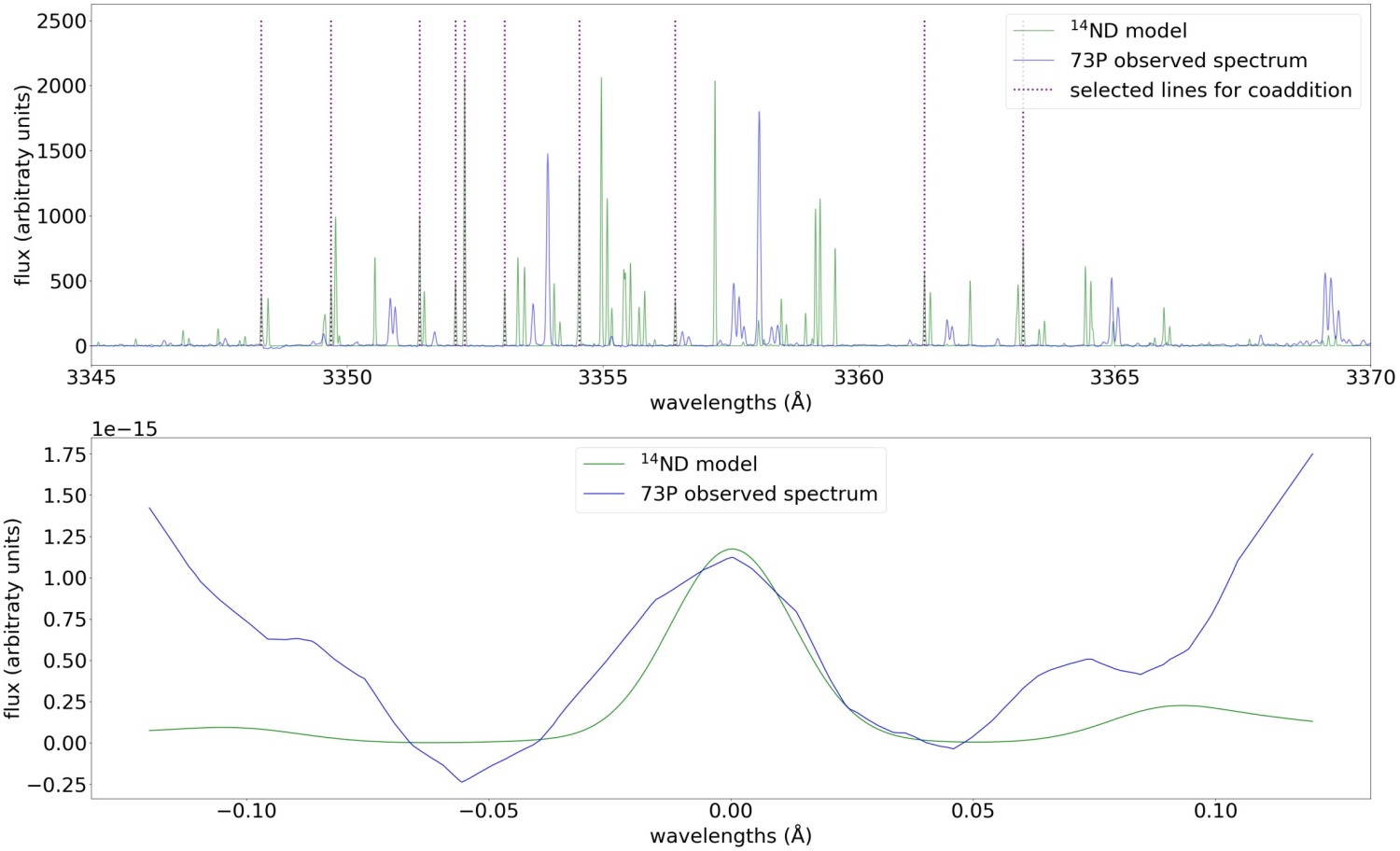
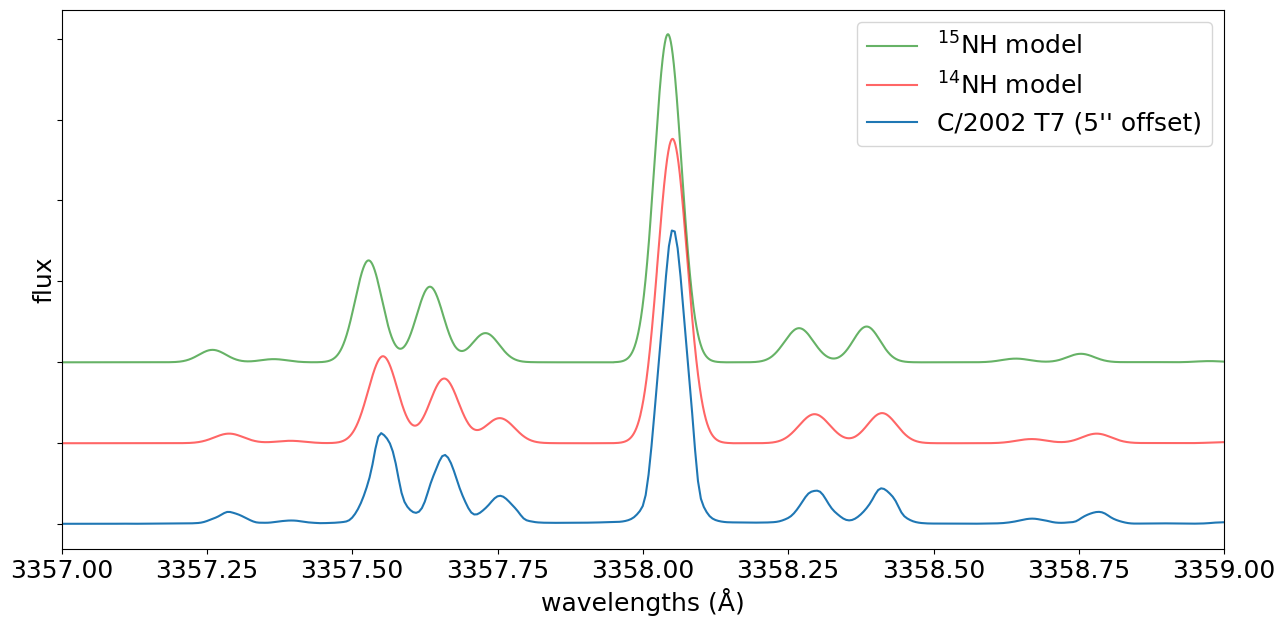
The study also successfully detected the presence of 14ND in Comet 73P, enabling for the first time the measurement of the D/H ratio in the NH radical (Figure 4). The derived isotopic ratio 14ND/14NH was 2.7 × 10⁻³ ± 1.8 × 10⁻³. In comets T7 and F6, the signal from ND was too weak to allow for a reliable measurement. No detection of 15NH was achieved due to the minimal wavelength shift (as little as 0.008 Å from 14NH) (Figure 5).
Discussion and Implications
The successful identification of 14ND in 73P represents a significant milestone, as this is the first direct D/H ratio measurement in NH, a nitrogen-bearing species in cometary comae. The result aligns well with the upper limit of (D/H)NH ≤ 0.006 previously derived in Comet Hyakutake and the D/H ratio in ammonia (1.1 × 10⁻³) measured in Comet 67P by the Rosetta spacecraft. These findings reinforce the observation that D/H ratios in nitrogen-bearing molecules tend to be an order of magnitude higher than those in water.
This discrepancy in isotopic ratios among cometary species has important implications for understanding the origin and processing of volatiles in the early Solar System. It suggests either differing formation environments for water and ammonia or subsequent fractionation processes affecting these molecules differently. Additionally, the improved g-factors for NH and its isotopologues will enable more accurate future measurements of nitrogen isotopic ratios in comets, once spectral resolutions improve to a level that can distinguish 15NH lines.
Conclusions
This study provides an enhanced fluorescence model for 14NH, 14ND, and 15NH, validated by high-resolution spectroscopic observations of three comets. The new model allows the identification of previously undetected spectral features and the computation of updated fluorescence efficiencies. Importantly, it enabled the first D/H measurement in NH, revealing isotopic fractionation trends that match prior findings for other nitrogen-bearing species and diverge from water-based measurements.
This work contributes to the advancement of isotopic studies of cometary volatiles and emphasizes the importance of continued high-resolution spectroscopic observations. In particular, future instruments with improved spectral resolution may make it possible to distinguish closely spaced spectral lines, such as those of 14NH and 15NH.
How to cite: Blond Hanten, E., Rousselot, P., Jehin, E., Hardy, P., Hutsemékers, D., and Manfroid, J.: NH fluorescence models for measuring cometary D/H isotopic ratios, EPSC-DPS Joint Meeting 2025, Helsinki, Finland, 7–12 Sep 2025, EPSC-DPS2025-1523, https://doi.org/10.5194/epsc-dps2025-1523, 2025.


