
 1
1- 1Institut de physique du globe de Paris, Université Paris Cité, Paris, France (lark@ipgp.fr)
- 2York University, Toronto, Canada
Energy from accretion, differentiation, and short-lived radionuclides likely caused large-scale melting of terrestrial planets (Elkins-Tanton, 2012; Abe, 1997) and rocky exo-planets (Stixrude, 2014). Differentiation of these “magma oceans” through melt-crystal chemical fractionation combined with physical separation drives the formation of large-scale chemical and density heterogeneity in planetary mantles. Dense material, which tends to be enriched in iron, heat-producing elements (HPE), trace elements, and perhaps volatiles, sinks to the core-mantle boundary (CMB). For Earth, this likely led to the gradual, stable chemical stratification of the deep solid mantle (Ballmer et al., 2017) as well as the formation of a basal magma ocean enriched in iron and HPE (Boukaré et al., 2025). Similar stratification following differentiation has been hypothesized for the Moon (Hess and Parmentier, 1995) and Mars (Samuel et al., 2021; Day et al., 2024).
Mantle heterogeneity following magma ocean solidification has lifelong consequences for planetary geological evolution. For example, HPE-rich layers at the CMB suppress core cooling (or leads to core top-heating) while enhancing mantle cooling by isolating the mantle from core heat, which makes the co-occurrence of volcanism (outgassing, availability of fresh nutrients) and magnetic field generation (shielding of the surface from stellar radiation) unlikely (Lark et al, 2024). Furthermore, deep stratification blocks transport between the deeper planet and the surface, trapping volatiles or trace elements and chemically/thermally decoupling the deep and shallow planet. Therefore, the persistence of deep chemical stratification is extremely relevant to both the geological and biological evolution of rocky planets.
We explore the geodynamic evolution of a chemically stratified deep mantle bottom-heated by an enriched basal magma ocean numerically using the geodynamic code Bambari, which incorporates melting and melt-crystal chemical fractionation as well as density-driven Stokes flow of the bulk material and percolation of the melt (Boukaré et al., 2025).
We find that for Earth-like planets, bottom-heating drives erasure of stratification in two endmember regimes; one in which melt-rich plumes stir the stratified region, and one in which drainage of fractional melts in the boundary layer leads to chemical plumes of depleted material, removing the dense stratifying component to the BMO (Figure 1). The timescale of erasure can be estimated based on the concept of a buoyancy deficit (compositional stratification) and a buoyancy source (heat delivery + heat-density relationship), similar to what has been described for simple thermal expansion (Alley and Parmentier, 1998). The regime can be determined by balancing the timescale of erasure with the melt percolation timescale.
For typical planetary physical properties, notably melt viscosity and grain size, Earth should be in the drainage regime. Therefore, if Earth had a gradually stratified layer in its deep mantle, bottom-heating by plausible radioactive heat production and core secular cooling would cause drainage of the dense enriched component (FeO+trace elements) downward to the growing basal magma ocean. This process would have left Earth’s mantle with a depleted deep reservoir that is only slightly denser than the shallow mantle, as well as a thick, enriched basal magma ocean. The solid reservoirs will be far more similar in density than if the stratified region had simply mixed, facilitating their mixing by entrainment so that this residual solid reservoir plausibly does not insulate the core or stratify the mantle long-term.
The drainage mechanism which depletes a stratified deep mantle to a basal magma ocean is not directly sensitive to planet size, but depends on several pressure-dependent and composition-dependent quantities. For example, the mechanism depends on fractional melt density, which is lower at lower pressure or with an iron-poorer bulk composition, changing the conditions under which negatively buoyant melts are produced.
As another example, regardless of regime, stratification erasure requires the delivery of adequate heat. For Earth, this corresponds to ~2% of its total radioactive budget or a few hundred degrees of core secular cooling; we expect this quantity to be available over at most a few hundred million years. However, in planets with small core fractions and low abundances of radioactive isotopes, this quantity of heat may be unavailable. Similarly, for super-Earths, the diverging adiabat and solidus as well as the decreasing thermal expansivity with pressure predict an era of highly inefficient and likely incomplete mixing by thermal double diffusive convection. In these cases, the stratification will remain much longer-term, locking the material in the deep mantle and isolating the shallow mantle from the deeper planet, with implications for its geological and biological evolution.
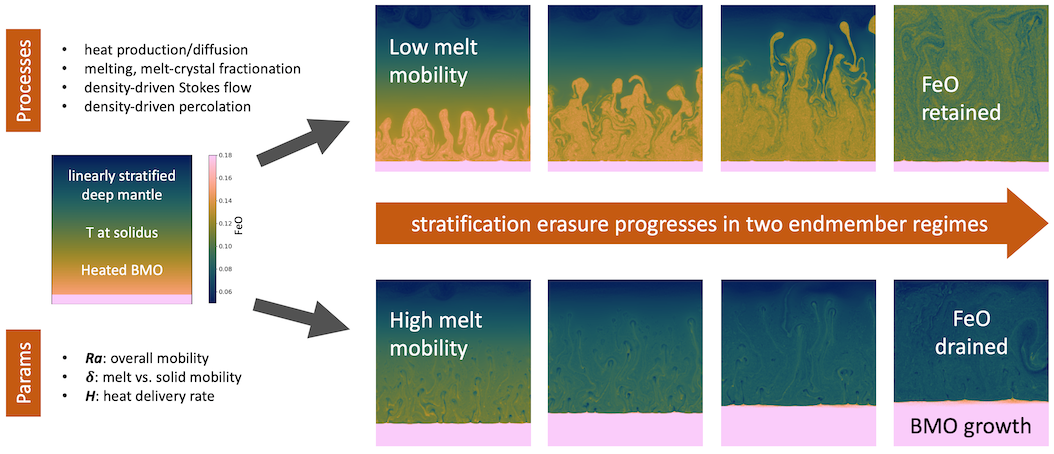
Figure 1. (left) Numerical setup and (right) snapshots of FeO field showing progression of erasure of stratification through stirring by melt-rich plumes (top) and drainage of FeO-rich fractional melts to the BMO (bottom).
References
Abe, Y. (1997). Phys Earth Planet Inter, 100(1-4), 27-39.
Alley, K. M., & Parmentier, E. M. (1998). Phys Earth Planet Inter, 108(1), 15-32.
Ballmer, M. D., Lourenço, D. L., Hirose, K., Caracas, R., & Nomura, R. (2017). Geochemistry, Geophysics, Geosystems, 18(7), 2785-2806.
Boukaré, C. É., Badro, J., & Samuel, H. (2025). Nature, 1-6.
Day, J. M., Paquet, M., Udry, A., & Moynier, F. (2024). Sci Adv, 10(22), eadn9830.
Elkins-Tanton, L. T. (2012). Annu Rev Earth Planet Sci, 40(1), 113-139.
Hess, P. C., & Parmentier, E. M. (1995). EPSL, 134(3-4), 501-514.
Lark, L. H., Huber, C., Parmentier, E. M., & Head, J. W. (2024). JGR: Planets, 129(11), e2024JE008361.
Samuel, H., Ballmer, M. D., Padovan, S., Tosi, N., Rivoldini, A., & Plesa, A. C. (2021). JGR: Planets, 126(4), e2020JE006613.
Stixrude, L. (2014). Phil Trans R Soc A, 372(2014), 20130076.
How to cite: Lark, L., Boukaré, C. E., Badro, J., and Samuel, H.: Coupled formation of a depleted deep mantle reservoir and a basal magma ocean in rocky planets., EPSC-DPS Joint Meeting 2025, Helsinki, Finland, 7–12 Sep 2025, EPSC-DPS2025-1536, https://doi.org/10.5194/epsc-dps2025-1536, 2025.


