
 1,2,2,
- 1University of Trento, Via Sommarive 14, Trento, 38123, Italy
- 2INAF - Istituto di Radioastronomia, Via Gobetti 101, Bologna, 40128, Italy
- 3Max-Planck-Institut für Radioastronomie, Auf dem Hügel 69, Bonn, 53121, Germany
This work presents results from radar observations of the binary asteroid 2005 LW3, conducted in the wake of the ESA project “NEO Observation Concepts for Radar Systems”, which aimed at a future development of a European radar system for near-Earth objects (NEOs).
Thanks to collaboration with JPL/DSN, a continuous-wave (CW) radar signal at 7167 MHz was transmitted using the 70-m DSS-63 antenna in Madrid (Spain) as part of a multistatic radar experiment. The echo was received by the 32-m “Grueff” radio telescope in Medicina (Italy), operated by INAF – Istituto di Radioastronomia, and by the 100-m Effelsberg radio telescope (Germany) of the Max Planck Institute for Radio Astronomy.
The observations were performed on November 23, 2022, when the ~400-meter potentially hazardous asteroid (PHA) 2005 LW3 made a close approach at approximately 3.1 lunar distances (LD) from Earth. Both receiving antennas successfully detected the echo with a high signal-to-noise ratio and resolved it well in the frequency domain. Time-domain data were processed using a phase-stopping technique to correct for Doppler drift due to the target’s radial motion [1]. The resulting high-resolution power spectra allowed us to estimate the asteroid’s rotation period (~4 hours, assuming an equatorial aspect) and revealed a frequency offset of 1.0 ± 0.1 Hz from the predicted ephemeris, information that can be used to improve the orbital knowledge.
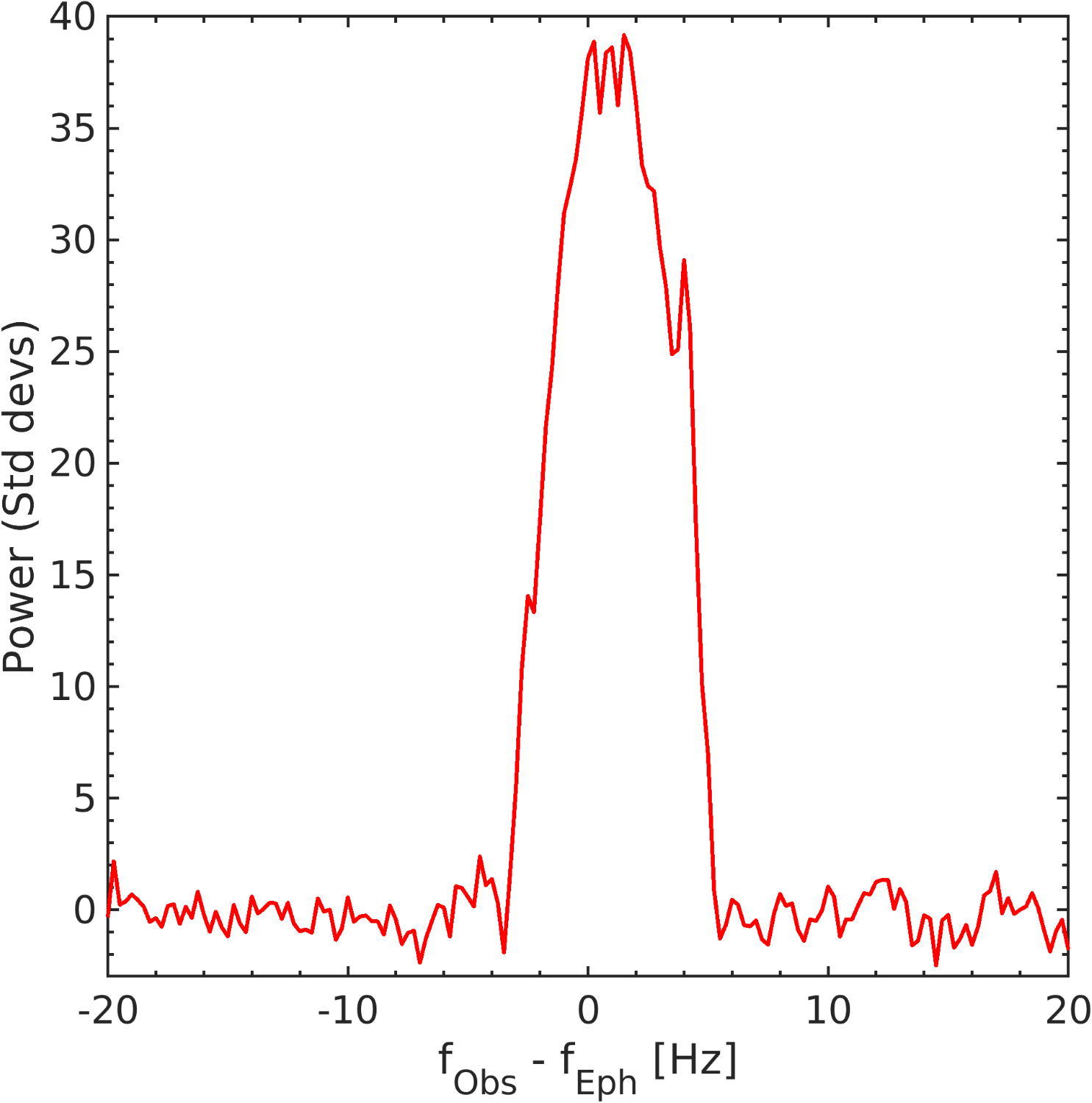
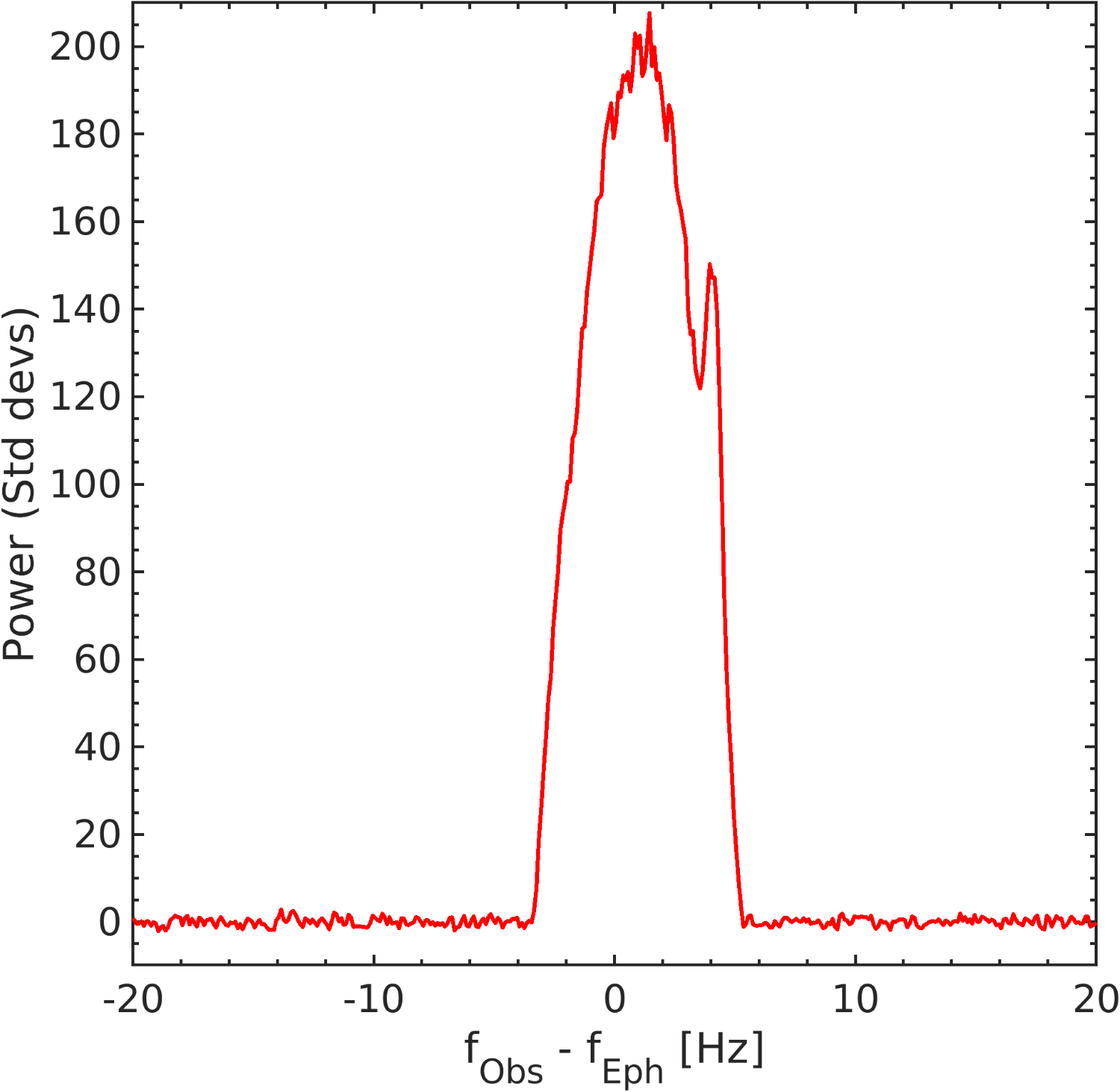
Fig 1: Full-track integrated power spectra of radar echoes produced with Effelsberg (left) and Medicina (right) data, at resolution 0.1 Hz and 0.25 Hz, respectively. Zero frequency is the expected center of mass (COM) frequency of the asteroid. The spike at ~4 Hz is the echo from the asteroid’s satellite.
Delay-Doppler imaging independently acquired at Goldstone (NASA/JPL) revealed that 2005 LW3 is a binary system, identifying a companion approximately 50-100 m in diameter orbiting at ~4000 m from the primary body [2].

Fig 2: Delay-Doppler image of 2005 LW3 and its satellite obtained at Goldstone (courtesy of NASA/JPL).
Our CW Doppler spectra provide an independent confirmation of this binarity: the satellite was detected as a distinct secondary peak in the high-resolution spectra, demonstrating that fine structures can be revealed even in CW observations where delay information is unavailable.
The Medicina telescope also detected echoes in both same-sense (SC) and opposite-sense (OC) circular polarizations, allowing us to estimate a circular polarization ratio between 0.1 and 0.2. This value, which is sensitive to surface and subsurface roughness at radar wavelengths, suggests a relatively smooth surface. Such polarization ratios are particularly important as they provide insight into the scattering properties and surface microstructure of the target [3].
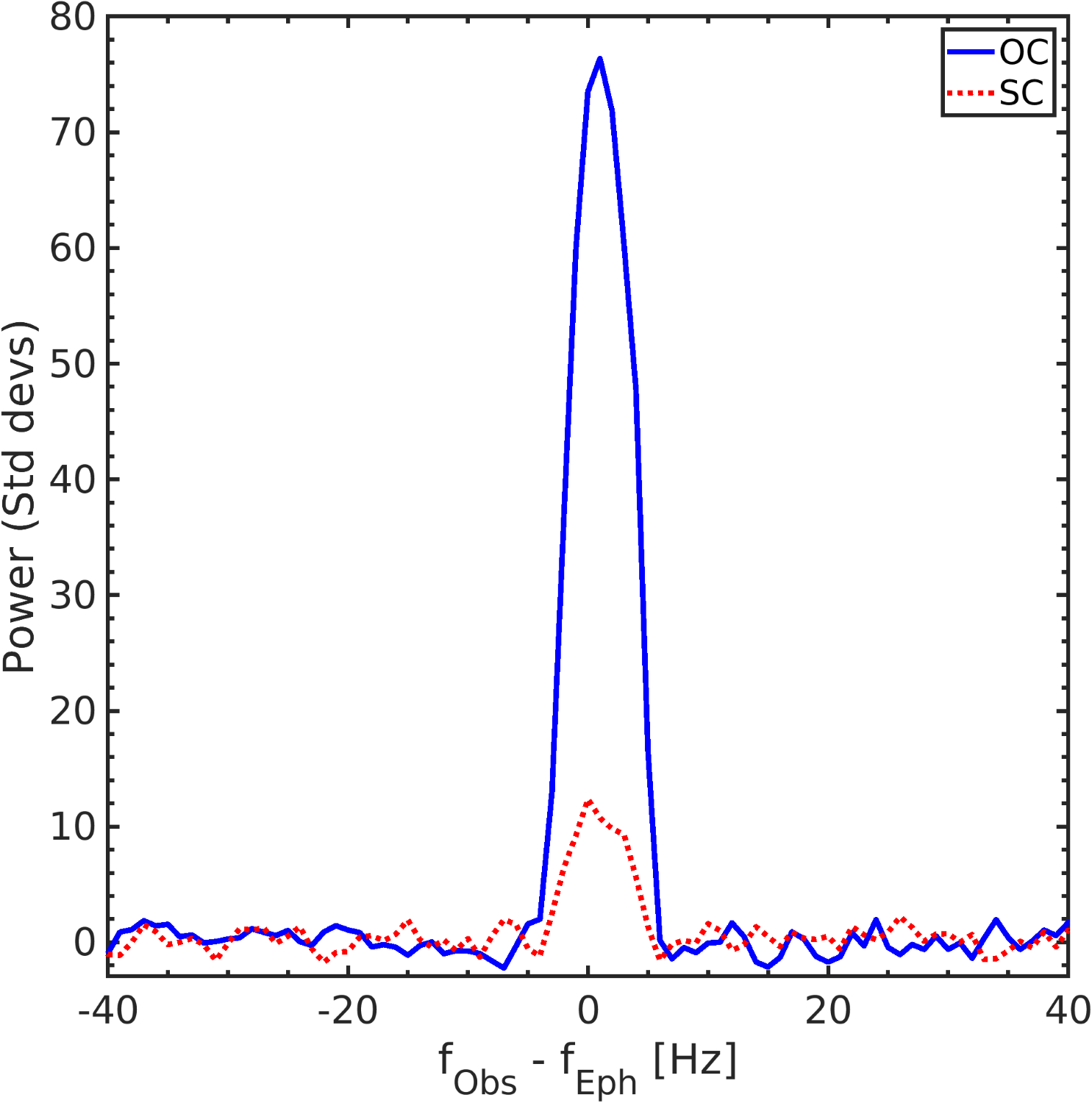
Fig 3: Echo power spectrum of 2005 LW3 in the OC polarization (solid blue) and in the SC polarization (dotted red) derived from Medicina data.
Beyond classical observables, we explored the feasibility of extracting shape and physical properties from Doppler spectra alone. We first implemented a method to estimate the convex hull of the asteroid, interpreted as the pole-on projection of its convex envelope, based on the technique described in [4]. After subtracting the satellite’s spectral contribution, the echo edges were identified as the frequencies at which the spectral profile crosses the zero-sigma level, corresponding to the statistical noise floor (zero-crossing criterion).
The asteroid’s radial profile was then modeled with a truncated Fourier series under convexity constraints and fitted using weighted least squares to account for measurement uncertainty. This method assumes adequate rotational coverage, which in our case was about 88% of the asteroid’s spin period. The resulting shape dimensions are in good agreement with those reported in the literature, supporting the reliability of our estimation.
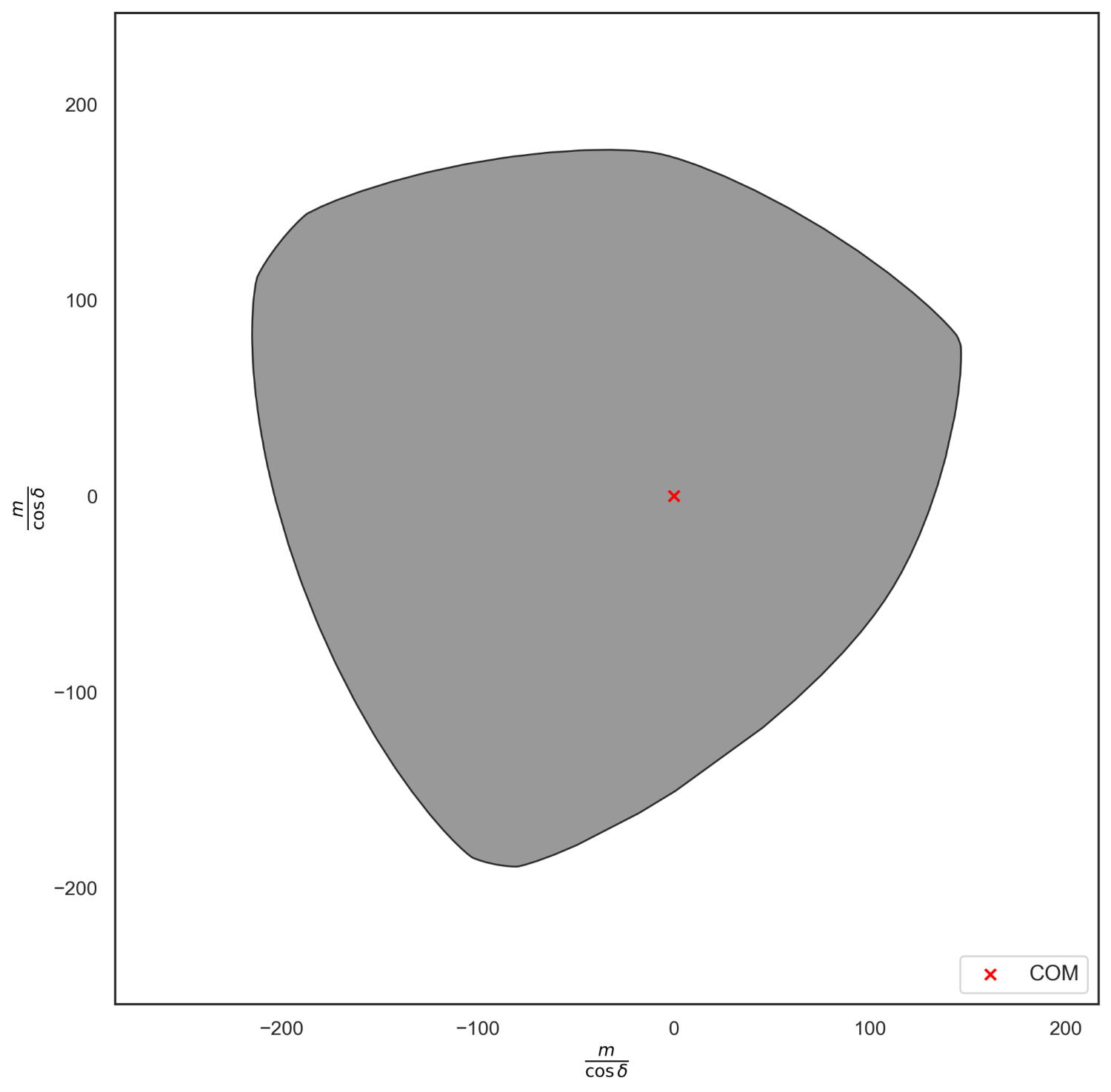
Fig 4: Pole-on projection of the 2005 LW3 convex envelope. The red cross marks the rotation center.
The current convex hull estimation relies on the variation of edge frequencies with rotation, but disregards the full spectral shape, leaving much of the spectral information unused. To advance beyond edge-only analyses, we implemented an algorithm to estimate the third semiaxis of the asteroid - assuming a triaxial ellipsoid geometry - by fitting the full sequence of observed radar power spectra. The algorithm simulates Doppler spectra from a Lambertian scattering model over a rotating ellipsoid, given known equatorial semiaxes from convex hull analysis. We jointly estimate the polar radius and sub-radar latitude at observation by minimizing residuals between observed and simulated spectra via nonlinear least squares. This approach leverages the complete spectral echo profile, allowing for improved 3D shape constraints even with limited viewing geometries.
We extended the method by perturbing the reference ellipsoid using small-scale deformations and harmonic distortions. We plan to test various perturbation schemes and compare the results with available delay-Doppler reconstructions, which serve as ground truth in this context. If successful, the comparison would demonstrate good agreement in both spectral features and estimated dimensions, validating the approach as a useful tool for preliminary shape reconstruction.
These findings demonstrate that Doppler-only shape reconstruction is feasible and robust, especially when supported by convex hull constraints and physical scattering models. Further improvements could be achieved through better knowledge of sub-radar latitude and spin axis orientation. This could be accomplished, for example, by multi-apparition observations or by the inversion of joint radar-optical data.
Bibliography
[1]: Molera Calvés G. et al. (2014) A&A, 564, 1-7.
[2]: Green D.W.E. (2022), IAU Circular No. 5198, 2022 Dec. 10.
[3]: Virkki A. and Muinonen K. (2016) Icarus, 269, 38-49.
[4]: Ostro S. et al. (1988) Icarus, 73, 15-24.
How to cite: Margheri, A., Pupillo, G., Righini, S., Orosei, R., Bach, U., Bortolotti, C., Kraus, A., Maccaferri, G., and Roma, M.: Advanced Doppler-Only Characterization of Binary Asteroid 2005 LW3: New Insights from the European Multistatic Radar Campaign, EPSC-DPS Joint Meeting 2025, Helsinki, Finland, 7–12 Sep 2025, EPSC-DPS2025-1542, https://doi.org/10.5194/epsc-dps2025-1542, 2025.


