
 1,23
1,23- 1Department of Astronomical Science, The Graduate University for Advanced Studies, SOKENDAI, 2-21-1 Osawa, Mitaka, 181-8588, Tokyo, Japan (gabriel.guimaraes@grad.nao.ac.jp)
- 2Division of Science, National Astronomical Observatory of Japan, NAOJ, 2-21-1 Osawa, Mitaka, 181-8588, Tokyo, Japan (gabriel.guimaraes@grad.nao.ac.jp)
- 3Center for Computational Astrophysics, CfCA, National Astronomical Observatory of Japan, NAOJ, 2-21-1 Osawa, Mitaka, 181-8588, Tokyo, Japan (kokubo.eiichiro@nao.ac.jp)
Compact protoplanet systems are a natural outcome of runaway and oligarchic growth of planetesimals, with low-mass protoplanets with orbital separations of K≈10 mutual Hill radii. Those protoplanets evolve to Earth-mass bodies through giant impacts after gravitational instabilities are triggered. On the other hand, Kepler observations reveal older, non-resonant and more massive systems with orbital separations clustered at K>10 Hill radii, suggesting long-term stability despite similar compactness. This raises a question: does the stability difference between compact protoplanets and Kepler sample come from a primordial configuration or from subsequent dynamical evolution?
To investigate these stability differences, we conducted tens of thousands of numerical simulations of compact systems with varying orbital separations, mass distributions, inclinations and eccentricities, and quantified instability timescales and their sensitivity to these different parameters.
Our results indicate that inhomogeneities in mass, in the same way as seen in orbital separation inhomogeneities, are a source of instability for more massive systems, even for larger orbital separations. Such inhomogeneity can destroy the resonant architecture seen in typical τinst x K, but also allow for new dynamical architectures by having pairs of planets closer to resonances that didn't exist in homogeneous systems. Analysis still underway indicate that, for more massive systems, ordering in planetary masses can be a source of stability, whereas systems which don't show masses increasing with semimajor-axis are more prone to instabilities.
Regarding the sensitivity of instability times to distinct orbital architectures, we analysed the effect of relative eccentricities rather than absolute ones. Motivated by Doty et al. (2025), who numerically constrained eccentricities of the Multi-planet Kepler Sample and came to the conclusion that some systems were deemed stable even for substantially high initial eccentricities (≈0.15), we compared the instability timescales τinst to both average absolute eccentricities ef and relative eccentricities ep.
A set of results for orbital separation K = 10 can be seen in Figure 1. Left plot shows instability timescales τinst as a function of relative eccentricities ⟨ep2⟩1/2 for different initial absolute eccentricities ef; right plot shows τinst as a function of absolute eccentricities ef for different initial relative eccentricities.
Eccentricities described in the legend refer to ef in the left plot and to ⟨ep2⟩1/2 in the right plot.
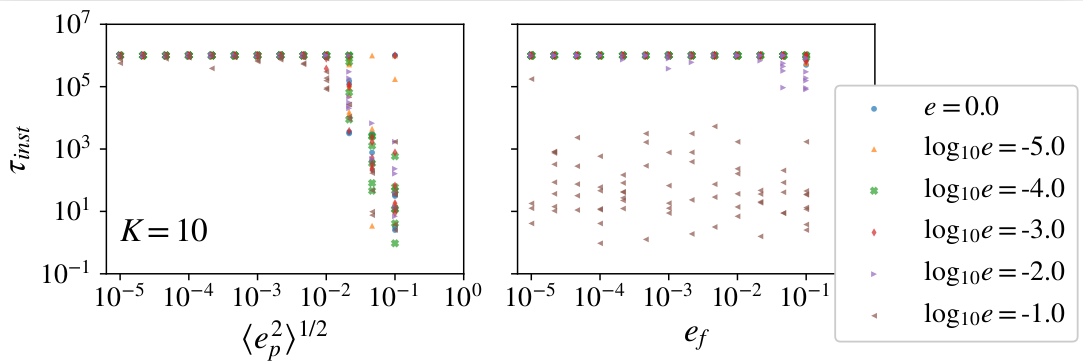
Our results indicate that eccentric systems can be deemed as stable for essentially any value of ef provided that the relative eccentricities remain relatively low (⟨ep2⟩1/2≈10-2), as seen on the left plot.
Right-hand plot highlight this dependency on ep rather than on ef: For all values of absolute eccentricities (x-axis), shorter instability timescales are linked exclusively to higher values of relative eccentricities ⟨ep2⟩1/2. For ef>10-2, τinst decreases by approximately one order of magnitude even for smaller ⟨ep2⟩1/2.
Our results should help constrain evolutionary pathways and also available parameter space characterization for future observations.
How to cite: Teixeira Guimarães, G. and Kokubo, E.: Orbital instabilities in compact planetary systems, EPSC-DPS Joint Meeting 2025, Helsinki, Finland, 7–12 Sep 2025, EPSC-DPS2025-1555, https://doi.org/10.5194/epsc-dps2025-1555, 2025.


