EXOA17 | Dynamics and stability of extrasolar systems

EXOA17

Dynamics and stability of extrasolar systems
Convener: Anne-Sophie Libert | Co-conveners: Alexandre Revol, Adrien Leleu
Orals FRI-OB4
| Fri, 12 Sep, 14:00–16:00 (EEST)
 
Room Neptune (rooms 22+23)
Posters THU-POS
| Attendance Thu, 11 Sep, 18:00–19:30 (EEST) | Display Thu, 11 Sep, 08:30–19:30
 
Finlandia Hall foyer, F227–231
Fri, 14:00
Thu, 18:00
The number of known planetary systems continuously grows, revealing an increasingly complex nature of extrasolar worlds, challenging our understanding of planetary system formation and evolution.

In this session, we address the question of the intricate dynamical evolution of RV-detected systems and transit-detected planetary systems, where resonant and chaotic processes emerge from complex gravitational interactions. Additional effects, including tidal forces, general relativistic effects, planet-disc interactions, and the gravitational influence of binary companions, can strongly affect the architecture and long-term stability of such systems.

This session aims to explore how theoretical modeling can provide crucial insights into system characterization by confronting dynamical predictions with observational constraints, highlighting how dynamical constraints inform our interpretation of planetary system architectures from initial formation to long-term evolutionary states.

Session assets

Orals: Fri, 12 Sep, 14:00–16:00 | Room Neptune (rooms 22+23)

Chairpersons: Anne-Sophie Libert, Alexandre Revol
Stability
14:00–14:12
|
EPSC-DPS2025-608
|
ECP
|
On-site presentation
Alexandru Căliman and Anne-Sophie Libert

The growing number of exoplanets detected over the past three decades has created a need for fast, reliable methods to study the long-term survival of planetary systems. Here, we investigate the challenging problem of the stability of compact three-planet systems, in which resonant and chaotic processes are intrinsically linked. Four completely different chaos indicators are tested on a data set of 10,000 three-planet configurations that are in or near mean-motion resonance. On the one hand, we consider two well-established chaos indicators, namely the mean exponential growth factor of nearby orbits (MEGNO) and a modified chaos indicator based on Lagrangian descriptors. On the other hand, two non-variational chaos indicators which do not require the tangent vector computation are considered for the first time for compact systems. We evaluate the performance of each chaos indicator in correctly predicting the stability of the planetary systems, and also highlight their differences by studying the dynamics of system configurations that are inconsistently classified by different indicators. Finally, we discuss what can be done to combine these chaos indicators to improve the overall performance, and how it could be useful for further constraining the orbital parameters of detected planetary systems.

How to cite: Căliman, A. and Libert, A.-S.: Predicting the stability of planetary systems through chaos indicators, EPSC-DPS Joint Meeting 2025, Helsinki, Finland, 7–13 Sep 2025, EPSC-DPS2025-608, https://doi.org/10.5194/epsc-dps2025-608, 2025.

14:12–14:24
|
EPSC-DPS2025-1555
|
On-site presentation
Gabriel Teixeira Guimarães and Eiichiro Kokubo

Compact protoplanet systems are a natural outcome of runaway and oligarchic growth of planetesimals, with low-mass protoplanets with orbital separations of K≈10 mutual Hill radii. Those protoplanets evolve to Earth-mass bodies through giant impacts after gravitational instabilities are triggered. On the other hand, Kepler observations reveal older, non-resonant and more massive systems with orbital separations clustered at K>10 Hill radii, suggesting long-term stability despite similar compactness. This raises a question: does the stability difference between compact protoplanets and Kepler sample come from a primordial configuration or from subsequent dynamical evolution?

To investigate these stability differences, we conducted tens of thousands of numerical simulations of compact systems with varying orbital separations, mass distributions, inclinations and eccentricities, and quantified instability timescales and their sensitivity to these different parameters. 

Our results indicate that inhomogeneities in mass, in the same way as seen in orbital separation inhomogeneities, are a source of instability for more massive systems, even for larger orbital separations. Such inhomogeneity can destroy the resonant architecture seen in typical τinst x K, but also allow for new dynamical architectures by having pairs of planets closer to resonances that didn't exist in homogeneous systems. Analysis still underway indicate that, for more massive systems, ordering in planetary masses can be a source of stability, whereas systems which don't show masses increasing with semimajor-axis are more prone to instabilities.

Regarding the sensitivity of instability times to distinct orbital architectures, we analysed the effect of relative eccentricities rather than absolute ones. Motivated by Doty et al. (2025), who  numerically constrained eccentricities of the Multi-planet Kepler Sample and came to the conclusion that some systems were deemed stable even for substantially high initial eccentricities (≈0.15), we compared the instability timescales τinst  to both average absolute eccentricities ef and relative eccentricities ep. 

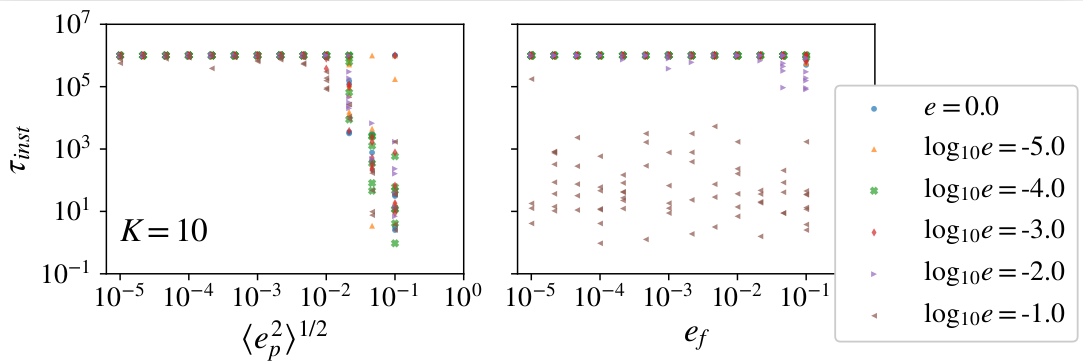
A set of results for orbital separation K = 10 can be seen in Figure 1. Left plot shows instability timescales τinst  as a function of relative eccentricities ⟨ep21/2 for different initial absolute eccentricities ef; right plot shows τinst  as a function of absolute eccentricities ef for different initial relative eccentricities.

Eccentricities described in the legend refer to ef in the left plot and to ⟨ep21/2 in the right plot.


Our results indicate that eccentric systems can be deemed as stable for essentially any value of ef provided that the relative eccentricities remain relatively low (⟨ep21/2≈10-2), as seen on the left plot.

Right-hand plot highlight this dependency on ep rather than on ef: For all values of absolute eccentricities (x-axis), shorter instability timescales are linked exclusively to higher values of relative eccentricities ⟨ep21/2. For ef>10-2, τinst decreases by approximately one order of magnitude even for smaller ⟨ep21/2.

Our results should help constrain evolutionary pathways and also available parameter space characterization for future observations.

How to cite: Teixeira Guimarães, G. and Kokubo, E.: Orbital instabilities in compact planetary systems, EPSC-DPS Joint Meeting 2025, Helsinki, Finland, 7–13 Sep 2025, EPSC-DPS2025-1555, https://doi.org/10.5194/epsc-dps2025-1555, 2025.

14:24–14:36
|
EPSC-DPS2025-1893
|
ECP
|
On-site presentation
Justine Bodart, Antoine C. Petit, and Anne-Sophie Libert

The increasing discovery of extrasolar systems has made it necessary to study their stability. In this work, we present a generalization of the AMD-stability criterion defined by Laskar and Petit (2017), which defines a critical AMD-value below which close encounters are prevented and the system can be considered stable. This secular approach does not take into account mean-motion resonance overlap which can be considerable for compact multi-planet systems. We present a new AMD-framework that extends the resonance overlap criterion previously introduced by different authors. This more general approach highlights the importance of eccentricity diffusion and is also valid for 3D planetary systems. We evaluate the performance of the proposed framework on several compact two- and three-planet first-order resonant systems and discuss how the criterion could be useful for filtering observational data, thereby improving the robustness of stability predictions for newly discovered systems.

How to cite: Bodart, J., Petit, A. C., and Libert, A.-S.: General AMD-stability criterion for exoplanet systems, EPSC-DPS Joint Meeting 2025, Helsinki, Finland, 7–13 Sep 2025, EPSC-DPS2025-1893, https://doi.org/10.5194/epsc-dps2025-1893, 2025.

14:36–14:48
|
EPSC-DPS2025-633
|
On-site presentation
Nikolaos Georgakarakos, Siegfried Eggl, Mohamad Ali-Dib, and Ian Dobbs-Dixon

Many stars are found in pairs. An interesting problem in stellar binary systems is how to assess whether a planetary orbit is dynamically stable or not.  Besides being a theoretical puzzle, the solution to that problem has many applications in topics such as for example in planet detection, planet formation, habitability, and the evolution of planetary systems off the  Main Sequence. Here, we present the latest developments in the problem of the stability of circumbinary planetary orbits.  With the aim of identifying stable and unstable orbits in such systems, we carry out more than 3x10⁸ numerical simulations of planets between the size of Mercury and the lower fusion boundary (13 Jupiter masses) which revolve around the center of mass of a stellar binary over long timescales. For the first time, three dimensional and eccentric planetary orbits are considered. Based on the results of our numerical simulations, we determine two critical borders: an outer border beyond which all planetary orbits are stable and an inner border closer to the binary below which all planetary orbits are unstable. In between the two borders, a mixture of stable and unstable planetary orbits is observed. We provide empirical expressions in the form of multidimensional, parameterized fits for the two borders that separate the three dynamical regimes. Moreover, we train a machine learning model on our data set in order to have an additional tool for predicting stable and unstable motion. Both the empirical fits and the machine learning model are tested for their predictive capabilities against randomly generated circumbinary planetary systems. The parameterized fits are also applied to the Kepler and TESS circumbinary systems, confirming the stability of the planets in these systems. Finally, the empirical fits are compared against previously derived stability criteria.

How to cite: Georgakarakos, N., Eggl, S., Ali-Dib, M., and Dobbs-Dixon, I.: New criteria for evaluating the orbital stability of circumbinary planets, EPSC-DPS Joint Meeting 2025, Helsinki, Finland, 7–13 Sep 2025, EPSC-DPS2025-633, https://doi.org/10.5194/epsc-dps2025-633, 2025.

System evolution
14:48–15:00
|
EPSC-DPS2025-784
|
ECP
|
On-site presentation
Leon Ka-Wang Kwok, Emeline Bolmont, Alexandre Revol, Stéphane Mathis, Aurélie Astoul, Corinne Charbonnel, and Sean Raymond

One of the open questions in exoplanet research is the lack of mean-motion resonances (MMRs) in observed planetary systems, even though planet formation models predict that disk-driven migration should create resonant chains. This suggests that some physical process may be breaking these resonances after formation. In this project, we explore whether stellar dynamical tides could play a role in this process.

To model dynamical tides more accurately, we implemented the frequency-dependent Kaula model into the N-body code Posidonius, using Love number spectra provided by a collaborator. Unlike the constant time lag (CTL) model—which smooths out the tidal response by averaging over frequencies—the Kaula approach accounts for how the star responds to each individual tidal frequency.


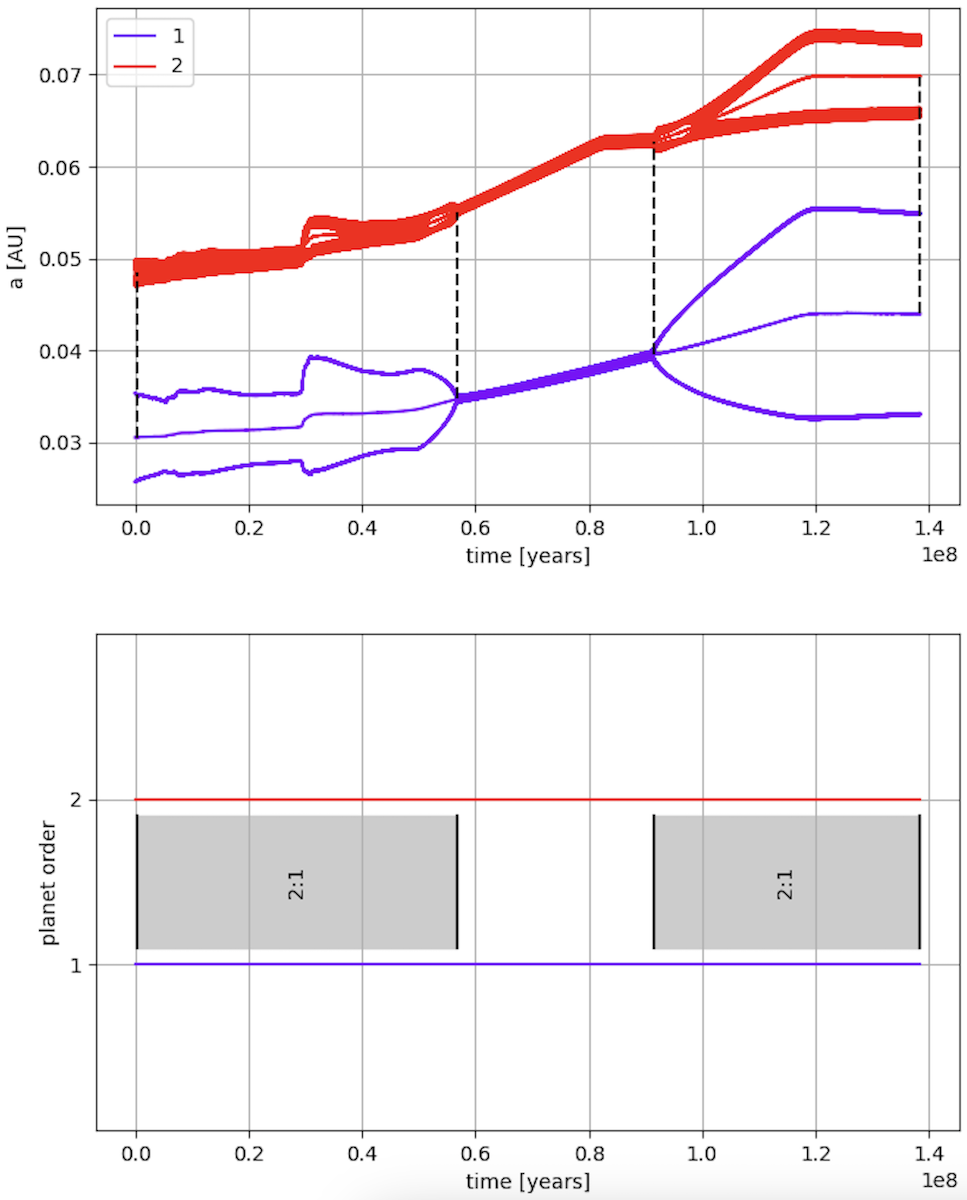
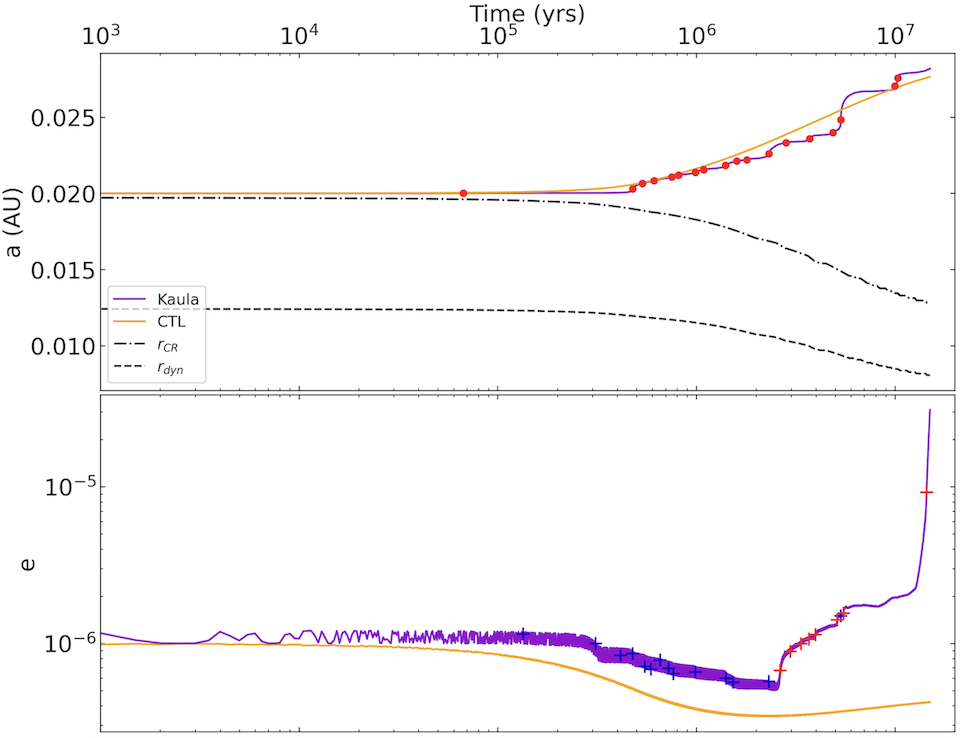
Fig. 1 shows the orbital evolution of a 5 M⊕ super-Earth under both tidal models. Although both lead to similar final semi-major axes, their evolution is quite different. The CTL model produces a smooth migration path, while the Kaula model shows multiple outward migration boosts, causing the semi-major axis to oscillate around that of the CTL case. The eccentricity also evolves differently: CTL is dominated by the main tidal frequency (ω2200), while Kaula includes contributions from additional frequencies like (ω220-1), which can excite the eccentricity. This highlights the importance of using a frequency-dependent model to capture the full behavior of tidal interactions.


We also applied the model to a two-planet system near the 2:1 MMR. Fig. 2 shows the evolution of the semi-major axes and the mean-motion resonance (MMR) states. In the top panel, the split between the upper and lower lines for each planet indicates the evolution of its apastron and periastron distances. In the Kaula model, the outer planet experiences strong tidal interactions despite being farther from the star, due to higher Love numbers at certain frequencies. With additional eccentricity damping from planetary tides (modeled by CTL), the system temporarily leaves the 2:1 resonance and later re-enters it as the inner planet undergoes stronger tidal effects. This result shows that dynamical tides can break and restore resonances, and may contribute to the dynamical evolution that leads to the absence of resonances in some systems.

These early results suggest that stellar tides may influence the long-term architecture of planetary systems, but a more complete picture will require studying additional resonances.

How to cite: Kwok, L. K.-W., Bolmont, E., Revol, A., Mathis, S., Astoul, A., Charbonnel, C., and Raymond, S.: Impact of Dynamical Tides on Planetary System Stability: Evolution of Multi-Planet Systems, EPSC-DPS Joint Meeting 2025, Helsinki, Finland, 7–13 Sep 2025, EPSC-DPS2025-784, https://doi.org/10.5194/epsc-dps2025-784, 2025.

15:00–15:12
|
EPSC-DPS2025-1121
|
On-site presentation
Nader Haghighipour

It is widely known that the secular resonances of giant planets have played fundamental roles in the formation and dynamical evolution of the inner Solar System. These resonances have shaped the architecture of the asteroid belt [1,2], and have had significant contributions to the final mass, water content, and orbital architecture of terrestrial planets [3,4]. The successful detection of circumstellar planets in moderately close binary stars (i.e., binaries with separations smaller than 40 AU) in the past two decades has raised the question that, how these secular resonances appear and operate when the system is subject to the perturbation of a secondary star. We have launched an expansive project on this topic where in a three-article series [5,6,7], we have demonstrated how secular resonances of giant planets appear in binary star systems, and how they affect the formation and orbital evolution of planets interior to their orbits. Using the concept of generalized disturbing function, we have derived the formula for the locations of secular resonances in binary stars with two giant planets, and have shown that in systems where the perturbation of the secondary star is stronger, the locations of secular resonances are farther way from the primary and closer to the giant planets. The latter indicates that in these systems, the secular resonances have larger areas to migrate, and therefore, affect the dynamics of the system more strongly [6]. The most important result obtained from our study is that the perturbation of the secondary star suppresses the effects of secular resonances.

To investigate the effects of secular resonances on the orbital architecture of the system, we also simulated the late stage of terrestrial planet formation for different types of the secondary, and different orbital elements of the binary and giant planets. Results demonstrate that terrestrial planet formation can indeed proceed constructively in such systems; however, as predicted by the general theory, secular resonances are suppressed and do not contribute to the formation process. It is in fact the mean-motion resonances of the inner giant planet that drive the dynamics of the protoplanetary disk, and the mass and orbital architecture of the final bodies. Simulations also show that in the majority of the cases, the final systems contain only one terrestrial planet with a mass of 0.6 - 1.7 Earth masses. Multiple planets appear in rare occasions in the of form Earth-Mars analogs with the smaller planet in an exterior orbit. When giant planets are in larger orbits, the number of these double-planet systems increases and their planets become more massive. Results also show that when the orbits of the giant planets carry inclinations, while secular resonances are still suppressed, mean-motion resonances are strongly enhanced, drastically reducing the efficacy of the formation process. We present details of our simulations and discuss the implications of their results [7].

[1] Milani, A. & Kneževic, Z. 1992, Icarus, 98, 211

[2] Milani, A. & Kneževic, Z. 1994, Icarus, 107, 219

[3] Levison, H. F. & Agnor, c. 2003, AJ, 125, 2692

[4] Haghighipour, N. & Winter, O. C. 2016, Cel. Mech. Dyn. Ast., 124, 235

[5] Andrews, M. & Haghighipour, N. 2024, Proc. IAUS, 382, 116-122

[6] Haghighipour, N. & Andrews, M. 2025a, ApJ, in press

[7] Haghighipour, N. & Andrews, M. 2025b, ApJ, in press

How to cite: Haghighipour, N.: On the effects of secular resonances on the dynamical evolution and orbital architecture of planetary systems in binary stars, EPSC-DPS Joint Meeting 2025, Helsinki, Finland, 7–13 Sep 2025, EPSC-DPS2025-1121, https://doi.org/10.5194/epsc-dps2025-1121, 2025.

Dynamics
15:12–15:24
|
EPSC-DPS2025-310
|
On-site presentation
Alexandre Prieur, Philippe Robutel, and Jacques Fejoz

Although many theoretical works suggest that co-orbital exoplanets may also exist, such a pair of planets has yet to be observed. In particular, out of the hundreds of multi-planetary systems discovered by the Kepler mission, none were found in co-orbital configuration thus far. Although this result points to a relative rarity of the configuration, part of this absence might be due to observational biases (Robutel, Leleu 2024). We are interested here in one of these: the fact that the planets do not orbit in the same plane, which can prevent the transit of, at least, one of the bodies. In this talk, we explore the stability domain in the spatial case, paying a particular attention to a family of periodic orbits, in a rotating frame, emanating from the Lagrange’s equilateral configuration in the vertical direction.  Theses solutions have been first discovered by Marchal (2009) in the special case of the restricted secular problem. We propose a numerical study to follow this family in a more general case. We show that the family discovered by Marchal exists in the full three-body problem (neither restricted nor secular) for a wide range of masses, and that the stability of its orbits evolves along the family, sometimes leading to stable systems for masses exceeding the Gascheau’s value (also known as Routh’s critical value). We try to continue these families increasing the planetary masses the two extreme cases, that is between the Marchal’s and P12 families.  we try to extend these families by increasing the planetary masses until they reach that of the central body, in the hope of discovering links between these orbits of the planetary problem and the P12 family, containing the famous “Figure 8” when the 3 masses are equal (Chenciner, Montgomery, 2000).


Bibliographie

Chenciner A. and Montgomery R. “A remarkable periodic solution of the three-body problem in the case of equal masse”. Annals of Mathematics, 152 (2000), 881–901

Marchal C. “Long term evolution of quasi-circular Trojan orbits”. Celestial Mechanics and Dynamical Astronomy, 105(2009), 53-67

Robutel P. and Leleu A. “Trojan Exoplanets” (2024) arXiv:2402.15168. To be published in: Handbook of Exoplanets, 2nd Edition, Hans Deeg and Juan Antonio       Belmonte (Eds. in Chief), Springer International Publishing AG, part of Springer Nature.


How to cite: Prieur, A., Robutel, P., and Fejoz, J.: Vertical stability of co-orbital planetary systems: from Marchal’s family to P12? , EPSC-DPS Joint Meeting 2025, Helsinki, Finland, 7–13 Sep 2025, EPSC-DPS2025-310, https://doi.org/10.5194/epsc-dps2025-310, 2025.

15:24–15:36
|
EPSC-DPS2025-1993
|
ECP
|
On-site presentation
Nicolas Pan Rivero, Tabaré Gallardo, Adrián Rodríguez, and Fernando Roig

Over the past 30 years, the number of confirmed exoplanetary systems has increased enormously, with nearly a thousand systems hosting multiple planets. The orbital architectures of these systems have challenged traditional formation models and reshaped our understanding of how planetary systems form and evolve. Notably, the observed eccentricity distribution shows that many exoplanets have highly eccentric orbits, in sharp contrast to the quasi circular orbits of the Solar System (SS) planets. Additionally, observations using the Rossiter-McLaughlin effect have shown that some exoplanets orbit in polar orbits relative to their host star’s equator, whereas all planets in the SS orbit within relatively coplanar configuration. These findings highlight the importance of studying the dynamics of inclined and eccentric planetary configurations.

Furthermore, the distribution of period ratios in multi planet systems exhibit clear concentrations near mean-motion resonances (MMRs), which can significantly influence the long-term orbital evolution of such systems. For instance, the system HD 31527 appears to be stable only within the high-order 16:3 resonance. In this configuration, resonance helps prevent close encounters between outer planets, avoiding chaotic zones. In contrast, planets in the SS lie close but out of major resonances. Numerical experiments show that forcing SS planets into resonance typically leads to instability. This could be expected, since formation models suggest that planetary migration can be stopped by resonant trapping, but raises important questions: are planetary resonances stabilizing or destabilizing systems?
The answer depends on the context, much like the case of small body populations in the SS, where some resonances appear as concentrations of objects while others are empty.

It is crucial to understand the structure and properties of individual resonances and how they influence long-term orbital evolution. Generally, classical approaches for calculating the resonant disturbing function were analytical expansions only valid for some interval of eccentricities and inclinations or for particular resonances. However, calculating the resonant function numerically is advantageous as it has no restrictions on orbital elements or type of resonance.

In this work, we apply a semi-analytical model to compute the resonant disturbing function, the Hamiltonian, and the properties of any given resonance between two planets. We are only limited by the fast evolution of eccentricity, inclination, argument of perihelia or longitude of ascending nodes as the model assumes they stay more or less constant during a libration period.The model calculates the resonance width, the location of the equilibrium points and the libration period.

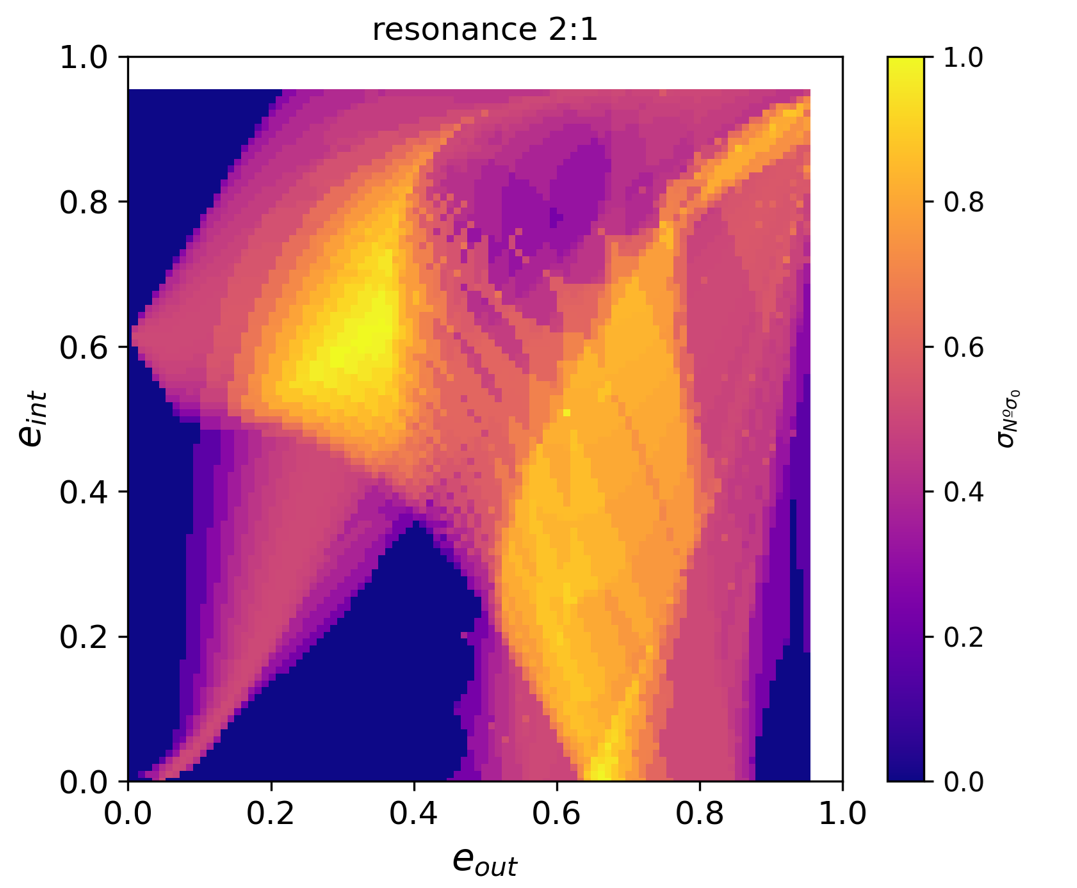
Traditionally, resonances have been classically classified as symmetric if there exists one equilibrium point where the critical angle oscillates around 0° or 180°or as asymmetric if there exists two equilibrium points separated by less than 180°. Most low inclination resonances are symmetric whereas 1:1 and all other 1:N resonances are asymmetric. In this work, we present results from mapping resonance properties in the (eccentricity, inclination) and (inner eccentricity, outer eccentricity) phase spaces. These include new resonant equilibrium points, which we validated through numerical integrations and compared with observed exoplanet systems from available databases.

Finally, we explore how the long-term secular evolution within resonances is affected by high eccentricities and inclinations. Our findings indicate that the phase-space topology of resonances can change dramatically under such conditions, challenging the traditional classification and revealing more complex dynamical structures.

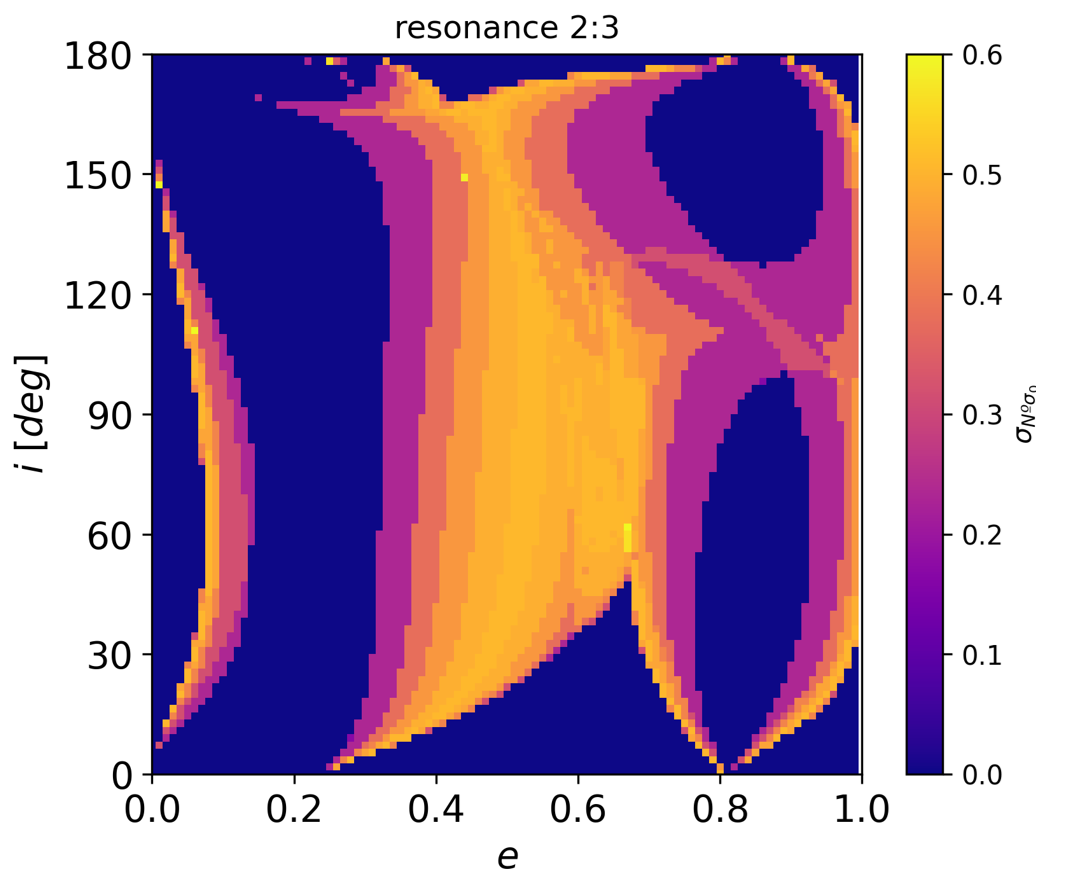
Figure 1: Standard deviation of the number of equilibrium points for the 2:3 resonance in the (e, i) plane varying ω.

Figure 2: Standard deviation of the number of equilibrium points for the 2:1 resonance in the eccentricities plane varying ∆ω.

How to cite: Pan Rivero, N., Gallardo, T., Rodríguez, A., and Roig, F.: Extreme planetary resonances: Study of high eccentricity and high inclination resonances in exoplanet systems, EPSC-DPS Joint Meeting 2025, Helsinki, Finland, 7–13 Sep 2025, EPSC-DPS2025-1993, https://doi.org/10.5194/epsc-dps2025-1993, 2025.

15:36–15:48
|
EPSC-DPS2025-223
|
ECP
|
On-site presentation
Andrea Bocchieri, Jiri Zak, and Diego Turrini

Multi-planetary systems reveal diverse dynamical histories. Stellar obliquity is a key diagnostic of these histories, linking past dynamical interactions to migration pathways (e.g., quiescent disc vs. violent high-eccentricity). To measure the remaining dynamical violence of planetary systems, we introduce an obliquity-based NAMD (Normalized Angular Momentum Deficit), improving on the previous relative inclination-based NAMD in capturing the systems’ architectures. Our open-source ExoNAMD Python tool calculates these metrics, enabling cross-system dynamical state comparisons. The dynamical context provided by the NAMD can be used for (1) interpreting planetary atmospheres, as migration history shapes composition and thermal structure; (2) unbiased target selection for future observations and to guide model testing; (3) enabling comprehensive dynamical descriptions alongside stability indicators (AMD, MEGNO, SPOCK) in the forthcoming era of PLATO and Ariel.

How to cite: Bocchieri, A., Zak, J., and Turrini, D.: ExoNAMD: a community tool to gauge multi-planetary systems, EPSC-DPS Joint Meeting 2025, Helsinki, Finland, 7–13 Sep 2025, EPSC-DPS2025-223, https://doi.org/10.5194/epsc-dps2025-223, 2025.

15:48–16:00
|
EPSC-DPS2025-1996
|
On-site presentation
Tabaré Gallardo and Alfredo Suescun

We investigate a fundamental planetary system comprising a Sun-like star, a Jupiter-like planet, and a Neptune-like planet across a wide range of orbital configurations, not limited to the well-studied hierarchical case. We present resonance atlases illustrating the domains of thousands of mutual mean-motion resonances (MMRs) and their connection to both chaotic and regular dynamics. Our analysis reveals that an eccentric Jupiter generates a significant chaotic region in its vicinity due to close encounters and overlapping MMRs, particularly extended in semi-major axis for inclinations below 30 degrees. Notably, some strong resonances, such as the 1:1, persist within these chaotic zones.

Employing a semi-analytical method to study secular dynamics, we identify two regimes for equilibrium configurations. At low mutual inclinations, equilibrium arises from oscillations of mutual pericenters around 0 or 180 degrees. Conversely, at high mutual inclinations equilibrium is characterized by specific values of the arguments of pericenters that are integer multiples of 90 degrees.

Through numerical integration of the full equations of motion, we calculate the three fundamental frequencies of the system across diverse configurations and analyze their dependence on orbital elements. Based on this frequency analysis, we find two distinct dynamical regimes separated by a critical mutual inclination between 30 and 40 degrees, where a secular resonance occurs due to the coincidence of the two fundamental pericenter frequencies. Below this critical inclination, the dynamics resembles the classical secular model for low-inclination orbits, featuring three well-defined fundamental frequencies and free and forced modes, with mutual inclination remaining quasi-constant. Above this threshold, the dynamics shifts dramatically, exhibiting increased variations in mutual inclination and the emergence of combined fundamental frequencies, potentially dominated by the secular resonance or the von Zeipel-Lidov-Kozai (vZLK) mechanism. The observed change in dynamical regimes correlates with the transition in the equilibrium configurations of the pericenters.

While the planetary mass ratio has a limited qualitative impact on our findings, it directly influences the individual fundamental frequencies. Furthermore, the relative placement of the Neptune-mass planet (interior or exterior to Jupiter) leads to different dynamical behaviors at increasing mutual inclinations. An interior Neptune exhibits gradual secular changes in eccentricity and inclination, whereas an exterior Neptune shows a rapid increase in these elements following the onset of the vZLK mechanism.

How to cite: Gallardo, T. and Suescun, A.: The role of the mutual inclination in the dynamics of a two eccentric giant-planet system, EPSC-DPS Joint Meeting 2025, Helsinki, Finland, 7–13 Sep 2025, EPSC-DPS2025-1996, https://doi.org/10.5194/epsc-dps2025-1996, 2025.

Posters: Thu, 11 Sep, 18:00–19:30 | Finlandia Hall foyer

Display time: Thu, 11 Sep, 08:30–19:30
Chairpersons: Anne-Sophie Libert, Alexandre Revol
F227
|
EPSC-DPS2025-1120
|
ECP
|
On-site presentation
Barbara Celi Braga Camargo and Adrian Rodríguez Colucci

The formation and evolution of planetary systems are conducted by a series of complex physical processes, with planetary migration playing a crucial role. Traditional models suggested that the presence of gas giants in very close proximity to their host stars—known as hot Jupiters—would be incompatible with the existence of low-mass planets in the inner regions of the system. It was believed that the inward migration of these giants would either expel or destroy smaller planets along the way. However, recent observations have challenged this view, revealing multiple systems where hot Jupiters coexist with super-Earths or mini-Neptunes in inner orbits. This finding suggests the need to rethink current models of system evolution and to further investigate the mechanisms that make such configurations possible.

In this study, we examine the role of tidal forces in the planetary migration of compact multi-planet systems, focusing on TOI-1130. This system consists of two exoplanets: TOI-1130 b, a Neptune-like planet with an orbital period of 4.1 days, and TOI-1130 c, a gas giant with a period of 8.4 days. The close orbital proximity of both bodies and their host star indicates migration processes, and perhaps even resonance interactions must have played an important role in sculpting the current system architecture.

Planetary migration refers to the gradual change in a planet’s semi-major axis over time, altering its distance from the star. This process can explain the presence of gas giants in extremely close-in orbits, regions where they are unlikely to have formed in situ, as well as the compact arrangement of multiple planets and the presence of orbital resonances that lock their periods into specific ratios.

The primary drivers of migration include interactions with the protoplanetary disc during the system’s early stages, when planets are still embedded in the surrounding gas and dust. Gravitational torques between a planet and the disc generate density waves that redistribute angular momentum. After the disc dissipates, tidal effects become increasingly important. Gravitational interactions with the host star deform the planets and star, leading to energy dissipation and a gradual inward drift of the orbits.

Tidal forces, in particular, have a pronounced impact on close-in systems. The difference in gravitational pull between the near and far sides of a planet causes periodic deformation, and the efficiency of energy dissipation depends on the planet’s internal viscosity. This efficiency is characterized by parameters such as Love numbers and relaxation times. Gas giants, with more deformable interiors, tend to dissipate energy more effectively, thus accelerating their inward migration.

In the case of TOI-1130, its current orbital configuration suggests a strong influence from tidal forces, possibly combined with past resonance capture between the two planets. The dynamical history of the system may include phases of convergent migration, resonance capture, and later decoupling, leading to the observed configuration.

To explore this scenario, we employed the TIDYMESS numerical code (Tidal Dynamics of Multi-Body Extra-Solar Systems), developed to simulate the orbital and rotational evolution of exoplanetary systems under tidal influence. TIDYMESS uses a viscoelastic creep-type deformation model, which is well-suited to representing planets with diverse internal structures. The code allows for detailed customization of each body’s physical parameters, such as Love numbers, relaxation times, and moments of inertia, and accounts for mutual gravitational interactions between multiple planets and their host star.

The simulations conducted for the TOI-1130 system aimed to reproduce possible evolutionary trajectories that could explain the current positions of the two planets. We explored scenarios with varying initial configurations to determine a stable configuration similar to the one observed today.

How to cite: Braga Camargo, B. C. and Rodríguez Colucci, A.: Tidal Effects on Planetary Migration in Systems Hosting a Hot Jupiter and an Inner Companion, EPSC-DPS Joint Meeting 2025, Helsinki, Finland, 7–13 Sep 2025, EPSC-DPS2025-1120, https://doi.org/10.5194/epsc-dps2025-1120, 2025.

F228
|
EPSC-DPS2025-1152
|
ECP
|
On-site presentation
Isabel de Jesus Lima, Rafael Ribeiro de Sousa, Silvia M. G. Winter, and Rosana A. Nogueira de Araújo

Exoplanets are common in binary systems. There are 140 known exoplanets in these systems, about 10 of which orbit binary systems containing an evolved star, such as a white dwarf (WD) or subdwarf (see the NASA Exoplanet Archive at http://exoplanets.org). The existence of two planets orbiting the post-common-envelope binary NN Serpentis has allowed fundamental studies of planet formation and dynamics in the context of binary interactions (Beuermann K., et al., 2010, A\&A, 521, L60). Recently, Xing Z., et al. 2025 (MNRAS, 537, 285) developed the NBSE code, a framework designed to incorporate binary evolution data from the stellar evolution code MESA into the N-body simulation code REBOUND to understand the dynamical effects on planets orbiting interacting binaries. This work motivates us to use the N-body simulations to study the dynamical evolution and stability of circumstellar planetary systems belonging to two zero-age main-sequence stars, a white dwarf and a 0.8 solar mass main sequence star, from the moment just after common-envelope evolution onwards, using MESA. We expect to determine the stability of the multi-planets through all phases of stellar evolution, including the effects of drag and migration caused by the gas envelope resulting from the approximation of the stars to the common envelope. Our work will address the dearth of work in this scenario.

How to cite: de Jesus Lima, I., Ribeiro de Sousa, R., G. Winter, S. M., and A. Nogueira de Araújo, R.: Dynamic study of multi-planets in binary systems, EPSC-DPS Joint Meeting 2025, Helsinki, Finland, 7–13 Sep 2025, EPSC-DPS2025-1152, https://doi.org/10.5194/epsc-dps2025-1152, 2025.

F229
|
EPSC-DPS2025-2046
|
On-site presentation
Wolfgang Sakuler and Elke Pilat-Lohinger

Introduction

We present a new approach to test the orbital stability of a newly discovered planet in a two-body system. This work is based on stability map calculations that were used for building up the so-called Exocatalogue [1] which has been compiled for a dynamical model consisting of a star with, a giant planet, and a small Earth-like planet.

Stability calculations have been performed for various values of (i) the mass ratio μ = m1 / (m0 + m1) of the star (m0) and the giant planet (m1), (ii) the eccentricity e1 of the giant planet, (iii) the semi-major axis a of the Earth-like planet, and (iv) the mean anomaly M1 of the giant planet. Stability maps were calculated for 23 discrete mass-ratios (from 0.0001 to 0.05) using the chaos indicators RLI (Relative Lyapunov Indicator [2]) and FLI (Fast Lyapunov Indicator [3]) to distinguish between regular and chaotic motion. These stability maps were also used to check whether the habitable zone (HZ) of a star is fully, partly, or not in a stable area.

The advantage of the new approach is that smooth boundary lines separating stable and chaotic regions are determined via AI methods so that we are no more restricted to certain discrete mass-ratios, since the AI model can calculate the stability map for any μ between 0.0001 and 0.05.


Method

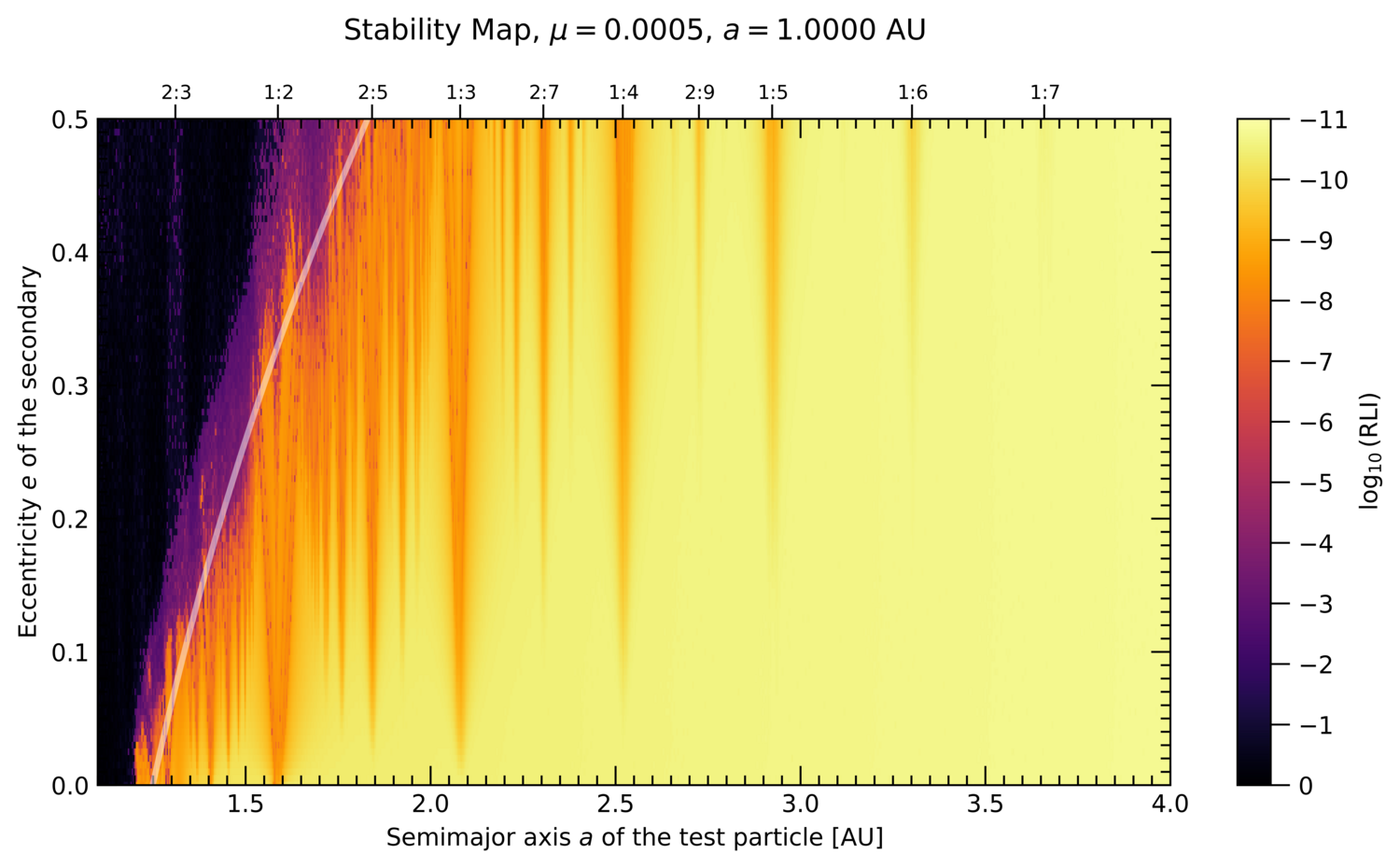
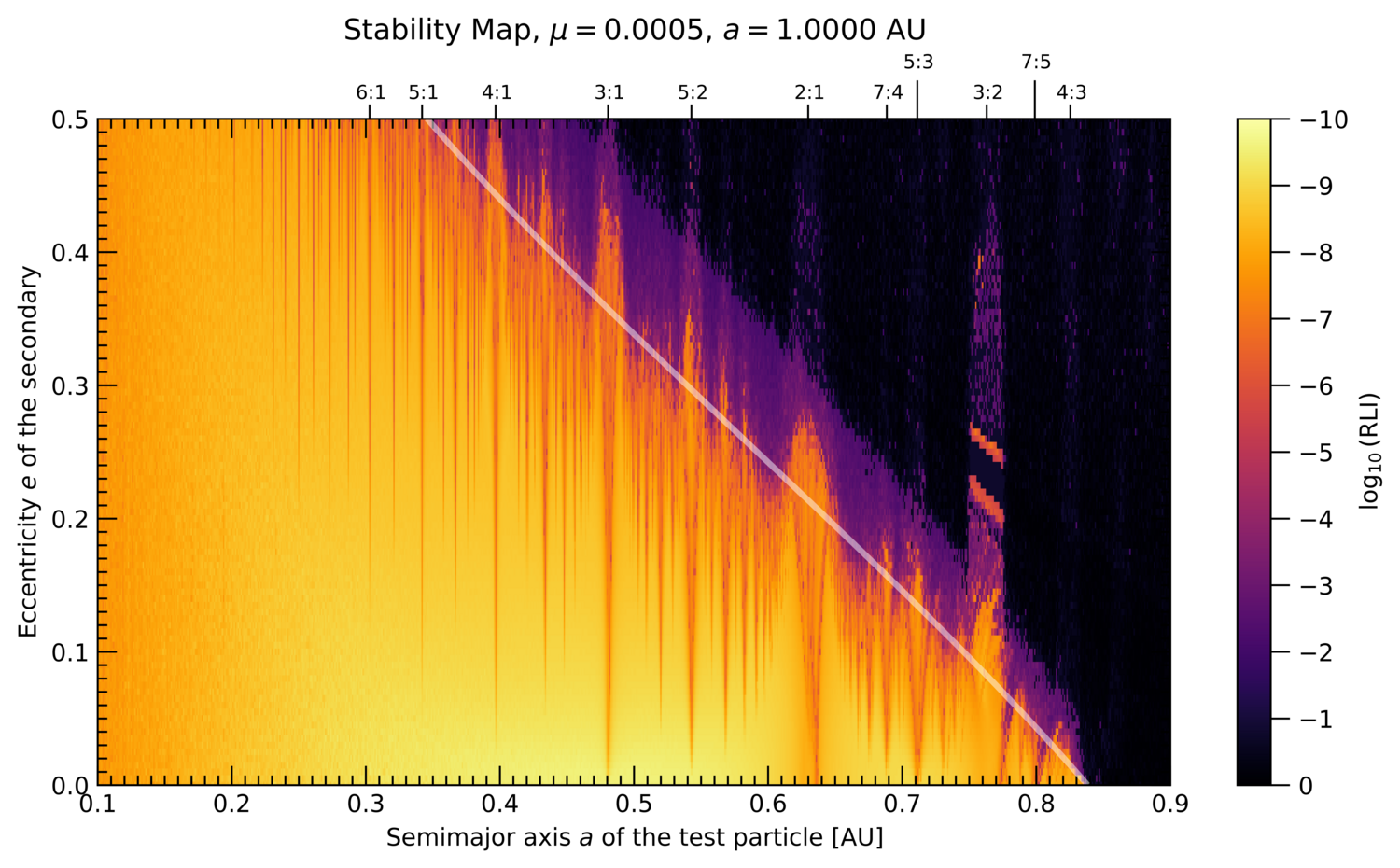
The existing stability maps do not show a clear smooth border line between regular and chaotic motion, moreover, the border region itself looks rather chaotic (see Fig. 1). However, a smooth border line in the (a, e1)-plane can be determined by the following procedure:

First, for each value of μ the average of all existing stability maps (different M1 values) is computed. Though, the boundary region gets smoothed, it still has a chaotic, fractal-like shape.

We then apply a machine learning (ML) method, namely a Support Vector Machine (SVM; see https://scikit-learn.org/stable/modules/svm.html) to extract the decision boundaries between the regular and chaotic regions of the stability maps for the various values of μ for inner and outer orbits (with respect to the giant planet’s orbit). SVMs are supervised ML models that are commonly employed for classification problems. When classifying, the SVM constructs a hyperplane that represents the boundary surface between the different classes. A basic element in the SVM is the so-called kernel function that is the crucial factor in the classification procedure. In our specific case there are two classes, regular and chaotic, in a two-dimensional plane, thus, a one-dimensional decision boundary will be determined by the SVM model for each stability map.

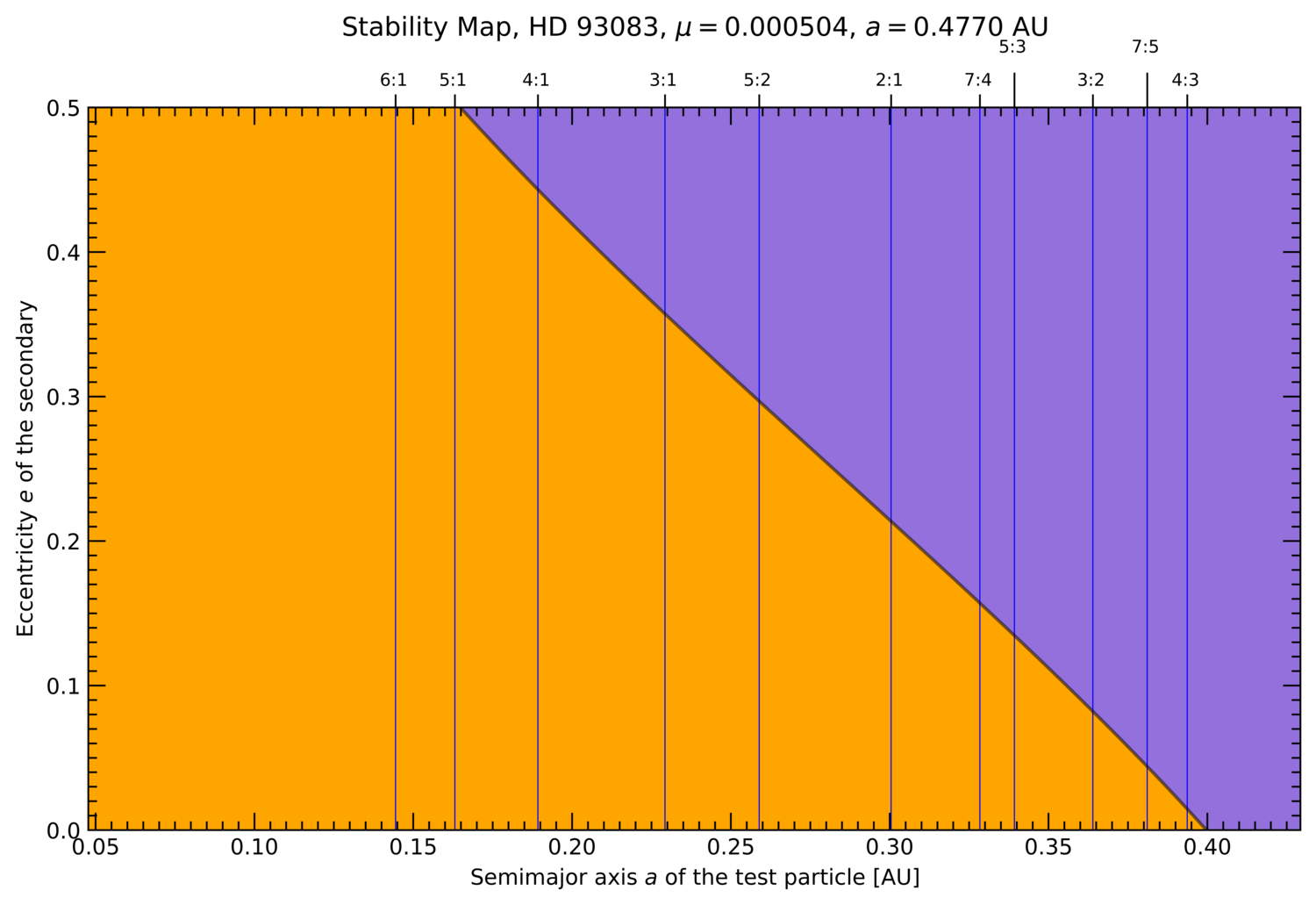
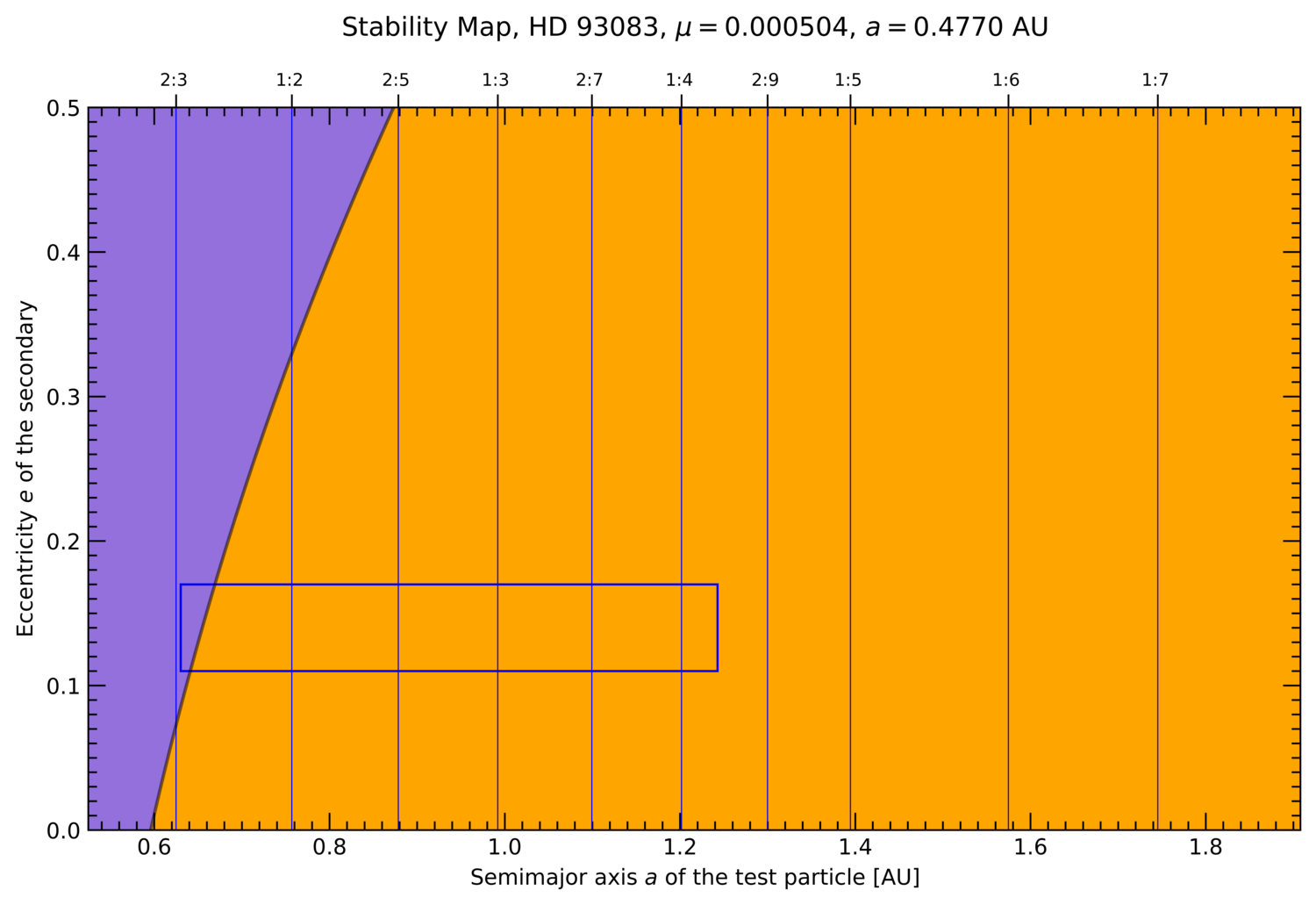
To get a SVM decision boundary that follows the computed fractal boundary region close enough we use a polynomial SVM kernel of degree three. Finally, we computed 46 decision boundary lines, for the 23 values of μ for inner and outer orbits. With these values stability map plots (see Fig. 2) have been created where (i) the boundary lines are drawn, (ii) the stable/chaotic regions are colored (orange: stable, purple: chaotic), and (iii) a set of selected mean motion resonances (MMRs) are superimposed.

To calculate the stability maps for an arbitrary planetary system s which has a specific mass ratio μs and a specific giant planet semi-major axis as, the closest neighboring μ values for which calculated stability boundaries lines exist will be determined, and the boundary line for the system’s mass ratio μs will be computed by interpolating the underlying two-dimensional arrays of the neighbor’s decision boundary data. The semi-major axis will be scaled correspondingly to the value as.

Results

The stability maps for a planetary system with mass ratio μ = 0.0005 with data of the original Exocatalogue including the boundary (white curve) separating regular and chaotic regions computed by AI is shown in Fig. 1. These maps serve as basis for the calculations of planetary systems of interest. An example of AI stability maps of a real existing system is shown in Fig. 2 for the planetary system HD 93083 where a giant planet is orbiting the host-star at 0.477 au, which has a mass ratio μ = 0.000504, and which uses the data of Fig. 1 for determining its stability boundary


Figure 1: Stability maps (left: inner, right: outer region) for μ = 0.0005, the giant planet at 1 au according to the Exocatalogue. Yellow/orange indicates regular motion and purple/black chaotic regions. The white lines are the stability boundaries computed by the AI model.


Figure 2: Stability maps (left: inner, right: outer region) generated by AI for HD 93083 (μ = 0.000504) with a giant planet at 0.477 au. The boundaries between regular (orange) and chaotic (purple) motion have been generated by the AI model. The rectangle located in the outer region marks the HZ.

Conclusion

Employing AI methods we are able to determine stability maps for any continuous value of the stellar to giant-planet mass ratio μ between 0.0001 and 0.05.

We plan to build a publicly available Web service, where users can enter the basic data for a planetary system s of interest, i.e. μs, as, and optionally the boundaries of the HZ, and the service computes in real-time the stability maps of that specific system, and creates plots for the inner and outer region containing the stability boundary lines, the colored areas of regular and chaotic orbits, a set of vertical lines representing MMRs, and optionally the edges of the HZ.

Acknowledgements

This research was funded by the Austrian Science Fund (FWF) [PAT3059124].


References

[1] Sándor, Zs., Süli, Á., Érdi, B.; Pilat-Lohinger, E., Dvorak, R.: 2007, MNRAS, 375, 1495.

[2] Sándor, Zs., Érdi, B., & Efthymiopoulos, C.: 2000, CeMDA, 78, 113

[3] Froeschlé, C., Lega, E., Gonczi, R.: 1997, CMDA, 67, 41.

How to cite: Sakuler, W. and Pilat-Lohinger, E.: Stability Maps for Terrestrial Planets in Star-Giant Planet configurations, EPSC-DPS Joint Meeting 2025, Helsinki, Finland, 7–13 Sep 2025, EPSC-DPS2025-2046, https://doi.org/10.5194/epsc-dps2025-2046, 2025.

F230
|
EPSC-DPS2025-15
|
On-site presentation
Sergei Ipatov

Introduction. Migration of planetesimals to forming exoplanets from different distances from the central star was studied in the Proxima Centauri, TRAPPIST-1, and GLISSE 581 exoplanetary systems. The gravitational influence of the star and planets was taken into account. The symplectic algorithm RMVS3 from the SWIFT package was used to integrate the equations of motion. Planetesimals were excluded from integration when they collided with planets or the star or were ejected into hyperbolic orbits. The probabilities of collisions of planetesimals with planets and the star were calculated. Initially, the orbits of the planetesimals were near the orbit of one of the planets. The initial eccentricities of their orbits in different calculation options were eo=0.02 or eo=0.15, and their initial inclinations were eo/2 rad.

Proxima Centauri. Migration of planetesimals in the Proxima Centauri exoplanetary system was studied in (Ipatov, 2023a,b,c, 2024a). According to the obtained estimates, the amount of water delivered by planetesimals to the inner planet Proxima Centauri b from the feeding zone of the outer, more massive planet Proxima Centauri c could exceed the mass of the Earth's oceans (Ipatov, 2023a). Although the initial orbits of the dust particles considered were close to the orbit of Proxima Centauri c, and planet c is more massive than planet b, for a ratio of the radiation pressure to the force of gravity β between 0.001 and 0.1 (for particle diameters of the order of 4-400 microns), more particles collided with the inner planet b than with the larger planet c (Ipatov, 2024a) With such values of β, the dust particles effectively deliver matter (including volatiles) to planet b.

TRAPPIST-1. Migration of planetesimals in the TRAPPIST-1 exoplanetary system was studied in (Ipatov, 2024b,c). In the TRAPPIST-1 exoplanetary system consisting of seven planets, the fraction of planetesimals that collided with the host planet (compared to collisions with all planets) generally decreased with increasing considered time interval. In each calculation variant, there was at least one planet for which the number of collisions with planetesimals exceeded 25% of the number of planetesimals’ collisions with the host planet. Planetesimals could have collided with all planets for disks near the orbits of planets from d to h. Therefore, the outer layers of neighboring planets in the TRAPPIST-1 system may include similar material if there were many planetesimals near their orbits at the late stages of planet accumulation.

Bodies from the outer zones of the TRAPPIST-1 exoplanetary system containing water could, in particular, fall onto planets d, e, and f, located in the habitable zone. For example, in the calculation variant with 1000 planetesimals initially located near the orbit of the outer planet h, with eo=0.15 it was found that 47, 89 and 165 planetesimals fell onto planets d, e and f, respectively. This probability of collision is four orders of magnitude greater than the probability of a collision of a body from the zone of giant planets with the Earth. These data indicate the possibility of delivering a large amount of water to planets d, e and f in the TRAPPIST-1 system.

Gliese 581. Migration of planetesimals in the Gliese 581 exoplanetary system was studied in (Ipatov, 2023d, 2024c). In the calculations of the migration of planetesimals in the Gliese 581 exoplanetary system with three planets (b, c, and e), the evolution times of the disks of the planetesimals only slightly exceeded 1 million years. The fraction of planetesimals that collided with one of the neighboring planets (close to the host planet) for disks e, b, and c at eo=0.02 was 0.50, 0.20, and 0.36, respectively. At eo=0.15 this fraction was 0.52, 0.15, and 0.40, respectively. These results indicate that the outer layers of neighboring exoplanets in the Gliese 581 exoplanetary system may include similar material. The calculations of the migration of bodies in the Gliese 581 planetary system were also carried out with five planets (b, c, d, e, and g). At present, the existence of two outer planets (e and g) is not confirmed. The unconfirmed planet Gliese 581g (with a mass of about two Earth masses) would be in the habitable zone of its star. In calculations, about 5% of planetesimals from the orbital vicinity of the outer planet d (with a mass of 7 Earth masses) fell on planet g. Therefore, such planet g could have an influx of bodies containing water. Studies of migration of planetesimals in the considered exoplanetary systems were shortly summarized in (Marov, Ipatov, 2023; Ipatov 2024c).

Acknowledgments: The studies were carried out under government-financed research project for the Vernadsky Institute.

References: Ipatov S.I. (2023a) Delivery of icy planetesimals to inner planets in the Proxima Centauri planetary system // Meteoritics and Planetary Science. 58:752-774. https://doi.org/10.1111/maps.13985, https://arxiv.org/abs/2309.00695. Ipatov S.I. (2023b) Stable orbits in the feeding zone of the planet Proxima Centauri c // Solar System Research. 57:236-248. https://doi.org/10.1134/S0038094623030036. https://arxiv.org/abs/2309.00492. Ipatov S.I. (2023c) Motion of planetesimals in the Hill sphere of the star Proxima Centauri // Solar System Research. 57:612-628. https://doi.org/10.1134/S0038094623060047. http://arxiv.org/abs/2401.09086. Ipatov S.I. (2023d) Mixing of planetesimals in the Glisse 581 planetary system // Fourteenth Moscow Solar System Symposium (October 9-13, 2023), https://ms2023.cosmos.ru/docs/2023/14ms3_ABSTRACT-BOOK-2023-10-06.pdf. P. 333-335. Ipatov S.I. (2024a) Migration of planetesimals and dust particles in the Proxima Centauri exoplanetary system // Modern astronomy: from the Early Universe to exoplanets and black holes. P. 845-851. https://doi.org/10.26119/VAK2024.134. https://www.researchgate.net/publication/387473114. Ipatov S.I. (2024b) Migration of planetesimals in the TRAPPIST-1 exoplanetary system // Modern astronomy: from the Early Universe to exoplanets and black holes. P. 852-855. https://doi.org/10.26119/VAK2024.135. https://www.researchgate.net/publication/387472279. Ipatov S.I. (2024c) Migration of planetesimals in the TRAPPIST-1 and GLISSE 581 exoplanetary systems // The Fifteenth Moscow Solar System Symposium (October 21- 25, 2024). https://ms2024.cosmos.ru/docs/2024/15-MS3_Abstract_Book-10-18.pdf. 15MS3-EP-01. P. 320-322. https://www.academia.edu/126487193/. Ipatov S.I. (2024c) Migration of celestial bodies in the Solar system and in several exoplanetary systems // Solar System Research. 58, Suppl. 1, pp. S50-S63. https://doi.org/10.1134/S0038094623600105. https://rdcu.be/d04Q0, http://arxiv.org/abs/2411.05436. Marov M.Ya., Ipatov S.I. (2023) Migration processes in the Solar System and their role in the evolution of the Earth and planets // Physics–Uspekhi. 66:2-31. https://doi.org/10.3367/UFNe.2021.08.039044. https://arxiv.org/abs/2309.00716.

How to cite: Ipatov, S.: Probabilities of collisions of planetesimals with planets in the Proxima Centauri, Trappist-1 and Gliese 581 exoplanetary systems, EPSC-DPS Joint Meeting 2025, Helsinki, Finland, 7–13 Sep 2025, EPSC-DPS2025-15, https://doi.org/10.5194/epsc-dps2025-15, 2025.

F231
|
EPSC-DPS2025-2052
|
On-site presentation
Erwan Hochart and Simon Portegies Zwarts

We introduce a revamped Nemesis, a numerical tool designed to circumvent the multi-scale, multi-physics problem inherent to numerical simulations of planetary systems in star clusters. We validate the algorithm by comparing it against both a 4th-order Hermite and a symplectic N-body code in simulations of a star cluster hosting five planetary systems, including ~1000 asteroids. Nemesis finds indistinguishable orbital parameters of evolved planetary systems when compared to its direct N-body code counterparts. Moreover, energy errors are comparable to symplectic codes and the algorithm reduces computation time by up to several orders of magnitude. Due to its parallelisation, t, the performance gain increases significantly with the number of planetary systems. As a result, preliminary results of an ongoing simulation consisting of ~4600 star cluster (~4500 planetary systems) is shown, focusing on captured planets, rogue planets and collisional events.

How to cite: Hochart, E. and Portegies Zwarts, S.: Nemesis: An Optimised Algorithm for Simulating Planetary Systems in Clusters, EPSC-DPS Joint Meeting 2025, Helsinki, Finland, 7–13 Sep 2025, EPSC-DPS2025-2052, https://doi.org/10.5194/epsc-dps2025-2052, 2025.