
 ,,
,,- Politecnico di Milano, Department of Aerospace Science and Technology, Milano, Italy (alessia.cremasco@polimi.it)
Introduction
This study presents results from a validation campaign combining microgravity experiments with numerical simulations to investigate contact dynamics in asteroid scenarios. The research is part of the ERC-funded TRACES project, which aims to characterize the behavior of granular materials in the environment of rubble-pile asteroids.
Many asteroids, ranging from a few hundred meters to several kilometers in size, are considered rubble-piles, i.e., gravitational aggregates held together by self-gravity and weak cohesion, rather than by the intrinsic strength of their bulk material [1]. Therefore, their dynamics can be effectively simulated as granular systems using N-body simulation tools. The GRAINS N-body code, used in this study, is capable of simulating gravitational interactions and contacts between large numbers of non-spherical bodies, with contact dynamics based on modules from Chrono [2]. Contact models in Chrono depend on numerous parameters, which are typically tuned to reproduce at best the macroscopic behavior of the system, rather than the local-scale properties. TRACES proposes a paradigm shift by focusing on accurate particle-scale physics, rather than relying solely on a macroscopic perspective, to enhance the realism of granular media characterization.
Experimental Campaign
The GEMS experimental campaign, funded by ESA, included 16 tests conducted at the ZARM Drop Tower facility in Bremen. The first phase took place between October and November 2024, and the second between March and April 2025. Each phase consisted of two half-days in the GraviTower Bremen Pro, followed by six drops in the Bremen Drop Tower.
The experiments involved low-speed collisions between two 8-10 cm asteroid simulant cobbles under microgravity and vacuum conditions, replicating the asteroid environment. The simulant particles were selected to reproduce asteroid materials in terms of mechanical and surface properties. Three different sets were used: two sets were purchased from Space Resources Technologies, with chemical compositions closely matching those of carbonaceous chondrites (CM and CI), while the third set was collected from Mount Etna, with minimal atmospheric alteration. To enable the tracking, markers were placed on the simulants.
A 3D scanner was used to create a digital mesh of each cobble for the numerical replication of the experiments. In each test, the two cobbles were placed in separate bins, and the initial velocity required to obtain the collision was provided by a spring-based release mechanism. The experimental setup was mounted inside a vacuum chamber. Two high-speed cameras were placed outside the vacuum chamber, while GoPro cameras were positioned inside. Markers were tracked (Figure 1-2), and the trajectories of the cobbles before and after the contact were reconstructed.
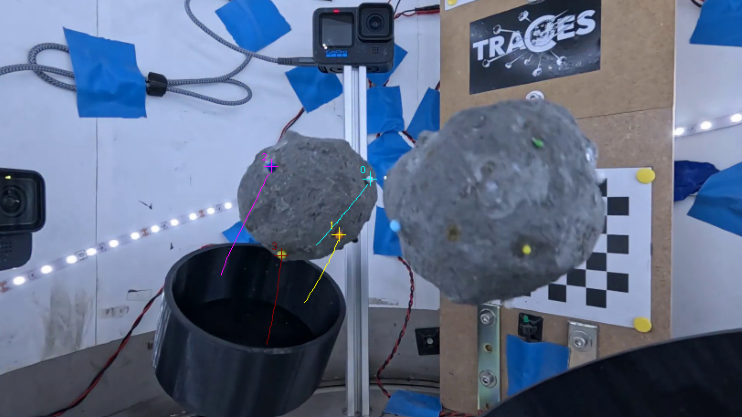
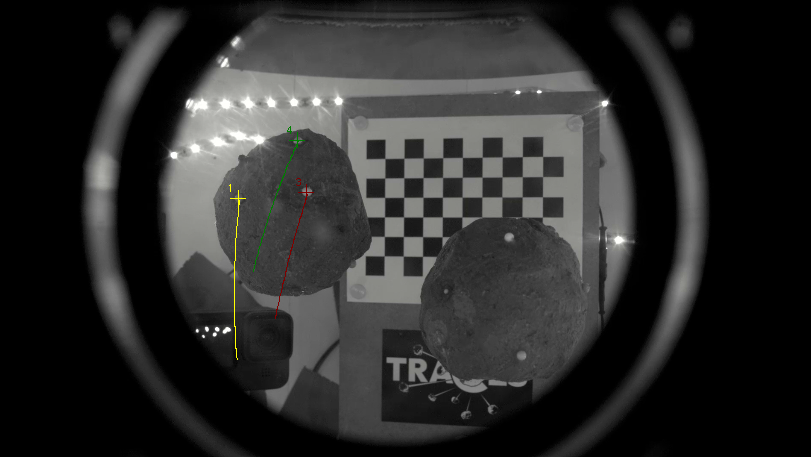
Figure 1-2: Tracked markers from GoPro before the contact and high-speed camera after the contact.
Numerical simulations
A batch least-squares filter was implemented to estimate the initial conditions (position, velocity, attitude, and angular velocity) of the two cobbles, using the 2D pixel coordinates of the tracked markers as measurements. These pre-contact initial conditions were then used as input for the numerical simulations.
A digital twin of the experiment was developed in GRAINS to validate the contact dynamics models and tune their contact parameters. The shape of the cobbles is modeled as a mesh in Chrono, with collision detection managed through the Bullet library.
Among the contact models implemented in Chrono, namely smooth and non-smooth contacts, the non-smooth contact model with compliance [3] was selected as the most suitable for replicating the collision experiment, since this hard-body method, enhanced with damping, is expected to better reproduce the experimental results. However, all contact models are compared with experimental data to evaluate their performance. Figure 3 shows snapshots from a simulation of a Drop Tower experiment.
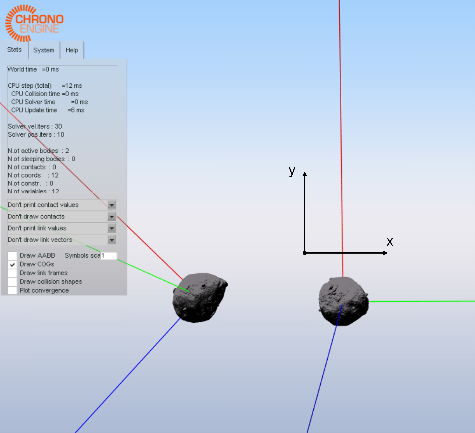
(a)Start: t=0s
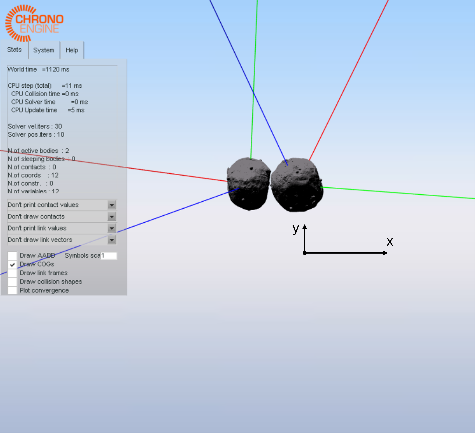
(b)Before contact: t=1.12s

(c)End: t=2.219s
Figure 3: Snapshots from a GRAINS simulation replicating an experiment conducted in the Drop Tower. The local reference frames of the cobbles are shown, with the global reference frame in black.
To accurately reproduce the post-collision trajectories observed in the experiments, the most relevant parameters to calibrate include the coefficient of friction, coefficient of restitution, compliance, and damping. A parameter estimation algorithm based on the Markov Chain Monte Carlo (MCMC) method has been developed for this purpose. The algorithm evaluates a likelihood function to assess how well the model reproduces the post-contact trajectories, based on the discrepancy between the predicted and observed 2D pixel coordinates of the markers. The MCMC framework provides parameter distributions, giving both estimates and associated uncertainties, offering valuable insights into the sensitivity of the contact dynamics model.
Conclusions
In conclusion, useful data on contact dynamics in asteroid environments were collected during the microgravity campaign. Collisions between different pairs of cobbles were successfully observed, and the trajectories were reconstructed with satisfactory accuracy. A digital twin of the experiment and a parameter estimation algorithm were developed to validate and calibrate the contact dynamics models in GRAINS against the experimental results. The outcomes of this validation campaign will contribute to improving the realism of local-scale interaction modeling, enhancing our ability to simulate the full-scale dynamics of rubble-pile asteroids and their response to external forces. A new experimental campaign is being designed, involving a parabolic flight with full granular media, along with a corresponding numerical analogue scenario in GRAINS replicating the new experiments.
Acknowledgments
This work is funded by the European Union (ERC, TRACES, 101077758). Views and opinions expressed are however those of the authors only and do not necessarily reflect those of the European Union or the European Research Council. Neither the European Union nor the granting authority can be held responsible for them.
References
[1] K. J. Walsh. Rubble pile asteroids. Annual Review of Astronomy and Astrophysics, 56(1):593-624, 2018.
[2] F. Ferrari, M. Lavagna, and E. Blazquez. A parallel-GPU code for asteroid aggregation problems with angular particles. Monthly Notices of the Royal Astronomical Society, 492(1):749-761, 2020.
[3] A. Tasora, et al. A compliant visco-plastic particle contact model based on differential variational inequalities. International Journal of Non-Linear Mechanics 53, 2-12, 2013.
How to cite: Cremasco, A., Vaghi, S., Delfanti, L. V., Fodde, I., San Sebastian, I. L., Civati, L. F., and Ferrari, F.: Validating and Calibrating Contact Dynamics for Rubble-Pile Asteroids through Microgravity Experiments, EPSC-DPS Joint Meeting 2025, Helsinki, Finland, 7–12 Sep 2025, EPSC-DPS2025-1576, https://doi.org/10.5194/epsc-dps2025-1576, 2025.


