
 1,2,1,3,5,
- 1University of Kent, School of Engineering, Maths, and Physics, Canterbury, United Kingdom of Great Britain – England, Scotland, Wales (jejf3@kent.ac.uk)
- 2University of Kent, School of Natural Sciences, Canterbury, Kent, CT2 7NH, United Kingdom
- 3ESTEC (ESA), Keplerlaan 1, Noordwijk, 2201AZ, Netherlands
- 4LRT/TU München, Boltzmannstr. 15, D-85748 Garching, Germany
- 5University of Leicester, School of Physics and Astronomy, University Road, LE1 7RH, United Kingdom
- 6Institute for Space, Space Park Leicester, 92 Corporation Road, LE4 5SP, United Kingdom
Background:
The morphology of impact craters has been used to study the surface and near-surface properties of many bodies throughout the Solar System. Comparative planetological methods have then furthered this to infer specific parameters regarding the sub-surface of planetary targets through comparison of morphological features across both Solar System bodies and to laboratory-scale craters [1,2]. Being ubiquitous throughout the outer Solar System, ice:silicate mixtures have received a high level of interest within laboratory-scale impact studies, with the primary focus being on ice-dominated mixtures (silicate content of <50 wt.%) thought to be present on comets and outer Solar System moons, e.g. [3,4].
The results of these experiments (along with a comparison to outer Solar System morphological features) have then been used to infer the properties of ice bearing bodies across the inner Solar System, in particular Ceres [5,6] and Mars [2,7,8]. Observations, however, have estimated the near-surface ice quantity for these bodies to be far below 50 wt.% [6], placing them well within the silicate-dominated range for ice:silicate mixtures rather than the ice-dominated regime studied by previous experiments. Consequently, this presents a potential source of error in the interpretation of Martian craters due to the misuse of applied assumptions to understand the morphology of craters. The work presented here aims to study the cratering process for silicate-dominated Martian simulant and kiln-dried sand mixtures, thereby better constraining the influence of ice on cratering processes in such inner Solar System targets.
Methodology:
Impacted targets were formed of ice:silicate mixtures containing either a 50 wt.% or 80 wt.% silicate content. Targets (Figure 1) were constructed from a mixture of crushed ice with either JSC Mars-1 Martian simulant (Figure 2) [9] or a typical commercial kiln-dried sand (KDS) (Figure 3) for 50 wt.% targets only. Constructed targets measured 20 cm in diameter and 9 cm in depth. Once frozen, targets were impacted by 1.5 mm spherical copper projectiles over the velocity range of 2-5 km/s using the light-gas gun at the University of Kent impact laboratory [10]. Following the impact, depth profiles of the crater were taken across each target in orthogonal directions allowing measurement of depth and diameter. Profiles across the crater additionally provided a means for morphological comparisons to be made between the silicate types (JSC Mars-1 and KDS) and ice quantities (50 wt.% and 80 wt.%).

Figure 1: Example pre-impact JSC Mars-1 target mounted to the Kent light-gas gun. The target diameter was 20 cm.
Results and Discussion:
Crater parameters (e.g. depth, diameter, etc.) were analysed versus the energy of the impactor, allowing comparisons to be made for varying projectile materials. The results show that variations in crater parameters were seen when altering both the quantity of ice and the type of silicate within the target. Analysis of the two silicate materials themselves shows that they possess highly different morphologies, with the JSC Mars-1 having much more irregular (in both size and shape) grains when compared to the KDS (Figures 2 and 3). This variation is thought to be the likely cause for the observed variation in crater diameter due to the induced changes in internal friction and responses to shock processing. A variation in crater depth was only seen, however, between targets of differing ice quantities. This indicates that the crater depth was somewhat influenced by the target properties, but that changes were less pronounced than for the crater diameter.

Figure 2: Optical microscopy image of the JSC Mars-1 simulant.

Figure 3: Optical microscopy image of the Kiln-dried sand.
Analysis of the interior crater morphology shows further differences between both silicate types and the ice quantity. Figure 4 compares craters morphologies for targets containing a different silicate type when impacted at various speeds. All targets contained the same 50:50 wt.% ice:silicate ratio. As the impact speed increases, variations in the morphology become substantially more pronounced. The same trend is seen when considering craters formed in targets of a differing silicate quantity.
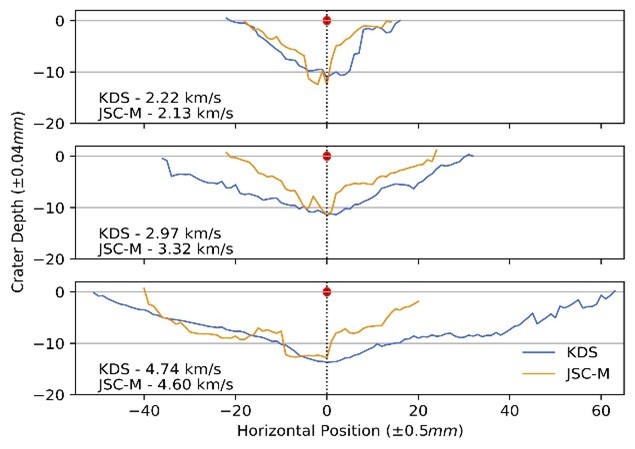
Figure 4: Comparisons at varying impact speeds between craters formed in JSC Mars-1 and standard sand targets containing a 50 wt.% quantity of silicate material.
Conclusions:
Overall, whilst past investigations have shown that crater parameters change with increasing silicate quantity within a target, the results of this investigation show that initial trends assumed from previous studies may not hold as the silicate quantity increases above the 50 wt.% limit. Hence, the continuing investigation of these processes is likely to further understanding of processes occurring on the Martian surface.
References:
[1] C.M. Ernst, et al., J. Geophys. Res. Planets 123, 2628 (2018).
[2] N.G. Barlow, et al., Meteorit. Planet. Sci. 52, 1371 (2017).
[3] D. Koschny, E. Grun, Icarus 154, 391 (2001).
[4] K. Hiraoka, et al., Adv. in Space Res. 39, 392 (2007)
[5] P. Schenk, et al., Icarus 320, 159 (2019).
[6] H.G. Sizemore, et al., J. Geophys. Res. Planets 124, 1650 (2019).
[7] G. de Villers, et al., Meteorit. Planet. Sci. 54, 947 (2010).
[8] P.J. Mouginis-Mark, Meteorit Planet. Sci. 50, 51 (2015).
[9] C.C. Allen, et al., EOS Trans. AGU 79, 405 (1998).
[10] R. Hibbert, et al., Procedia Enginering 204, 208 (2017).
How to cite: Finch, J. E., Wozniakiewicz, P., Tandy, J., Burchell, M., Sefton-Nash, E., Alesbrook, L., Koschny, D., Avdellidou, C., and Spathis, V.: Experimental ice:silicate craters and their application to Mars, EPSC-DPS Joint Meeting 2025, Helsinki, Finland, 7–12 Sep 2025, EPSC-DPS2025-1580, https://doi.org/10.5194/epsc-dps2025-1580, 2025.


