EPSC Abstracts
Vol. 18, EPSC-DPS2025-1586, 2025, updated on 09 Jul 2025
https://doi.org/10.5194/epsc-dps2025-1586
EPSC-DPS Joint Meeting 2025
© Author(s) 2025. This work is distributed under the Creative Commons Attribution 4.0 License.

The variation of galactic tides affecting the long-term dynamics of distant trans-Neptunian objects
 2,2,
2,2,- 1LTE, Observatoire de Paris, Université PSL, Sorbonne Université, Université de Lille, LNE, CNRS, 75014 Paris, France
- 2Université de Strasbourg, CNRS UMR 7550, Observatoire astronomique de Strasbourg, 67000 Strasbourg, France
- 3LIRA, Observatoire de Paris, PSL Research University, CNRS, 92195 Meudon, France
Abstract
The orbital dynamics of small Solar System bodies beyond Neptune are affected by the gravitational attraction of the Sun's galactic neighborhood [1,2]. This effect is stronger for the most distant small bodies in the Scattered Disc and Oort cloud, with semi-major axes of thousands of astronomical units. The Gaia mission reveals the structure of our Galaxy with an unprecedented level of details; it is therefore possible now to investigate the variety of trajectories that may have been followed by the Sun in the Galaxy, and how these trajectories have affected the dynamics of distant trans-Neptunian objects [3,4].
We focus on the effects of the galactic tides, which are caused by the difference between the gravitational attraction from the galactic medium exerted on the Sun and on distant small Solar System bodies. Locally, the potential of the galactic tides has the following form:
V(r) = (G1x2 + G2y2 + G3z2)/2 ,
where r = (x, y, z)T is the position vector of the small body with respect to the Sun in a rotating galactic frame, and G1, G2 and G3 are the parameters of the galactic tides. The so-called normal component about the z-axis, depending of G3, is usually the dominant one. It is directly related to the local mass density ρ0 of the Galaxy.
The parameters G1, G2 and G3 depend on the instantaneous position of the Sun in the Galaxy. Prior to Gaia, most studies considered very simplified models in which the Sun follows a circular orbit in the plane of an axi-symmetric galactic potential [5]. These rough approximations led to constant values for G1, G2 and G3. In a more realistic model of the Galaxy, the Sun follows a complex trajectory that depends on the galactic structure, including its bulge, halo, bar, and evolving spiral arms [6].
Khalil et al. (2024) [7] have recently used the Gaia data to adjust a new, state-of-the-art model of the Milky Way. Here, we investigate the variety of possible past trajectories of the Sun produced by this refined model, and disentangle the dynamical features produced by each component of the galactic potential. Along the Sun's trajectory, we compute the parameters G1, G2 and G3 of the galactic tides and the local mass density ρ0 of the Galaxy.
Figure~1 shows an example of trajectory produced by the core axi-symmetric component of the potential of Khalil et al. (2024)—it includes the galactic bulge, disks and halo. The local mass density ρ0 of the Galaxy varies by almost a factor two, which result in large variations of the external forcing felt by distant small Solar System bodies beyond Neptune.
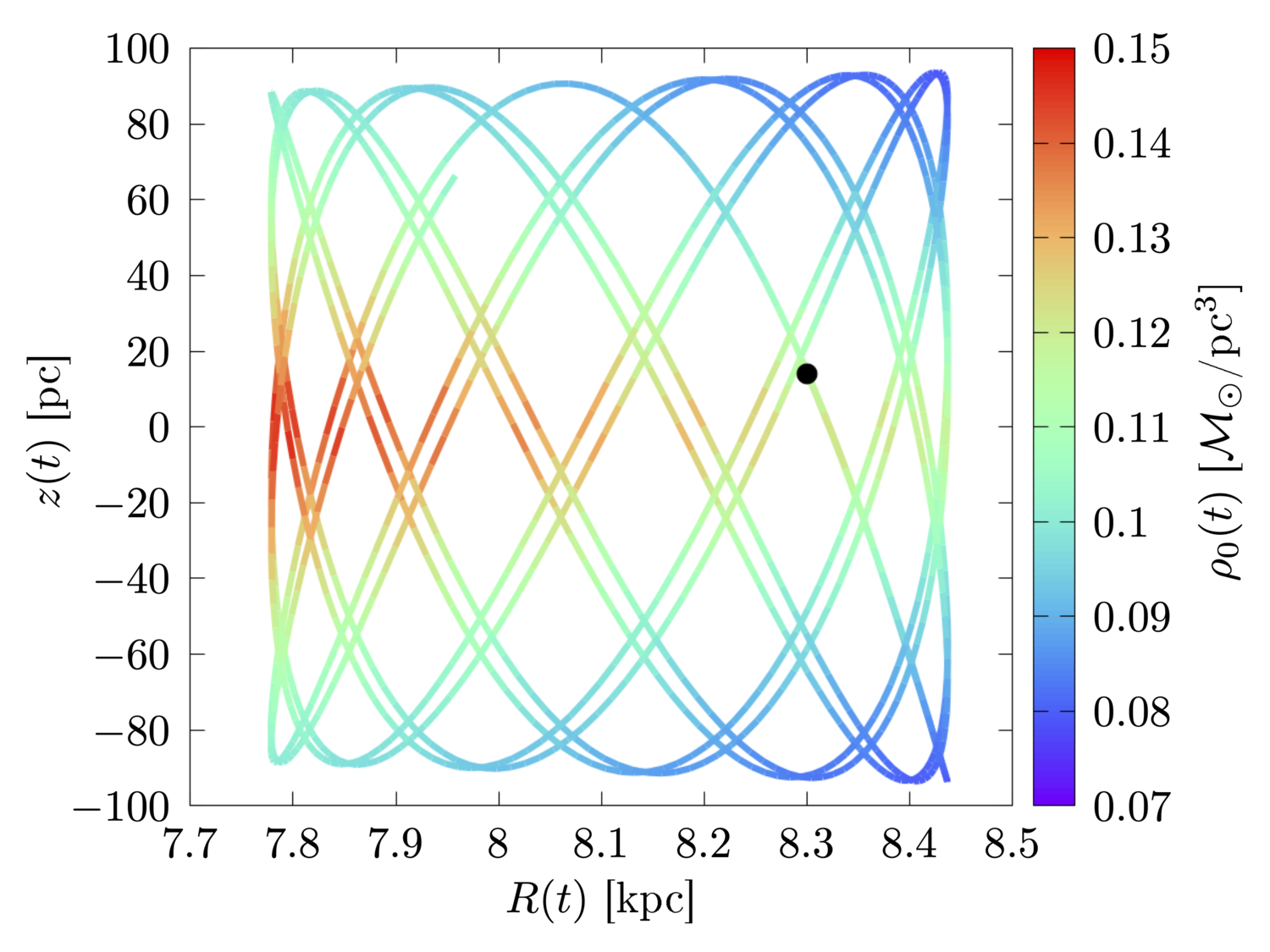
Figure~1: Evolution of the galactic mass density ρ0 in the (R, z) plane,
where R and z are the distance of the Sun with respect to the galactic
center and with respect to the galactic disc.
acknowledgement: This work was supported by the Programme de Planétologie (PNP) of CNRS/INSU, co-funded by CNES.
References
[1] H. Rickman, Ch. Froeschlé, Cl. Froeschlé, G.~B. Valsecchi, 2004, A&A 428, 673
[2] M. Saillenfest, M. Fouchard, T. Ito, A. Higuchi, 2019, A&A 629, A95
[3] N. Kaib, R. Roškar, T. Quinn, 2011, Icarus 215, 491
[4] C.~A. Martínez-Barbosa, L. Jílková, S. Portegies Zwart, A.~G.~A. Brown, 2016, MNRAS 464, 2290
[5] J. Heisler, S. Tremaine, 1986, Icarus 65, 13
[6] E. Gardner, P. Nurmi, C. Flynn, S. Mikkola, 2011, MNRAS 411, 947
[7] Y. R. Khalil, B. Famaey, G. Monari, M. Bernet, A. Siebert, R. Ibata, G. F. Thomas, P. Ramos, T. Antoja, C. Li, S. Rozier, M. Romero-Gómez, 2024, A&A, in press
How to cite: Bougakov, A., Khalil, Y. R., Fouchard, M., Saillenfest, M., Famaey, B., and Di Matteo, P.: The variation of galactic tides affecting the long-term dynamics of distant trans-Neptunian objects, EPSC-DPS Joint Meeting 2025, Helsinki, Finland, 7–12 Sep 2025, EPSC-DPS2025-1586, https://doi.org/10.5194/epsc-dps2025-1586, 2025.


