
 ,,
,,- Adam Mickiewicz University, Institute Astronomical Observatory, Faculty of Physics and Astronomy, Poznań, Poland (tkastr@vesta.astro.amu.edu.pl)
Introduction
Barbarian asteroids represent a unique group of objects that exhibit a broad negative branch in their polarization phase curves. They are named after (234) Barbara, the first asteroid for which such behaviour was observed [1], and are primarily classified within the L taxonomic class. Since magnitude–phase (mag–phase) curves are sensitive to the surface properties of asteroids, we aim to derive such relations for a number of Barbarian asteroids to determine whether they also display anomalous behaviour in this respect.
To date, we have presented results for (599) Luisa and (729) Watsonia [2], as well as for (234) Barbara, (236) Honoria, and (980) Anacostia [3]. These studies show that, except for Honoria, the other four objects occupy a distinct position on the G₁–G₂ plot, where G₁ and G₂ are the coefficients of the [H, G₁, G₂] phase function. At the upcoming conference, we will present results for (387) Aquitania, for which the observing campaign is still ongoing.
Observing Campaign
Previous observations of Barbarian asteroid lightcurves were conducted using multiple telescopes with different photometric systems. While the geographic distribution of these telescopes (at different longitudes) facilitated full rotation-phase coverage in the composite lightcurve, it also introduced systematic biases in the transformation of photometric data. To mitigate this issue, we conducted observations of Aquitania using a single instrument: our 0.7-m robotic telescope at Winer Observatory (Arizona), equipped with Johnson R and Pan-STARRS g, r, i, z filters.
This approach allows us to collect data in a consistent and well-defined photometric system. However, it has one drawback: the rotation period of Aquitania is 24.144 hours, requiring a long observational window to achieve full phase coverage. Consequently, the campaign is ongoing (planned through the end of May 2025), and we will present final results at the conference.
Colour Indices of Aquitania at Different Phase Angles
To derive the most accurate mag–phase curves, it is necessary to account for: (1) lightcurve amplitude effects (addressed by aligning partial lightcurves to a reference composite lightcurve), (2) aspect angle effects (corrected by normalizing average magnitudes to a 90° aspect), and (3) the dependence of mag–phase behaviour on wavelength (minimized by using a consistent photometric band). In our study, we account for point (1), but not for (2), as we compare our G₁ and G₂ parameters with those reported by Shevchenko et al. (2016) [4], who did not normalize their data to a 90° aspect.
However, Shevchenko et al. used Johnson V-band data, whereas our results are based on the Johnson R band. Therefore, we must consider potential biases introduced by the wavelength dependence (3).
Starting from Aquitania’s opposition in January 2025, we performed observations not only in the R band, but also in the Pan-STARRS g, r, and i bands (the V filter was unavailable). Our aim was to quantify the bias that may arise when comparing mag–phase curves obtained in different bands, and to derive a correction equation. Figures 1–3 show the relationship between the (g–R), (g–r), and (g–i) colour indices and solar phase angle. Red lines indicate the least-squares weighted linear fits. In all three cases, the Pearson correlation coefficient is statistically significant, confirming the validity of the linear relationship. Quadratic fits did not improve the results.
The slope parameters and their 1σ uncertainties are:
- g–r: slope = 0.0030 ± 0.0004
- g–R: slope = 0.0017 ± 0.0004
- g–i: slope = 0.0026 ± 0.0005
It is worth noting that the result for the g–R colour may be biased, as the asteroid magnitudes were calibrated using solar analogue stars from the Pan-STARRS catalogue. The R magnitudes of these stars were obtained via additional transformations. When considering only g–r (136 nm effective wavelength difference) and g–i (270 nm difference), the slope coefficients are nearly identical. In contrast, the slope for r–i (135 nm difference) is effectively zero (0.0002 ± 0.0006), suggesting that wavelength effects are more pronounced at shorter wavelengths. This is compatible with the overall trend that phase dependence gradually weakens with wavelength [5].
We will investigate how this wavelength dependence influences the G₁ and G₂ parameters of the mag–phase relations for Barbarian asteroids.
References
- [1] Cellino, A., et al. (2006) Icarus, 180, 565
- [2] Mykhailova, S, et al. (2023) ACM Conference, Flagstaff, Arizona. LPI Contribution No. 2851, 2023, id. 2202
- [3] Kwiatkowski, T., et al (2024) EPSC Abstracts Vol. 17, EPSC2024-858, 2024, https://doi.org/10.5194/epsc2024-858
- [4] Shevchenko, V. G., et al. (2016). Planetary and Space Science, 123, 101
- [5] Alvarez-Candal, A. et al. (2024) A&A 685, A29
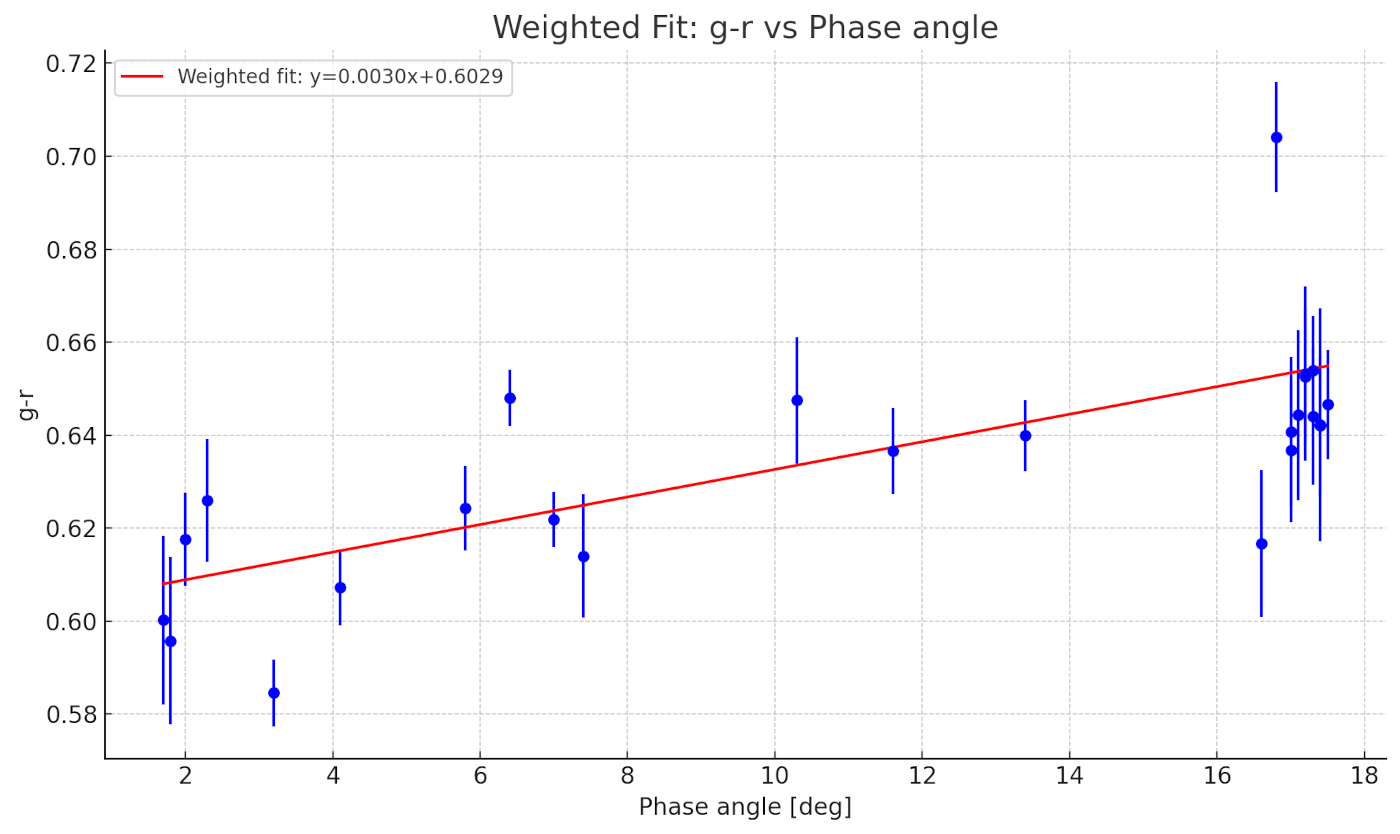
Fig. 1. Dependence of (g-r) on the phase angle.
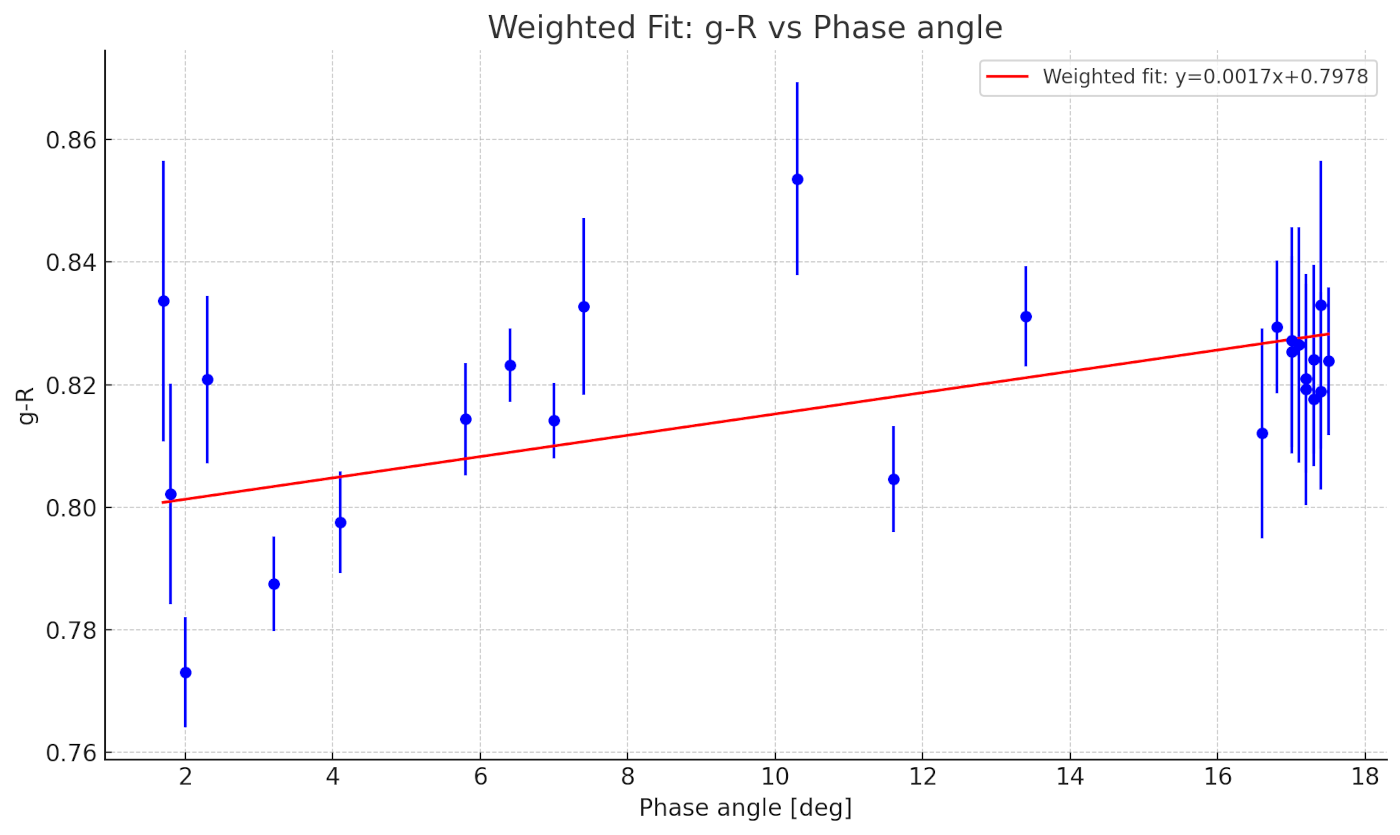
Fig. 2. Dependence of (g-R) on the phase angle.
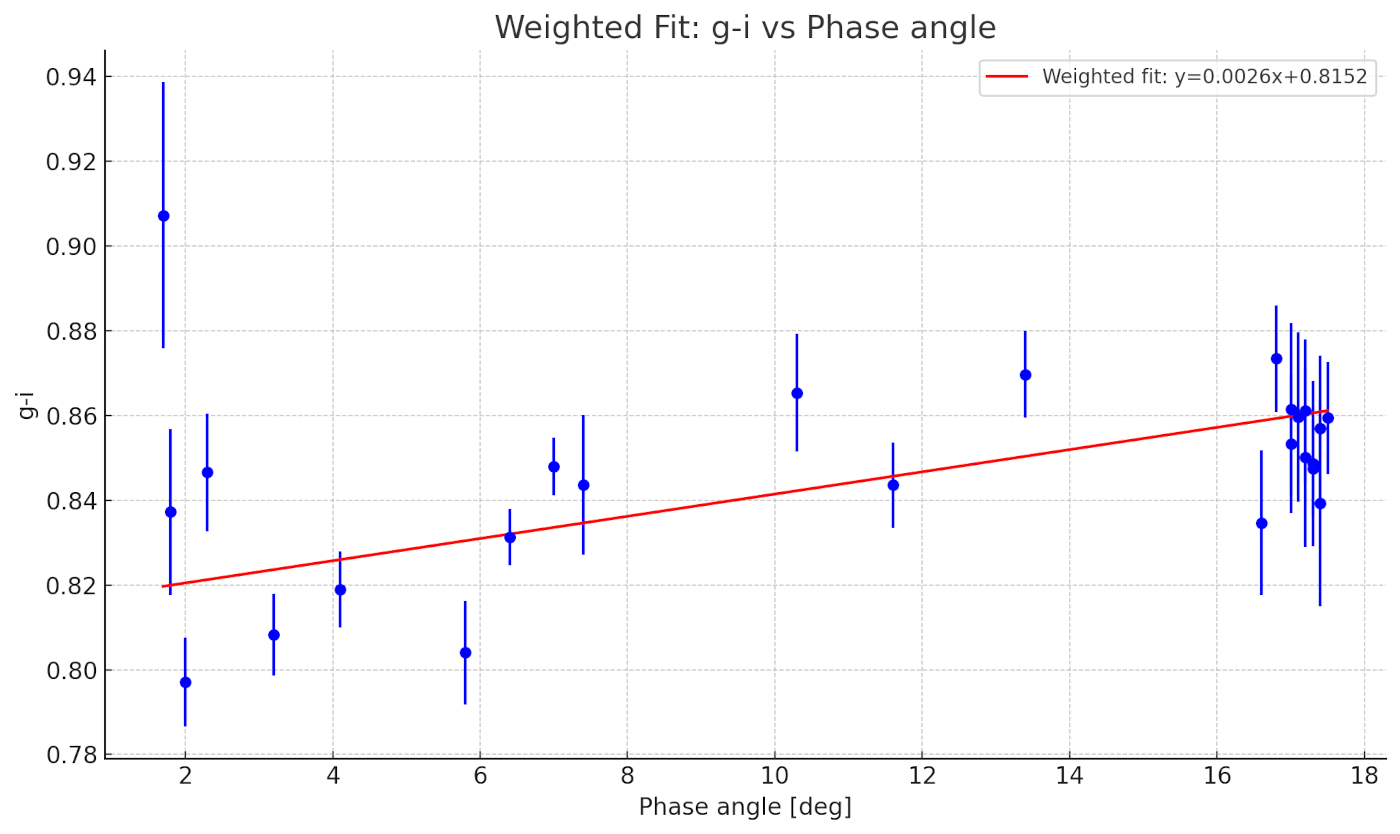
Fig. 3. Dependence of (g-i) on the phase angle.
How to cite: Kwiatkowski, T., Mykhailova, S., and Kamiński, K.: Magnitude–Phase Curves of the Barbarian Asteroids: The Case of (387) Aquitania, EPSC-DPS Joint Meeting 2025, Helsinki, Finland, 7–12 Sep 2025, EPSC-DPS2025-1596, https://doi.org/10.5194/epsc-dps2025-1596, 2025.


