
 1,3,4,1,7,
- 1Space Telescope Science Institute, Baltimore, United States of America
- 2Southwest Research Institute, Boulder, United States of America
- 3Université Paris-Saclay, CNRS, Institut d’Astrophysique Spatiale, Orsay, France
- 4Florida Space Institute, University of Central Florida, Orlando, United States of America
- 5Johns Hopkins University Applied Physics Laboratory, Laurel, United States of America
- 6Planetary Science Institute, Tucson, United States of America
- 7Northern Arizona University, Flagstaff, United States of America
- 8INAF–Osservatorio Astronomico di Roma, Rome, Italy
- 9Instituto de Ciencias y Tecnologías Espaciales de Asturias, Universidad de Oviedo, Oviedo, Spain
Introduction. Trans-Neptunian objects (TNOs) record the history of planetary migration in their orbital architecture and the chemical diversity of the outer solar system in their largely unaltered surface compositions. Through the large Cycle 1 DiSCo program, Pinilla-Alonso et al. (2025) revealed 3 broad spectral types among TNOs with diameters <900 km, and suggested that those groups of objects formed at different heliocentric distances before being placed onto their current orbits via interactions with Neptune. But the origins of one particular population, the extreme trans-Neptunian objects (ETNOs), remains uncertain. The ETNOs are a subset of the detached TNO population with perihelia > 30 au and semi-major axes > 150 au (e.g., Trujillo & Sheppard 2014). Migration of Neptune is unable to explain the placement of the ETNOs on their current orbits, leading to more exotic theories to explain their existence, including: a larger eccentricity for Neptune in the past (Gladman et al. 2002), capture from or disruption of the primordial Kuiper belt by a passing star (Ida et al. 2000; Morbidelli & Levison 2004; Brasser & Schwamb 2015), perihelion lifting due to galactic tides (Gomes et al. 2005; Adams 2010; Kaib et al. 2011), orbital disruption due to a rogue planet (Gladman & Chan 2006; Huang et al. 2022), or the ongoing influence of an unidentified giant planet (Batygin & Brown 2016). These theories are extremely varied, so any new information about these objects should help to constrain their origins.
Observations. To contribute to our understanding of the ETNOs, we obtained near-infrared spectra of 6 ETNOs with the NIRSpec IFU on the James Webb Space Telescope (JWST) as part of program 4665 (PI: Holler). We obtained low resolving power (R~100) spectra from 0.6-5.2 μm using the Prism setting. The data were calibrated using the JWST calibration pipeline, ultimately producing 3D spectral data cubes, and 1D spectra were extracted and corrected using the “template PSF” technique described in, e.g., Wong et al. (2024) and Pinilla-Alonso et al. (2025).
The ETNOs observed in this program include (474640) Alicanto (2004 VN112), 2012 VP113, (765047) 2013 RA109, (765133) 2013 SL102, (543735) 2014 OS394, and (771740) 2016 QV89. Of note, 2012 VP113 is a “sednoid” with the largest known perihelion distance in the solar system at ~80 au. In preparation for the JWST observations and blind-pointing of the targets into the small IFU field of view, we obtained new astrometry of the targets with Gemini GMOS-N, resulting in numbers being assigned to 2013 RA109, 2013 SL102, and 2016 QV89.
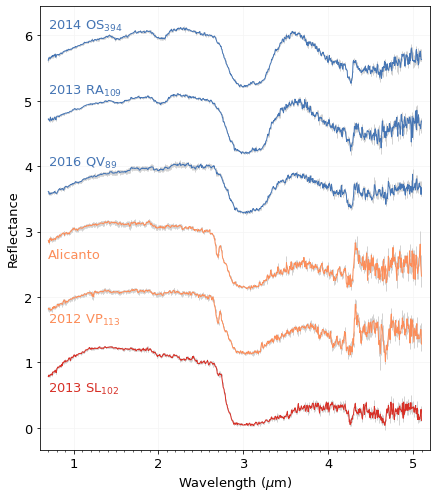
Discussion. The spectra of the 6 targets are presented in the figure. At quick glance, we see 3 of the 6 ETNOs are of the “bowl” spectral type (blue), with signatures of water ice visible in the spectrum; two ETNOs are “double-dips” (orange) with very strong CO2 absorption features and reflection peaks around the 4.26-μm CO2 fundamental indicative of small grains (e.g., Brown & Fraser 2023; de Prá et al., 2025); and one ETNO is a “cliff” (red) with strong absorptions due to organics at longer wavelengths, similar to cold classical KBOs. The spectral diversity of the ENTOs is comparable to that seen in other “stirred” populations of TNOs, including resonant TNOs, hot classicals, and scattering disk objects (Pinilla-Alonso et al. 2025).
In this presentation we will also compare the ETNOs to Sedna, the largest of the ETNOs, and Quaoar (Emery et al. 2024); determine the nearest spectral matches to the ETNOs using a principle component analysis (PCA); discuss ETNO spectral diversity in the context of the detached TNO population, which were all observed to be double-dips in the DiSCo program (Pinilla-Alonso et al. 2025); and evaluate trends in the state of H2O ice (i.e., amorphous vs. crystalline) across the larger population of TNO bowls. In light of this information, we re-evaluate which of the origin theories remain viable and which no longer appear to be favored.
Acknowledgements. This work is based on observations made with the NASA/ESA/CSA James Webb Space Telescope. The data were obtained from the Mikulski Archive for Space Telescopes at the Space Telescope Science Institute, which is operated by the Association of Universities for Research in Astronomy, Inc., under NASA contract NAS 5-03127 for JWST. These observations are associated with programs #4665 & #2418. Based on observations obtained through program GN-2024B-Q-134 at the international Gemini Observatory, a program of NSF NOIRLab, which is managed by the Association of Universities for Research in Astronomy (AURA) under a cooperative agreement with the U.S. National Science Foundation on behalf of the Gemini Observatory partnership.
References
Adams, F. C. (2010). ARAA 48, 47-85.
Batygin, K., Brown, M. E. (2016). AJ 151, 22.
Brasser, R., Schwamb, M. E. (2015). MNRAS 446, 3788-3796.
Brown, M. E., Fraser, W. C. (2023). PSJ 4, 130.
de Prá, M. N., et al. (2025). Nat. Astro. 9, 252-261.
Emery, J. P., et al. (2024). Icarus 414, 116017.
Gladman, B., et al. (2002). Icarus 157, 269-279.
Gladman, B., Chan, C. (2006). ApJ 643, L135-L138.
Gomes, R. S., et al. (2005). CMDA 91, 109-129.
Huang, Y., et al. (2022). ApJL 938, L23.
Ida, S., et al. (2000). ApJ 528, 351-356.
Kaib, N. A., et al. (2011). Icarus 215, 491-507.
Morbidelli, A., Levison, H. F., (2004). AJ 128, 2564-2576.
Pinilla-Alonso, N., et al. (2025). Nat. Astro. 9, 230-244.
Trujillo, C. A., Sheppard, S. S. (2014). Nature 507, 471-474.
Wong, I., et al. (2024). PSJ 5, 87.
How to cite: Holler, B., Young, L., Brunetto, R., de Souza Feliciano, A. C., Wong, I., Protopapa, S., Cartwright, R., Benecchi, S., Emery, J., Ieva, S., Pinilla-Alonso, N., and Stansberry, J.: Compositional diversity within the extreme trans-Neptunian object (ETNO) population, EPSC-DPS Joint Meeting 2025, Helsinki, Finland, 7–12 Sep 2025, EPSC-DPS2025-16, https://doi.org/10.5194/epsc-dps2025-16, 2025.


