
 ,,
,,- Armagh Observatory & Planetarium, Armagh, United Kingdom of Great Britain – Northern Ireland (alexander.sivitilli@armagh.ac.uk)
Asteroid families are groups of small bodies originating from a common progenitor asteroid that fragmented through collisional, tidal or rotational disruptions. Identifying these groups holds the benefit of furthering our understanding of the solar system’s dynamical and compositional evolution. Traditional ways to classify these families through the Hierarchal Clustering Method (HCM) [1] in proper orbital parameter space have a unique sensitivity to added data points. This is due to the increased possibility of chaining effects [2] that merge families without shared collisional histories into single ones, especially in the cases of complex or overlapping distributions. This sensitivity trade-off results in so-called 'halo' asteroids being excluded from core family membership.
The upcoming Vera C. Rubin Observatory’s Legacy Survey of Space and Time (LSST) is expected to detect more than 5 million new asteroids[GU1] [3]. Entering this era of Big Data for asteroids means an increasing likelihood of chaining effects. Introducing additional parameters, such as magnitude and albedo, can add new constraints to avoid this. Artificial Neural Networks (ANNs) offer a promising approach to identifying families [4] by enabling such constraints. Training models on both real and synthetic data transforms large volumes into an asset rather than a limitation.
As these ANNs are only recently being developed, we must consider methods of confirming their family classifications, both in the realm of synthetic training data and for real results. Such methods require dedicated tools to render large, sparse datasets while also enabling productive interaction with them. A robust human interface for both data and results is thus needed that can handle multiparameter data.
The immersive Data Visualisation Interactive Explorer (iDaVIE) [5] software suite is an open-source, Unity-based virtual reality (VR) tool developed alongside the H I astronomy community for quality control of automated source finding of galaxies in SKA pathfinder projects. With iDaVIE, researchers in the field have successfully used VR both to identify real H I emission that was missed and to remove spurious detections [6-8]. Although iDaVIE’s primary scientific use has been through its tools for volumetric data analysis, its secondary particle rendering and interaction capabilities have remained underutilised. Asteroid family classification with ANNs presents a well-suited application for this flavour of iDaVIE.
In this contribution, we present early results on integrating iDaVIE to assist with ANN model development, particularly in the verification of asteroid family classification and the labelling of training data. The VR environment enables researchers to explore and validate families, whether derived from traditional techniques or modern synthetic methods. We have enhanced iDaVIE’s particle rendering capabilities and interactive tools to support this application, allowing users to inspect model classification results in an immersive 3D space. New features, such as a basic GUI interface, conditional subsets, navigation aids, and fine-tuning adjustments for rendering parameters, are described in how they were implemented and used. Many of these were either adapted from the volumetric context or developed from scratch based on our specific use cases.
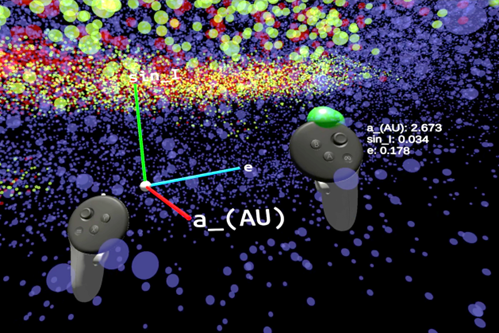
Figure 1 Using iDaVIE to investigate main belt family halos in proper orbital parameter space with data from the Asteroid Family Portal [9]
We also review these use-cases, specifically how we verified results from an ANN model developed to classify asteroid halo members of the (163) Erigone family. Here we took the output probabilities of family membership and compared it to previous study results that relied on the HCM. By mapping proper orbital and physical properties to various spatial and rendering parameters in the 3D virtual space (see Figure 1), we were able to identify which halo asteroids were classified appropriately. The new interaction tools allowed us to isolate these asteroids and iteratively adjust parameters to refine and confirm results.
Our contribution demonstrates how immersive data visualisation can play a key role in advancing both methodological development and scientific discovery in planetary science, particularly when working alongside Artificial Intelligence. This also serves to open up the discussion to the broader planetary science community of how such interactive tools can be introduced to modern research workflows. A critical next step is collecting input on new features and tools that could support other applications, particularly with aiding in the development of machine learning models.
Acknowledgements:
Astronomical research at the Armagh Observatory & Planetarium is grant-aided by the Northern Ireland Department for Communities (DfC). Work by the authors was supported by the Leverhulme Trust. The visualisation work was supported by the iDaVIE development team hosted at the Inter-University Institute of Data Intensive Astronomy.
Bibliography:
- Zappala, V., et al., Asteroid Families. I. Identification by Hierarchical Clustering and Reliability Assessment. The Astronomical Journal, 1990. 100: p. 2030.
- Nesvorný, D., M. Brož, and V. Carruba, Identification and Dynamical Properties of Asteroid Families, in Asteroids IV, P. Michel, F.E. DeMeo, and W.F. Bottke, Editors. 2015. p. 297-321.
- Abell, P.A., et al., Lsst science book, version 2.0. 2009.
- Carruba, V., et al., Machine learning classification of new asteroid families members. Monthly Notices of the Royal Astronomical Society, 2020. 496(1): p. 540-549.
- Jarrett, T., et al., iDaVIE: Immersive Data Visualisation Interactive Explorer, in Zenodo Software. 2024, Zenodo: Zenodo. p. 4614115.
- Deg, N., et al., WALLABY pilot survey: the potential polar ring galaxies NGC 4632 and NGC 6156. Monthly Notices of the Royal Astronomical Society, 2023. 525: p. 4663-4684.
- Glowacki, M., et al., A serendipitous discovery of H I-rich galaxy groups with MeerKAT. Monthly Notices of the Royal Astronomical Society, 2024. 529: p. 3469-3483.
- Kleiner, D., et al., A MeerKAT view of pre-processing in the Fornax A group. Astronomy and Astrophysics, 2021. 648: p. A32.
- Novaković, B., et al., Asteroid families: properties, recent advances, and future opportunities. Celestial Mechanics and Dynamical Astronomy, 2022. 134(4): p. 34.
How to cite: Sivitilli, A., Marshall-Lee, A., and Christou, A.: Supporting Machine Learning-Based Asteroid Family Classification with Immersive Visualisation, EPSC-DPS Joint Meeting 2025, Helsinki, Finland, 7–12 Sep 2025, EPSC-DPS2025-1601, https://doi.org/10.5194/epsc-dps2025-1601, 2025.


