
 1,
1,- 1INAF OATS, Trieste, Italy
- 2Politecnico di Milano, Milano, Italy
INTRODUCTION
In November 2021, NASA launched the first planetary defense mission against asteroids with the Double Asteroid Redirection Test (DART) [1]. Nearly a year later, the Light Italian Cubesat for Imaging of Asteroids (LICIACube) [2] captured the kinetic impact between the DART spacecraft and the small celestial body Dimorphos, revealing a prominent plume of dust that was also observed by ground-based telescopes.
ESA’s Hera spacecraft launched in October 2024 and is currently traveling toward the Didymos–Dimorphos binary system to study the post-impact environment.
Before Hera's arrival, we aim to estimate what it will observe and to better understand the plume features recorded by LICIACube.
MODEL
A subset of 1000 dust particles was extracted from a dataset comprising 100000 particles, initially distributed in position, velocity, and geometric size, with diameters ranging from 10E-5 m to 1 m. The selection was performed by randomly sampling 200 particles within each order of magnitude of diameter.
We ran the LICIACube Model for Aspherical Rotating Dust Ejecta (LIMARDE) [3] while varying the particles’ shapes (oblate, prolate, spherical), both with and without vapor plume effects.
We conducted an analysis of fragmentation by splitting each particle into two fragments after the first 10 seconds of simulation in the presence of a vapor plume. In particular, the mass of each particle was redistributed while ensuring the momentum conservation. Figure 1 shows the behavior of the function that relates the normalized velocity of the heavier fragment to a coefficient c, which defines how much faster the lighter fragment is compared to the heavier one. Subsequently, we selected c values of 2, 10, and 50, which corresponded to velocity variations of approximately 20%, 30%, and 10% of the initial velocity, depending on the mass redistribution.
We studied pairs of particles with the following percentages of the initial mass: 10–90%, 20–80%, 30–70%, and 40–60%. Figure 2 presents an example of how the particle cone varies depending on the coefficient c, for a fragmentation scenario with a 10%-90% mass redistribution.
Finally, we carried out a numerical analysis to determine how many and which particles remain gravitationally bound to the system, how much mass escapes, and the corresponding percentages relative to the total.
RESULT
The results of simulations indicate that the presence of a vapor plume is essential to reproduce the observed morphology of the dust cone. We found that the geometry of the cone is influenced not only by particle shape but also by the occurrence and degree of fragmentation. Furthermore, the way particles fragment imposes constraints on the spatial distribution of the ejecta. Remarkably, prolate-like particles tend to remain more frequently bound to the binary system than other shapes, meanwhile oblate-like particles are more likely to produce streamers.
These insights will help interpret Hera’s future observations and refine our understanding of impact-driven ejecta processes.
REFERENCE
[1] Andrew S. Rivkin and Andrew F. Cheng, “Planetary defense with the Double Asteroid Redirection Test (DART) mission and prospects,” Nature Communications, vol. 14, pp. 1003, Mar. 2023.
[2] E. Dotto et al, z, “LICIACube - The Light Italian Cubesat for Imaging of Asteroids In support of the NASA DART mission towards asteroid (65803) Didymos,” , vol. 199, pp. 105185, May 2021.
[3] Eugene G. Fahnestock et al, “Pre-encounter Predictions of DART Impact Ejecta Behavior and Observability,” , vol. 3, no. 9, pp. 206, Sept. 2022.
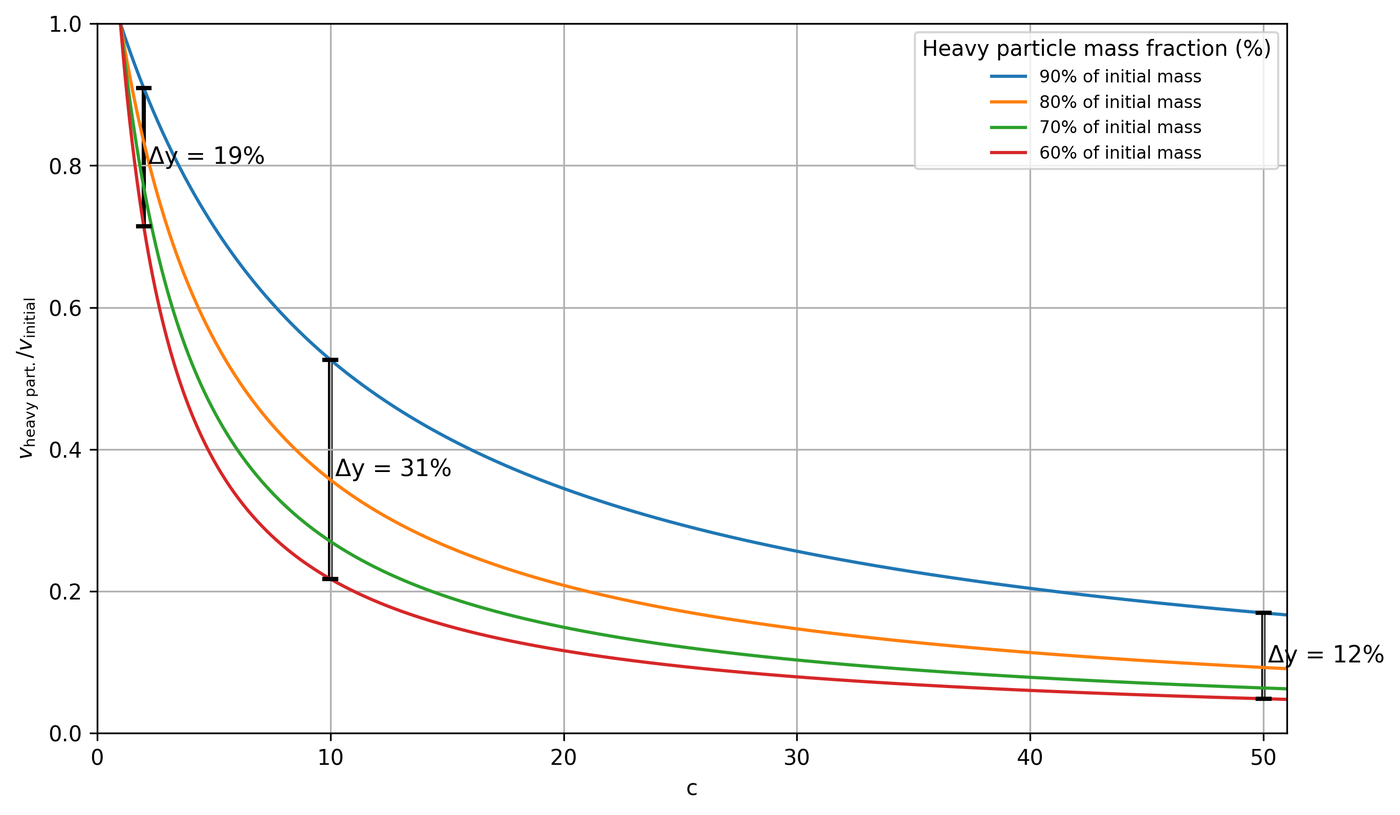
Figure 1: The plot shows the behavior, following particle fragmentation, of the relationship between the velocity ratio of the heavier fragment particle to the initial velocity of the parent particle, and the parameter c, which defines how much faster the lighter fragment particle is compared to the heavier one.
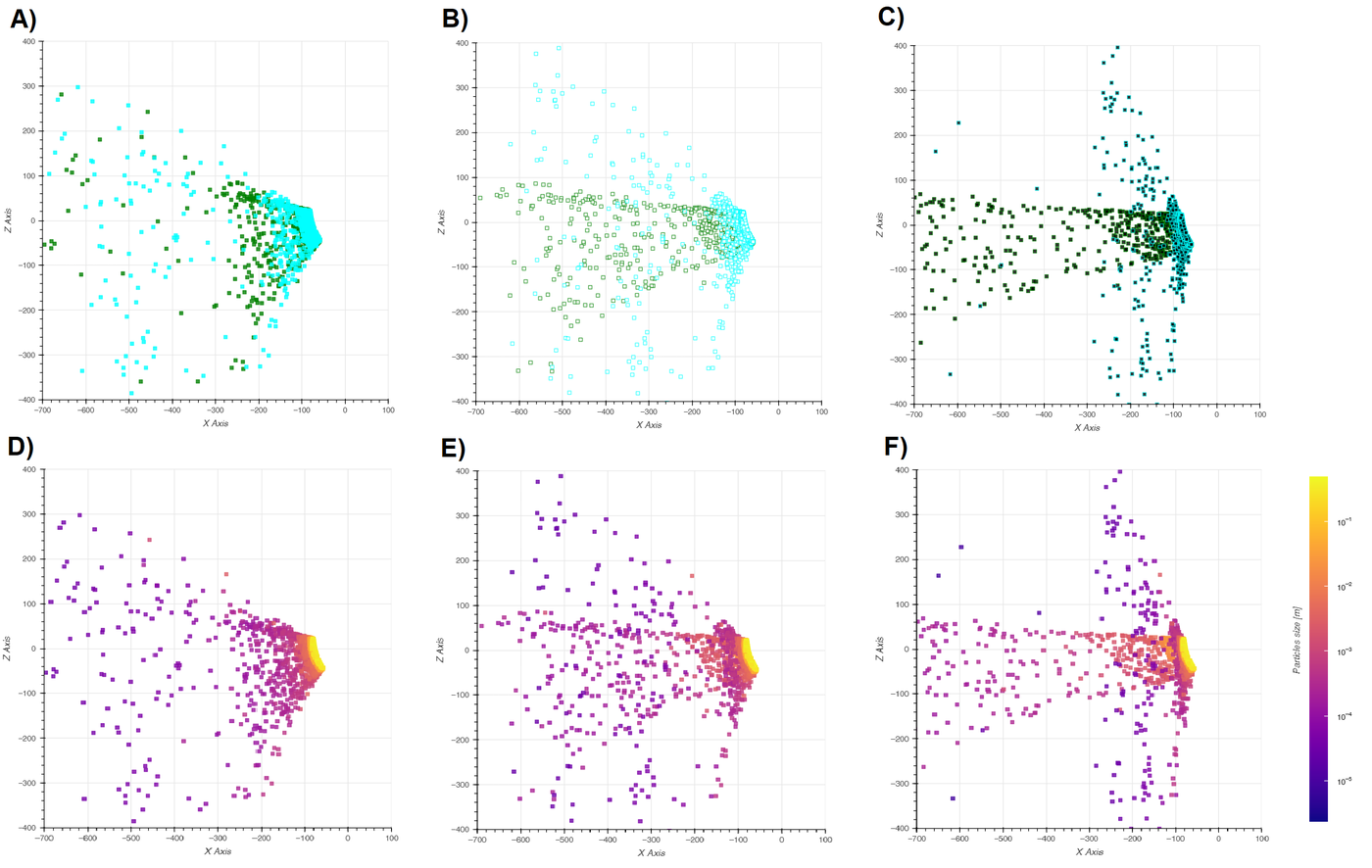
Figure 2: The plot shows the simulation at the 120th second in the case where 1000 oblate particles fragment into two sub-particles with masses equal to 10% (green particles) and 90% (light blue particles) of the original mass. Panels A and D represent the case where the lighter particles have a velocity equal to 2 times (c = 2) that of the heavier ones along the main direction of propagation. Panels B and E correspond to the case where c = 10, and panels C and F to the case where c = 50. While panels A, B, and C highlight the different behavior of the particles due to fragmentation, panels D, E, and F show the dust plume as a function of particle size.
How to cite: Calderone, L., Ivanovski, S., and Zanotti, G.: Deposited dust after the DART impact: Predictions for the HERA mission using LIMARDE simulations, EPSC-DPS Joint Meeting 2025, Helsinki, Finland, 7–12 Sep 2025, EPSC-DPS2025-1636, https://doi.org/10.5194/epsc-dps2025-1636, 2025.


