
 1,2,5,6,3,3,10,
- 1Planetary Science Institute, Tucson, Arizona, United States of America (carly.howett@physics.ox.ac.uk)
- 2University of Oxford, Parks Road, Oxford, OX1 3PU, UK
- 3NASA GSFC, Code 693, Greenbelt, MD, USA
- 4Southwest Research Institute, 1301 Walnut St Suite 400, Boulder, CO 80302, USA
- 5Northern Arizona University, 900 S Knoles Dr, Flagstaff AZ 86011, USA
- 6University of Maryland, 296 Stadium Dr., College Park, MD 20742, USA
- 7American University, 4400 Massachusetts Avenue, NW, Washington, DC 2001, USA
- 8BigHeadEndian LLC, Burden, KS, USA
- 9Lowell Observatory, 1400 W. Mars Hill Rd., Flagstaff AZ 86001, USA
- 10Massachusetts Institute of Technology, Cambridge, MA, USA
Introduction: On the 20th of April 2025, NASA’s Lucy mission [1] flew by the C-type main-belt asteroid (52246) Donaldjohanson (hereafter DJ). The encounter’s goal was to test the spacecraft and instruments during an observation sequence commensurate with those to be used on Lucy’s main targets – Jupiter’s Trojan asteroids. Data returned from the panchromatic Lucy LOng Range Reconnaissance Imager (L’LORRI, 450-850 nm, [2]) during this testing sequence reveal the asteroid to be bi-lobed and elongated shape (Fig. 1).
DJ is a member of the Erigone collisional family, named after the parent body asteroid (163) Erigone (see references in [3]). Ground-based color observations (Fig. 2) show it to decrease in color towards shorter wavelengths, possibly due to the presence of hydrated materials [4].
In this work, we present an analysis of color images taken by Lucy’s Multispectral Visible Imaging Camera (MVIC). MVIC consists of six time delay integration (TDI) charge-coupled devices (CCDs). TDI works by synchronizing the transfer rate of the image between CCD rows and the relative motion of the instrument allowing a high signal to noise image to be built up even for fast scans. It covers wavelengths between 375 nm and 950 nm using five color filters and a panchromatic one (see Table 1).
Color Analysis: We focus our analysis on images acquired with the four wide band filters: violet, green, orange and near-IR. Our results will provide resolved color variations and contextualise DJ’s color with respect to ground-based observations of DJ, Erigone (Fig. 2), other members of the Erigone family, and the broader asteroid and small body populations.
| Filter | Wavelength |
|
Violet |
375-480 |
|
Green |
480-520 |
|
Orange |
520-625 |
|
Phyllosilicate |
625-750 |
|
Near-IR |
750-950 |
|
Panchromatic |
350-950 |
Table 1 – MVIC filters [5]
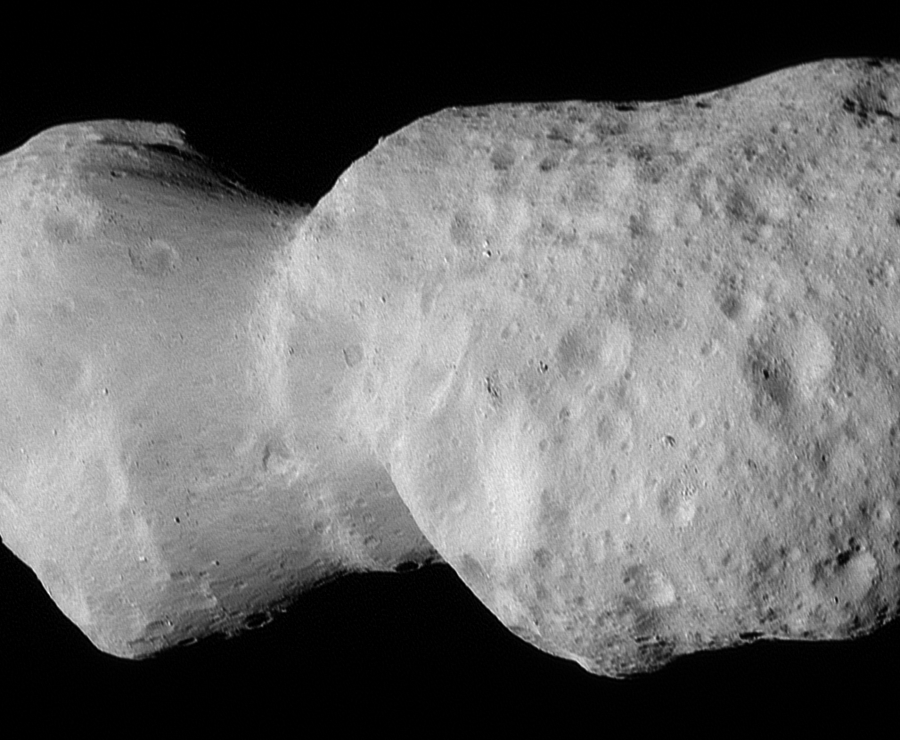
Figure 1 – (52246) Donaldjohanson as seen by the panchromatic Lucy L’LORRI instrument, taken on April 20, 2025 at 17:51 UTC.
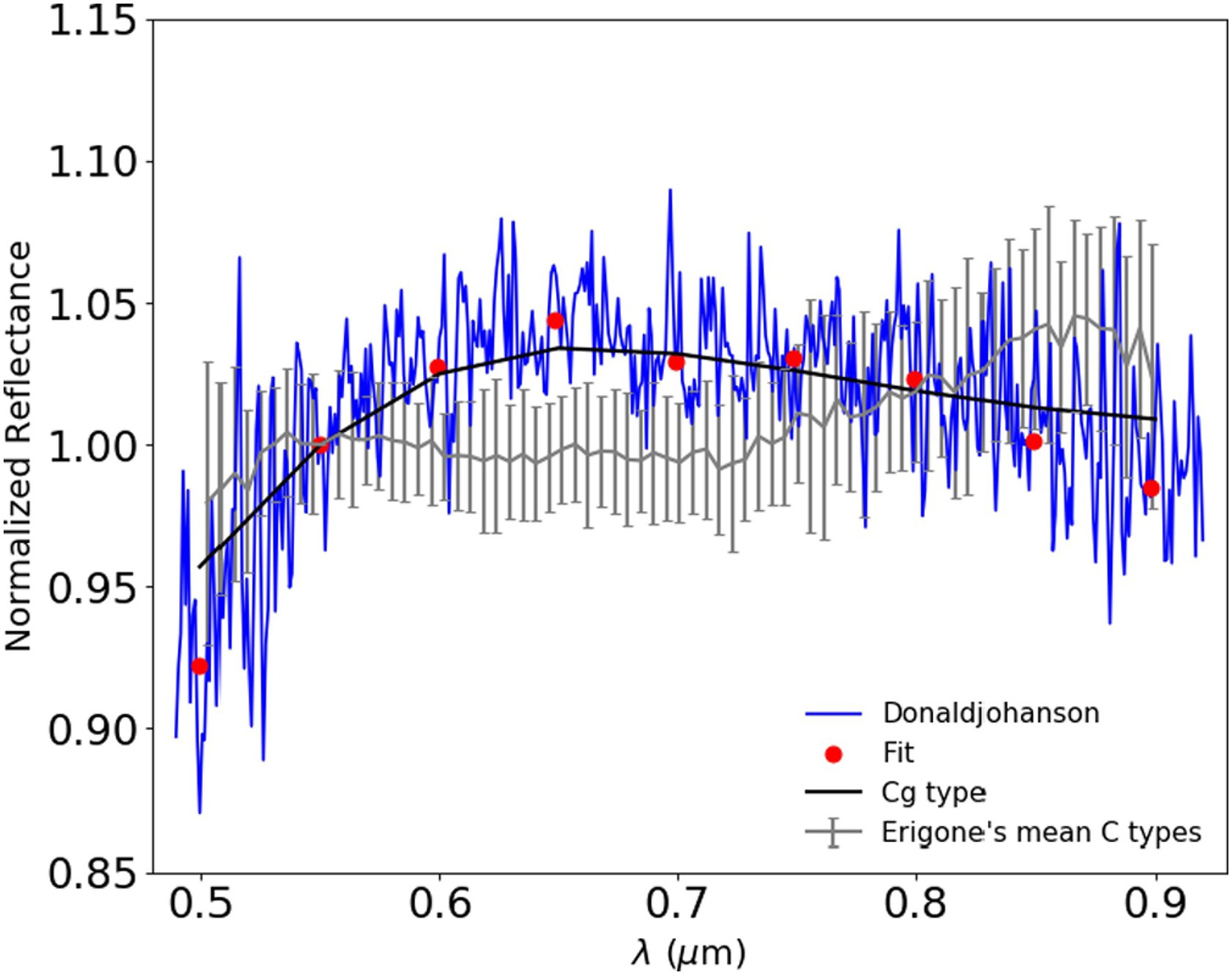
Figure 2 – Ground-based normalized (at 0.55 µm) visible spectrum of DJ (blue) acquired with the Gran Telescopio Canarias compared to the Bus-DeMeo’s Cg-type (black) and the mean spectrum of the C-type members within the Erigone family (grey). Taken from [6].
Acknowledgments: The Lucy mission is funded through the NASA Discovery program on contract No. NNM16AA08C.
References: [1] Levison et al. (2021) PSJ 2, 171. [2] Weaver et al. (2023), SSR 219, 82. [3] Marchi et al., (2025) PSJ 6, 59. [4] Vilas (1995) Icarus 115, 217-218. [5] Reuter et al. (2023), SSR 219, 69. [6] Souza-Feliciano et al. (2020), Icarus 338, 113463.
How to cite: Howett, C., Kaplan, H., Protopapa, S., Emery, J., Sunshine, J., Simon, A., Lunsford, A., Weigle, G., Grundy, W., Solanki, I., Marchi, S., Levison, H., Noll, K., Spencer, J., Binzel, R., and Team, L.: Resolved Color of Main-Belt Asteroid (52246) Donaldjohanson as seen by NASA’s Lucy Mission, EPSC-DPS Joint Meeting 2025, Helsinki, Finland, 7–12 Sep 2025, EPSC-DPS2025-164, https://doi.org/10.5194/epsc-dps2025-164, 2025.


