
 1,1,1,3,
- 1University of Liege, Space sciences, Technologies and Astrophysics Research (STAR), Belgium (mathieu.vanderdonckt@uliege.be)
- 2Aix Marseille Univ, CNRS, CNES, LAM, Marseille, France
- 3Cadi Ayyad University (UCA), Oukaimeden Observatory (OUCA), Faculté des Sciences Semlalia (FSSM), High Energy Physics, Astrophysics and Geoscience Laboratory (LPHEAG), Marrakech, Morocco
- 4Physical Research Laboratory, Navarangpura, Ahmedabad, 380058, Gujarat, India
We present photometric and spectroscopic observations of comet 12P/Pons-Brooks (hereafter 12P) during its 2024 passage. 12P is a 71 years period comet on a Halley-type orbit discovered by J.L. Pons in 1812 and rediscovered during its following passage by W.R. Brooks in 1883 [1,2]. As during previous passages, the comet showed during its recent approach several impressive outbursts [3], with up to 4 units of magnitude increase. Peculiarly, those outbursts occurred at heliocentric distances between 4 and 2.5 au, excluding the sublimation of water ice as the main source of this activity. A recent study looking in more details at the mass and energy releases by the outbursts pointed towards the crystallization of amorphous water ice as a likely mechanism [4].
Our photometric survey contains over 130 nights of observation with the TRAPPIST-North and -South telescopes [5] from May 6, 2023 (rh = 4.62 au, inbound), to September 7, 2024 (rh = 2.06 au, outbound). We collected images with broad-band Johnson–Cousins filters (BVRI) as well as narrow-band HB filters [6] (OH, CN, C2, C3 and NH for gas species and RC, GC and BC for the dust continuum) to compute the comet's gas activity, using the Haser model [7], and dust activity, using the proxy A(0)fρ [8].
From the lightcurve we detect more than 10 outbursts, accompanied with gas and dust activity increases; OH production rate reaching values as high as 1029 molecules/s and A(0)fρ as high as 105 cm. Individual dust images show the formation of a horn-shaped coma and the expansion of a dust shell the days following the strongest outbursts (see Fig. 1). Since we had images for several days after outbursts, the dust shell velocity could be measured. Observations with narrow-band filters allowed the study of the gas and dust ratios behaviour during those events, which differs from recent observations of outbursting comets closer to the Sun.
Analysis of CN jet features allowed us to estimate to rotation period of the comet and measure the gas ejection velocity in the plane of the sky
Long-slit low resolution spectra were obtained at the Observatoire de Haute Provence with the MISTRAL instrument [9] (5.5’x1.9’’ slit, R~700@6000 Å) on the night of March 23, 2024, when the comet was at a heliocentric distance of 0.94 au. The spectra were extracted from the observed data and calibrated to analyse the emissions from the different molecular bands. Usual emission bands from the neutral molecular species, C2 , NH2 , CN, were observed. Additionally, a detection of H2O+ close to the photocenter has also been made.
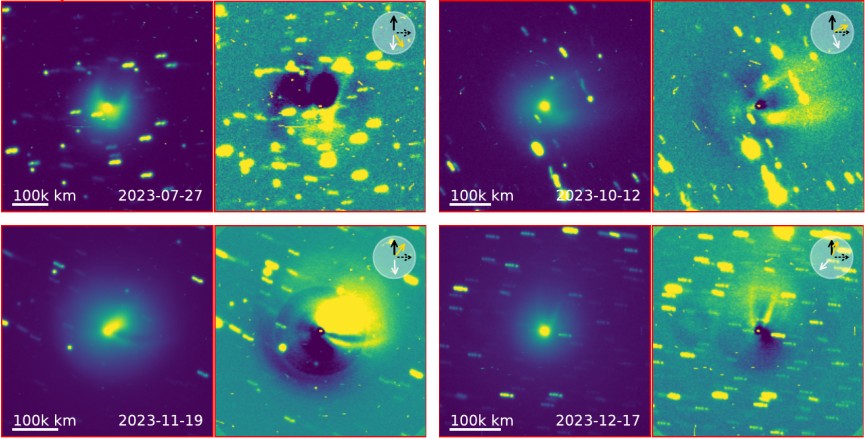
Fig. 1: Comet 12P/Pons-Brooks in the R filter during different outbursts. Left is the unmodified image and right is the image after subtraction by an azimedian profile. The dust shell and the two horns are visible during all the shown outbursts, although the shape of the horns change between the occurrences. The yellow and white arrows are the antisunward and the negative of the target heliocentric velocity vector directions, respectively. Images are oriented north up and east right.
References
[1] Gary W Kronk, Cometography: a catalog of comets. Vol. 4, 1933-1959, Cambridge University Press (2009)
[2] Kronk, G. W. 1999, Cometography: Volume 2, 1800-1899: A Catalog of Comets (Cambridge University Press)
[3] ATel#16194, ATel#16202, ATel#16223, ATel#16229, ATel#16254, ATel#16270, ATel#16282, ATel#16315, ATel#16338, ATel#16343, ATel#16408, ATel#16498
[4] Jewitt and Luu, Multiple Outbursts of Halley-Type Comet 12P/Pons-Brooks, arXiv:2504.20316 (2025)
[5] Jehin, E. et al., TRAPPIST: TRAnsiting Planets and PlanetesImals Small Telescope. The Messenger 145, (2011).
[6] Farnham, T., The HB Narrowband Comet Filters: Standard Stars and Calibrations. Icarus 147, 180–204 (2000).
[7] Haser, L., Distribution d’intensité dans la tête d’une comète. Bulletins de l'Académie Royale de Belgique 43 pp. 740-750 (1957)
[8] A'Hearn et al., Comet Bowell 1980b, The Astronomical Journal 89-4, 579-591 (1984)
[9] Schmitt, J. et al., Multi-purpose InSTRument for Astronomy at Low-resolution: MISTRAL@OHP. Preprint at http://arxiv.org/abs/2404.03705 (2024).
Acknowledgments
This work is a result of the bilateral Belgo-Indian projects on Precision Astronomical Spectroscopy for Stellar and Solar system bodies, BIPASS, funded by the Belgian Federal Science Policy Office (BELSPO, Government of Belgium; BL/33/IN22_BIPASS) and the International Division, Department of Science and Technology, (DST, Government of India; DST/INT/BELG/P-01/2021(G)). M.V.D. acknowledges support from the French-speaking Community of Belgium through its FRIA grant
How to cite: Vander Donckt, M., Jehin, E., Krishnakumar, A., Adami, C., Hmiddouch, S., Manfroid, J., Ganesh, S., Benkhaldoun, Z., Delsanti, A., and Jabiri, A.: Photometric and spectroscopic monitoring of the outbursting Halley-type comet 12P/Pons-Brooks, EPSC-DPS Joint Meeting 2025, Helsinki, Finland, 7–12 Sep 2025, EPSC-DPS2025-1646, https://doi.org/10.5194/epsc-dps2025-1646, 2025.


