
 1,1,3,1
- 1Physics & Astronomy, University of Leicester, Space Park Leicester, Leicester, UK (ardf1@leicester.ac.uk)
- 2Geography, Geology and the Environment, University of Leicester, Leicester, UK
- 3University of Liege, Liege, Belgium
- 4KU Leuven, Leuven, Belgium
Introduction
The BepiColombo mission to Mercury [1] will arrive in late 2026 and carries the Mercury Imaging X-ray Spectrometer (MIXS) [2]. MIXS will recover elemental abundances from the upper tens of microns of Mercury’s surface through X-ray fluorescence (XRF), using solar coronal X-rays as the excitation source. MIXS will map elemental abundances at greater spatial resolution than has been achieved previously at Mercury through novel X-ray optics; MIXS also uses solid state DEPFET detector technology [3] to achieve greater spectral resolution (~140 eV full-width at half-maximum at Mn Kα) than previous instrumentation. MIXS comprises two channels, a high spatial-resolution telescope, MIXS-T, and a wide field-of-view collimator, MIXS-C, with identical detectors. The DEPFET detectors will allow for spectrally-resolved measurements of fluorescence peaks from closely separated elements, as well as analysis of fluorescence lines at lower energy than previously possible. For some elements, MIXS will make the first XRF measurements at Mercury (e.g. O, Na, K), whilst for others, they will be measured globally with more precise spatial resolution than ever before (e.g. S, Fe).
Methodology
As peaks from new elements become resolvable, some remain close to the resolution limit; in this case strong neighbouring peaks can overlap with the peak of interest. In addition to this, other artefacts (e.g. escape peaks, diffraction peaks) which are a part of the instrument response can restrict analyses. In order to better understand the impact on elemental sensitivity that such artifacts may have with data from Mercury, we describe the analysis of a collection of synthetic materials with compositions that probe cases where peak-overlap may occur [4]. We have targeted several examples where geochemically significant results are impacted: overlap between Na-Mg, Al-Si, K-Ca, as well as detection limits for S and Mn. For example, Na may be a key volatile in Mercury’s hollows e.g. [5] and as such, resolving the peak from Mercury’s strong Mg peak will be crucial to investigating these features.
We are analysing these samples with the MIXS Ground Reference Facility (GREF) [2,6], a large vacuum chamber which provides ground observations using the qualification model MIXS detector in a controlled environment. The samples are prepared as pressed powder pellets from analytical-grade powders, mixed with a binder to allow for exposure to high-vacuum. Each sample is analysed under the same illumination and observation conditions, with a detector and electronics chain which is identical to that of the two flight models. The spectra are background-subtracted and the peaks fitted to extract the relationship between detected line intensity and abundance. These relationships will highlight the detection limits for certain elements and, in other cases, the relationships between fluorescence peaks from different elements.
Preliminary Results
Figures 1 and 2 show some preliminary results from one of the series of samples which focuses on the sensitivity to Na in the presence of a Mg abundance which is similar to those expected within Mercury’s High Magnesium Terrane [7]. Figure 1 shows the calibrated spectra from each of those samples, which cover a Na2O range of 0.1-8 wt%. The Na peak ceases to be resolvable as a peak below ~3 wt% Na2O, however the results of the fitting, shown in Figure 2, suggest that MIXS detectors continue to have sensitivity at this level. For comparison, the Na2O at Mercury is estimated at ~3-8 wt% Na2O [7,8].
Next Steps
Our analyses will continue and, through fitting, will produce similar results for each of the other series of samples. This process will investigate escape peaks, diffraction peaks and enhancement effects via secondary fluorescence. The work will provide the basis for understanding the geochemical sensitivity that MIXS will achieve at Mercury, where detection limits will also be governed by count rate, correlated with solar flare state. At Mercury, the incident solar spectrum is highly variable and differs significantly in spectral shape from the laboratory X-ray source, this dataset will allow for better predictions of elemental sensitivity in data returned from Mercury. Interpretation of these experimental results will therefore inform refinements to the data analysis techniques that will be carried out on the MIXS data, thus providing crucial instrument information which will inform plans for observation campaigns of targets on Mercury’s surface. Maximising the returns of MIXS and BepiColombo will be key to driving our understanding of Mercury for decades to come.
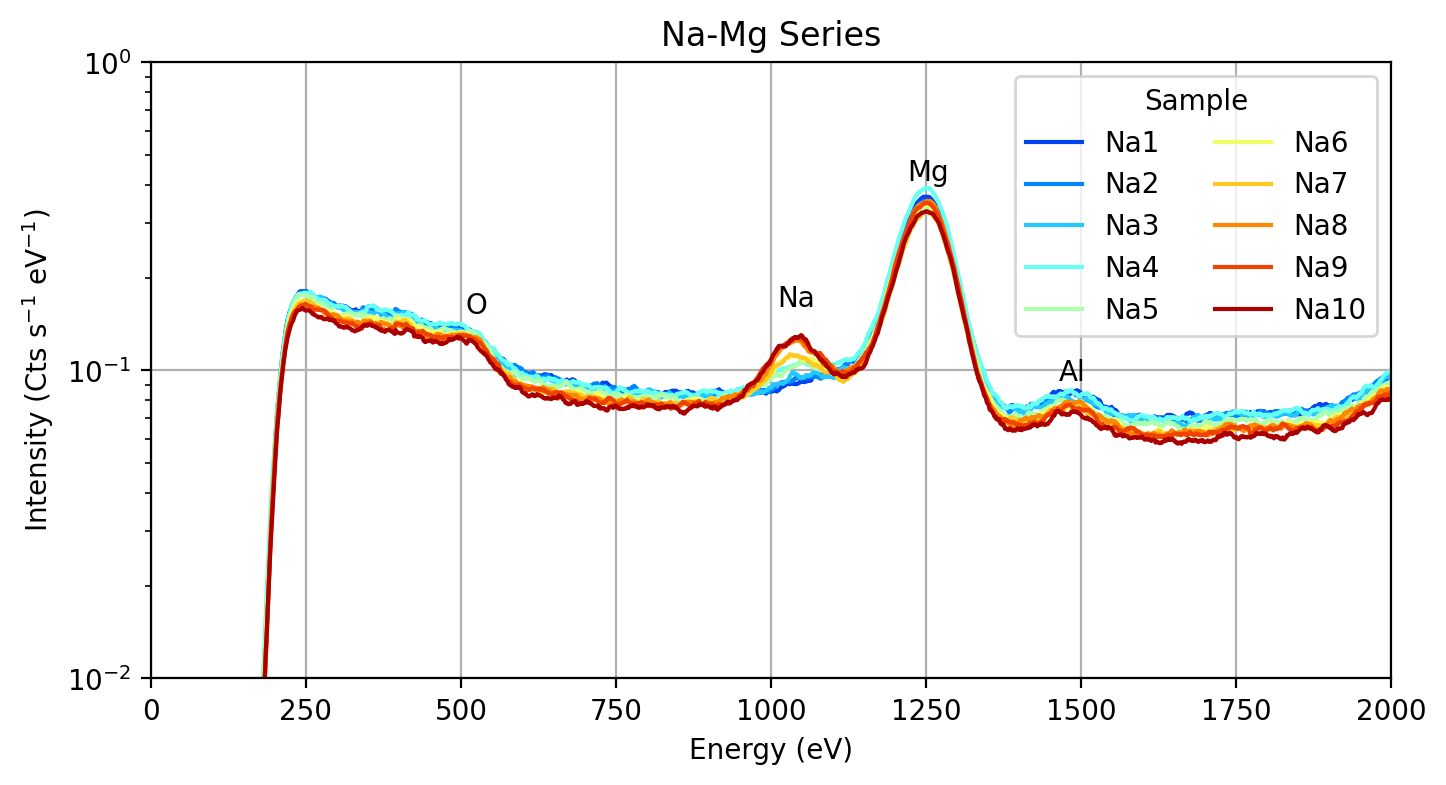
Figure 1 – GREF X-ray spectra (around the peak of the Na K-series) from a series of samples targeting sensitivity to Na, increasing in Na abundance through samples Na1 to Na10.
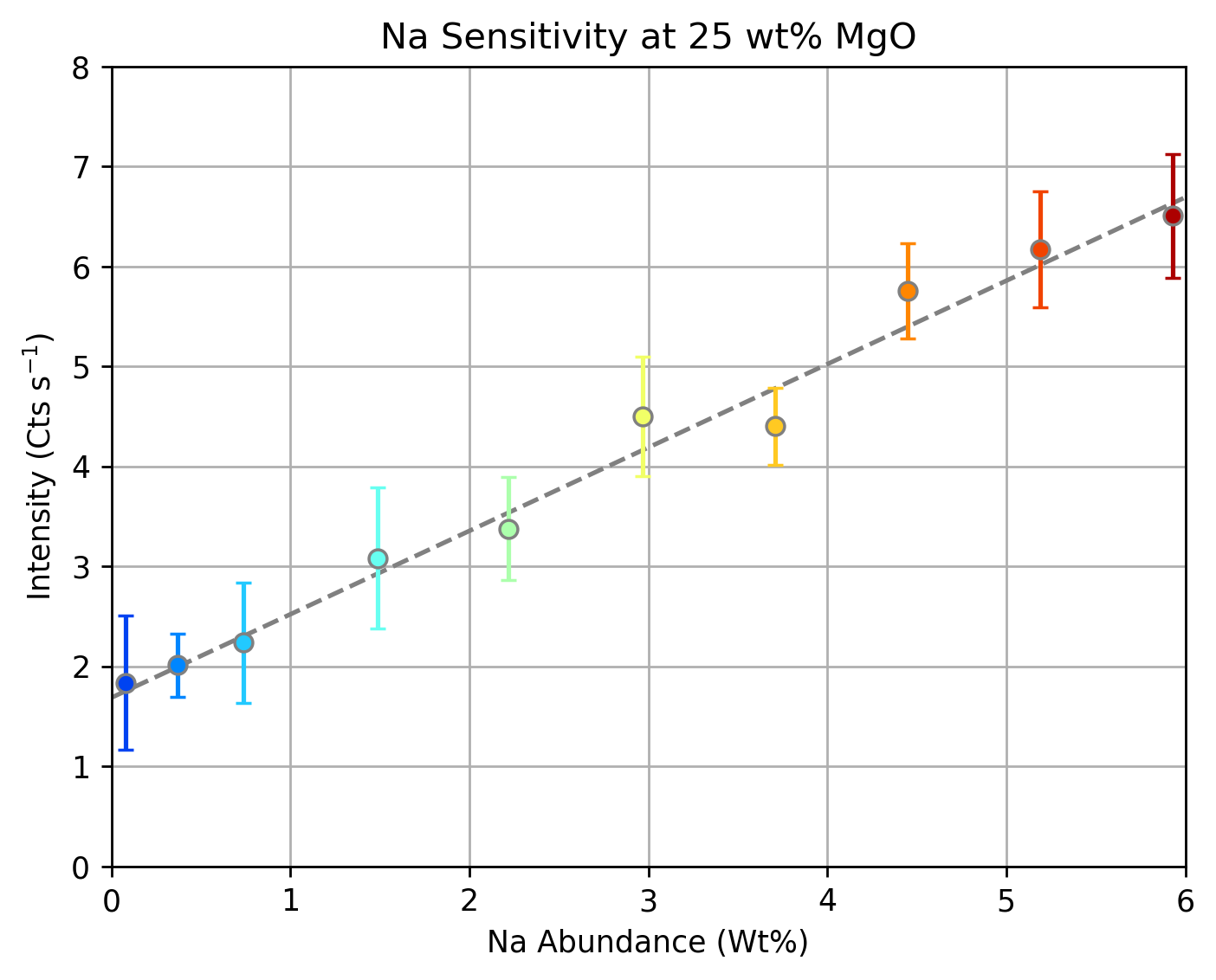
Figure 2 – Fitted count rate to the Na peak from the spectra in Figure 1 after background subtraction.
References: [1] Benkhoff et al. (2021) Space Sci. Rev., 217:90(8). [2] Bunce et. al. (2020) Space Sci. Rev., 216:126(8). [3] Majewski et al. (2014) Exp. Astron., 37(3). [4] Lecaille et al. (2024) Geologica Belgica Luxemburga International Meeting., Liege. [5] Barraud et al. (2020) JGR Planets., 125(12) [6] Cartwright et al. (in prep.) [7] Peplowski and Stockstill-Cahill (2019) JGR Planets., 124(9). [8] Peplowski et al. (2014) Icarus., 228.
How to cite: Fox, A., Martindale, A., Barry, T., Lindsay, S., Bridges, J., Bunce, E., Cartwright, J., Charlier, B., Hall, G., Lecaille, M., Namur, O., and Tikkanen, T.: Experimental measurements of the elemental sensitivity of MIXS detectors in support of the BepiColombo mission, EPSC-DPS Joint Meeting 2025, Helsinki, Finland, 7–12 Sep 2025, EPSC-DPS2025-1651, https://doi.org/10.5194/epsc-dps2025-1651, 2025.


