
 1,1,1,1,3,4,7,10,11,12,13,12,
- 1Royal Belgian Institute for Space Aeronomy (BIRA-IASB), Brussels, Belgium (severine.robert@aeronomie.be)
- 2Institute of Astronomy, KU Leuven, Belgium
- 3Université de Reims Champagne-Ardenne, CNRS, GSMA, Reims, France
- 4Institute of Life, Earth and Environment (ILEE), University of Namur (UNamur), Belgium
- 5Faculty of Sciences, University of Lisbon, Portugal
- 6Instituto de Astrofísica e Ciências do Espaço (IA), Lisbon, Portugal
- 7ETH, Zurich, Switzerland
- 8J. Heyrovsky Institute of Physical Chemistry, Czech Academy of Sciences, Czech Republic
- 9Space Research Organisation Netherlands (SRON), Leiden, the Netherlands
- 10Instituto de Astrofísica de Andalucía, Granada, Spain
- 11European Space Agency ESA, ESTEC, Noordwijk, The Netherlands
- 12Institute of Space Research, DLR, Germany
- 13LATMOS, Université de Versailles Saint-Quentin, France
- *A full list of authors appears at the end of the abstract
VenSpec-H is part of the VenSpec suite [1], also including an IR mapper and a UV spectrometer [2]. The suite science objectives are to search for temporal variations in surface temperatures and tropospheric concentrations of volcanically emitted gases, indicative of volcanic eruptions; and to study surface-atmosphere interactions. Maintenance of the clouds requires a constant input of H2O and SO2. A large eruption would locally alter the composition by increasing abundances of H2O, SO2, and CO and perhaps decreasing the D/H ratio. Observations of changes in lower atmospheric SO2, CO, and H2O vapour levels, cloud level H2SO4 droplet concentration, and mesospheric SO2, are therefore required to link specific volcanic events with past and ongoing observations of the variable and dynamic mesosphere, to understand both the importance of volatiles in volcanic activity on Venus and their effect on cloud maintenance and dynamics. VenSpec-H’s main scientific objectives are (1) to better constrain the composition of the atmosphere both below and above the clouds to relate changes in the composition to changes on the surface or geological processes such as volcanism; (2) to investigate short and long-term trends in the composition to better grasp the climate evolution on Venus [3].
VenSpec-H is designed to measure H2O, HDO, CO, OCS, and SO2 on both the night and day side to contribute to this investigation. VenSpec-H is a nadir-pointing, high-resolution (R~8000) infrared spectrometer that will perform observations in different spectral windows between 1 and 2.5 µm. Spectra in these bands will be recorded sequentially with the help of a filter wheel and will allow the sounding of different layers in the Venusian atmosphere: close to the surface (1.17 µm), 15-30 km (1.7 µm), 30-40 km (2.4 µm) and above the clouds (1.38 & 2.4 µm) [4]. Two additional polarization filters will be used during dayside observations to better characterize the clouds’ properties and mitigate the impact of polarization. A 3D drawing of the instrument and its electronic box is shown in Fig. 1.
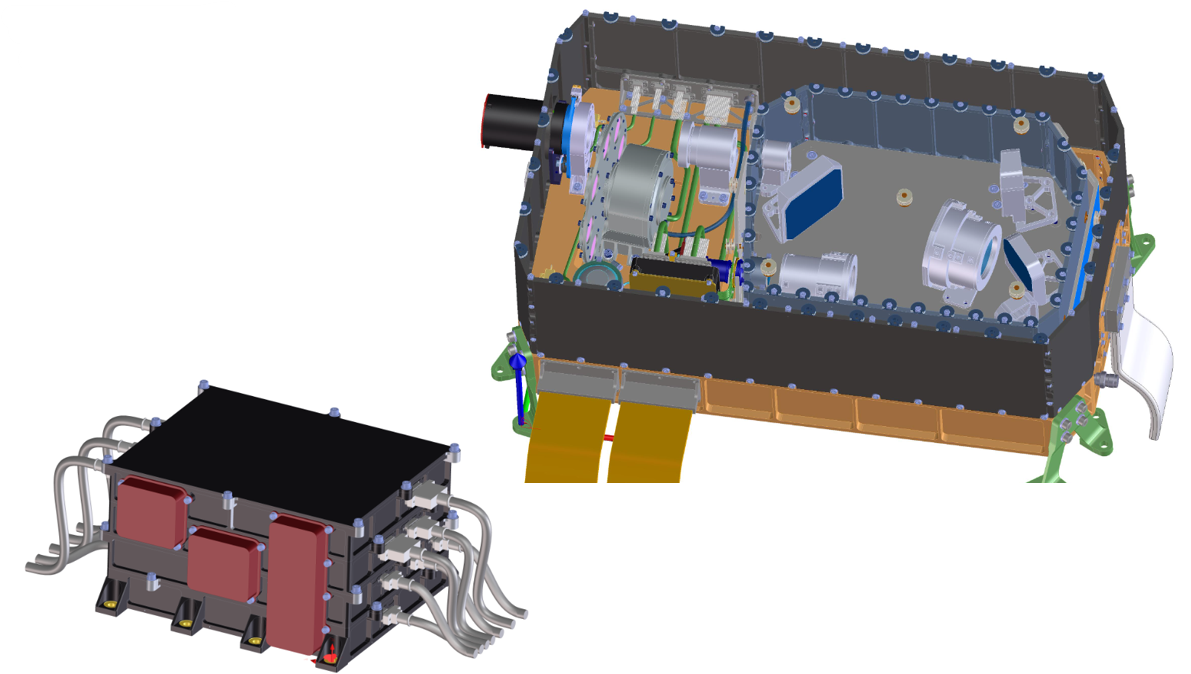
Figure 1: 3D drawings of the electronic box (left) and the optical bench (right), from Neefs et al., 2025 [4].
Significant progress has been made recently on the technical side. The optical components (FFCP and grating) passed their TRL evaluation campaigns by proving performance under thermovacuum conditions. The filter wheel mechanism succeeded by completing a lifetime test (>1M movements) under thermovacuum tests, in addition to shock and vibration testing. The B1 breadboard was manufactured, which contained warm and cold baseplates with feet and flexures and aluminum boxes. Mass dummies for other components (filter wheel, detector, turn window unit, and optical components) were used to perform and shock and vibration test. Some of the engineering models of the Integrated detector and cooler assembly (IDCA) were delivered. Prototype electronics were built to control and readout the IDCA and performance tests were made. The development of critical elements are described in [5]. Mechanical design continues, as updates to all subsystems need to be integrated to ensure compatibility.
The expected instrument performance and the ability to meet the science requirements are continuously investigated, for instance, by revisiting previous datasets [6] or by performing modelling exercises [7]. The planning of calibrations and operations is also ongoing work.
Building a new instrument is a challenge that requires an incredible team and support. There are so many aspects to it and nothing can be left to chance. Luckily, VenSpec-H is in good hands. In this presentation we will highlight the most important achievements of the past year.
References
[1] J. Helbert et al., “The VenSpec suite on the ESA EnVision mission to Venus”, Proc. SPIE 11128, Infrared Remote Sensing and Instrumentation XXVII, 1112804 (2019).
[2] E. Marcq et al., “Instrumental requirements for the study of Venus’ cloud top using the UV imaging spectrometer VeSUV”, Advances in Space Research, 68 (2021) 275-291.
[3] S. Robert et al., “Scientific objectives and instrumental requirements of the infrared spectrometer VenSpec-H onboard EnVision”, Journal of Applied Remote Sensing, 19 (2025) 014525
[4] E. Neefs et al., “VenSpec-H spectrometer on the ESA EnVision mission: Design, modeling, analysis”, Acta Astronautica, 226 (2025) 178-201.
[5] R. De Cock et al. “Design of the VenSpec-H instrument on ESA’s EnVision mission: development of critical elements, highlighting the wavefront corrector and grating”, Journal of Applied Remote Sensing, 19 (2025) 014523.
[6] J.T. Erwin et al., “Venus nightside radiances data analysis and model comparison in view of upcoming Venus missions”, EPSC-DPS, 2025
[7] J. Dias et al., “Volcanic gas plumes’ effect on the spectrum of Venus”; Icarus, 438 (2025) 116589.
Acknowledgements
This work has been performed with the support of the Belgian Science Policy Office (BELSPO) contract 4000144206, with the financial and contractual coordination by the ESA Prodex Office. EM acknowledges support from CNES and ESA for all EnVision-related activities.
Pieter Bogaert, Bram Beeckman, Ian Thomas, Bojan Ristic, Ansje Brassine, Claudia Smits, Filip Vanhellemont, David Bolsée.
How to cite: Robert, S., Erwin, J., Neefs, E., De Cock, R., Vandaele, A. C., Berkenbosch, S., Jacobs, L., Pereira, N., Ducreux, E., Dias, J., Machado, P., Tackley, P., Ferus, M., Min, M., Lara, L. M., Helbert, J., Barraud, O., Marcq, E., and Alemanno, G. and the more members of the BIRA-IASB VenSpec-H team: VenSpec-H spectrometer on the ESA EnVision mission: Instrument’s status, EPSC-DPS Joint Meeting 2025, Helsinki, Finland, 7–12 Sep 2025, EPSC-DPS2025-1652, https://doi.org/10.5194/epsc-dps2025-1652, 2025.


