
 1,1,1,2,3,4,
- 1Institute of Space Research, German Aerospace Center (DLR), Berlin, Germany (oceane.barraud@dlr.de)
- 2BIRA-IASB, Belgium
- 3LATMOS, Université de Versailles Saint-Quentin, France
- 4European Space Agency ESA, ESTEC, Noordwijk, The Netherlands.
- *A full list of authors appears at the end of the abstract
The VenSpec consortium [1] aboard the ESA EnVision mission is composed of three channels VenSpec-M (push-broom NIR multispectral imager) [2], VenSpec-U (UV spectral imager) [3], and VenSpec-H (a high-resolution IR spectrometer) [4] designed to observe the surface and atmosphere of Venus. VenSpec will perform a comprehensive search for past and current volcanic activities by targeting atmospheric, thermal, and compositional signatures, as well as a global map of surface composition. In order to achieve the science objectives of the mission, the VenSpec science team is structured into interdisciplinary Working Groups (WGs) that leverage synergies across the three instrument channels and foster collaboration among researchers and institutions. Among those, the Regions of Interest (RoI) WG is defining a list of targets on the surface of Venus of major interest to meet the VenSpec Suite’s science objectives.
The VenSpec Regions of Interest WG is working closely with the VenSAR (Venus Synthetic Aperture Radar), and SRS (Subsurface Radar Sounder) instrument teams alongside the Envision Science Working Team and its appointed Regions of Interest (ROI) WG, an ESA-coordinated inter-instrument working group [5]. The combined target list and prioritization assessment of all instruments’ teams will serve as base for EnVision's orbit definition during the mission's science phase. This effort aims to define shared Venus regions of interest that align with the operational constraints of VenSAR while optimizing the scientific priorities of the mission. For example, in the case of VenSpec-M focused on mapping at least 60% of Venus’s surface, its scientific return will be significantly enhanced through coordinated observations with the other instruments, particularly by acquiring high-resolution digital elevation models (DEMs) over high priority targets of VenSpec.
The VenSpec RoI WG unites a wide range of international researchers with a wide range of expertise working together to provide a comprehensive and diverse target list. Although the targets lie on the surface, all three VenSpec channels are actively represented within the WG, contributing collaboratively to optimize scientific outcomes. Over the past six months, the group has convened more than a dozen times to refine and consolidate the target selection process. As a result, the current VenSpec target list comprises over 320 locations, encompassing a broad diversity of geological features—from tectono-magmatic features to aeolian landforms including impact and volcanic features—distributed across a wide range of latitudes and longitudes (Figure 1). The target list has been developed based on a comprehensive set of parameters, including target prioritization, spatial extent, relevance to key scientific objectives, and whether there are publications discussing these features. . To ensure transparency in the prioritization process, the VenSpec Regions of Interest Working Group (ROI WG) has implemented a voting system, categorizing targets into two main groups: high-priority “must-have” targets and secondary targets. Among the high-priority must-have targets of VenSpec instrument are
- Landing Sites of the Venera, Vega and DAVINCI missions; that will contribute to refine the calibration of the VenSpec-M channel.
- Venusian Hotspots; identified by the Visible and Infrared Thermal Imaging Spectrometer (VIRTIS) aboard ESA’s Venus Express mission, have been interpreted as sites of active or recently active surface processes [6]. Volcanic features that show potential surface changes between different Magellan cycles have also been given high-priority due to likely ongoing activity [e.g., 7]. These regions are of high scientific interest for all three VenSpec channels. VenSpec-M will investigate thermal and compositional anomalies at these locations, contributing to our understanding of crustal evolution and the volcanic resurfacing history. In parallel, VenSpec-M and VenSpec-H will track volcanic plumes from their source near the surface through the middle atmosphere, while VenSpec-U will extend these observations to the cloud tops. Together, these coordinated measurements will provide a comprehensive view of gas exchanges and atmospheric dynamics linked to volcanic activity.
- Key regions representing diverse surface features relevant to Venus’s geological evolution; for example, Ovda Regio has been chosen to represent crustal plateaus, Maxwell Montes as a characteristic mountain belt and Aramaiti as an example of Type 1 Corona located in a volcanic plain. Some surface features within these regions are direct or indirect indicators of Venus's internal geodynamic processes, such as impact craters (e.g., Sabin Crater) and rift-related structures. This selection ensures comprehensive coverage of the planet’s diverse surface features relevant to Venus’s geodynamic evolution.
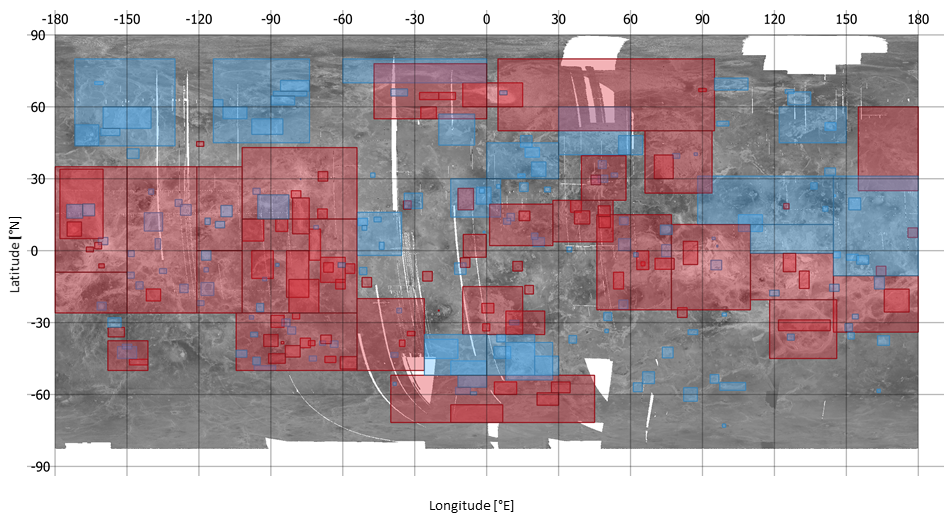
Figure: Map of the VenSpec Region of Interest colored by priority: high-priority “must-have” targets in red and secondary targets in blue.
The work of the VenSpec Regions of Interest Working Group alongside the EnVision ROI WG represents a critical step in optimizing the scientific return of the EnVision mission. Through interdisciplinary collaboration, strategic coordination with other instrument teams, and the careful prioritization of surface targets, the WG is ensuring that VenSpec observations will directly address key questions about Venus’s geological and atmospheric evolution. As the mission advances, this evolving target list will remain central to maximizing the value of synergistic, multi-instrument investigations of our enigmatic sister planet.
References: [1] Alemanno et al., (2025a, this meeting) [2] Alemanno et al., (2025b, this meeting). [3] Marcq et al. (2025, this meeting). [4] Robert et al. (2025, this meeting). [5] Straume-Linder et al. (2025, this meeting). [6] Mueller et al. (2008), JGR DOI: doi.org/10.1029/2008JE003118. [7] Herrick and Hensley (2023) Science DOI: doi.org/10.1126/science.abm7735.
A.-C. Plesa1, S. Smrekar5, I. López6, C. Gillmann7, M. Lefevre3, N. Mueller1, K. Jessup8, S. Adeli1, P. Brož9, N. Schneider10, A. Nathues11, J. Peralta12, P. Tackley7, T. Gerya7, A. Das1 and C. Herrera1. 5Jet Propulsion Laboratory, California Institute of Technology, 4800 Oak Grove Dr., Pasadena, CA 91109. 6Universidad Rey Juan Carlos: Mostoles, Madrid, Spain. 7ETH Zürich, Institute of Geophysics, Zürich, Switzerland. 8Southwest Research Institute, Boulder, CO, USA. 9Institute of Geophysics of the Czech Academy of Sciences, Prague, Czechia. 10Laboratory for Atmospheric and Space Physics, University of Colorado, Boulder, CO, USA. 11Max Planck Institute for Solar System Research, Göttingen, Germany. 12Universidad de Sevilla, Sevilla, Andalucía, Spain.
How to cite: Barraud, O., Alemanno, G., Van den Neucker, A., Maia, J., Robert, S., Marcq, E., and Helbert, J. and the VenSpec ROI WG team: Defining Surface Targets for the EnVision’s VenSpec Suite: Collaborative Strategies of the Regions of Interest Working Group, EPSC-DPS Joint Meeting 2025, Helsinki, Finland, 7–12 Sep 2025, EPSC-DPS2025-1653, https://doi.org/10.5194/epsc-dps2025-1653, 2025.


