
 1,1,2
1,1,2- 1Institute of Geodesy and Geoinformation Science, Technische Universität Berlin, Berlin, Germany
- 2Macau University of Science and Technology, Avenida Wai Long, Taipa, Macau
Introduction
Enceladus, Saturn’s sixth-largest moon with a radius of 252.0 ± 0.2 km [1], was visited by NASA’s Cassini spacecraft in 2005. During close flybys, Cassini used backlighting techniques to detect plumes erupting from the South Polar Terrain (SPT) [2], identifying Enceladus as the source of fine icy particles that replenish Saturn’s E ring [3]. These observations suggest the presence of a subsurface liquid water ocean [2].
With a density of 1608 ± 5 kg/m³ and an icy surface [2], Enceladus appears to have an ice-rich bulk composition. Its moment of inertia (MOI) coefficient, initially estimated at 0.33–0.34 [4] and later refined to 0.336–0.339 [5], indicates a differentiated interior, likely composed of a rocky core beneath an H₂O mantle [6].
In this study, we investigate a range of internal structure models and their corresponding MOI values to determine which configurations are most consistent with the spacecraft-derived MOI constraints.
Methodology
This study builds upon the internal structure models developed by [6] (called henceforth "Neumann-Kruse models"), which explored Enceladus’ thermal and differentiation evolution driven by radiogenic heating and tidal dissipation. Their models considered three rheologies for the rocky core: wet olivine, dry olivine, and antigorite. The resulting internal structures featured a differentiated body with a core radius of ~185–205 km, a porous core layer of ~2–80 km, a subsurface ocean of ~10–27 km, and an ice-rock crust of ~30–40 km. Notably, the crust was assumed to be undifferentiated, composed of a mixture of ice and rock.
In this study, we refine these models by introducing rock subduction from the crust to the core, leading to core enlargement and a corresponding change in crust density. We evaluate three crust densities: 850 kg/m³ [1], 918 kg/m³, and 925 kg/m³ [7,8]. We calculated the MOI for nearly 500 internal structure models, including both the original and adjusted cases, to assess their compatibility with spacecraft-derived values.
Results
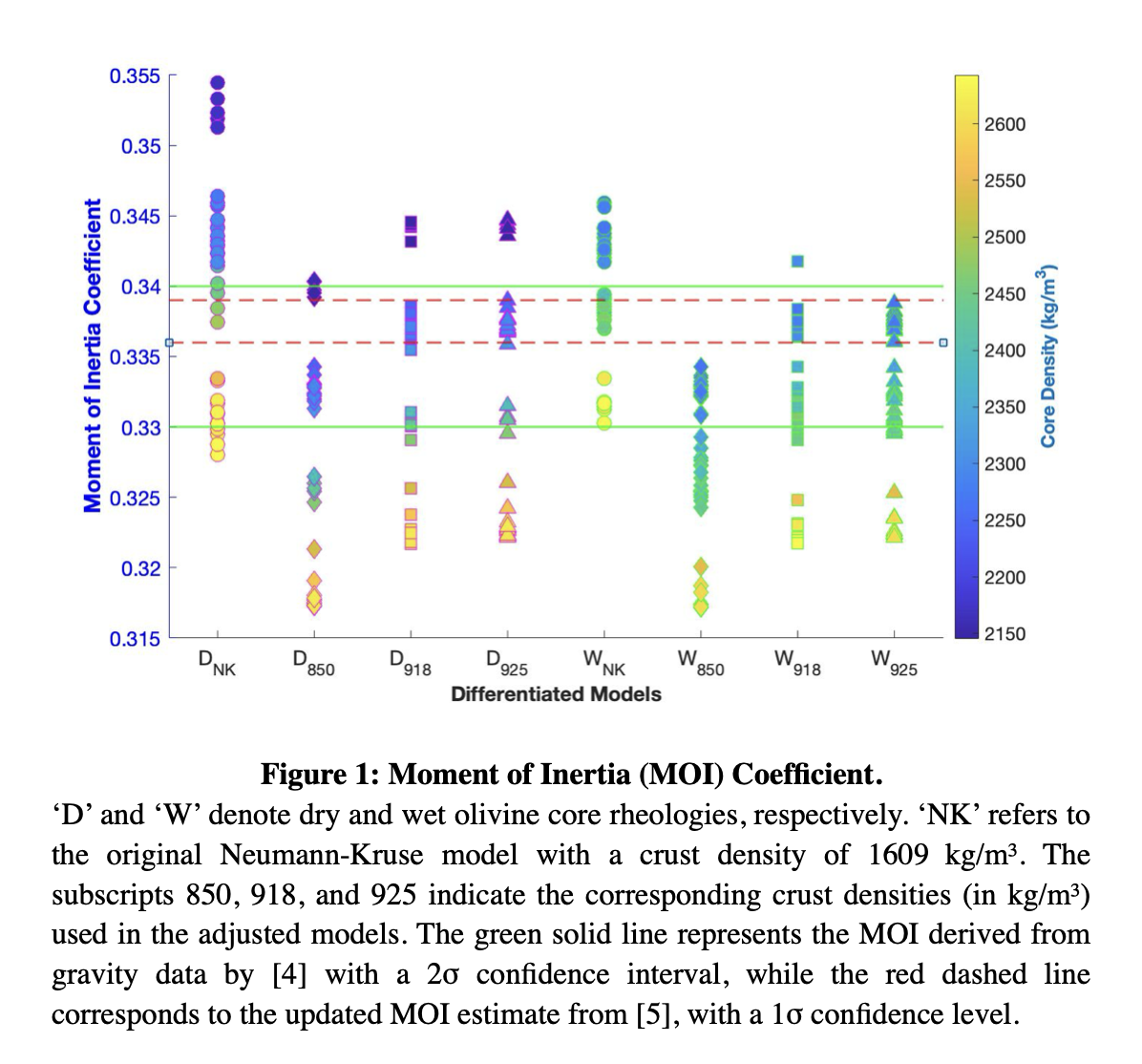
Figure 1 presents the calculated MOI coefficients for the differentiated Neumann-Kruse models and the adjusted models incorporating a differentiated crust with densities of 850 kg/m³ [1], 918 kg/m³, and 925 kg/m³ [7,8], for both dry and wet olivine core rheologies.
Models with a crust density of 850 kg/m³ show no agreement with the MOI range derived from gravity data [5]. Similarly, models with an undifferentiated crust (1609 kg/m³) yield the lowest agreement, approximately 5% for dry olivine and 18% for wet olivine.
In contrast, models with crust densities of 918 and 925 kg/m³ show significantly better alignment. For dry olivine, both densities yield about 39.5% agreement with the observed MOI. For wet olivine, the model with a crust density of 925 kg/m³ provides the highest overall agreement. In general, wet olivine models exhibit better consistency with the observed MOI range than dry olivine models.
A key observation is that wet olivine models require higher core densities to match the observed MOI, whereas dry olivine models align better with lower core densities. Accepted dry olivine models typically have a porous outer core thickness ranging from ~3 to 73 km, with 55% of these models having a porous layer thinner than 5 km. For wet olivine, the range is ~2 to 80 km, and only 41% of accepted models feature a porous outer core under 5 km. This indicates that wet olivine rheology generally requires a thicker porous outer core than dry olivine.
Conclusions
Our study builds upon the differentiated internal structure models proposed by [6], initially based on a rock-ice crust model. We further refined these models by incorporating a differentiated crust with varying densities. Our analysis indicates that most models, with a crust density of 925 kg/m³, align with the MOI range of [0.336–0.339] [5]. This trend persists regardless of whether the core rheology is dry or wet olivine. As expected, lower crust densities result in lower average MOI coefficients. In contrast, antigorite rheology predicts a higher MOI than the observed range, suggesting inconsistency with gravity data. Overall, our models support compatibility with spacecraft-derived constraints.
Acknowledgment
This work was supported by the Berlin University Alliance (BUA), by the Deutsche Forschungsgemeinschaft (DFG), and by the International Space Science Institute (ISSI) in Bern and Beijing, through ISSI/ISSI-BJ International Team project “Timing and Processes of Planetesimal Formation and Evolution”.
References
[1] P.C. Thomas. et al., Icarus 264, 37 (2016).
[2] C.C. Porco. et al., Science 311, 1393 (2006).
[3] F. Spahn. et al., Science 311, 1416 (2006).
[4] L. Iess. et al., Science 344, 78 (2014).
[5] R. S. Park et al., J. Geophys. Res. Planets 129 (2024).
[6] W. Neumann and A. Kruse, The Astrophysical Journal 882, 47 (2019).
[7] W.B. McKinnon, Geophysical Research Letters 42, 2137 (2015).
[8] D.J. Hemingway and T. Mittal, Icarus 332, 111 (2019).
How to cite: Darivasi, D., Oberst, J., and Neumann, W.: Insights into Enceladus’ Interior: Structural Modeling from Moment of Inertia, EPSC-DPS Joint Meeting 2025, Helsinki, Finland, 7–12 Sep 2025, EPSC-DPS2025-1654, https://doi.org/10.5194/epsc-dps2025-1654, 2025.


