
 1,2,3,1,2,1,2,2,2,8,9,1,12,12,15,
- 1University of Washington, DiRAC Institute and Department of Astronomy, United States of America
- 2Northern Arizona University, Department of Astronomy and Planetary Science, United States of America
- 3LSST Interdisciplinary Network for Collaboration and Computing, United States of America
- 4Raw Data Speaks Initiative
- 5National Science Foundation Graduate Research Fellow
- 6University of Arizona, Deptartment of Astronomy and Steward Observatory, United States of America
- 7University of Arizona, Wyant College of Optical Sciences, United States of America
- 8Planetary Science Institute, United States of America
- 9Academia Sinica, Institute of Astronomy and Astrophysics, Taiwan
- 10University of California San Francisco, Department of Laboratory Medicine, United States of America
- 11Carnegie Institution for Science, Department of Terrestrial Magnetism, United States of America
- 12Active Asteroids Citizen Scientist
- 13Royal Astronomical Society, United Kingdom
- 14Siena Academy of Sciences, Physical Sciences Group, Italy
- 15Delaware Valley Amateur Astronomers, United States of America
- *A full list of authors appears at the end of the abstract
We report the discovery of recurrent cometary activity from minor planet 2017 QN84. Cometary activity on 2017 QN84 was first identified by volunteers of our NASA Partner Citizen Science program, Active Asteroids, hosted on the Zooniverse platform. In the project, volunteers examine archival images of minor planets, searching for cometary activity like comae and tails. Project volunteers identified activity on 2017 QN84 in one Dark Energy Camera (DECam) image from UT 2017 December 23 (Prop. ID 2017B-0307, PI: Sheppard) in the form of a coma and tail (Figure 1). This represents the Active Asteroids project’s first activity discovery by participants, and was originally reported by volunteers on the project's chat forum (Chandler 2022; Chandler et al. 2024)
Further archival searches of images of 2017 QN84 did not discover additional evidence of activity. However, images of the field directly behind 2017 QN84 in the DECam image did not reveal any background source that could have caused 2017 QN84’s apparent coma and tail. This suggests that the UT 2017 December 23 image shows true cometary activity on the object, not an image artifact. With only one known epoch of activity, the underlying cause of the outburst (e.g., sublimation, rotational distribution, impact) could not be constrained. Although, the observed activity was present at heliocentric distance rH = 2.62 au and true anomaly angle f = 38°, consistent with sublimation near perihelion.
As part of our Active Asteroids campaign, we routinely perform follow-up observations of project discoveries at various observatories, including the Astrophysical Research Consortium (ARC) 3.5-meter telescope at Apache Point Observatory (New Mexico, USA) and the Lowell Discovery Telescope (LDT) at Lowell Observatory (Arizona, USA). We observed 2017 QN84 as it approached its December 2024 perihelion passage. On UT 2024 July 14, we detected a short tail emanating from 2017 QN84 in images we acquired with the ARC 3.5-m (Figure 1; observers C. Chandler, M. Frissell) when 2017 QN84 was at f = 312° (Figure 2). We continued to monitor activity through perihelion passage with the ARC 3.5-m and LDT (Figure 3; observer K. Farrell). 2017 QN84 continued to display cometary activity as of UT 2025 April 10, at f = 36°.
We have observed two epochs of cometary activity near perihelion passage from small body 2017 QN84 through the Active Asteroids project and follow-up observations. This suggests that the activity is caused by volatile sublimation. With a Tisserand parameter with respect to Jupiter TJ = 2.943 in the prescribed 2 < TJ < 3 range, we classify 2017 QN84 as a Jupiter-family comet (JFC). JFCs are a dynamically unstable class of comets that originate from the outer solar system and are disturbed inward by interactions with the giant planets. Thus, they hold clues to the current distribution of volatiles in the solar system and how those volatiles are transported into the inner solar system.
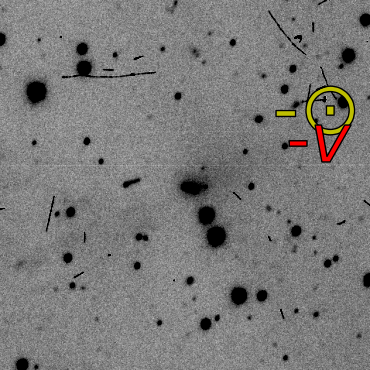
Figure 1. This is the DECam image from UT 2017 December 23 (Prop. ID 2017B-0307, PI: Sheppard) where volunteers identified activity. At the time of the exposure, 2017 QN84 was at f = 38°. The yellow and red markers indicate the anti-solar and anti-motion directions, respectively.
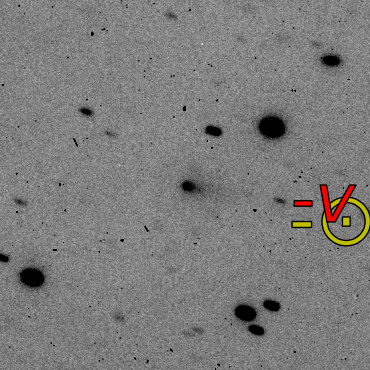
Figure 2. The ARC 3.5-m telescope image of 2017 QN84 from UT 2024 July 14 (observers C. Chandler, M. Frissell), where we discovered recurrent activity. In this image 2017 QN84 is at true anomaly angle f = 320°. The yellow and red markers indicate the anti-solar and anti-motion directions, respectively.
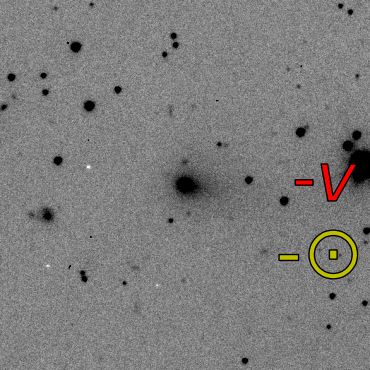
Figure 3. An LDT image of 2017 QN84 from UT 2024 October 31 (observer K. Farrell) from our activity monitoring program. At the time of the exposure, 2017 QN84 was at f = 350°. The yellow and red markers indicate the anti-solar and anti-motion directions, respectively.
Colin Chandler, Maxwell Frissell, Naomi Morato, Dmitrii Vavilov, Chadwick Trujillo, William Oldroyd, Nima Sedaghat, William Burris, Jay Kueny, Kennedy Farrell, Henry Hsieh, Jarod DeSpain, Pedro Bernardinelli, Mark Jesus Mendoza Magbanua, Scott Sheppard, Michele Mazzucato, Milton Bosch, Tiffany Shaw-Diaz, Virgilio Gonano, Al Lamperti, Jose da Silva Campos, Brian Goodwin, Ivan Terentev, Charles Dukes
How to cite: Frissell, M., Chandler, C., Morato, N., Vavilov, D., Trujillo, C., Oldroyd, W., Sedaghat, N., Burris, W., Kueny, J., Farrell, K., Hsieh, H., DeSpain, J., Bernardinelli, P., Magbanua, M., Sheppard, S., Mazzucato, M., Bosch, M., Shaw-Diaz, T., Gonano, V., and Lamperti, A. and the Active Asteroids Team: Reactivation of 2017 QN84, a Jupiter-Family Comet Discovered through Citizen Science, EPSC-DPS Joint Meeting 2025, Helsinki, Finland, 7–12 Sep 2025, EPSC-DPS2025-1661, https://doi.org/10.5194/epsc-dps2025-1661, 2025.


