SB8 | Active small bodies: dynamics, activity, and genetic links

SB8

Active small bodies: dynamics, activity, and genetic links
Convener: Olena Shubina | Co-conveners: Oleksandra Ivanova, Colin Snodgrass, Irina Belskaya, Olga Muñoz, David Jewitt, Jürgen Blum, James Bauer, Ludmilla Kolokolova, Javier Licandro, Davide Perna, Maria Hajdukova, Yuhui Zhao, Evgenij Zubko
Orals TUE-OB5
| Tue, 09 Sep, 15:00–16:00 (EEST)
 
Room Uranus (Helsinki Hall)
Orals TUE-OB6
| Tue, 09 Sep, 16:30–18:00 (EEST)
 
Room Uranus (Helsinki Hall)
Orals WED-OB3
| Wed, 10 Sep, 11:00–12:30 (EEST)
 
Room Mars (Veranda 1)
Posters TUE-POS
| Attendance Tue, 09 Sep, 18:00–19:30 (EEST) | Display Tue, 09 Sep, 08:30–19:30
 
Finlandia Hall foyer, F187–196
Tue, 15:00
Tue, 16:30
Wed, 11:00
Tue, 18:00
This session focuses on the connections between various types of small bodies in the Solar System, such as comets, asteroids, and centaurs, emphasizing their activity at different distances from the Sun. Special attention will be given to analyzing the activity of small bodies in the context of their evolution, as well as addressing open questions and unresolved issues in this field. The session will also highlight the importance of monitoring and archival data, which serve as resources for current analysis and as crucial elements for long-term observations of small bodies. Furthermore, such data allow for the study of activity changes over time and provide essential context for understanding evolutionary processes.
Various research methods for studying small bodies will be discussed, as the use of data from new space missions and modeling techniques will contribute to a more accurate understanding of the mechanisms behind their activity as well as the development of new approaches to studying the origin and evolution of small bodies in the Solar System.

Session assets

Orals TUE-OB5: Tue, 9 Sep, 15:00–16:00 | Room Uranus (Helsinki Hall)

Chairpersons: Jürgen Blum, James Bauer
15:00–15:12
|
EPSC-DPS2025-166
|
On-site presentation
Simone Ieva, Jules Bourdelle de Micas, Charles Schambeau, Masateru Ishiguro, Fumi Yoshida, Davide Perna, Elisabetta Dotto, Elena Mazzotta Epifani, Vasiliki Petropoulou, J. D. Prasanna Deshapriya, Pedro H. Hasselmann, Yonsoo K. Bach, and Sunho Jin

The classical distinction between asteroids (rocky and inert), and comets (ice-rich and active) has been blended in the last 15 years, leading to a more nuanced picture. Both classes are now believed to be simply end-members of a physical and dynamical continuum [1]. In particular, transient objects show the characteristics of both classes (asteroids exhibiting intense activity or comets in asteroidal orbits) and they have often double cometary/asteroidal designation.

We started a project called TRANSNEO, devoted to the physical characterization of TRANSient NEOs (Near-Earth Objects showing characteristics of both classes). We targeted TRANSNEO because: i) their repeated passages around the Sun make it in principle easier to detect a potential activity; ii) their proximity with Earth makes them accessible for observations and future space mission; iii) activity on NEO surfaces has been recently discovered even on apparently inactive places, thus attracting the interest of various space agencies. The study of their physical attributes (colors, spectra, activity…) is very promising, showing intermediate characteristics between asteroids and comets. This could strengthen furthermore the idea of a “continuum of small bodies” paradigm, with TRANSNEOs potentially be the missing link to understand the asteroid-comet transition.

Indeed, one of these extremely intriguing bodies is (3200) Phaethon, which will be the target of the future DESTINY+ mission. This JAXA-financed mission will perform a high-speed (36 km/s) flyby of Phaethon at a distance of approximately 500 km. During the flyby, physical and chemical properties of the dust near Phaethon will be measured with a dust analyzer (DDA) [2]; surface characterization will be conducted with a Telescopic Camera (TCAP) and Multiband Camera (MCAP) to better understand the active asteroid surface compositional variation [3].

Phaethon is a very interesting object. Originally discovered as an asteroid in 1983, over the past three decades the situation regarding its physical nature has become less and less clear. It has been identified as an active asteroid, with recurrent dust ejecting phenomena near its perihelion [4]. Moreover, it has an extremely small perihelion distance (q = 0.14 au) and an unusually large eccentricity (0.89), making it one of the largest (> 6 km) near-Sun and near-Earth objects. Due to the extreme temperatures experienced on Phaethon’s surface, particularly at perihelion (up to 1000 K), it is possible that certain minerals, unstable at high temperatures, become volatile, causing dust ejection at small heliocentric distances [5]. Several mechanisms have been proposed over the years to explain Phaethon’s activity, or they are reasonably plausible based on the extreme thermal environment. Among others: volatilization of some elements [6], thermal fracturing [7], meteoroid collisions [8], radiation pressure [9]. Thermal fracturing should be more efficient for larger rocks (i.e. boulders) present on its surface, and could be more relevant in the northern equatorial regions, where boulders should be more abundant. Finally, it is also possible that small particles are lost via radiation pressure, and transported from northern areas to southern latitudes. Recently, using thermophysical modeling, [10] found evidence of potential different grain sizes on Phaethon surface: the southern hemisphere should be dominated by fine-grained material, while the northern hemisphere is probably abundant in coarse-grained regolith and boulders. 

In order to unveil the potential mechanism beyond Phaethon’s activity and assist the proper design of the DESTINY+ mission (i.e. identify the best regions to investigate during the flyby) we obtained new spectral observations during the last year from TNG, NOT and IRTF. During this window, Phaethon was observed close to the equatorial latitudes, up until the southern hemisphere, while during the previous passages the sub-observer's latitude was much closer to the northern pole. We will present this new data, and compare them with previously available spectra in literature, in order to tackle Phaeton’s variability, and put these results in the wider context of other TRANSNEO characterizations made by our group.


References:

[1] Jewitt & Hsieh (2024) in Comets III [2] Kobayashi M. et al. (2018), 49th LPSC, #2050 [3] Ishibashi K. et al. (2018), LPSC 49th, #2126 [4] Jewitt, D. (2013), AJ, 145, 133 [5] MacLennan, E. M. et al. (2021), Icarus, 366, 114535 [6] Springmann, A. et al. (2019), Icarus, 324, 104 [7] Delbo, M. et al. (2014), Nat., 508, 233 [8] Szalay, J.R. et al. (2019), PSS, 165, 194 [9] Bach, Y.P. & Ishiguro, M. (2021), A&A, 654, A113 [10] MacLennan et al. (2022), Icarus, 388, 115226

How to cite: Ieva, S., Bourdelle de Micas, J., Schambeau, C., Ishiguro, M., Yoshida, F., Perna, D., Dotto, E., Mazzotta Epifani, E., Petropoulou, V., Deshapriya, J. D. P., Hasselmann, P. H., Bach, Y. K., and Jin, S.: The intriguing TRANSNEO population: leading the way for the DESTINY+ mission, EPSC-DPS Joint Meeting 2025, Helsinki, Finland, 7–13 Sep 2025, EPSC-DPS2025-166, https://doi.org/10.5194/epsc-dps2025-166, 2025.

15:12–15:24
|
EPSC-DPS2025-300
|
On-site presentation
Chad Trujillo, Kennedy Farrell, Colin Chandler, Maxwell Frissell, Jarod Despain, and Annabella Dickenson

We are searching for new active asteroids using data from the Subaru Hyper Suprime-Cam (HSC) Public Data Release 3 (PDR3). The active asteroids are a poorly understood class of asteroids, which have orbits similar to other asteroids but exhibit tails or comae like comets. Of the over 1.4 million catalogued minor planets, most of which are main belt asteroids, fewer than 100 of the asteroids have exhibited activity, and roughly half of those are thought to be driven by water ice. The true fraction and solar system distribution of active asteroids is poorly known as most have been discovered serendipitously by a variety of methods. In this work, we search for activity among the known asteroids using one of the deepest wide-area public datasets available, the HSC PDR3. The goal of this work is to discover new active asteroid candidates and recurring activity in known active asteroids in archival data, collect contemporary images of those asteroids using ground based telescopes, and assess the true rate of active asteroid activity in a consistent manner using a large dataset. This will lead to insights into the present day distribution of water ice in our solar system.

The HSC PDR3 has been collected using one of the largest ground-based optical telescopes, the 8.2 m Subaru telescope atop Maunakea in Hawaii which regularly achieves image quality better than 0.7 arcseconds yielding single-image depths of 25 to 25.5 magnitudes in the typical exposure times used for the PDR3. In addition, HSC itself has an extremely wide field of view, about 1.8 square degrees, for such a large telescope. Over 13,000 fields were imaged in good conditions with HSC as part of the PDR3, representing over 23,000 square degrees. The PDR3 dataset was collected for scientific purposes unrelated to the asteroids but many fields contain serendipitous images of asteroids. We have cross-correlated the PDR3 fields and the Minor Planet Database using the SkyBoT project and find that over 230,000 minor planets (over 15% of all minor planets and the vast majority asteroids) were serendipitously imaged in the dataset for a total of over 1.6 million minor planet images. We have begun the process of constructing thumbnail images of these minor planets from the full HSC PDR3 data release and expect to finish this year.

Initially, we are examining images by eye ourselves to determine activity candidates. However, we will launch a Citizen Science campaign akin to activeasteroids.net, which has to date only used data from the DECam public archive. This will allow us to mobilize volunteers to examine more images than we can reliably categorize ourselves. We present first results from this work including an assessment of activity levels for thousands of asteroids most likely to exhibit activity including: previously known active asteroids, distant C-type main belt asteroids, and Centaurs on unstable orbits that could have recently moved inward from the trans-Neptunian region.

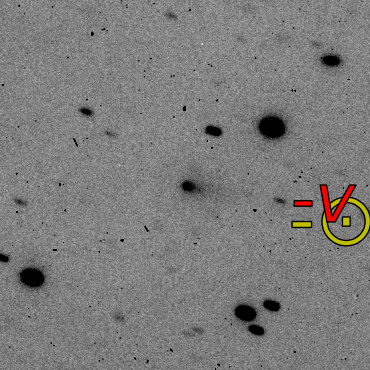
Figure 1: One of 4 images from the HSC PDR3 archive of known active outer main belt asteroid 331P/Gibbs, exhibiting a faint linear tail.

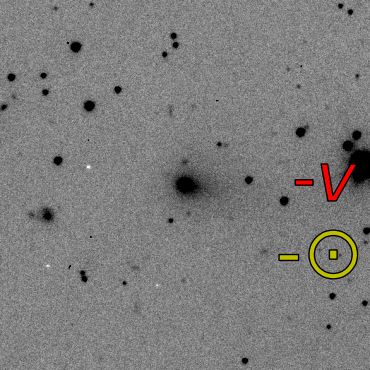
Figure 2: One of 17 images from the HSC PDR3 archive of known Jupiter family comet 242P/Spahr, exhibiting a tail. While not a primary target of this work, many comets are present in the HSC PDR3.

How to cite: Trujillo, C., Farrell, K., Chandler, C., Frissell, M., Despain, J., and Dickenson, A.: Archival Search for Active Asteroids in Subaru Hyper Suprime-Cam Public Data Release 3, EPSC-DPS Joint Meeting 2025, Helsinki, Finland, 7–13 Sep 2025, EPSC-DPS2025-300, https://doi.org/10.5194/epsc-dps2025-300, 2025.

15:24–15:36
|
EPSC-DPS2025-471
|
On-site presentation
Jessica Agarwal and Benjamin Schrand

The middle main-belt asteroid P/2023 JN16 was reported to have emitted a significant quantity of dust in spring 2023 (Deen et al., 2024; Ly et al. 2024), and has shown a debris trail at least until the end of 2024. This combination of comet-like dust emission and an asteroidal orbit makes it a member of the group of "active asteroids" (e.g., Jewitt et al., 2015).

A sub-group of the active asteroids are the "main-belt comets" (MBCs), the dust emission of which recurs at subsequent perihelia and is driven by the sublimation of water ice (Hsieh & Jewitt, 2006). Water ice cannot remain on the surfaces of main-belt asteroids on solar-system-age timescales and therefore, if present, must have been shielded from sunlight by, e.g., a dust cover (e.g., Schorghofer, 2008). It is thought that impulsive events like impacts or landslides can locally remove this cover and thus trigger the sublimation-driven activity of MBCs. However, recurrent perihelion sublimation and a preceding potential trigger event have not yet been observed in the same object.

The reported 2023 dust emission took place at a true anomaly around 215deg, when JN16 was just returning from aphelion, rendering ice-sublimation an unlikely cause of this activity. However, the 2023 event might have uncovered potential ice that should have sublimated during the subsequent perihelion passage of JN16, which was on 30 December 2024.

We here report on imaging data obtained with the ESO/VLT/FORS2 in December 2024 to investigate the debris cloud and to search for a potential re-activation of JN16. We estimate the size and mass of debris remaining from the 2023 event taking into account the effect of solar radiation pressure, and the size of the largest fragment. We report on the search for a fresh debris tail that would result from sublimation-driven activity, and discuss the result in the context of the water ice content of JN16.

References:

Deen, S., Collaboration, Z. T. F., Helou, G., et al. 2024, Minor Planet Electronic Circulars, 2024-Q04
Hsieh, H. H. & Jewitt, D. 2006, Science, 312, 561
Jewitt, D., Hsieh, H., & Agarwal, J. 2015, in Asteroids IV, ed. P. Michel, F. E. DeMeo, & W. F. Bottke, 221–241
Ly, K., Schnabel, A., Deen, S., et al. 2024, Central Bureau Electronic Telegrams, 5430, 1
Schorghofer, N. 2008, ApJ, 682, 697

How to cite: Agarwal, J. and Schrand, B.: Dust emission by middle main-belt asteroid P/2023 JN16, EPSC-DPS Joint Meeting 2025, Helsinki, Finland, 7–13 Sep 2025, EPSC-DPS2025-471, https://doi.org/10.5194/epsc-dps2025-471, 2025.

15:36–15:48
|
EPSC-DPS2025-683
|
ECP
|
On-site presentation
Man-To Hui, Paul Wiegert, Robert Weryk, Marco Micheli, David Tholen, Sam Deen, Andrew Walker, and Richard Wainscoat

Saturn has long been the only giant planet in our solar system without any known Trojan members. With serendipitous archival observations and refined orbit determination, we report that 2019 UO14 is a Trojan of the gas giant. However, the object is only a transient Trojan currently librating around the leading Lagrange point L4 of the Sun–Saturn system in a period of ∼0.7 kyr. Our N-body numerical simulation shows that 2019 UO14 was likely captured as a Centaur and became trapped around L4 ∼ 2 kyr ago from a horseshoe co-orbital. The current Trojan state will be maintained for another millennium or thereabouts before transitioning back to a horseshoe state. Additionally, we characterize the physical properties of 2019 UO14. Assuming a linear phase slope of 0.06 ± 0.01 mag deg−1, the mean r-band absolute magnitude of the object was determined to be Hr = 13.11 ± 0.07, with its color measured to be consistent with that of Jupiter and Neptune Trojans and not statistically different from Centaurs. Although the short-lived Saturn Trojan exhibited no compelling evidence of activity in the observations, we favor the possibility that it could be an active Trojan. If confirmed, 2019 UO14 would be marked as the first active Trojan in our solar system. We conservatively determine the optical depth of dust within our photometric aperture to be ≲10−7, corresponding to a dust mass-loss rate to be ≲1 kg s−1, provided that the physical properties of dust grains resemble Centaur 29P/Schwassmann–Wachmann 1.

How to cite: Hui, M.-T., Wiegert, P., Weryk, R., Micheli, M., Tholen, D., Deen, S., Walker, A., and Wainscoat, R.: 2019 UO14: A Transient Trojan of Saturn, EPSC-DPS Joint Meeting 2025, Helsinki, Finland, 7–13 Sep 2025, EPSC-DPS2025-683, https://doi.org/10.5194/epsc-dps2025-683, 2025.

15:48–16:00
|
EPSC-DPS2025-554
|
ECP
|
Virtual presentation
Georgios Tsirvoulis, Philipp Fürst, Leonard Schirner, Athanasia Toliou, Axel Hagermann, and Mikael Granvik

Over the past few years, the activity displayed by near-Earth asteroids has become the focal point of a considerable number of studies. From NEA population models ( e.g. Granvik et al. 2016), observational results (e.g. Jewitt et al. 2013, Wiegert et al. 2020, Lauretta et al. 2019), numerical investigations (e.g. Molaro et al. 2020), and experimental efforts (e.g. Delbo et al. 2014, Masiero et al. 2021) it is evident that the activity of NEAs, and more specifically the thermally-driven component, can provide useful insights on physical properties such as the bulk composition and internal structure of these objects.

We present experiments using the Space and High Irradiance Near-Sun Simulator (SHINeS; Tsirvoulis et al. 2022), where we study the effects of direct insolation at high intensity, simulating the solar irradiance at heliocentric distances in the range from 0.08 to 0.23 AU, on CI-type asteroid simulant material (Britt et al. 2019). We demonstrate that immediate erosion can take place under these circumstances, without the need of prior weakening of the material via other mechanisms such as crack growth over many heating cycles or micrometeoroid impacts. Furthermore, to assess the efficacy of the observed disruption process to lead to mass-loss from an asteroid surface, we developed particle-velocimetry algorithms that allow us to analyse high-speed footage of the experiments, and reconstruct the three-dimensional velocity field of the ejected particles.

With these methods we are able to examine the nature of the disruption mechanisms, and the rates of surface erosion and mass-loss as a function of the simulated heliocentric distance, in an effort to understand the effectiveness of direct thermal disruption of NEAs during their perihelion passages.

References:

 1) Granvik, M. et al.: Super-catastrophic disruption of asteroids at small perihelion distances. Nature 530(7590), 303–306 (2016).
2) Jewitt, D. et al.: The Dust Tail of Asteroid (3200)Phaethon. ApJ 771(2), 36 (2013).
3) Wiegert, P. et al.: Supercatastrophic Disruption of Asteroids in the Context of SOHO Comet, Fireball, and Meteor Observations. AJ 159(4), 143 (2020).
4) Lauretta, D.S. and Hergenrother, C.W. et al.: Episodes of particle ejection from the surface of the active asteroid (101955) Bennu. Science 366(6470), 3544 (2019).
5) Molaro, J.L. et al.: In situ evidence of thermally induced rock breakdown widespread on Bennu’s surface. Nature Communications 11(1) (2020).
6) Delbo, M. et al.: Thermal fatigue as the origin of regolith on small  asteroids. Nature 508(7495), 233–236 (2014).
7) Masiero, J.R.et al.: Volatility of sodium in carbonaceous chondrites at temperatures consistent with low-perihelion asteroids. The Planetary Science Journal 2(4), 165 (2021).
8) Tsirvoulis, G. et al.: Shines: Space and high-irradiance near-Sun simulator. Planetary and Space Science 217, 105490 (2022).

How to cite: Tsirvoulis, G., Fürst, P., Schirner, L., Toliou, A., Hagermann, A., and Granvik, M.: Thermal disruption of NEAs: Experimental results based on CI asteroid simulants, EPSC-DPS Joint Meeting 2025, Helsinki, Finland, 7–13 Sep 2025, EPSC-DPS2025-554, https://doi.org/10.5194/epsc-dps2025-554, 2025.

Orals TUE-OB6: Tue, 9 Sep, 16:30–18:00 | Room Uranus (Helsinki Hall)

Chairpersons: Olena Shubina, Ludmilla Kolokolova
16:30–16:45
|
EPSC-DPS2025-388
|
ECP
|
solicited
|
Virtual presentation
Adam Parhi and Dina Prialnik

The incentive for studying the continuous evolutionary path of comets stems from recent developments in observational astronomy, which allow us to monitor comets at unprecedented heliocentric distances. New data from highly sensitive instruments—most notably the James Webb Space Telescope—reveal that many comets become active far from the Sun, at distances where temperatures are too low to allow for water ice sublimation. Recent examples include C/2014 UN271 Bernardinelli-Bernstein (Farnham et al. 2021), an Oort Cloud (OC) comet, which was already active at 20 au and C/2017 K2 PanSTARRS, another OC comet, found active at 16 au pre-perihelion (Yang et al. 2021). More recently, long-period comet C/2024 E1 Wierzchos was observed to exhibit activity driven by CO2 at a heliocentric distance of 7 au (Snodgrass et al. 2025). These observations suggest the presence of other mechanisms and volatile species driving the detected activity.

There have been attempts to understand the long-term thermal processing of comet nuclei using theoretical estimates and numerical models. The simplest approach is to consider the saturated vapor pressure that controls the sublimation rate as a function of temperature for the most common volatiles detected in comets. Since the temperature is related to the heliocentric distance, this gives an idea of the time needed to lose a volatile species at a given distance from the Sun (Lisse et al. 2021). However, this remains an approximate estimate, since it presumes that all volatile constituents of the comet body are uniformly exposed to solar radiation, without considering the internal composition and structure. Recent studies by Gkotsinas et al. (2024) have used simplified thermal evolution models that track temperature changes in conjunction with the dynamical evolution from the Kuiper Belt and the OC inward (Gkotsinas et al. 2022; Guilbert-Lepoutre et al. 2023), but they explicitly acknowledge that temperature profiles alone are insufficient—and potentially misleading—indicators of internal thermal evolution.

We present a fully integrated model of cometary evolution that couples thermal and compositional processes with dynamical processes continuously, from formation to present-day activity. The combined code takes into account changes in orbital parameters that define the heliocentric distance as function of time that is fed into the thermal/compositional evolution code. The latter includes a set of volatile species, gas flow through the porous interior, crystallization, sublimation and refreezing of volatiles in the pores (Prialnik et al. 2004, Parhi and Prialnik 2023).

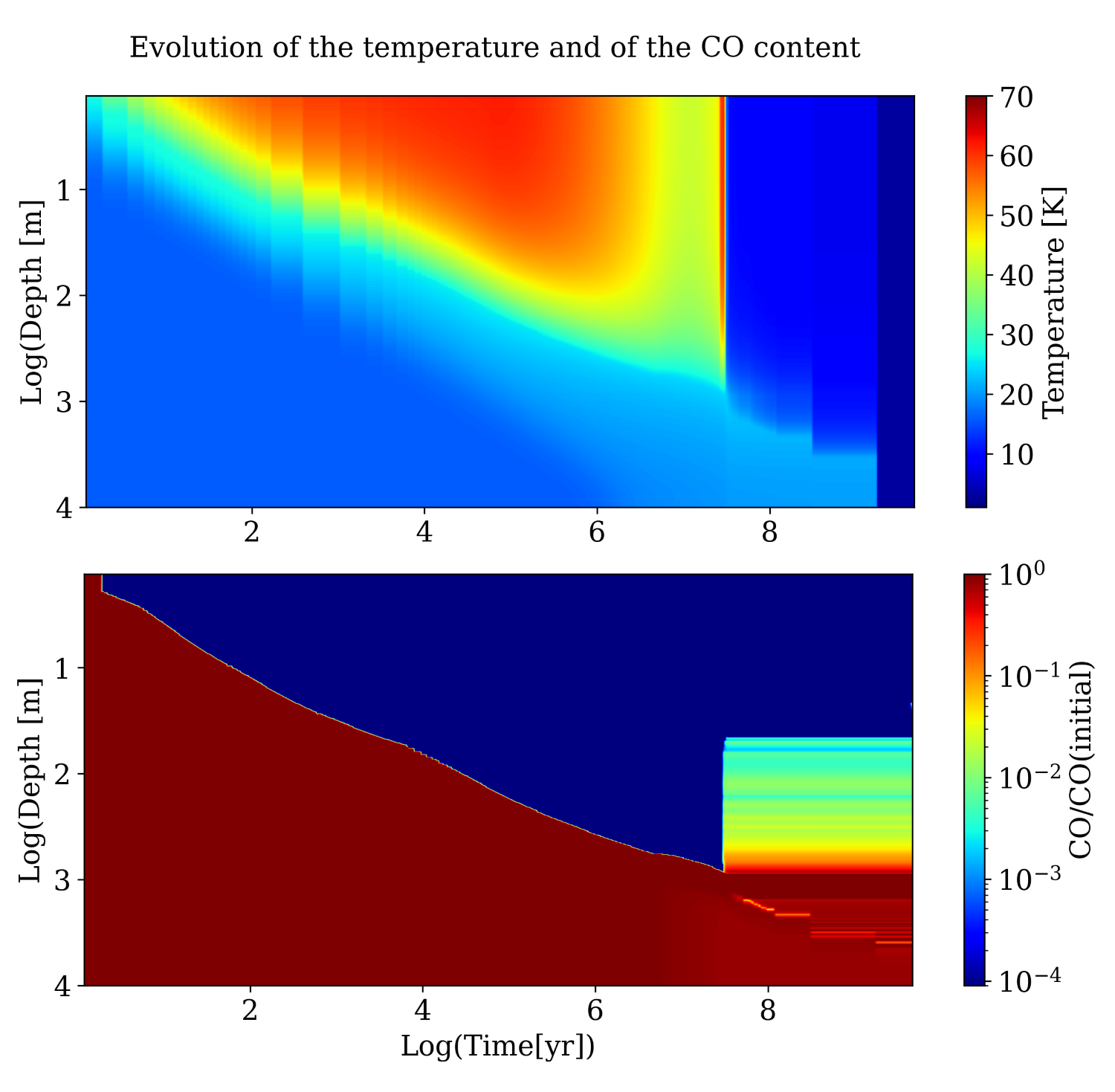
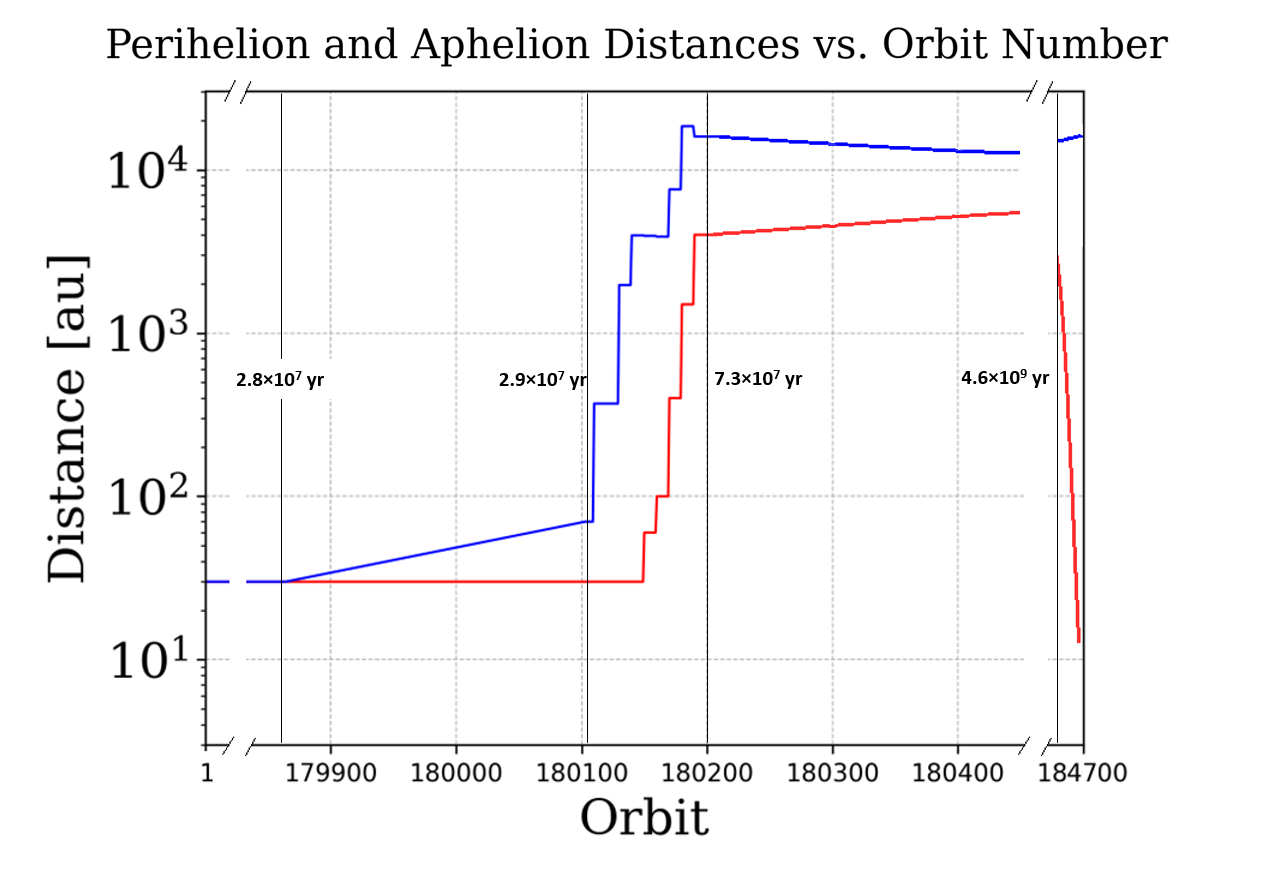
We follow the evolution of a 10 km radius model for 4.5 Gyr, through different epochs, starting in the vicinity of Neptune, moving to the OC and then back inwards to the planetary region. The initial composition includes a mixture of CO, CO₂ ices, amorphous water ice with trapped CO and CO₂ , and dust. The evolution of the eccentric orbits is shown in Fig.1, and the evolution of the temperature is shown in Fig.2. We find that the CO ice is gradually lost during the first 5.5 Myr of evolution, while the CO₂ and the amorphous ice are entirely preserved. Upon return from the OC the activity is driven by CO₂ sublimation, starting around 15 au and slowly declining as the CO₂ sublimation front recedes from the surface. It is rekindled at ~7 au, when the amorphous ice starts crystallizing and releasing the occluded gases.

These results are consistent with observations of LP comets (Meech et al. 2017), although they are not yet meant to simulate the behavior of any particular comet. Future studies will consider the effect of parameters and specific orbits of returning LP comets.


References

Farnham, T. L., Kelley, M. S., et al. (2021). The Planetary Science Journal, 2, 236.

Gkotsinas, A., Guilbert-Lepoutre, A., Raymond, S. N., & Nesvorny, D. (2022). The Astrophysical Journal, 928, 43.

Gkotsinas, A., Nesvorny, D., Guilbert-Lepoutre, A., Raymond, S. N., & Kaib, N. (2024). The Planetary Science Journal, 5, 243.

Guilbert-Lepoutre, A., Gkotsinas, A., Raymond, S. N., & Nesvorny, D. (2023). The Astrophysical Journal, 942, 92.

Lisse, C., Young, L., et al. (2021). Icarus, 356, 114072.

Meech, K. J., Kleyna, J. T., Hainaut, O. R., et al. (2017). The Astrophysical Journal, 849, L8

Parhi, A., & Prialnik, D. (2023). Monthly Notices of the Royal Astronomical Society, 522, 2081.

Prialnik, D., Benkhoff, J., & Podolak, M. (2004). In Comets II, eds. Festou, Keller, & Weaver (p. 359).

Snodgrass, C., et al. (2025). arXiv preprint, arXiv:2503.14071.

Yang, B., Jewitt, D., et al. (2021). The Astrophysical Journal Letters, 914, L17.

Fig.1. Evolution of orbital parameters expressed by aphelion and perihelion distances.

Fig.2. Evolution of the surface temperature, the maximal temperature and the central temperature of the comet model. The surface temperature oscillates between aphelion and perihelion; for the most part, the maximal temperature occurs at the surface, hence the overlap.

Figure 1

Figure 2

How to cite: Parhi, A. and Prialnik, D.: Combined Long-term Orbital and Thermal Evolution Simulations of Oort Cloud Comets, EPSC-DPS Joint Meeting 2025, Helsinki, Finland, 7–13 Sep 2025, EPSC-DPS2025-388, https://doi.org/10.5194/epsc-dps2025-388, 2025.

16:45–17:00
|
EPSC-DPS2025-702
|
ECP
|
On-site presentation
Anhelina Voitko and Oleksandra Ivanova

We present the results of our search for rapid changes in cometary dust color and the investigation of their frequency of occurrence, possible mechanisms, and triggers. Basically, we collected and processed the observational data and explored the previously published reports in order to find and analyse variations in the dust color from red to blue or neutral or vice versa, that occurred in a few days. As the subject of the research, we selected distant comets observed beyond 3 au from the Sun. Contrary to comets orbiting at shorter heliocentric distances, namely Jupiter-family members, the activity of these objects is driven by different mechanisms than water-ice sublimation. There can be annealing or crystallization of water ice, or sublimation of volatiles, even though the contribution of water ice cannot be entirely excluded (1; 2). Another reason for choosing distant comets is that, typically, for research on them, sporadic observations are used, whereas we employed monitoring data (3).

Despite significant progress in the in situ techniques, the remote sensing methods still account for the majority of the gathered knowledge. Among the available techniques, an effective approach is to study the light-scattering response from comets. It enables us to reproduce the properties of coma dust particles that are inherently linked to the nucleus.  One of the key light-scattering characteristics is the color, which reflects the difference in scattering efficiency by dust particles at two different wavelengths or filters. This parameter depends on the size distribution and chemical composition of dust; however, it is insensitive to the number of particles within the aperture (4). Consequently, variations in the dust color may indicate the ongoing processes causing the alternation of particles emanating from the nucleus or in the coma, or generally reflect specific characteristics of the nucleus.

The main part of the work was performed based on the archival observations from the Skalnaté Pleso Observatory (IAU code 056) supplemented by recent observations from this and three other observatories. We managed to collect data for 11 various comets. Among these, 5 revealed some changes in their color during periods of heightened activity (Afρ ≥ 1000 cm) or at the perihelion when their activity peaked. In some cases, the strong activity also supported the appearance of morphological features within the coma. The application of the model of agglomerated debris particles (5) allowed us to estimate specifically how the microphysical properties of dust probably changed. Furthermore, the identified morphological features were reproduced using the geometrical model (6), which allowed for the estimation of the rotation and surface properties of several nuclei.

To extend the research, we have performed a review of the literature published since 1970. It allowed us to compile a database of dust color variations containing more than 200 records, accompanied by multiple parameters. The analysis showed that the majority of color variations were reported for Jupiter-family comets within 3 au. It can be attributed to the higher frequency of observations of these objects and the fact that they maintain relatively high activity levels at such heliocentric distances. Conversely, at larger distances from the Sun, changes in color were primarily reported for long-period and hyperbolic comets. Various authors considered the observed color changes as the result of some alteration of dust. In particular, our estimations of the properties of dust particles are generally in agreement with their findings.

In conclusion, our study showed that dust color variations and the formation of some morphological structures in comae can be triggered by strong activity. The bluer dust color is associated with smaller particles with a higher abundance of water-ice, Mg-rich, or pure Mg silicates, while the redder color can be induced by larger particles or those containing a larger amount of organics, dirty ices, or Mg-Fe silicates.

This work establishes a foundation for future studies. Particularly, there is a necessity for a more detailed investigation of the mechanisms causing the dust color variations. However, they should be addressed through dedicated modeling and further observational campaigns.

References

(1)  Meech K. J. and Svoreň J. Comets II. s.l. : University of Arizona Press, 2004.
(2) Ivanova O., et al. A&A. 2019, Vol. 626.
(3) Ivanova O., et al. Icarus. 2015, Vol. 258, pp. 28 - 36.
(4) Luk'yanyk I., et al. MNRAS. 2019, Vol. 485, 3, pp. 4013-4023.
(5) Zubko E., et al. MNRAS. 2014, Vol. 440, 4, pp. 2928 - 2943.
(6) Kleshchonok V. and Sierks H. Icarus. 2025, Vol. 425.
(7) Guilbert-Lepoutre A., et al. SSR. 2015, Vol. 197, 1 - 4, pp. 271 - 296.
(8) Krishna Swamy K. S. Physics of comets. s.l. : World Scientific, 2010.

How to cite: Voitko, A. and Ivanova, O.: Short-term color changes in comets at large heliocentric distances, EPSC-DPS Joint Meeting 2025, Helsinki, Finland, 7–13 Sep 2025, EPSC-DPS2025-702, https://doi.org/10.5194/epsc-dps2025-702, 2025.

17:00–17:12
|
EPSC-DPS2025-1419
|
On-site presentation
Colin Snodgrass, Carrie E. Holt, Michael S. P. Kelley, Cyrielle Opitom, Aurélie Guilbert-Lepoutre, Matthew M. Knight, Rosita Kokotanekova, Emmanuel Jehin, Elena Mazzotta Epifani, Alessandra Migliorini, Cecilia Tubiana, Marco Micheli, and Davide Farnocchia

We observed the recently discovered long period comet C/2024 E1 (Wierzchos) with JWST at three epochs in 2024 and 2025 as it approaches its perihelion in 2026. These observations, at heliocentric distances of approximately 7, 5 and 3 au, bracket the point where water ice sublimation is expected to begin, and provide a unique insight into the drivers of cometary activity. We use the integral field unit of NIRSpec on JWST to obtain spatially resolved spectroscopy of the comet at each epoch. These observations cover a wavelength range of 0.6 - 5.3 microns, and are sensitive to emissions from the three major drivers of cometary activity: H2O, CO, and CO2

The first epoch was obtained in June 2024 with the comet at 7 au from the Sun. The spectrum (shown in the figure) shows clear CO2 emission but no evidence of water or CO sublimation. At this distance water ice was not expected to sublimate, but the lack of CO emission was surprising, as it is more volatile than CO2. The CO2 production rate was measured to be 2.546 +/- 0.019 x 1025 molecules/s. The spectrum also shows clear absorption features due to water ice. The Fresnel peak at 3.1 microns suggests that this water ice is crystalline, and the spatial distribution of the absorption feature indicates that the ice is on coma particles. The spatial distribution of water ice absorption matches that of the dust (reflected light component), and is distinct from the distribution of the CO2 emission. The dust and ice are asymmetric, extending in the anti-solar direction with a weak clockwise spiral, while the CO2 emission is symmetric around the nucleus. 

The absorption spectrum of the comet’s coma is remarkably similar to the water dominated Centaurs and Trans-Neptunian Objects (TNOs) observed by the large ‘DiSCo’ programme on JWST (e.g. Pinilla-Alonso et al 2025). With the caveat that we observed coma particles rather than the nucleus surface, and that the comet is likely a much smaller body (we find an upper limit nucleus radius of 13.7 km) than those observed in the DiSCo sample, this similarity is intriguing. The DiSCo observed objects and this Oort cloud comet likely formed in a similar region of the disc, but have undergone different evolution since then: the TNOs remained largely at the same distance from the Sun, Centaurs had repeated closer passages (potentially within the water ice sublimation zone if they temporarily transitioned to become Jupiter-family comets), and the comet has been kept in deep freeze in the Oort cloud since it was scattered  there, likely during the era of giant planet formation and migration. The lack of CO emission from C/2024 E1 suggests that it possibly underwent significant thermal evolution (and lost any near-surface CO) during the process of being scattered into the Oort cloud (Gkotsinas et al 2024 predict this to be a common outcome for dynamically new Oort cloud comets); alternatively, it might have formed in a region depleted in CO ice. 

At the time of writing this abstract the second epoch observations have just been taken, and the third epoch is scheduled for July 2025. At EPSC/DPS we will describe the results from the first epoch (details published by Snodgrass et al 2025) and updates from the second and third epochs, in particular whether or not CO emission is seen as the comet approaches the Sun (and presumably deeper layers could become active), when and how water sublimation starts, and how the water ice absorption features change (they are expected to disappear). 

References:

  • Gkotsinas A., Nesvorný D., Guilbert-Lepoutre A., Raymond S. N., Kaib N., 2024, PSJ, 5, 243
  • Pinilla-Alonso N., et al., 2025, Nature Astronomy, 9, 230
  • Snodgrass C. et al., 2025, MNRAS in press (arXiv 2503.14071)

Figure: Spectrum extracted within a 0.4′′ radius aperture centered on the nucleus.

How to cite: Snodgrass, C., Holt, C. E., Kelley, M. S. P., Opitom, C., Guilbert-Lepoutre, A., Knight, M. M., Kokotanekova, R., Jehin, E., Mazzotta Epifani, E., Migliorini, A., Tubiana, C., Micheli, M., and Farnocchia, D.: JWST observations of distant long period comet C/2024 E1 (Wierzchos), EPSC-DPS Joint Meeting 2025, Helsinki, Finland, 7–13 Sep 2025, EPSC-DPS2025-1419, https://doi.org/10.5194/epsc-dps2025-1419, 2025.

17:12–17:24
|
EPSC-DPS2025-2
|
On-site presentation
Bryce Bolin

Comets are relatively pristine remnants of the original planetesimals ejected from the planetary region in the late stages of planetary formation. The Oort cloud comet C/2014 UN271, hereafter UN271, is ~140 km in diameter, large enough to be an intact example of a planetesimal formed in the protoplanetary disk before being ejected into the Oort cloud. UN271 is currently beyond 16 au from the Sun as it moves to a perihelion distance of 11 au in 2031. Given the large heliocentric distance of the comet, the temperatures on and below its surface are too low for efficient sublimation of water ice. Its activity is likely driven by hypervolatiles such as CO or CO2, not H2O. C/2014 UN271 is dynamically new and on its first inbound trip to the Solar System's planetary region, providing the rare opportunity to study the volatile content of one of the original planetesimals in a pristine state. We present JWST/NIRSpec prism IFU observations of UN271 with R~100 covering the spectral range where we can detect emission features from the vibrational bands of the gas-phase all the main volatiles found in comets (such as CO2, CO, and C2H6). Moreover, this range also includes absorption bands of solid-phase water-ice grains. Our observations, taken on December 22, 2022, when the comet was at 18.2 au from the Sun, provide constraints on the comet's CO and CO2 production rates, the activity driving mechanism, the presence and nature of water-ice grains in its coma and can be compared with similar spectra of Kuiper Belt bodies. We will discuss the implications for the timing of the formation of the original planetesimals as well as UN271's formation environment within the primordial Kuiper Belt.

How to cite: Bolin, B.: The volatile content of giant Oort cloud comet C/2014 UN271 during its return to the planetary region, EPSC-DPS Joint Meeting 2025, Helsinki, Finland, 7–13 Sep 2025, EPSC-DPS2025-2, https://doi.org/10.5194/epsc-dps2025-2, 2025.

17:24–17:36
|
EPSC-DPS2025-17
|
On-site presentation
Markku Nissinen, Maria Gritsevich, Marcin Wesołowski, Jorma Ryske, and Alberto J. Castro-Tirado

Abstract

We present a numerical modeling approach for the sublimation flux and dust particle propagation associated with the 2007 outburst of comet 17P/Holmes. This study integrates sublimation physics, effects of particle size and bulk density, and the gravitational and radiative dynamics affecting ejected particles. The model is supported by continued ground-based observations of the comet's dust trail and offers predictions for its long-term evolution. We discuss the results in the context of ongoing observational campaigns and implications for future monitoring of similar cometary outbursts.

1. Introduction

The mega-outburst of comet 17P/Holmes in October 2007 provided a unique opportunity to study dust and gas ejection processes and long-term dynamical evolution of these ejection events. This work focuses on modeling the sublimation-driven mass loss, analyzing the physical properties of ejected material, and simulating the propagation of dust particles influenced by gravitational and radiative forces.

2. Modeling of Sublimation Flux

To estimate the total ejected mass, we developed a numerical model based on observational data, employing Pogson’s law to convert photometric data to mass estimates (Gritsevich et al. 2025). The model accounts for three sublimation regimes: i) dust-covered porous agglomerates, ii) directly exposed porous agglomerates, and iii) sublimation corrected using an anomalous evaporation coefficient. These cases represent varying surface conditions, affecting the sublimation efficiency and consequent dust ejection.

3. Effects of Particle Size and Bulk Density

Outburst events release both gas and dust; however, dust dominates the scattering signal and is thus used as the primary proxy for estimating ejected mass. We simulate mass loss under different sublimation fluxes, focusing on porous ice, organic, and dust agglomerates, each with a 50% active surface fraction. These scenarios enable exploration of the influence of particle composition, size distribution, and density on the mass flux during the outburst phase.

4. Dust Propagation Modeling

A Monte Carlo-based dust dynamics model is constructed to simulate the trajectory and distribution of particles released during the 2007 outburst. The simulation includes solar radiation pressure, planetary perturbations from Venus, Earth-Moon system, Mars, Jupiter, Saturn, and the self-gravity of the comet itself (Gritsevich et al. 2022). The modeling framework utilizes the Orekit Java library and is augmented by Python tools employing the Skyfield library to calculate 3D trail positions (Nissinen et al. 2023b). These tools correct for Earth topography, light-time delay, and atmospheric refraction, with all computations referenced to the J2000 epoch.

5. Observational Campaigns

Continued observations of the 17P/Holmes dust trail provide critical data for model validation. Ground-based telescopes using visible-light imaging and differential photometry techniques such as image subtraction have successfully detected the trail. The first detection occurred in February 2013 at the southern node (Lyytinen et al. 2013), followed by a second campaign targeting the northern node from 2014 through 2015. Recent observations confirm continued visibility of the trail at the northern node (Ryske et al. 2022; Nissinen et al. 2023a). Infrared observations are encouraged to further constrain particle size and composition.

6. Conclusions

This study provides a comprehensive framework for modeling cometary outbursts, from sublimation flux characterization to particle propagation and observational validation. The 2007 outburst of comet 17P/Holmes serves as a benchmark for refining models applicable to future events, improving our understanding of the physical processes driving cometary activity.

References

Gritsevich, M., Nissinen, M., Oksanen, A., Suomela, J., Silber, E. A. (2022). Evolution of the dust trail of comet 17P/Holmes. MNRAS, 513, 2201–2214. https://doi.org/10.1093/mnras/stac822

Gritsevich, M., Wesołowski, M., Castro-Tirado, A. J. (2025). Mass of particles released by comet 12P/Pons-Brooks during 2023–2024 outbursts. MNRAS, 538, 470–479. https://doi.org/10.1093/mnras/staf219

Lyytinen, E., Nissinen, M., Lehto, H. J. (2013). Journal of the International Meteor Organization, 41, 77

Nissinen, M., Gritsevich, M., Ryske, J. (2023a). Recent Observations of the 17P/Holmes Dust Trail. 54th Lunar and Planetary Science Conference (LPI Contrib. No. 2806)

Nissinen, M., & Gritsevich, M. (2023b). Instructions for Ongoing Observations of the Dust Trail from the 2007 Outburst of Comet 17P/Holmes. Zenodo. https://doi.org/10.5281/zenodo.8319474

Ryske, J., Gritsevich, M., Nissinen, M. (2022). Validation of the Dust Trail kit model with the recent observations of the comet 17P/Holmes dust trail (February –March 2022), Europlanet Science Congress 2022, Granada, Spain, 18–23 Sep 2022, EPSC2022-60. https://doi.org/10.5194/epsc2022-60

How to cite: Nissinen, M., Gritsevich, M., Wesołowski, M., Ryske, J., and Castro-Tirado, A. J.: Modeling Sublimation Dynamics and Dust Propagation of Comet 17P/Holmes During its 2007 Outburst, EPSC-DPS Joint Meeting 2025, Helsinki, Finland, 7–13 Sep 2025, EPSC-DPS2025-17, https://doi.org/10.5194/epsc-dps2025-17, 2025.

17:36–17:48
|
EPSC-DPS2025-930
|
ECP
|
On-site presentation
Dar Dahlen, Pablo Lemos, Marius Pfeifer, Nicholas Attree, Raphael Marschall, and Jessica Agarwal

Jupiter-family comet 67P/Churyumov-Gerasimenko was orbited by ESA’s Rosetta spacecraft for more than two years during its 2014-2016 perihelion passage. Rosetta’s scientific camera system OSIRIS repeatedly caught evidence of decimetre-sized chunks of debris leaving the comet’s near-surface environment and travelling the inner coma. The chunks are typically visible as individual point sources, either as bright streaks in single long-exposure images, or as dotted lines in stacks of high-cadence image sequences. The combinations of measured brightness and angular speed allows us to constrain their sizes, speeds, and source regions, if plausible assumptions about their distances and albedos are made (Agarwal et al, 2016).

Pfeifer et al. (2022, 2024) and Lemos et al. (2023, 2024) have developed algorithms to automatically detect and track chunks across images sequences, finding indications that their emission is concentrated in specific regions on the comet and that they leave the surface with an initial speed of about 1 m/s that is not explained by standard coma gas drag formalism.

While these earlier publications each concentrated on a few sets of images, we now aim to analyze the OSIRIS data set more comprehensively. In this presentation we review the available data and discuss their potential for studying the evolution of the chunk emission with time, as the comet approached perihelion and subsequently receded from the sun.


References:

Agarwal, J., A’Hearn, M. F., Vincent, J.-B., et al. (2016) MNRAS, 462, S78

Lemos, P., Agarwal, J., & Schröter, M. (2023) MNRAS, 519, 5775

Lemos, P., Agarwal, J., Marschall, R., Pfeifer, M. (2024), A&A 687, A289

Pfeifer, M., Agarwal, J., & Schröter, M. (2022) A&A, 659, A171

Pfeifer, M., Agarwal, J., Marschall, R., Grieger, B., & Lemos, P. (2024) A&A, 685, A136

How to cite: Dahlen, D., Lemos, P., Pfeifer, M., Attree, N., Marschall, R., and Agarwal, J.: Emission of decimetre-sized debris from comet 67P, EPSC-DPS Joint Meeting 2025, Helsinki, Finland, 7–13 Sep 2025, EPSC-DPS2025-930, https://doi.org/10.5194/epsc-dps2025-930, 2025.

17:48–18:00
|
EPSC-DPS2025-1059
|
Virtual presentation
Theodore Kareta and John Noonan

P/2023 V6 (PANSTARRS) is the second-known active Jupiter co-orbital comet after the well-studied P/2019 LD2 (ATLAS). These two objects, along with other populations like the Gateway Centaurs and those comets temporarily captured by Jupiter, are some of the best analogues for the objects which impact Jupiter and thus their physical properties are of interdisciplinary relevance. Starting in 2023, we began a campaign of telescopic characterization of V6 that culminated in observations with the Hubble Space Telescope in December 2024. While V6 was always dimmer than LD2, even at its slightly warmer perihelion, initial characterization efforts reported in Kareta et al. (2024) suggested that this was most likely due to V6 being physically larger but with a significantly lower active fraction – in essence, it was more ‘evolved’ than LD2. The comet appeared to be experiencing stable (e.g., not outburst driven) activity around peak brightness much like LD2 has been four years prior.

In this talk, we will present our analyses of later ground-based and HST observations which show that the opposite might be true; V6 is very small and was just as active as LD2 was at a similar distance, if not moreso. The HST images are consistent with an object with a diameter of just about a few hundred meters assuming a typical cometary albedo and phase curve, almost certainly the smallest cometary nucleus detected at such a distance. A precipitous decline in brightness and mass loss rates in V6 just months after its perihelion passage, however, is quite unlike its more active cousin and cannot be explained by the object crossing any major ice lines or as an observational bias. We could not detect V6 with any confidence in two nights of ground-based imaging late in 2024 and early 2025, and the HST images don’t appear to show any dust around the point-source-like object at all. This indicates that the objects do still have significant differences in the physical states of their nuclei and in the talk we will present several hypotheses that might be tested through studies of other near-Jupiter comets in the Rubin era. We will also comment on how advances in understanding the properties of these comets might help interpret the cratering record of the Galilean satellites and thus in assessing how often material from impactors gets through the ice to the oceans beneath.

How to cite: Kareta, T. and Noonan, J.: The Orbit and Size of the Active Jupiter Co-Orbital P/2023 V6 (PANSTARRS), EPSC-DPS Joint Meeting 2025, Helsinki, Finland, 7–13 Sep 2025, EPSC-DPS2025-1059, https://doi.org/10.5194/epsc-dps2025-1059, 2025.

Orals WED-OB3: Wed, 10 Sep, 11:00–12:30 | Room Mars (Veranda 1)

Chairpersons: Colin Snodgrass, Oleksandra Ivanova
11:00–11:15
|
EPSC-DPS2025-1108
|
solicited
|
On-site presentation
Henry H. Hsieh, John Noonan, Michael S. P. Kelley, Dennis Bodewits, Marco Micheli, Jana Pittichová, Scott S. Sheppard, Audrey Thirouin, Richard Cannon, Colin O. Chandler, Theodore Kareta, Brian P. Murphy, and Colin Snodgrass

Main-belt comets (MBCs) are small solar system objects that display comet-like activity with characteristics indicative of the sublimation of volatile ices yet have dynamically stable orbits in the main asteroid belt.  Until recently, sublimation has only been inferred as the primary activity driver for MBCs, largely based on observations of recurrent activity near perihelion and the inability of other activity drivers to plausibly account for such behavior over a wide range of objects.  Starting in 2022, however, JWST observations of four active MBCs — 238P/Read, 358P/PANSTARRS, 133P/Elst-Pizarro, and 457P/Lemmon-PANSTARRS — have provided unambiguous spectroscopic evidence of the presence of water vapor sublimation in at least three of these objects: 238P (JWST GTO program 1252; Kelley et al., 2023, Nature, 619, 720), 358P (JWST GO program 4250; Hsieh et al., 2025, PSJ, 6, 3), and 133P (JWST GO programs 4250 and 5551; this work).  These observations have also shown that these MBCs have a striking relative absence of CO2, which is commonly found in other comets with similar water production rates, pointing to MBCs comprising a distinct volatile inventory compared to other classical comets.  The enhanced sensitivity of JWST’s NIRSpec instrument has significantly advanced the study of main-belt comets, shifting the focus from the long-standing question of whether volatile sublimation could be directly detected to now characterizing its properties and examining how they vary across different objects and observing conditions.

We will present and discuss JWST observations of 133P, the archetype of the MBC population, obtained at two positions in its orbit. These observations confirm that the activity is driven by water ice sublimation and continue to show the relative absence of more volatile species, extending the emerging pattern established by 238P and 358P.  JWST NIRCam and NIRSpec observations of 133P were obtained on UT 2024 June 12 and UT 2024 October 14 and 28 when the object was at a true anomaly of 8° and a heliocentric distance of 2.67 au, and a true anomaly of ~40° and a heliocentric distance of ~2.75 au, respectively.  Preliminary measurements show water sublimation rates of Q(H2O)~1025 molecules/s during both sets of observations, while only upper limits were obtained for CO, CO2, and CH3OH sublimation rates.  

We will also present results from optical imaging campaigns conducted for all four JWST-observed MBCs over the courses of their entire corresponding active apparitions from a range of ground-based facilities giving us information on the photometric and morphological evolution of each target over many months before and after their JWST observations.  We will specifically describe efforts to correlate measured water sublimation rates with estimated dust production rates (as parameterized by the Afρ parameter) for comparison to other types of comets, ascertain the feasibility of estimating water sublimation rates for non-JWST-observed comets from Afρ measurements alone, and examine how Afρ/Q(H2O) varies for objects with different physical and orbital properties, and different observational circumstances when observed by JWST.

How to cite: Hsieh, H. H., Noonan, J., Kelley, M. S. P., Bodewits, D., Micheli, M., Pittichová, J., Sheppard, S. S., Thirouin, A., Cannon, R., Chandler, C. O., Kareta, T., Murphy, B. P., and Snodgrass, C.: The Ensemble Volatile Compositional Properties of 133P/Elst-Pizarro and Other JWST-Observed Main-Belt Comets, EPSC-DPS Joint Meeting 2025, Helsinki, Finland, 7–13 Sep 2025, EPSC-DPS2025-1108, https://doi.org/10.5194/epsc-dps2025-1108, 2025.

11:15–11:27
|
EPSC-DPS2025-1231
|
On-site presentation
Xian Shi, Shunjing Zhao, Man-To Hui, Jianchun Shi, and Hanlun Lei

Water ice is the primary volatile component of most comets. Its various forms and abundances across different comets provide critical clues about the formation and evolution of the Solar System, as well as planetary habitability. As comets approach the Sun, rising temperatures trigger the sublimation of surface and subsurface water ice. Within the water snowline, the resulting water vapor dominates the gas coma and acts as the primary driver of dust ejection, forming the dust coma and tail. Studying the spatial and temporal variations in cometary water activity enables us to infer key physical properties, such as nucleus size, porosity, composition, refractory-to-ice ratio, and erosion history.

A fundamental metric of water activity is the global water production rate, which quantifies the total outgassing of water vapor from the nucleus. Accurately interpreting this rate requires high-fidelity thermophysical modelling that accounts for the specific radiative environment surrounding the nucleus. Traditionally, such modelling is conducted by solving one-dimensional heat conduction equations numerically. Although numerous tools have been developed and successfully applied to data from telescopic and space-based observations, conventional numerical approaches are computationally intensive and often struggle with high-resolution shape models or large parameter spaces.

In this study, we present the application of our AI-based thermophysical model, ThermoONet, to the interpretation of cometary water production rates. ThermoONet is a general-purpose neural network capable of modelling a wide range of cometary nuclei with diverse physical characteristics [1]. It achieves comparable accuracy to traditional numerical methods while reducing computation time by five orders of magnitude. We demonstrate the utility of ThermoONet by analysing water production curves of dozens of comets observed by SOHO/SWAN [2]. Through curve fitting, we retrieve key properties such as nucleus sizes, offering new insights into cometary formation and evolutionary processes.

1. Zhao, S., Shi, X. and Lei, H., 2025. ThermoONet: Deep learning-based small-body thermophysical network: Applications to modeling the water activity of comets. Astronomy & Astrophysics, in press.

2. Combi, M.R., Mäkinen, T.T., Bertaux, J.L., Quémerais, E. and Ferron, S., 2019. A survey of water production in 61 comets from SOHO/SWAN observations of hydrogen Lyman-alpha: Twenty-one years 1996–2016. Icarus317, pp.610-620.

How to cite: Shi, X., Zhao, S., Hui, M.-T., Shi, J., and Lei, H.: Interpreting Cometary Water Activity Using the AI-Driven Thermophysical Model ThermoONet, EPSC-DPS Joint Meeting 2025, Helsinki, Finland, 7–13 Sep 2025, EPSC-DPS2025-1231, https://doi.org/10.5194/epsc-dps2025-1231, 2025.

11:27–11:39
|
EPSC-DPS2025-1235
|
ECP
|
On-site presentation
Carrie Holt and Colin Snodgrass

Modern sky surveys are now discovering comets at distances beyond 5 to 10 au from the Sun, a range expected to increase with the upcoming Vera C. Rubin Observatory’s Legacy Survey of Space and Time (LSST). However, the mechanisms driving comet activity at such distances remain poorly understood, as temperatures are too low for efficient water ice sublimation, the usual driver closer to the Sun (within 3–5 au). At these larger distances, activity is likely driven by the sublimation of more volatile ices such as CO and CO2, or by phase transitions in amorphous water ice. But the relative importance of these processes remains uncertain. Understanding the drivers of distant activity is essential not only for modeling the physical evolution of cometary nuclei, but also for interpreting future discoveries and planning future observations, including spacecraft missions like ESA’s Comet Interceptor (Jones et al., 2024). One way to gain insight is through the characterization of the observed brightening behavior of comets as they approach the Sun using well-calibrated photometry over a wide range of heliocentric distances.

As part of the Las Cumbres Observatory (LCO) Outbursting Objects Key (LOOK) Project, we have been monitoring more than 45 long-period comets discovered inbound beyond 5 au using LCO’s global network of 1-meter telescopes since 2020 (Lister et al. 2022; Holt et al. 2024). The LOOK dataset provides frequent, uniform photometric coverage from shortly after discovery through perihelion. Using this dataset, we compare the performance of two empirical models for comet brightening: the traditional power-law model with a constant slope, and a more flexible model in which the brightening rate varies linearly with heliocentric distance. This new model reflects the observed trend that many comets brighten more rapidly at large heliocentric distances, with the rate of brightening decreasing as they approach the Sun (Holt et al., 2024).

We fit both models and perform a statistical comparison on the pre-perihelion lightcurves of a high-quality subset of comets with well-sampled photometric coverage across large heliocentric distance ranges. Model performance is evaluated using residual metrics and standard statistical tools for model selection. Across this sample, we find that the variable-slope model consistently provides a better fit to the data beyond 3 au from the Sun. We will present a comparison of model performance across the sample, highlighting where the variable-slope model is favored. In addition to these sample-wide trends, we will show representative fits to individual comets that illustrate how the flexible model captures early brightening more effectively and is better at predicting future brightness at smaller heliocentric distances based on distant observations (e.g., Figure 1). These examples demonstrate how the model improves both the fit to existing data and the reliability of extrapolated predictions, which is critical for follow-up coordination and mission planning.

We will present the range of fit coefficients and their correlation with other comet parameters (such as absolute magnitude or dynamical type). We will also explore the limitations of both models, especially near the Sun, where increased activity due to water-ice sublimation, outbursts, and seasonal effects introduces additional complexity. Finally, we consider the implications for LSST predictions and how this empirical model can inform target selection for the ESA Comet Interceptor mission.

Figure 1. Example lightcurve of C/2023 A3 (Tsuchinshan–ATLAS), showing observed pre-perihelion heliocentric magnitudes versus heliocentric distance. Overplotted are the fits from the constant-slope model (blue line) and the variable-slope model (orange line). The variable model better captures the brightening behavior at large heliocentric distances.


References: 

Holt, C. et al., 2024, PSJ, 5, 12

Jones, G. et al., 2024, Space Science Reviews, 22, 9

Lister, T. et al., 2022, PSJ, 3, 7

How to cite: Holt, C. and Snodgrass, C.: A New Empirical Brightening Model for Distantly Active Long-Period Comets, EPSC-DPS Joint Meeting 2025, Helsinki, Finland, 7–13 Sep 2025, EPSC-DPS2025-1235, https://doi.org/10.5194/epsc-dps2025-1235, 2025.

11:39–11:51
|
EPSC-DPS2025-1648
|
ECP
|
On-site presentation
Abbie Donaldson, Rosita Kokotanekova, Colin Snodgrass, Stephen Lowry, Isaac Holst, James Robinson, and Agata Rozek

In situ missions to Jupiter-family comets (JFCs) have revealed that the population exhibits a diverse range of physical characteristics, from the shapes of their nuclei to their levels of activity. The nucleus properties of such comets may be dictated by the specific processes that they experience throughout their lifetimes as they evolve from the Kuiper Belt onto confined, short period orbits. Recent studies have linked the erosion of global surface topography with thermal processing close to the Sun [1, 2, 3], and provided evidence that the extent of surface evolution may impact the photometric properties of the nucleus [4]. In addition, the prevalence of bi-lobed shapes among the spacecraft-visited comets has resulted in much speculation on whether or not this configuration can be attributed to formation processes [e.g. 5,6]. However, these findings are all based on measurements for only a handful of JFCs. Our present goal is to extend the number of comets with well-constrained nucleus properties via ground-based observations, in order to test the validity of these predictions.

In this work, we present an analysis of rotational lightcurves acquired for five of the largest JFCs: 137P/Shoemaker-Levy 2, 143P/Kowal-Mrkos, 162P/Siding Spring, 169P/NEAT and 172P/Yeung. The datasets are composed of newly acquired observations in combination with archival lightcurves, providing a long temporal baseline for each comet. For three of the comets in the sample (137P, 143P and 162P) the collected data provided sufficient geometry coverage to derive uniquely-defined models of the shapes and spin states of their nuclei using convex lightcurve inversion: to date, the only other JFC to have been modelled in this way was Rosetta mission target 67P prior to the spacecraft encounter [7]. The new JFC shape models indicate an elongated nucleus for 162P, and more rounded shapes for 137P and 143P. Artificial lightcurves generated using these models suggest lower limits of nucleus elongation (a/b) of 1.82, 1.20, and 1.54 respectively. If the convex shape model properties are representative of the true nucleus elongations, the observed bilobed fraction for all short period comets with well-constrained shapes is reduced from ~71% to 60%, which remains significantly higher than is estimated for other small body populations. 

Using the shape models to correct the lightcurves for rotational modulation, linear phase functions (β) were measured as 0.048 ± 0.01 mag/deg for 137P, 0.048 ± 0.002 mag/deg for 143P, and 0.051 ± 0.002 mag/deg for 162P. Three of the JFCs in our sample were observed at phase angles ɑ < 1° but interestingly none exhibited any evidence for an opposition surge. Using the effective radii of the targets as measured by SEPPCoN [8] and the absolute magnitude extrapolated from the linear phase function fits, we derived geometric albedos (pV) for each comet. These ranged from 0.022 for 162P to 0.046 for 143P, consistent with the dark surfaces typical of JFCs. We will discuss the implications of these findings at the meeting, including anticipated advances resulting from the vast quantities of sparse-in-time photometry that the upcoming Legacy Survey of Space and Time (LSST) at Vera Rubin Observatory will provide [9].

[1] Vincent et al. (2017) MNRAS 469 pp.S329–S338

[2] Benseguane et al. (2022) A&A 668 p.A132

[3] Guilbert-Lepoutre et al. (2023) PSJ 4 p.220

[4] Kokotanekova et al. (2018) MNRAS 479 4 pp.4665-4680

[5] Davidsson et al. (2016) A&A 592 p.A63

[6] Hirabayashi et al. (2016) Nature 534 7607 pp.352-355

[7] Lowry et al. (2012) A&A 548 p.A12

[8] Fernández et al. (2013) Icarus 226 1 pp.1138-1170

[9] Donaldson et al. (2024) PSJ 5 7 p.162

How to cite: Donaldson, A., Kokotanekova, R., Snodgrass, C., Lowry, S., Holst, I., Robinson, J., and Rozek, A.: Determining the shapes and surface properties of low-activity Jupiter-family comets from their rotational lightcurves, EPSC-DPS Joint Meeting 2025, Helsinki, Finland, 7–13 Sep 2025, EPSC-DPS2025-1648, https://doi.org/10.5194/epsc-dps2025-1648, 2025.

11:51–12:03
|
EPSC-DPS2025-1057
|
On-site presentation
Erica Molnar-Bufanda, Karen Meech, Cyrielle Opitom, and Mitchell Dennis

The development of all-sky surveys and the upcoming LSST’s deep, wide-field capabilities will enable the discovery of many more faint and distant comets, allowing them to be tracked from the outer solar system and revealing early activity that was previously undetectable. This opens the door for more comprehensive studies of cometary evolution and volatile-driven activity, particularly for comets beyond the reach of current surveys. With this anticipated influx of consistent, high-quality data, efficient methods of assessing activity are essential. We present the Volatile Activity Monitoring and Prediction (VAMP) model—an adaptable tool that systematically evaluates cometary activity using Bayesian statistics and a range of surface and subsurface sublimation models for volatiles. We demonstrate the model’s effectiveness in recovering key physical parameters, including nucleus size, fractional active area (FAA) for water, CO₂, and CO, and temporal activity characteristics such as fading, delayed onset, outbursts, and quenching. We validate VAMP by recovering physical parameters for short-period comets with independently measured in-situ observations, and test its performance on simulated datasets. VAMP is a versatile framework for assessing and predicting comet activity and will be invaluable for future mission planning, including Comet Interceptor and spectroscopic follow-up campaigns with observatories like JWST.

How to cite: Molnar-Bufanda, E., Meech, K., Opitom, C., and Dennis, M.: Systematic Assessment of Comet Behavior Using the Volatile Activity Monitoring and Prediction (VAMP) Tool, EPSC-DPS Joint Meeting 2025, Helsinki, Finland, 7–13 Sep 2025, EPSC-DPS2025-1057, https://doi.org/10.5194/epsc-dps2025-1057, 2025.

12:03–12:18
|
EPSC-DPS2025-900
|
ECP
|
On-site presentation
Brian Murphy

Abstract
Small bodies of the Solar System can display an array of active behaviors and extended morphologies, such as the sublimation-induced production of transient atmospheres called comae, and the rocky ejecta clouds instigated by impacts or geomorphological surface alterations. These comae and ejecta clouds are visible from Earth, and can therefore provide crucial information about the conditions and composition of the parent body, whether it be an asteroid or comet. Through studying these structures with spatially-resolved integral field unit (IFU) spectroscopy, we can directly disentangle and compare the synchronous gas and dust components, and better understand the activity mechanisms behind their formation and how to more robustly link comae and ejecta clouds to the parent body (Opitom et al, 2019.). Here, we present the culmination of dissertation work on around 900 IFU observations from the Multi-Unit Spectroscopic Explorer (MUSE) instrument at the Very Large Telescope (VLT), highlighting novel findings on the post-Double Asteroid Redirect Test (DART) Didymos-Dimorphos ejecta cloud and the chemomorphological coma evolution of 31 comets, including previous mission targets 9P/Tempel, 19P/Borrelly, 67P/Churyumov-Gerasimenko, 73P/Schwassmann–Wachmann, 81P/Wild, and 103P/Hartley (Murphy et al., 2023; Murphy et al., 2025; Murphy et al., in prep).   

Observations

We observed 31 comets and 1 active asteroid with the MUSE IFU spectrograph, from 2016 to 2024, across ESO programmes: 60.A-9800(T), 0102.C-0395(A), 0102.C-0395(B), 105.2086.001, 105.2086.002, 106.216F.001, 108.223B.001, 109.22ZS.001, 110.23TK.001, 111.24KA.001, 112.25H1.001, 113.269X.001, and 114.28H0.001. MUSE collects spatio-spectral datacubes, which consist of two spatial dimensions and one spectral dimension (x,y,λ). Across these observations, we primarily utilised MUSE in wide field mode (WFM, 1'x1',0.2"/pix), however, employed narrow field mode (NFM, 8"x8", 0.025"/pix) with adaptive optics (AO) for the DART observations. MUSE covers the 4800 to 9300A wavelength range with an average resolving power of 3000 (Bacon et al. 2010). Generally, we exposed MUSE for 600 seconds, used non-sidereal tracking, and rotated by 90° between observations. Standard stars were observed for flux calibration, followed by an O-S-O-O-S-O (O-object, S-sky) pattern for science exposures. The sky observations were positioned around 10 arcminutes from the system to ensure no diffuse contributions from comae or ejecta clouds. We also conducted offset observations for Didymos-Dimorphos, in order to better capture the rapidly evolving tail. We reduced the dataset using the ESO MUSE Pipeline (Wielbacher et al. 2020), ESO Molecfit Package (Smette et al. 2015), and custom continuum- and emission-isolation scripts.

Results

This work demonstrates the efficacy of integral field spectroscopy in resolving the spatial and spectral characteristics of small body activity and extended morphologies across the Solar System. Regarding the Didymos–Dimorphos system, we tracked the post-impact evolution of the ejecta over 11 nights following the DART collision and identified multiple morphological components; the ejecta cone, near-asteroid spirals, late-evolution wings, and dual debris tails. Complimenting other works (Li et al., 2023, Lin et al. 2023, Opitom et al., 2023) the ejecta cone opened at an angle of ~127±1°, the inner spirals corresponded to the binary gravitational dynamics, the bases of the two late-stage dust wings were comprised of grain sizes ~0.05–0.2 mm, and the unexpected secondary tail was detected on October 3 2022, earlier than any other study. We find that the secondary tail widths, position angles, and relative flux slopes indicate a similar origin to the primary tail, i.e. creation via surface impact(s). We tracked distinct clumps of material in the ejecta cloud, and extracted spectral slope measurements that showed redder colors associated with later clumps of larger, slower grains (~0.09m s-1), indicating that the ejecta cloud clumps are structurally or compositionally distinct from the rest of the ejecta cloud and are not line-of-sight apparitions. 

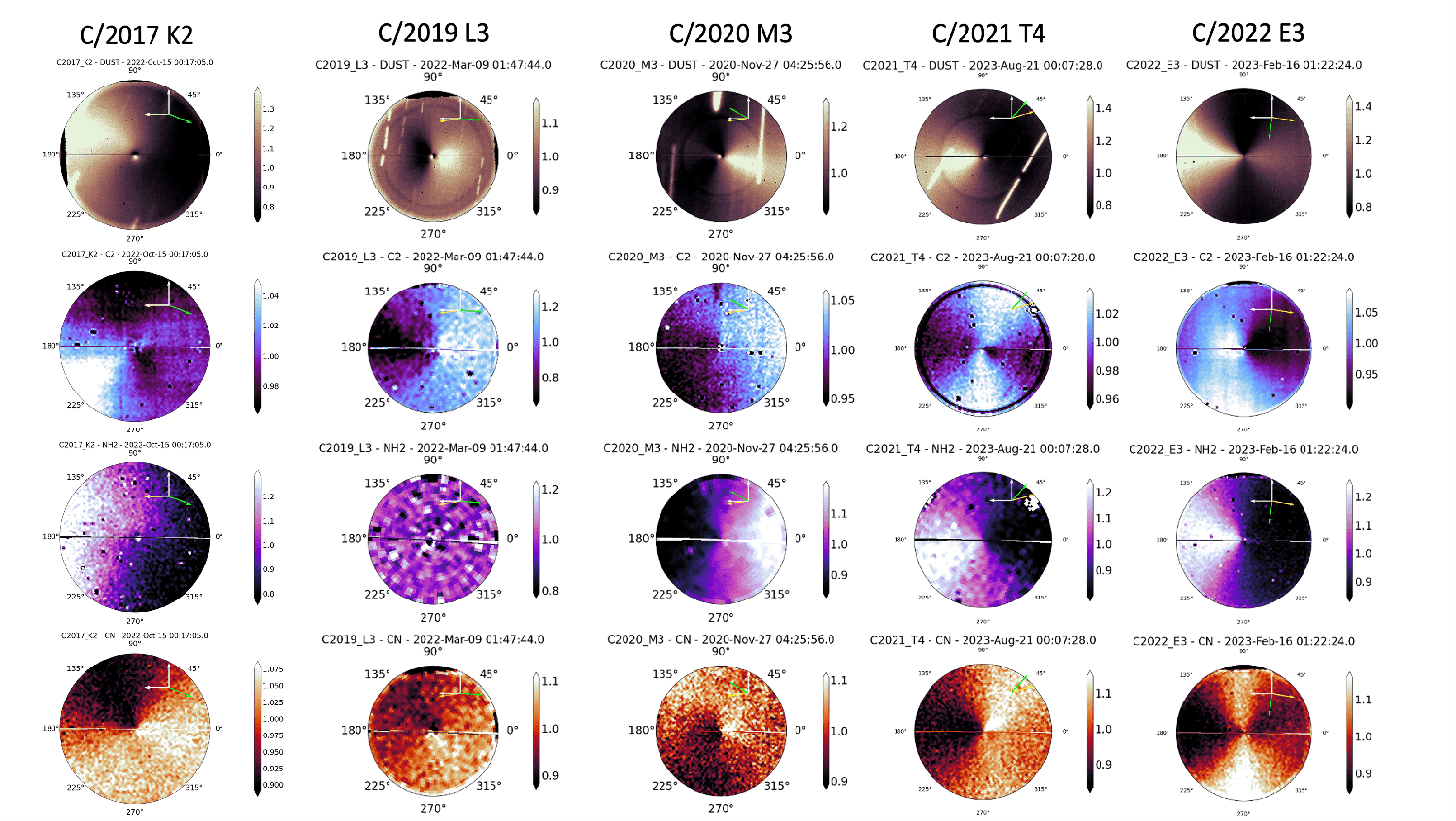
Fig. 1:Molecular and dust maps of five long period comets. All maps have been enhanced by division by azimuthal median, thus removing the diffuse component of the coma. The top row is the dust, the second row is C2, the third row is NH2, the fourth row is CN. North is up, and left is East. The yellow arrow represents the sunward position angle, and the green arrow is the velocity vector. 

Regarding the comets observed with MUSE, we began with comet 67P/Churyumov-Gerasimenko (hereafter 67P) due to the rich in-situ findings and context of the ESA/Rosetta mission (Koschny et al. 2007; Schulz 2012; Taylor et al. 2017). We analysed 11 MUSE epochs from the 2021 perihelion passage of 67P and extracted concurrent coma maps of [OI], C2, NH2, CN, and dust. We found that CN and NH2 emissions were strongly correlated with known dust fans, and retrieved NH2 effective scale lengths up to 1.9x those fitted elsewhere in the coma—supporting the presence of extended sources. Furthermore, dust spectral slopes ranged from 8–18%/1000A , consistent with Rosetta findings, while [OI] green-to-red line ratios (G/R) confirmed H2O as the dominant driver of coma production at the heliocentric distances we probed (G/R ≅ 0.1, 1.2-1.7 au). Looking forward, we are applying the same calibrated methodology to the remaining 30 comets, which span 0.6-19 au and a diverse range of taxonomic and dynamical classes and families. We have isolated similar gas and dust species, and computed spectral slopes, across this sample of comets, resulting in 585 comae maps. Throughout these maps, we find that long period comets exhibit more complex morphologies, with a higher rate of heterogeneous coma structure (~50% of maps), as seen in Figure 1. We do find complex morphologies in the short period comets, however, at a much lower rate of detection and largely homogeneous across species. Further analyses, modeling, and reduction are underway to better understand these trends.

Acknowledgments

The author would like to thank the following collaborators and colleagues for their support or data in these works, and in the dissertation, thus far: Colin Snodgrass, Matthew Knight, Rosita Kokotanekova, Bin Yang, Cyrielle Opitom, Sophie Deam, Lea Ferellec, Jian-Yang Li, Nancy L. Chabot, Andrew S. Rivkin, Simon F. Green, Michele Bannister, Aurélie Guilbert-Lepoutre, Paloma Guetzoyan, Vincent Okoth, Daniel Gardener, and Julia de León. Furthermore, the author highlights funding support from the United Kingdom Science Technology and Facilities Council, Royal Astronomical Society, and International Space Science Institute.

How to cite: Murphy, B.: Toward Understanding the Coma and Ejecta of Comets and Active Asteroids with Integral Field Spectroscopy, EPSC-DPS Joint Meeting 2025, Helsinki, Finland, 7–13 Sep 2025, EPSC-DPS2025-900, https://doi.org/10.5194/epsc-dps2025-900, 2025.

12:18–12:30
|
EPSC-DPS2025-1661
|
On-site presentation
Maxwell Frissell, Colin Chandler, Naomi Morato, Dmitrii Vavilov, Chadwick Trujillo, William Oldroyd, Nima Sedaghat, William Burris, Jay Kueny, Kennedy Farrell, Henry Hsieh, Jarod DeSpain, Pedro Bernardinelli, Mark Magbanua, Scott Sheppard, Michele Mazzucato, Milton Bosch, Tiffany Shaw-Diaz, Virgilio Gonano, and Al Lamperti and the Active Asteroids Team

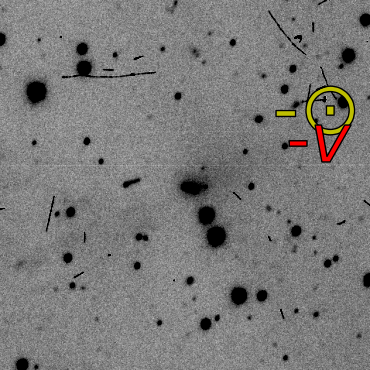
We report the discovery of recurrent cometary activity from minor planet 2017 QN84. Cometary activity on 2017 QN84 was first identified by volunteers of our NASA Partner Citizen Science program, Active Asteroids, hosted on the Zooniverse platform. In the project, volunteers examine archival images of minor planets, searching for cometary activity like comae and tails. Project volunteers identified activity on 2017 QN84 in one Dark Energy Camera (DECam) image from UT 2017 December 23 (Prop. ID 2017B-0307, PI: Sheppard) in the form of a coma and tail (Figure 1). This represents the Active Asteroids project’s first activity discovery by participants, and was originally reported by volunteers on the project's chat forum (Chandler 2022; Chandler et al. 2024)

Further archival searches of images of 2017 QN84 did not discover additional evidence of activity. However, images of the field directly behind 2017 QN84 in the DECam image did not reveal any background source that could have caused 2017 QN84’s apparent coma and tail. This suggests that the UT 2017 December 23 image shows true cometary activity on the object, not an image artifact. With only one known epoch of activity, the underlying cause of the outburst (e.g., sublimation, rotational distribution, impact) could not be constrained. Although, the observed activity was present at heliocentric distance rH = 2.62 au and true anomaly angle f = 38°, consistent with sublimation near perihelion.

As part of our Active Asteroids campaign, we routinely perform follow-up observations of project discoveries at various observatories, including the Astrophysical Research Consortium (ARC) 3.5-meter telescope at Apache Point Observatory (New Mexico, USA) and the Lowell Discovery Telescope (LDT) at Lowell Observatory (Arizona, USA). We observed 2017 QN84 as it approached its December 2024 perihelion passage. On UT 2024 July 14, we detected a short tail emanating from 2017 QN84 in images we acquired with the ARC 3.5-m (Figure 1; observers C. Chandler, M. Frissell) when 2017 QN84 was at f = 312° (Figure 2). We continued to monitor activity through perihelion passage with the ARC 3.5-m and LDT (Figure 3; observer K. Farrell). 2017 QN84 continued to display cometary activity as of UT 2025 April 10, at f = 36°.

We have observed two epochs of cometary activity near perihelion passage from small body 2017 QN84 through the Active Asteroids project and follow-up observations. This suggests that the activity is caused by volatile sublimation. With a Tisserand parameter with respect to Jupiter TJ = 2.943 in the prescribed 2 < TJ < 3 range, we classify 2017 QN84 as a Jupiter-family comet (JFC). JFCs are a dynamically unstable class of comets that originate from the outer solar system and are disturbed inward by interactions with the giant planets. Thus, they hold clues to the current distribution of volatiles in the solar system and how those volatiles are transported into the inner solar system.

Figure 1. This is the DECam image from UT 2017 December 23 (Prop. ID 2017B-0307, PI: Sheppard) where volunteers identified activity. At the time of the exposure, 2017 QN84 was at f = 38°. The yellow and red markers indicate the anti-solar and anti-motion directions, respectively.

Figure 2. The ARC 3.5-m telescope image of  2017 QN84 from UT 2024 July 14 (observers C. Chandler, M. Frissell), where we discovered recurrent activity. In this image 2017 QN84 is at true anomaly angle f = 320°. The yellow and red markers indicate the anti-solar and anti-motion directions, respectively.

Figure 3. An LDT image of 2017 QN84 from UT 2024 October 31 (observer K. Farrell) from our activity monitoring program. At the time of the exposure, 2017 QN84 was at f = 350°. The yellow and red markers indicate the anti-solar and anti-motion directions, respectively.

How to cite: Frissell, M., Chandler, C., Morato, N., Vavilov, D., Trujillo, C., Oldroyd, W., Sedaghat, N., Burris, W., Kueny, J., Farrell, K., Hsieh, H., DeSpain, J., Bernardinelli, P., Magbanua, M., Sheppard, S., Mazzucato, M., Bosch, M., Shaw-Diaz, T., Gonano, V., and Lamperti, A. and the Active Asteroids Team: Reactivation of 2017 QN84, a Jupiter-Family Comet Discovered through Citizen Science, EPSC-DPS Joint Meeting 2025, Helsinki, Finland, 7–13 Sep 2025, EPSC-DPS2025-1661, https://doi.org/10.5194/epsc-dps2025-1661, 2025.

Posters: Tue, 9 Sep, 18:00–19:30 | Finlandia Hall foyer

Display time: Tue, 9 Sep, 08:30–19:30
Chairpersons: Oleksandra Ivanova, Olena Shubina
F187
|
EPSC-DPS2025-12
|
Virtual presentation
Boris R. German

Introduction

The Carrington Event, observed from August 26 to September 7, 1859, was characterised by abnormal geomagnetic disturbances, low-latitude aurorae, and ignitions in the telegraph lines. Researchers believe that interplanetary coronal mass ejections (ICMEs), linked to solar flares on August 28/29 and September 1/2, 1859, caused two impacts on Earth. The second flare [1] was identified as a white-light flare (WLF) in the continuum spectrum. Although no active/geoeffective sunspots/WLFs were recorded on August 28/29, aurorae were observed more widely than on September 2, 1859 [2]. Proponents of the Carrington Event solar origin hypothesis cannot explain the brightness of aurorae, comparable to full moon illumination, nor their isolation in El Salvador on September 2/3, 1859, from other low-latitude aurorae [2]. However, in 1859, astronomers anticipated observing Andromedids meteors and two secondary comets resulting from the fragmentation of Comet 3D/Biela in 1846. The precise date, August 26, and observations of both these secondary comets in 1852 [3] and geomagnetic storms in 1859 [4] suggest a connection between the Biela fragments and the 1859 Carrington Event.

The Aurorae

According to the Smithsonian Institution collection [5], there were reports on Gamma-Andromeda, i.e., Andromedids meteors. Professor Hansteen from Christiania, Norway, observed that the auroral ray was directly related to Gamma-Andromeda. In St. Nottingham, England, an auroral dome near Gamma-Andromeda was reported. Despite poor weather conditions during the Carrington Event, fiery columns were visible in Rome through the clouds. In the USA, observers described fiery arrows flying like a dreadful bombardment, and also a rapidly falling star on 28 August, and eight meteors on 1/2 September. Over Civitavecchia Bay, Italy, sailors directly associated the fiery column with a comet [6], which is consistent with the abnormal geomagnetic disturbance recorded at the Rome Observatory. A meteor exploded over the town Mount Gambier, Australia, prompting an immediate aurora. This explosion, along with the aurora, was also observed in Adelaide [7]. The aurorae brightness in 1859 was equivalent to the surface illumination during a full moon at ~0.2 lux, corresponding to a meteor/fireball luminosity of ~40×109 cd at a distance of ~450 km [2]. Thus, meteor explosions could have caused the Carrington Event aurorae. In 1859, the maximum diameter of the auroral ray bunch was ~20 miles or ~32.2 km [9], and the space corresponding to each visible meteor in the 1885 Andromedids shower was equal to a cube with an edge of ~32.8 km [10]. However, the standard diameter of the auroral ray bunch associated with ICMEs is only ~1 km [8]. In 1868, e.g., meteorites with identical compositions fell in Poland, Madagascar, and Italy [2]. Similarly, the aurorae in 1859 could have been observed due to Andromedids meteors in many locations, including isolated low-latitude areas.

Comets suppress planetary magnetospheres

The magnetic field strength of the ICME’s sheath, reaching a maximum ~40 nT [11], was insufficient for the interplanetary electric field (IEF) during the geomagnetic storm at Colaba on September 2, 1859; furthermore, the Dst profile revealed no indication of a complex storm. Consequently, ICME’s sheath magnetic fields are dismissed as the IEF’s source for the Carrington storm [11,12]. Geomagnetic storms caused by solar flares should have well-known effects on Earth. For instance, the WLF is accompanied by solar energetic particles (SEP) and cosmogenic radionuclides in the atmosphere. The characteristic white aurorae of the Carrington Event should have correlated with high 14C levels associated with SEP [13]. The SEP fluence was estimated as F>30 MeV for the Carrington storm. However, significant levels of cosmogenic nuclides 14C [14,15], 10Be [14], or 36Cl [16], as well as nitrates [17], were not detected in the 1859 deposits. Therefore, the SEP fluence of F>30 MeV is questionable. Although Comet 3D/Biela disintegrated in the 1840s, its two secondary comets and the Andromedids moved along its orbit as a compact group. This group probably contained magnetic components since the Mazapil iron meteorite fell during the 1885 Andromedids maximum. Possessing a magnetic field, either their own or created through ionization by the solar wind, these fragments could suppress the geomagnetic field and trigger geomagnetic storms. On 28/29 August and 1/2 September 1859, geomagnetic storms had exactly a 6-hour period, equal to the 6-hour passage of the 1885 Andromedids when this meteor shower crossed Earth [2]. The external magnetic field required for the Carrington storm on September 2, 1859, was ~90 nT [12]. On Comet 67P/Churyumov-Gerasimenko, the spacecraft recorded a magnetic field of ~300 nT in 2015. Magnetic fields of secondary comets/meteors of Comet 3D/Biela, given both probable iron fragments in them and the compression by WLF plasma on September 1/2, 1859, could have been even stronger. An analogy to the Earth’s intersection with 3D/Biela fragments was the collision of Comet Siding Spring with Mars in 2014, when the cometary magnetic field suppressed the Martian magnetosphere. This collision resembled a solar storm because the cometary plasma density is two orders greater than in the solar wind [2]. Even after the comet left Mars, the spacecraft measured disturbances in the magnetosphere. Similarly, after the historical peak on September 2, 1859, geomagnetic disturbances continued until September 7, 1859.

Comets and solar white-light flares interdependence

As in 1859, the WLF on November 13, 1872, was associated with the Andromedids activation. This suggests a potential connection between solar white-light flares and comets/meteors. The longitudes of orbits of the Sun and 3D/Biela, before the comet's disintegration, were close. This admits their further synchronization [2]. Due to the magnetic field initiated by the Langmuir rotating waves both from the Sun and comets, the pinch-effect mechanism provides dense plasma dust filaments and their activation/discharge over long-range distances. Universum, probably, is permeated with such filaments [18,19].

Conclusion

The conventional paradigm, postulating two ICMEs, cannot explain the aurorae and geomagnetic characteristics of the Carrington Event. However, the interpretation based on the intersection of fragments/meteors from Comet 3D/Biela with Earth successfully explains these phenomena. While the 3D/Biela Comet probably no longer exists, the comets with magnetic nuclei/compositions, possessing enormous electrical charges, threaten our civilization.

References

[1]_R.Carrington_(1859)_https://doi.org/10.1093/mnras/20.1.13

[2]_B.German_(2024)_https://doi.org/10.13140/RG.2.2.10336.19201

[3]_G.Kronk_(1999)_http://cometography.com/pcomets/003d.html

[4]_D.Smart_et_al._(2006)_https://doi.org/10.1016/j.asr.2005.04.116

[5]_E.Loomis_(1860)_https://doi.org/10.2475/ajs.s2-30.88.79

[6]_S.Blake_et_al._(2020)_https://doi.org/10.1029/2019JA027336 (Appendix_B.1)

[7]_J.Green_et_al._(2006)_https://doi.org/10.1016/j.asr.2005.12.021

[8]_G.Baranoski_et_al._(2003)_https://doi.org/10.1002/vis.304 p.47

[9]_E.Loomis_(1861)_https://doi.org/10.2475/ajs.s2-32.96.318 p.322

[10]_H.Newton_(1886)_http://www.meteoritehistory.info/AJS/S3VIEWS/V31P424.HTM (p.425_Summary)

[11]_B.Tsurutani_et_ al._(2003)_https://doi.org/10.1029/2002JA009504

[12]_B.Tsurutani_et_al._(2023)_https://doi.org/10.1029/2022JA031034

[13]_D.Abbot&R.Juhl_(2016)_https://doi.org/10.1016/j.asr.2016.07.015

[14]_I.Usoskin&G.Kovaltsov_(2012)_http://doi.org/10.1088/0004-637X/757/1/92

[15]_J.Uusitalo_et_al._(2024)_https://doi.org/10.1029/2023GL106632

[16]_F.Miyake_et_al._(2023)_https://doi.org/10.1051/swsc/2023030

[17]_E.Wolff_et_al._(2012)_https://doi.org/10.1029/2012GL051603

[18]_W.Thornhill&D.Talbott_(2006)_https://www.thunderbolts.info/pdf/ElectricComet.pdf

[19]_A.Peratt_(2015)_https://link.springer.com/chapter/10.1007/978-1-4614-7819-5_12 

How to cite: German, B. R.: On the connection between Comet Biela and the Carrington Event , EPSC-DPS Joint Meeting 2025, Helsinki, Finland, 7–13 Sep 2025, EPSC-DPS2025-12, https://doi.org/10.5194/epsc-dps2025-12, 2025.

F188
|
EPSC-DPS2025-281
|
ECP
|
On-site presentation
Olena Shubina and Oleksandra Ivanova

Small celestial bodies are believed to contain primordial material from the epoch of Solar System formation. Long-period comets, which, due to their dynamical characteristics, spend most of their time far from the Sun, consist of material barely affected by solar radiation. Moreover, comets entering the inner part of the Solar System for the first time are the most prominent objects for study from this point of view. Research on short-period comets plays a crucial role in understanding the evolutionary processes of cometary matter, as the particles in their comas undergo significant changes due to multiple close encounters with the Sun. Unlike long-period comets, whose materials remain relatively unchanged, the material of short-period comets is transformed by solar radiation, allowing the study of changes in the properties of dust and gas with each perihelion passage. The colour variations observed in these comets serve as indicators of evolution, reflecting various physicochemical processes that affect the composition and structure of the particles.
Comet 41P/Tuttle-Giacobini-Kresák (hereafter 41P) is a short-period comet belonging to the Jupiter family, first discovered by Horace Tuttle in 1858. Then, Michel Giacobini observed the comet in 1907, but the link between the two apparitions was not established until 1928. The periodic nature of 41P was secured in 1951 by Lubor Kresák at Skalnaté Pleso observatory.

We present the results of observations obtained before the 2017 perihelion passage using quasi-simultaneous broadband photometric and polarimetric, and long-slit spectral methods. Such a complex analysis allows us to study the dust and gas components of the comet in greater detail.
The observations of comet 41P were carried out on January 22, 2017, when the heliocentric and geocentric distances of the comet were 1.471 au and 0.506 au, respectively, and the phase angle was 13 degrees.

The multimode focal reducer SCORPIO-2 attached to the prime focus of the 6-m telescope BTA was used. The observations of the comet were obtained in packet mode, which allowed us to make a sequence of exposures to obtain direct CCD images, long-slit spectra, and imaging linear polarimetry. We used the CCD chip E2V-42-90 with 2K × 2K square pixels of 16 µm corresponding to 0.18ʹʹ on the sky plane without binning. Photometric observations of comet 41P were performed through the g-sdss (the central wavelength λ0 and FWHM are λ4650/1300 Å) and r-sdss (λ6200/1200 Å) broadband filters, as well as in a medium-band filter SED500 (λ5019/246 Å). The dichroic polarization analyzer (POLAROID) was used to measure linear polarization in the r-sdss filter. We derived spectra of the comet with a long-slit mask using the transparent grism VPHG1200@540 as a disperser in the spectroscopic mode of the SCORPIO-2. The slit was placed at the nucleus position in the sky and oriented along the comet’s velocity vector. The obtained spectra covered the wavelength range 3600–7070 Å.

Photometry. We estimated the dust activity level using the Afρ parameter. It was about 50 cm in the red domain. The comet also demonstrated typical red colour, based on g-r calculated values. To reveal the low-contrast structures in the dust coma, we constructed an intensity map of comet 41P using digital filters. Based on the distribution map of intensity, we derived the radial profiles of the surface brightness for observed structures to describe the dust brightness as a function of the distance from the optocenter. 

Spectroscopy. We analyzed cometary spectra in the wavelength region of 3800–7000 Å. Significant gas emission lines were detected in the spectra. The strongest features belong to molecules of CN, C2, C3, and NH2. Gas production ratios were calculated for all detected molecules using the Haser model. Also, we estimated the gas contribution in wavelength regions corresponding to broadband filters used for photometric studies. To compare with photometrical results, we also computed a colour slope value based on the spectral data. The results from both methods are in good agreement.

Polarimetry. We analyzed the distribution of linear polarization degree over the coma. This map did not reveal dramatic variation in the linear polarization with cometocentric distance. Such homogeneity could be caused by a steady coma without any prominent active processes.

How to cite: Shubina, O. and Ivanova, O.: Quasi-simultaneous observations of comet 41P/Tuttle-Giacobini-Kresak in 2017 apparition, EPSC-DPS Joint Meeting 2025, Helsinki, Finland, 7–13 Sep 2025, EPSC-DPS2025-281, https://doi.org/10.5194/epsc-dps2025-281, 2025.

F189
|
EPSC-DPS2025-396
|
On-site presentation
James Bauer, Oleksandra Ivanova, Adam McKay, and Gal Sarid

Centaurs, the population of small bodies that occupy the region of our solar system between the orbits of giant planets, are inextricably linked with the phenomenon of cometary activity, including as the direct source of short period comets [1]. The first recognized member of the Centaur population discovered was 95P/Chiron [2], and it was active [3] as discerned from the Centaur’s brightening after its discovery.

We provide a discussion and overview of Centaur activity, as presented in our chapter in the "Centaurs" book by IOP publishing [4]. This includes outbursts, comae, ejections, and disruptions, among other phenomena relating to morphology. The effects of such activity on Centaurs are analyzed in detail, offering insights into their dynamic behavior and evolutionary processes. We explore how these phenomena are observed and interpreted from Earth, providing a valuable perspective on the observational techniques and data analysis methods used in Centaur research. We will also update the material based on more recent observations and present recent studies on more distant activity in Centaurs by the authors [5].

[1] Horner, J., Evans, N. W., & Bailey, M. E. 2004, MNRAS, 354, 798.

[2] Kowal, C. T., Liller, W., & Chaisson, L. J. 1977, IAU Colloq., 3147, 1.

[3] Tholen, D. J., Hartmann, W. K., Cruikshank, D. P., et al. 1988, IAU Colloq., 4554, 2.

[4] Bauer, J., Ivanova, O., McKay, A., and Sarid, G. 2025. Activity, Outbursts and Explosions. in Centaurs, ed. by. Volk, K., Womack, M., and Steckloff, J. IOP Publishing.

[5] Bauer, J. M. et al. 2025. M.P.E.C. 2025-A144.

How to cite: Bauer, J., Ivanova, O., McKay, A., and Sarid, G.: Centaur Activity, Outbursts and Explosions , EPSC-DPS Joint Meeting 2025, Helsinki, Finland, 7–13 Sep 2025, EPSC-DPS2025-396, https://doi.org/10.5194/epsc-dps2025-396, 2025.

F190
|
EPSC-DPS2025-775
|
ECP
|
On-site presentation
Maximus Hood, Tony Farnham, Jessica Sunshine, and Michael Kelley

Cometary dust trails are long-lived streams of large grains ejected from comet nuclei at low velocities and are widely thought to be the major source of outer Solar System material migrating inward. These trails are considered to be one of the primary delivery methods of organic material on Earth and play a key role in replenishing zodiacal dust. However, their study is complicated by the steep size distribution of cometary dust, meaning smaller particles overwhelmingly outnumber larger ones and dominate the scattered sunlight. While radiation pressure quickly removes the smallest grains, the remaining dust trail consists of larger, dimmer particles that require long-exposure imaging to detect. This also means significant telescope time is needed to properly image them. We plan to perform a comparative survey of trails from multiple comets using the Transiting Exoplanet Survey Satellite (TESS).


TESS has revolutionized the field of cometary trail analysis. Although designed to detect transiting exoplanets, the large pixel size and the ability to coadd 27 days of continuous observations make it ideal for detecting faint, extended features like dust trails (Figure 1). TESS’s wide-field coverage (24°×96° per sector) allows us to observe dust trails that extend across multiple sectors. With TESS data we aim to model trail brightness distributions to derive particle sizes and ejection velocities, quantify dust production rates and total mass ejected from comet nuclei, and constrain the mass transport rate of cometary material into the inner Solar System. To date TESS has detected potential trails in 56 comets, 32 of which are in comets that have not previously been known to exhibit dust trails. Previously, 44 comets were known to have trails (Kelley 2021), which means the new comets seen with TESS are likely to double the number of comets with identified trails. 


To analyze this data, we will modify an established data reduction pipeline (Farnham et al.  2021), develop a new automated process for trail extraction and analysis, and adapt an existing dust dynamics model (Kelley 2023). Preliminary results and progress will be reported as the project advances. 

How to cite: Hood, M., Farnham, T., Sunshine, J., and Kelley, M.: A Survey of Cometary Dust Trails in TESS, EPSC-DPS Joint Meeting 2025, Helsinki, Finland, 7–13 Sep 2025, EPSC-DPS2025-775, https://doi.org/10.5194/epsc-dps2025-775, 2025.

F191
|
EPSC-DPS2025-833
|
ECP
|
On-site presentation
Erin Clark, David Trilling, Revanth Munugala, Michael Gowanlock, Savannah Chappus, Maria Chernyavskaya, and Daniel Kramer

Introduction

Large-scale surveys of the sky are increasing the data volume for Solar System science. Deriving properties for a large number of primitive bodies makes it possible to identify rare cases that may offer important clues about the formation and evolution of the Solar System. We present results of our successful search for active asteroids– objects whose physical properties change over time and exhibit comet-like behavior. Asteroid activity is hypothesized to occur with physical instabilities, causing the sublimation of materials off the surface (Jewitt et al. 2012). Using the Solar System Notification Alert Processing System (SNAPS; Trilling et al. 2023) database, we have identified both known and unknown active asteroids, and demonstrated our ability to do so with future surveys, like LSST. 

The Solar System Notification Alert Processing System (SNAPS)

SNAPS is an alert broker that receives and processes data from all-sky surveys, deriving properties for asteroids such as rotation period, absolute magnitude, color, and produces lightcurves. SNAPShot1 (Trilling et al. 2023) ingested Zwicky Transient Facility (ZTF) alert data from 2018 July to 2020 May. SNAPShot1 alone accounts for 31,693 asteroids with a total of 5,458,459 observations. This large scale of data allows for the application of astroinformatics, a cross-disciplinary field that encompasses astronomy, data science, statistics, computer science, among others. The combination of these practices can be used to constrain behaviors for populations of small bodies, as well as statistical outliers. SNAPS plans to ingest the Legacy Survey of Space and Time (LSST) data in a similar fashion, and provide real-time alerts for objects of interest to the science community. LSST will report hundreds of measurements for each of some 5 million asteroids, and the first few months will produce the first LSST measurements of more than a million asteroids. It is important that the community is prepared with tools such as SNAPS to maximize the ability to draw conclusions about Solar System origins and evolution.

Methods

We investigate asteroids that vary in properties such as absolute magnitude and color over time, as well as evaluate postage stamps from the ZTF alert stream. We tested numerous methods to automate the candidate flagging process such as null-hypothesis significance testing and machine learning. Figure 1 shows the null-hypothesis method results, where the null-hypothesis assumes that an asteroid does not change in absolute magnitude over time. We hypothesize that outlier candidates reside in the 10-20-10-5 p-value range, a high probability of not fitting this criterion. Additionally, a Convolutional Neural Network (CNN) model has been trained to linearize postage stamps and classify objects as inactive or active. As shown in Figure 2, one object has a visible tail in the top right quadrant (North-West direction) of the postage stamp. The anti-solar vector aligns closely with the tail’s signature, agreeing with the expectation that comet tails either manifest in the anti-motion or anti-solar direction. This main belt asteroid also shows signs of recurrent activity, appearing elongated in observations taken a year apart.

Current and Future Work

We will continue to search for activity in archival and real-time ZTF observations. Applying similar evaluations to forthcoming LSST data on a nightly basis will allow us to identify other interesting objects, and issue alerts to the science community for follow-up. As LSST begins to release data, we plan on integrating LSST and ZTF results, in search of common targets. In turn, we may constrain outlier behavior for asteroids over the course of multiple epochs, but also be able to identify activity with a singular observation.

Figure 1. Probability-value histogram for all asteroids in SNAPShot1. Lower p-values have a lower probability of satisfying the null hypothesis.

Figure 2. Postage stamp for active asteroid in both minmax scale (left) and z-scale (right). The yellow vector represents the anti-solar vector while the red denotes the anti-motion vector (not to scale). The images are oriented with North up and East to the left.

This work is funded in part by the Arizona Board of Regents Technology and Research Initiative Fund, and by NASA and NSF grants to DET and MG.

Jewitt et al. 2012, AJ, 143, 66

Trilling et al. 2023, AJ, 165, 111

How to cite: Clark, E., Trilling, D., Munugala, R., Gowanlock, M., Chappus, S., Chernyavskaya, M., and Kramer, D.: Active Asteroid Identification with SNAPS in Preparation for LSST, EPSC-DPS Joint Meeting 2025, Helsinki, Finland, 7–13 Sep 2025, EPSC-DPS2025-833, https://doi.org/10.5194/epsc-dps2025-833, 2025.

F192
|
EPSC-DPS2025-858
|
ECP
|
On-site presentation
Daejhanae Smith, Yanga Fernandez, and Charles Schambeau

Past studies have explored the ambiguous boundary between asteroids and dormant comets, emphasizing the subtle differences that make it difficult to distinguish them [1-3]. Within asteroid populations, for example, some bodies have exhibited signs of transient activity, which challenges the common definition of asteroids being inactive bodies, and suggests that at least some may be of cometary origin. Dormant comets contain volatile materials that have been mostly sealed off due to past cometary activity, i.e. due to significant loss of near-surface ices and the accumulation of a fallback dust blanket that form an insulating layer. Consequently, there are dormant comets and asteroids that share physical characteristics, e.g. reflectance, albedo, and polarization [4-6], making it challenging to determine whether a given asteroid is a dormant comet. However, one direct way of testing this is by searching for low levels of activity. A recent analysis of 75 dynamically-selected dormant comet candidates and six near-Sun asteroids applied machine learning techniques to search for activity by comparing predicted and measured V-band brightnesses. From this, only the near-Earth object (NEO) (3552) Don Quixote displayed signs of activity [7]. Further analysis of Spitzer molecular band emission observations confirmed Don Quixote as a weakly active comet [8].

Here we address the complexities of delineating these bodies in a related way by performing a comprehensive search for weak levels of extended emission in archival imaging of dormant comet candidates. We first selected ~ 3700 comet candidates by looking at asteroids in ‘classic’ Jupiter-family comet (JFC)-type orbits that have appropriate Jupiter-MOID values, and that have Tisserand parameters, TJ, < 3. We are currently developing software – the Remnant Emission Survey Tool (REST) – that will be able to automatically search through data archives, retrieve images of dormant comet candidates, and analyze their radial profiles to identify objects with possible extended emission. We will present preliminary results from the initial application of REST to several objects in our candidate list. For now, we are analyzing archival images taken by the Dark Energy Camera (DECam) instrument on the Cerro Tololo Inter-American (CTIO) Blanco 4-meter telescope in Chile [9]. Our study will ultimately be conducted for all the selected candidates, and will be expanded to include additional data archives. We are particularly interested in imaging that samples the gas coma – e.g. V- and g-band imaging at visible wavelengths,  and NEOWISE Channel 2 (4.5 µm) imaging [10]. Here, we will outline the developmental stages of REST, and present further initial findings from its early applications.

Acknowledgements: We extend our acknowledgements to the CTIO Blanco DECam Data Release 1 archive for providing the data utilized in this preliminary study. We also acknowledge support from NASA’s SSERVI program via award 80NSSC19M0214. References: [1] Jewitt, D. & Hsieh, H. H. (2024) in Comets III, 767 [2] Jewitt, D. et al. (2015) in Asteroids IV, 221 [3] Binzel, R. P. et al. (2015) in Asteroids IV, 243  [4] Chamberlin, A. B. et al. (1996) Icarus 119, 173 [5] Fernández, Y. R. et al. (2005) AJ 130, 308 [6] Geem, J. et al. (2022) A&A 658, A158.  [7] Mommert, M. et al. (2020) PSJ 1, 10. [8] Mommert, M. et al. (2020) PSJ 1, 12. [9] Dark Energy Survey Collaboration et al. (2016) MNRAS 460, 1270 [10] Mainzer, A. et al. (2011) ApJ 731, 53.

How to cite: Smith, D., Fernandez, Y., and Schambeau, C.: RESTing Comets: Studying Dormant Comets via a Remnant Emission Survey Tool, EPSC-DPS Joint Meeting 2025, Helsinki, Finland, 7–13 Sep 2025, EPSC-DPS2025-858, https://doi.org/10.5194/epsc-dps2025-858, 2025.

F193
|
EPSC-DPS2025-975
|
ECP
|
On-site presentation
Megan Firgard, Charles Schambeau, Yanga Fernandez, Adam McKay, Michael S. P. Kelley, Olga Harrington Pinto, Sara Faggi, Maria Womack, Geronimo Villanueva, Dominique Bockelee-Morvan, Lori Feaga, Michael DiSanti, James Bauer, and Kacper Wierzchos

Centaurs are small bodies that, compared to age of the Solar System, are located on dynamically unstable, giant planet-crossing orbits between Jupiter and Neptune. Their orbits place them between the icy, distant trans-Neptunian objects (TNOs) and the rapidly sublimating Jupiter-family comets (JFCs), and it is thought that centaurs are one step in the evolution of the former to the latter (e.g., [1, 2, 3]). With this in mind, cometary activity in centaurs is of particular interest for a number of reasons. Perturbed out of the cold storage of the TNO region, these closer, warmer orbits could mean that this is the first time these objects are undergoing phase transitions of key volatile species (e.g., CO, CH4, CO2, amorphous water ice) in their interiors since their formations [4]. While centaurs are generally understood to have an abundance of volatile inventories, the observed diversity of centaur activity behaviors beyond the water ice sublimation line is not well understood. One possible mechanism for this distant activity is the sublimation of other volatile ices, such as CO and CO2 [5]; another one is the crystallization of porous amorphous water ice, which could have stored various amounts of non-water volatiles that are released upon crystallization [6]. Whatever the mechanism at work, one of the keys to understanding the gas-driven mass loss of these objects—the gas itself—has been difficult to observe in many centaurs directly until recently. With its sensitivity, the James Webb Space Telescope (JWST) has made it possible to observe volatile gas species in more centaurs, many of which for the first time [5, 7]. Through these new observations it is possible to analyze both components—the gas and the dust—of the comae around these objects directly through multi-wavelength observing campaigns.   

We present JWST near-infrared (NIR) spectral and Gemini North Telescope visible imaging data of the active centaur 423P/Lemmon (hereafter, 423P). The UT 2022 November 28 JWST spectrum was collected with Near Infrared Spectrograph (NIRSpec) in integral field unit (IFU) mode with the low-resolution PRISM/CLEAR disperser-filter combination [8]. The target and dedicated background observations were collected with the 4-point dither pattern. The data span the entire 0.6 - 5.3μm wavelength range of the NIRSpec instrument, which includes regions where CO, CO2, and H2O (common gas comae species) are known for fluorescence. The Gemini data were collected between 2019 - 2024 using the Gemini Multi-Object Spectrographs (GMOS) in imaging mode to monitor the dust coma’s secular lightcurve behavior. The combination of long baseline dust activity monitoring with snapshot gas comae measurements has been limited for active centaurs, especially for a relatively small one such as 423P (radius ~ 1.5 km) [9]. A multi-wavelength characterization of 423P such as this, in combination with similar studies of more active centaurs in general utilizing JWST observations (see, e.g., [5]), opens the door for future detailed thermophysical modeling investigations targeted at understanding the nature of the interiors of these objects.  

Our results focus on analysis of the gas species in the JWST data, with the Gemini data providing us with a long-term baseline understanding of the dust characteristics and behavior. We present an extracted NIR reflectance spectrum of 423P and provide estimates of the gas production rates (or their upper limits, in the case of non-detections) of common gas species.  Preliminary analysis shows that CO2 emission is present in the spectrum, with CO and H2O emission being more ambiguous. The format of the JWST datacubes allow us the unique opportunity to see the spatial distribution of gas and dust around the centaur through the examination of individual datacube slices at specific wavelengths that those particles are known to contribute at. We present preliminary analysis of gas and dust coma morphologies, the latter in the context of the Gemini data. We discuss how these morphologies could relate to activity mechanisms occurring on the nucleus. We also place this study of 423P in context with previous observations as well as compare it to other centaurs, TNOs, and JFCs.  

References: [1] Levison, H. F., & Duncan, M. J., 1997, Icarus, 127, 13. [2] Fraser, W. C., et al., 2024, Comets III, ed. K. J. Meech, M. R. Combi, D. Bockelee-Morvan, S. N. Raymond, & M. E. Zolensky, 121–152. [3] Guilbert-Lepoutre, A., et al., 2023, ApJ, 942, 92. [4] Jewitt, D., 2009, AJ, 137, 4296. [5] Harrington Pinto, O., et al., 2023, PSJ, 4, 208. [6] Meech, K. J., & Svoren, J., 2004, Comets II, ed. M. C. Festou, H. U. Keller, & H. A. Weaver, 317. [7] Pinilla-Alonso, N., et al., 2024, A&A, 692, L11. [8] McKay, A., et al., JWST Proposal Cycle 1, ID. #2416. [9] Schambeau et al., 2021, IAU CBET #4992.

How to cite: Firgard, M., Schambeau, C., Fernandez, Y., McKay, A., Kelley, M. S. P., Harrington Pinto, O., Faggi, S., Womack, M., Villanueva, G., Bockelee-Morvan, D., Feaga, L., DiSanti, M., Bauer, J., and Wierzchos, K.: JWST Observations of the Active Centaur 423P/Lemmon: Gas and Dust Comae Characterizations, EPSC-DPS Joint Meeting 2025, Helsinki, Finland, 7–13 Sep 2025, EPSC-DPS2025-975, https://doi.org/10.5194/epsc-dps2025-975, 2025.

F194
|
EPSC-DPS2025-1544
|
ECP
|
On-site presentation
Maélie Coutelier, Andreas Nathues, Ranjan Sarkar, Martin Hoffmann, Jan Hendrik Pasckert, and Nico Schmedermann

Ceres is the only dwarf planet of the inner Solar System, locater in the main asteroid belt as a mean solar distance of 2.8 AU. The DAWN spacecraft explored Ceres between 2015 and 2018. Its onboard Framing Camera (FC) and the reflectance Spectrometer (VIR) mapped the entire illuminated surface between 0.4 and 4 µm. Ceres is very dark, with an average albedo below 0.1.

VIR data revealed the predominantly presence of (Mg-NH4) phyllosilicates and (Mg-Ca) carbonates on the Cerean surface. In a number of craters, bright faculae indicate the presence of ammonium salts (NH4Cl), halite (NaCl) and Na-carbonates as for example in the prominent Occator crater. These materials and salts are originating from endogenic processes, partly caused by cryovolcanism activity, indicating the presence of a brine layer underneath the surfac. Ahuna Mons, a prominent topographic elevation in the southern hemisphere, is a further identified cryovolcanic surface feature also showing Na-carbonates and salts.

By combining findings of geomorphology, surface composition analysis and surface age dating, we are able to identify traces of past cryovolcanism on the Cerean surface and expect to shed light into the evolution of the brine composition using the age of the flows. Among a few prominent crater candidates, we focused our study on Ikapati.

Ikapati has a diameter of 48 km, centered at 33°N 45°E. Its geomorphology, potential cryovolcanic features (pits, flows, fractures) and surfaces ages were studied by (Krohn et al., 2016; Schmedemann et al., 2016; Pasckert et al., 2018; Sizemore et al., 2019) using FC imagery. The type and absorption band parameters of the carbonates of this area was studied by (Carrozzo et al., 2018; Raponi et al., 2019).

In our present study we use the aforementioned methods to characterize the Ikapati crater in detail to establish when possible a chronology of the cryovolcanic features and an evolution in the brine layer composition.

We used the VIR infrared dataset, corrected following (Carrozzo et al., 2016; Ciarniello et al., 2017, 2020), and the clear filter FC LAMO mosaic processed by MPS. We calculated the absorption band depth of the main absorptions features in Ceres spectra, at 2.73, 3.06, 3.47 and 3.96 µm using the formula from (Viviano et al., 2014), as well as the slope between 2.42 and 1.7 µm (Figure 1). Figure 2 is a color composition of the crater Ikapati using VIR HAMO images.

Figure 1 : Exemple of VIR spectral profile (I/F as a function of the wavelength in µm) at the central peak of Ikapati. The blank spaces correspond to detectors limits. Orange lines are the continuum considered to calculate the absorption band depth between the shoulders of the absorption. The dashed lines show the wavelengths at which the band depths is calculated. The red, green and blue vertical lines correspond to figure 2 selected wavelengths.

We can observe different compositions between the smooth and pitted terrains south of the central peak, and south-west of the crater (light blue), the central peak and the west of the crater (light orange) due to carbonates (Carrozzo et al., 2018), the north-west ridge (brown), the south of the crater (olive), and the northern plateau of the crater (lilac). According to Pasckert et al., (2018), the carbonate deposits range from 20 Myr around the central peak to 29 Myr at the west of the crater using the ADM crater counting method. The olive patches are around 27 (left) and 43 (right) Myr. This give us confidence in being able to observe an evolution in the composition depending on the age of the surface.

Figure 2 : color composition with a resolution of 350m/pxl (R : 2.43,  V : 3.055, B : 3.97 µm ) of Ikapati, overlaid with the HAMO FC mosaic. The VIR cubes used from the HAMO mission phase are  VIR_IR_1B_1_494727886_ 1, VIR_IR_1B_1_498127790_1, VIR_IR_1B_1_494794304_1, VIR_IR_1B_1_495678838_ 1, VIR_IR_1B_1_495743991_ 1, VIR_IR_1B_1_511816236_1, VIR_IR_1B_1_495743991_1.


References

Carrozzo, F.G. et al. (2016) ‘Artifacts reduction in VIR/Dawn data’, Review of Scientific Instruments, 87(12), p. 124501. Available at: https://doi.org/10.1063/1.4972256.

Carrozzo, F.G. et al. (2018) ‘Nature, formation, and distribution of carbonates on Ceres’, Science Advances, 4(3), p. e1701645. Available at: https://doi.org/10.1126/sciadv.1701645.

Ciarniello, M. et al. (2017) ‘Spectrophotometric properties of dwarf planet Ceres from the VIR spectrometer on board the Dawn mission’, Astronomy & Astrophysics, 598, p. A130. Available at: https://doi.org/10.1051/0004-6361/201629490.

Ciarniello, M. et al. (2020) ‘Ceres observed at low phase angles by VIR-Dawn’, Astronomy & Astrophysics, 634, p. A39. Available at: https://doi.org/10.1051/0004-6361/201936492.

Krohn, K. et al. (2016) ‘Cryogenic flow features on Ceres: Implications for crater‐related cryovolcanism’, Geophysical Research Letters, 43(23). Available at: https://doi.org/10.1002/2016GL070370.

Pasckert, J.H. et al. (2018) ‘Geologic mapping of the Ac-2 Coniraya quadrangle of Ceres from NASA’s Dawn mission: Implications for a heterogeneously composed crust’, Icarus, 316, pp. 28–45. Available at: https://doi.org/10.1016/j.icarus.2017.06.015.

Raponi, A. et al. (2019) ‘Mineralogy of Occator crater on Ceres and insight into its evolution from the properties of carbonates, phyllosilicates, and chlorides’, Icarus, 320, pp. 83–96. Available at: https://doi.org/10.1016/j.icarus.2018.02.001.

Schmedemann, N. et al. (2016) ‘Timing of optical maturation of recently exposed material on Ceres’, Geophysical Research Letters, 43(23), p. 11,987-11,993. Available at: https://doi.org/10.1002/2016GL071143.

Sizemore, H.G. et al. (2019) ‘A Global Inventory of Ice-Related Morphological Features on Dwarf Planet Ceres: Implications for the Evolution and Current State of the Cryosphere’, Journal of Geophysical Research: Planets, 124(7), pp. 1650–1689. Available at: https://doi.org/10.1029/2018JE005699.

Viviano, C.E. et al. (2014) ‘Revised CRISM spectral parameters and summary products based on the currently detected mineral diversity on Mars’, Journal of Geophysical Research: Planets, 119(6), pp. 1403–1431. Available at: https://doi.org/10.1002/2014JE004627.


How to cite: Coutelier, M., Nathues, A., Sarkar, R., Hoffmann, M., Pasckert, J. H., and Schmedermann, N.: Ikapati crater on Ceres: potential past cryogenic activities and brine layer evolution, EPSC-DPS Joint Meeting 2025, Helsinki, Finland, 7–13 Sep 2025, EPSC-DPS2025-1544, https://doi.org/10.5194/epsc-dps2025-1544, 2025.

F195
|
EPSC-DPS2025-1784
|
ECP
|
On-site presentation
Goldy Ahuja, Shashikiran Ganesh, Agnes Fienga, Aravind Krishnakumar, and Zach Murray

Comets are primitive small bodies that are mainly distributed in two big reservoirs, i.e., the Kuiper Belt and the Oort Cloud. The Oort Cloud is the source of the Long-Period Comets, hereafter LPCs, having isotropic inclinations. Dynamically New Comets, hereafter DNCs, are a subset of the LPCs having the semi-major axis greater than 10000 au [1]. These comets are called new because they have never been to the inner solar system before. Understanding these comets can give us insights into the evolution of the early solar system.  The origin of the DNCs, is still an open question.

In this work, we compare two DNCs, coming into the inner solar system for the very first time. Comet C/2020 V2 (ZTF), hereafter comet V2, had a perihelion distance of 2.28 au (8th-May-2023), while comet C/2023 A3 (Tsuchinshan-ATLAS), hereafter comet A3, had a perihelion distance of 0.39 au (27th-Sept-2024). On comparing the molecular band production rate ratios using spectroscopic and photometric techniques,  comet V2 is found to be typical in carbon composition (Ahuja et al., in preparation), while comet C/2023 A3 (Tsuchinshan-ATLAS), hereafter comet A3, is found to be depleted in carbon composition (Atel #16637, [2]). 

Both comets, V2 and A3, are in hyperbolic orbits as mentioned on the NASA JPL Horizons webpage.  Comet V2 has a heliocentric eccentricity of 1.000949 with an uncertainty of 0.0000027 or at almost 352σ level at the solution date of 28 Aug 2022, and comet A3, at the solution date of 01 Mar 2024, has a heliocentric eccentricity of 1.00012 with an uncertainty of 0.0000004 or at almost 300σ level. This shows that the comets are, presently (post-perihelion), in an unbound orbit. To understand these comets’ past and future, we have used the REBOUND simulation package [3] and run the simulation in the past and future for 1 million years. This is done to see whether the comets were bounded or unbounded prior to this perihelion passage.  To predict the nature of the orbit from this numerical simulation, we have used statistical methods and created 1000 clones by applying a multivariate distribution using the covariance matrix provided by the NASA JPL Small Body Database (SBDB) [4]. We have dynamically evolved these massless clones in the past and future, and then calculated the velocity parameter, which is the difference between the barycentric velocity calculated 1 million years ago and the escape velocity, which is calculated at the distance the clones reached at that time. The variation of the velocity parameter is used to calculate the probability of the comet being bound to the solar system or the comet being an interstellar interloper in the past.

Figure 1:  Distribution of radial distance (in au) vs time (in million years) for 200 massless clones of comet V2 integrated backwards to 1 million years. 


Figure 2: Distribution of radial distance (in au) vs time (in million years) for 200 massless clones of comet A3 integrated backwards to 1 million years. 


In Figure 1, we have plotted the radial distance vs time for the 200 massless clones of comet V2, integrated backwards for 1 million years. As shown in the figure, there is no interaction of comet V2 with the planets prior to the current apparition. We have also calculated the radial velocity of the comet V2  and used it to calculate the velocity parameter. The velocity parameter is the difference between the barycentric velocity and escape velocity in units of escape velocity. The distribution of the velocity parameter is between -0.48 to -0.41, which shows that the comet is bounded.

Similarly, Figure 2 shows the radial distance vs time for the 200 massless clones of comet A3 integrated backwards for 1 million years.  The velocity parameter is found to be -0.17 to -0.12, which also shows comet A3 to be bound to the solar system in the past.  

From our simulations, we conclude that the comets V2 and A3, now in hyperbolic orbits, were bound to the solar system in the past.


Acknowledgement:

We acknowledge the local staff at the Mount Abu InfraRed Observatory for their help. We thank the staff of Indian Astronomical Observatory, Hanle and Centre For Research & Education in Science & Technology, Hoskote that made these observations possible. The facilities at IAO and CREST are operated by the Indian Institute of Astrophysics, Bangalore. Work at Physical Research Laboratory is supported by the Department of Space, Govt. of India.

This work is a result of the bilateral Belgo-Indian projects on Precision Astronomical Spectroscopy for Stellar and Solar system bodies, BIPASS, funded by the Belgian Federal Science Policy Office (BELSPO, Government of Belgium; BL/33/IN22_BIPASS) and the International Division, Department of Science and Technology, (DST, Government of India; DST/INT/BELG/P-01/2021(G)).


References:

[1] Completing the Inventory of the Solar System, Levison H. F., 1996,  Astronomical Society of the Pacific Conference Proceedings, 107, 173.

[2] Molecular gas production rates of Comet C/2023 A3 (Tsuchinshan-ATLAS)., Ahuja, G., Aravind, K., Sahu, D., Jehin, E., Donckt, M.V., Hmiddouch, S., Ganesh, S., Sivarani, T., 2024. In: The Astronomer’s Telegram. p. 16637.

[3] REBOUND: an open-source multi-purpose N-body code for collisional dynamics, H.  Rein, S.-F.  Liu, A&A 537 A128 (2012), DOI: 10.1051/0004-6361/201118085

[4] Spectroscopic and dynamical properties of comet C/2018 F4, likely a true average former member of the Oort cloud, J.  Licandro, C.  de la Fuente Marcos, R.  de la Fuente Marcos, J.  de León, M.  Serra-Ricart, A.  Cabrera-Lavers, A&A 625 A133 (2019), DOI: 10.1051/0004-6361/201834902

How to cite: Ahuja, G., Ganesh, S., Fienga, A., Krishnakumar, A., and Murray, Z.: N-Body Simulations of two Dynamically New Comets with different compositional characteristics, EPSC-DPS Joint Meeting 2025, Helsinki, Finland, 7–13 Sep 2025, EPSC-DPS2025-1784, https://doi.org/10.5194/epsc-dps2025-1784, 2025.

F196
|
EPSC-DPS2025-2006
|
On-site presentation
Comet Science with NEO Surveyor
(withdrawn)
Yoonyoung Kim, Amy Mainzer, James Bauer, Yan Fernandez, Yuna Kwon, Joseph Masiero, Jana Pittichová, Paul Abell, W. Garrett Levine, and Serina Diniega and the NEO Surveyor Team