
 1,1,1,5,6,7
- 1Johns Hopkins University Applied Physics Laboratory, Laurel, USA (carolyn.ernst@jhuapl.edu)
- 2Planetary Science Institute, Tucson, USA
- 3DLR Institute for Planetary Research, Berlin, Germany
- 4Budapest University of Technology and Economics, Budapest, Hungary
- 5University of Tokyo, Tokyo, Japan
- 6Université Côte d'Azur, Observatoire de la Côte d'Azur, CNRS, , Lab. Lagrange, Nice, France
- 7ESA/ESAC, Madrid, Spain
While there has never been a dedicated spacecraft mission to Deimos, several Mars-focused spacecraft have imaged the small moon. The spacecraft orbits, number of imaging opportunities, and tidally locked state of Deimos have limited the spatial coverage of the surface. The anti-Mars side, in particular, has had few imaging opportunities. The first Deimos shape model to resolve geologic features (Ernst et al., 2023) was created with the stereophotoclinometry method (Gaskell et al., 2008, 2023) using 332 images from cameras on five spacecraft (four missions): the Viking Orbiter Visible Imaging Subsystem (VIS) (four cameras, two on each spacecraft, Viking Orbiter 1 and 2), the Mars Global Surveyor (MGS) Mars Orbiter Camera (MOC) narrow-angle camera, the Mars Express (MEX) High Resolution Stereo Camera super resolution channel (hereafter, SRC), and the Mars Reconnaissance Orbiter (MRO) High Resolution Imaging Science Experiment (HiRISE). All of those data are publicly available, through either the NASA Planetary Data System or the European Space Agency Planetary Science Archive. (Images taken by the Emirates eXploration Imager (EXI) on board the Hope probe were acquired after the construction of the Deimos shape model and were not included in that effort; the images would significantly improve the anti-Mars side of the model, but are not publicly available.)
The global shape model of Deimos has a ground sample of 20 m, though most of the images used to make the model were of coarser resolution. Figure 1 illustrates the limbs and SPC maplets (localized digital terrain maps) that were used to construct the model. Although some regions of Deimos still lack good limb observations, the bulk of its shape has been well constrained by limbs. About half of the body was imaged sufficiently to support the construction of SPC maplets, which allow the topographic modeling of geologic features and provide additional fidelity to the overall shape of the moon. This Deimos shape model and with co-registered images from Viking and SRC are available publicly in the Small Body Mapping Tool (SBMT; sbmt.jhuapl.edu).
On 12 March 2025, the Hera spacecraft performed a Mars flyby on its way to rendezvous with the asteroid Didymos (Michel et al., 2022). During the flyby, the Asteroid Framing Cameras (AFC) acquired several images of Deimos, centered on its anti-Mars hemisphere. The best six images captured Deimos at pixel scales ranging from 86–111 m (in family with most of the SRC images used in the model) and phase angles ranging from 13–17º. These images are well suited to detect albedo information, but are less useful for morphological assessments. Figure 2 shows a comparison between the outlines of Deimos in one of the highest-resolution AFC images and of the current shape model rendered to match the image. The side of the shape that was well-constrained matches well with the image. The side that was poorly constrained differs, showing that the AFC images can help to improve our knowledge of Deimos’s bulk shape and volume.
We have co-registered the highest-resolution AFC images to Viking images that were part of the solution for the current shape model and have started to incorporate the AFC images into SPC maplets of the anti-Mars side of Deimos. Figure 1 shows the areas of the model where the AFC images have provided new limbs and additional SPC maplet coverage. We will present an updated shape model of Deimos that incorporates the AFC data. We will discuss changes relative to prior shape models and address any subtle changes in the bulk physical attributes of the object, in preparation for the arrival of JAXA’s Mars Moon eXploration mission (Kuramoto et al., 2022) that will observe both Phobos and Deimos.
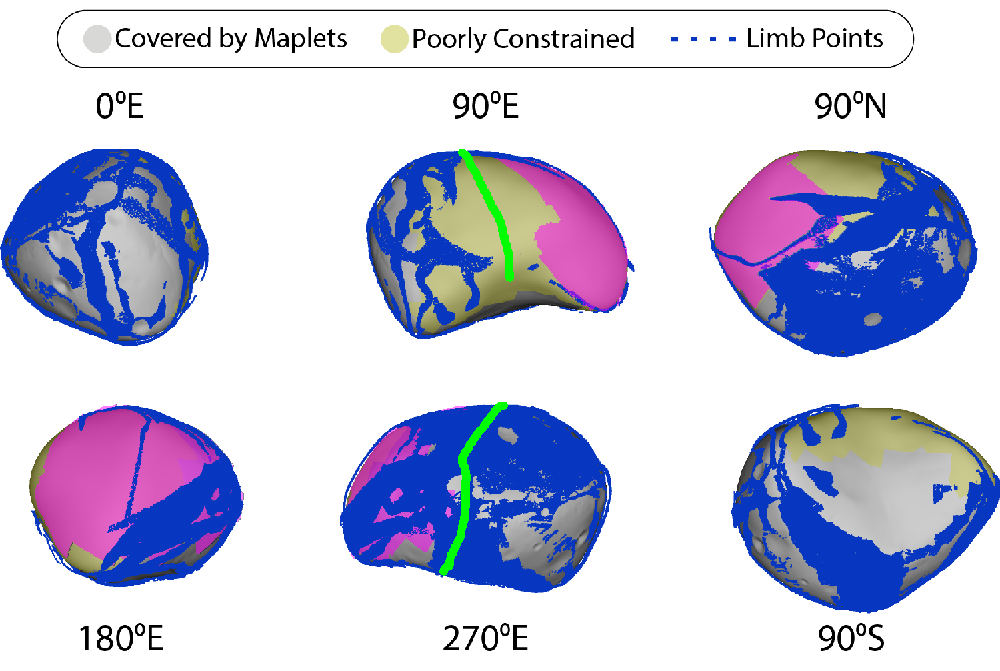
Figure 1. The current global SPC shape model of Deimos (Ernst et al. 2023), seen along the axes and rendered without albedo. The global model has an average resolution of 20 m per facet, a total of over 3 million facets, and was constructed from 332 images. Areas shaded yellow are constrained only by limbs. The blue limb points have been radially offset slightly above the body to aid visibility. Pink areas and green lines indicate where new SPC maplets and new limbs, respectively, are enabled by the Hera AFC images. The new limb visible in the 90ºE view in particular provides an important new constraint on the shape.
Figure 2. Comparison between the outline of Deimos in AFC image AF1_0CRROB_250312T120825_1B (green) and the outline of the existing Deimos shape model (blue) rendered to match the image. The right side of the shape, which was well constrained by maplets and limb points, matches well with the new image. The left side of the shape, which was poorly constrained, shows a mismatch that will be improved by incorporating the AFC limbs into the solution.
How to cite: Ernst, C., Barnouin, O., Daly, T., Gaskell, R., Vincent, J.-B., Kovács, G., Sugita, S., Michel, P., and Küppers, M.: Refining the Deimos Shape Model with Hera Asteroid Framing Cameras Observations, EPSC-DPS Joint Meeting 2025, Helsinki, Finland, 7–12 Sep 2025, EPSC-DPS2025-1668, https://doi.org/10.5194/epsc-dps2025-1668, 2025.


