
 1,1,1,1,3,4,
- 1German Aerospace Center (DLR), Institute of Space Research, Berlin, Germany (Nicolai.Krybus@dlr.de)
- 2Department of Earth and Planetary Science, The University of Tokyo, Tokyo, Japan
- 3Instituto National de Técnica Aerospacial (INTA), Torrejón de Ardoz, Spain
- 4Centro de Astrobiologia (CAB-INTA-CSIC), Torrejón de Ardoz, Spain
- 5German Aerospace Center (DLR), Microgravity User Support Center, Cologne, Germany
- 6ISAS/JAXA, Kanagawa, Japan
- 7Institut für Planetologie, Universität Münster, Münster, Germany
Introduction:
In late 2026, JAXA will launch the Martian Moons eXploration mission (MMX) towards the Mars system to gain insights into the origin of the two Martian moons, Phobos and Deimos. After a travel time of about a year and another year of observations from orbit, the spacecraft will approach Phobos where it deploys the rover IDEFIX to the moon’s surface to take in-situ measurements. Moreover, the main spacecraft will gather samples (<10g) to be returned back to Earth [1].
The small rover IDEFIX [2,3] is equipped with several instruments to investigate the surface regolith: among these is a Raman spectrometer called RAX [4], which is mounted on the underside of the rover. To conduct measurements, the rover first lowers its body to a height of about 8 cm over ground, then the opto-mechanical RAX autofocus is used to focus the laser onto the surface. From spectral analysis of the inelastically backscattered light, information about the mineral composition of the analyzed spot can be obtained. After two Raman spectrometers on NASA’s Perseverance rover operating on Mars since 2021, RAX will be only the third Raman spectrometer to be sent to space.
The RAX Development Model (DM) is the model most similar to the Flight Model (FM) in terms of its optics and software and was used for tests on the MMX flat rover until end of 2024. In this work, we report on the implementation of the RAX reference setup with the RAX DM in a thermal vacuum chamber and first reference measurements.
Reference Setup with the RAX Development Model:
Like the RAX FM, the DM features a continuous-wave laser with an excitation wavelength of λ = 532 nm that is connected to the RAX Spectrometer Module (RSM) via a multimode optical fiber with a core diameter of 50 µm [4]. The RSM contains a highly compact confocal optical assembly able to detect Raman shifts from 90 to 4000 cm-1 in a spectral range between 535 to 680 nm and with a resolution of 10 cm-1. The spot size is 50 µm. RAX is equipped with an integrated opto-mechanical autofocus subsystem (AFS) that can focus the laser within a working range of 13 mm, with an accuracy of 50 µm. Up to now, the RAX DM was used in a horizontal measurement geometry that did not allow the analysis of unconsolidated materials.
To generate reference data representative of in-situ measurements with RAX on Phobos, the RAX DM was set up similarly to how it will acquire data on Phobos. Important features for the reference setup were (1) a downwards facing measurement configuration which enables the analysis of loose samples of different grain sizes and (2) to keep the detector at temperatures below 5°C to achieve high signal-to-noise ratios representative of data from Phobos. The latter required to move the whole instrument into a thermal vacuum chamber in order to avoid condensation of humidity.
The vacuum chamber, which is shown in Fig. 1, features the main tank, where the RAX instrument is placed, as well as an additional six-flange cube for different electrical feed-throughs. For this setup, three feed-throughs were added for the power connection, the SpaceWire line for communication with the instrument, as well as a connection to power and move a sample stage. This sample stage was set up below the instrument and allows to take measurements on multiple samples without a need to open and close the chamber in between. We use a URS-BPPV6 rotary stage by Newport with a custom-made sample holder. Inside the chamber, RAX is mounted to a massive foundation plate which can be cooled by a closed-loop cooling system. The working distance was chosen so that the AFS can make full use of its focus range. This setup enables to fully operate RAX and the sample stage in thermal vacuum from outside the chamber to measure multiple samples. The goal is to acquire an extensive number of Raman spectra of different minerals and other samples in preparation of the mission.
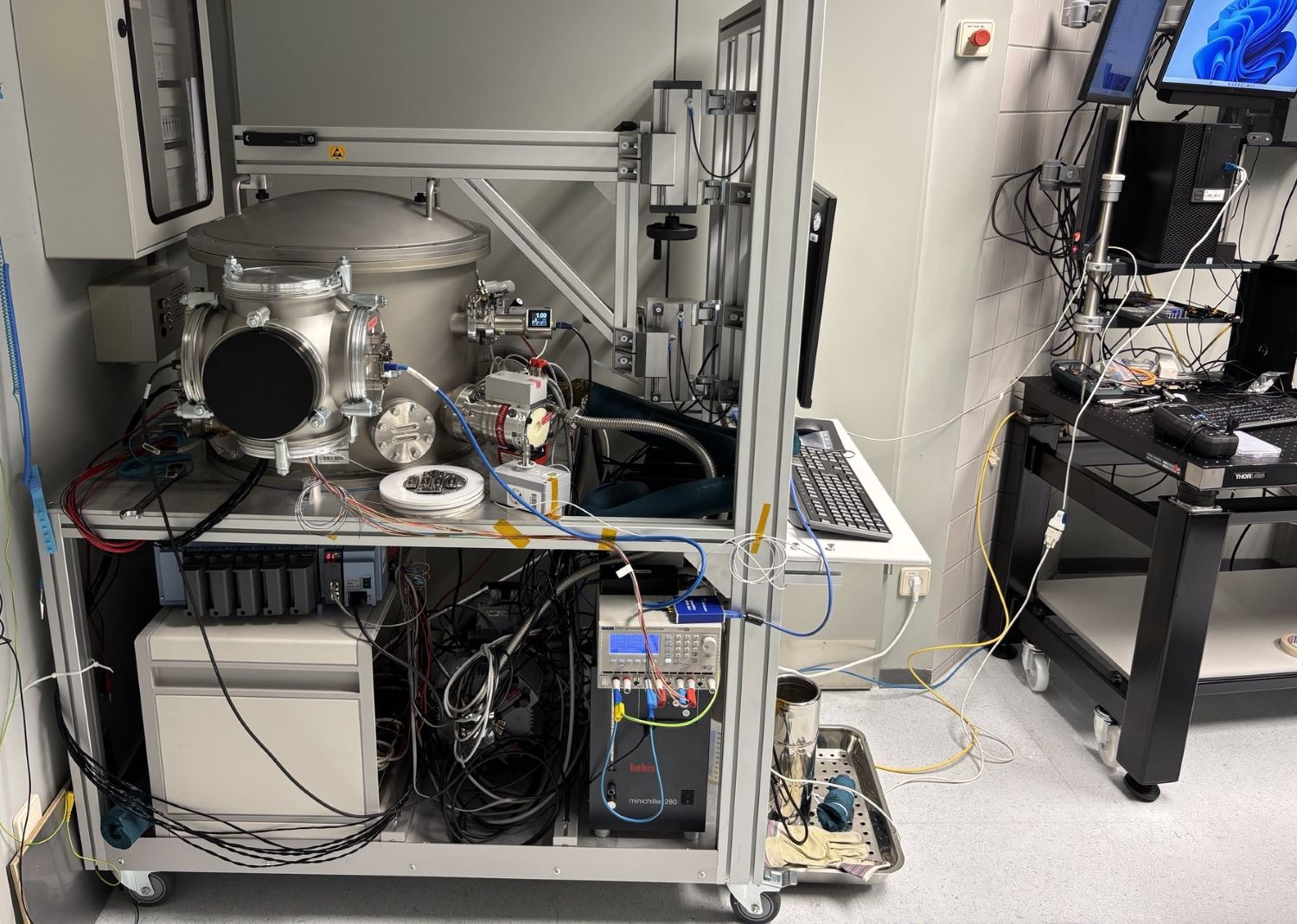
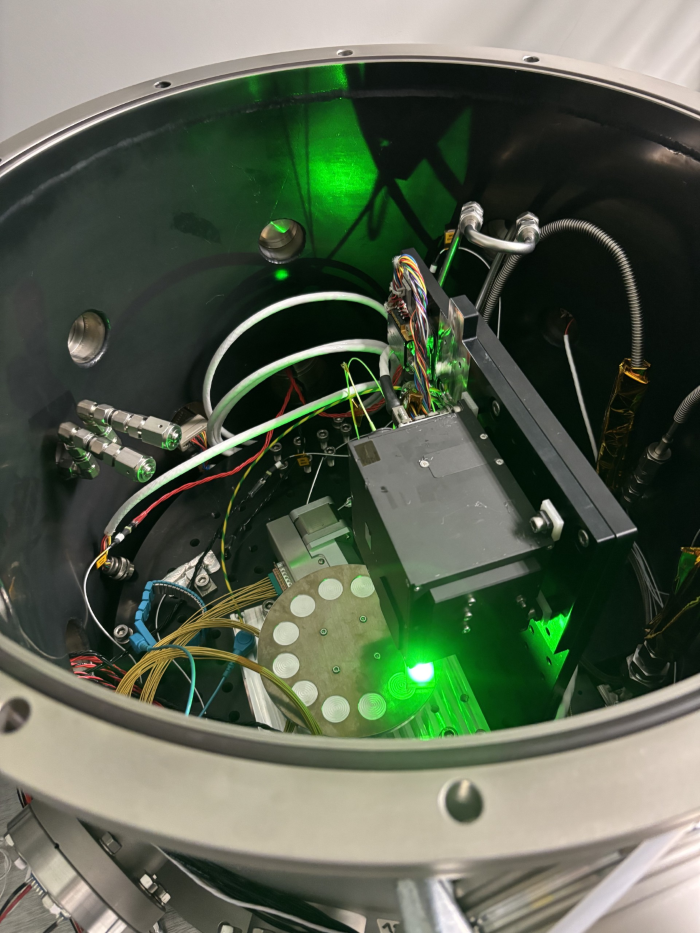
Figure 1: Top: Thermal vacuum chamber into which the RAX DM was integrated. Bottom: The RAX DM is facing downwards to measure reference samples placed on a rotating sample holder
First Reference Measurements:
The first measurements were done on several minerals including anatase and quartz. A dark image, i.e. without laser illumination, was acquired before every Raman measurement. This dark spectrum was subtracted from the Raman data afterwards. Spectral data from a measurement using only a neon light source was used for spectral calibration. The data was geometrically calibrated using a routine that was developed around the RAX FM and will be later optimized for the DM. The data from spatial as well as the spectral dimension was binned to optimize the visibility of Raman features. Each measurement was conducted ten times at the same spot and the resulting data averaged.
Fig. 2 shows exemplary data taken of quartz and anatase in their fingerprint region at ambient conditions. Data acquisition parameters will be optimized. Data taken at different lower temperatures of several minerals and analogue materials will be taken in the following weeks and presented at the conference.
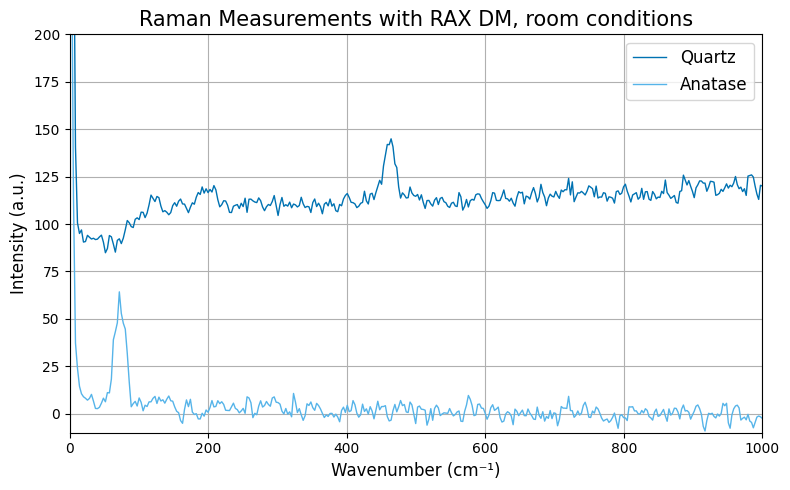
Figure 2: First light data of quartz and anatase measured using the RAX DM in the reference setup at ambient conditions. Data acquisition parameters need yet to be optimized.
Acknowledgements:
MMX is a JAXA mission with contributions from NASA, CNES and DLR. The MMX IDEFIX rover is provided by CNES and DLR. The RAX instrument is a joint development from DLR-OS, INTA/UVa, and JAXA/UTo.
References:
[1] Y. Kawakatsu, K. Kuramoto, T. Usui et al., Acta Astronaut. 2023, 202, 715.
[2] P. Michel, S. Ulamec, U. Böttger et al., Earth Planets and Space, 2022, 74, 2.
[3] S. Ulamec, P. Michel, M. Grott et al., Acta Astronaut. 2023, 210, 95.
[4] T. Hagelschuer, U. Böttger, M. Buder et al., Internat. Astronautical Congress (IAC): 18-22 September, 2022, Proceed. 2022, IAC-22-A3.4A.8
How to cite: Krybus, N., Seel, F., Schröder, S., Buder, M., Bunduki, Y., Hagelschuer, T., Eisenmenger, H., Binger, J., Dietz, E., Kopp, E., Rammelkamp, K., Säuberlich, T., Cho, Y., Hübers, H.-W., Moralia, A., Peter, G., Prieto-Ballesteros, O., Ulamec, S., Usui, T., and Weber, I.: The Reference Setup for the RAX Raman Spectrometer on the MMX IDEFIX Rover for Phobos in-situ analysis, EPSC-DPS Joint Meeting 2025, Helsinki, Finland, 7–13 Sep 2025, EPSC-DPS2025-1669, https://doi.org/10.5194/epsc-dps2025-1669, 2025.


