
 1,2,1,2,
- 1LATMOS, UVSQ Paris-Saclay University, CNRS, Guyancourt, France
- 2LIRA, Observatoire de Paris, Université PSL, CNRS, Sorbonne Université, Université Paris-Cité, Meudon, France
- 3Sorbonne Université, Laboratoire de Météorologie Dynamique, Paris, France
Martian dust, composed of micrometer-sized mineral particles, is a key parameter of the Martian atmosphere because of its high mobility and capacity to form dust storms and alter the heat balance of the atmosphere. These dust storms are part of the Martian dust cycle and can occur over a wide range of spatial and time scales (from sub-km to planetary scale, and from the minute to months). The dust studies are mostly concentrated on regional storms (> 2000 km), which are detected using UV-VIS global imagers [1, 2] or thermal-IR spectrometers [3]. These observations provide information about the frequency and size of the storms. However, some characteristics of the dust cycle remain uncertain, such as the exact mechanisms of storm formation and growth processes, with implications for the predictability of dust storms and Global Dust Storms (GDS, storm at a planetary scale).
Thus, it is important to study dust activity at a local scale, such as the local dust storms (< 2000 km) which have not been massively detected (some detections by [2] and a few individual storm characterisations as [4]). We focus our work on detecting dust storms in the OMEGA/Mars Express (near-IR imaging spectrometer) dataset, which has a high enough spatial resolution (0.36-4.8 km/px) to detect local dust storms. More precisely, we develop a method to detect automatically dust storms using dust optical depth computation (at 0.9 µm) made by [5] from late Martian Year 26 to early MY 30 (including the MY 28 GDS). The 1st-level detection is to exclude OMEGA observations that are least likely to contain dust storms (dust optical depth < 1.25). Then the 2nd-level detection principle is to identify pixel clusters of high optical depth within individual observations to identify storms, to confirm the detection using different criteria (e.g., decrease of surface reflectance) and to extract key characteristics of the storm (e.g., size, centroid, local time).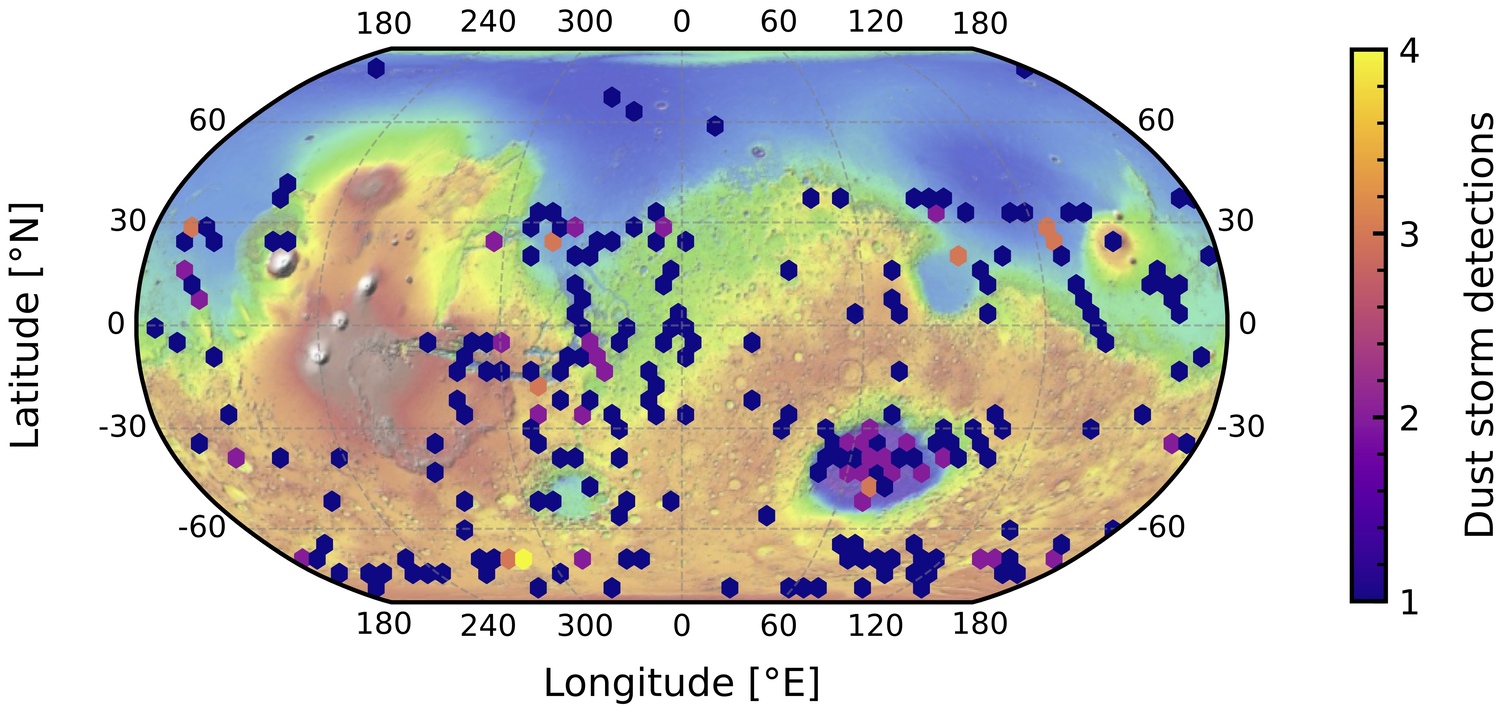
Figure 1: Spatial distribution of the dust storms (local and regional) detected with OMEGA/MEx from late MY 26 to early MY 30 (without MY 28 GDS period). The background corresponds to a topography map (MOLA/MGS).
With this 2-level method, we detected 287 dust storms (excluding the MY 28 GDS period during which 114 detections have been made) composed of 283 local and 4 regional. Here we summarised our results that will be presented in detail during the conference (notably by separating the local and regional dust storms). From the spatial distribution of the detections (Figure 1), we notice some known preferential areas such as the flushing dust storm channels (e.g., Acidalia-Chryse, Utopia-Isidis, see [1]) or Hellas Planitia, as well as next to the southern polar cap. The seasonal distribution of the detected storms (Figure 2) shows many detections in the Ls=240-270° period, particularly in MY 27, and also during the Ls=330-360° period, notably in MY 29. Interestingly, only a few storms were reported during these periods using UV-VIS imagery [1], suggesting that our method may be capturing local-scale events that were previously undetected. Another strength of OMEGA data is the local time coverage during the Mars Express mission, allowing the study of the time dependence. We noticed many detections from 10:00 to 18:00 with an increase (compared to the OMEGA local time coverage) at the end of the afternoon (16:00-18:00), and also some detections early in the morning (04:00-06:00).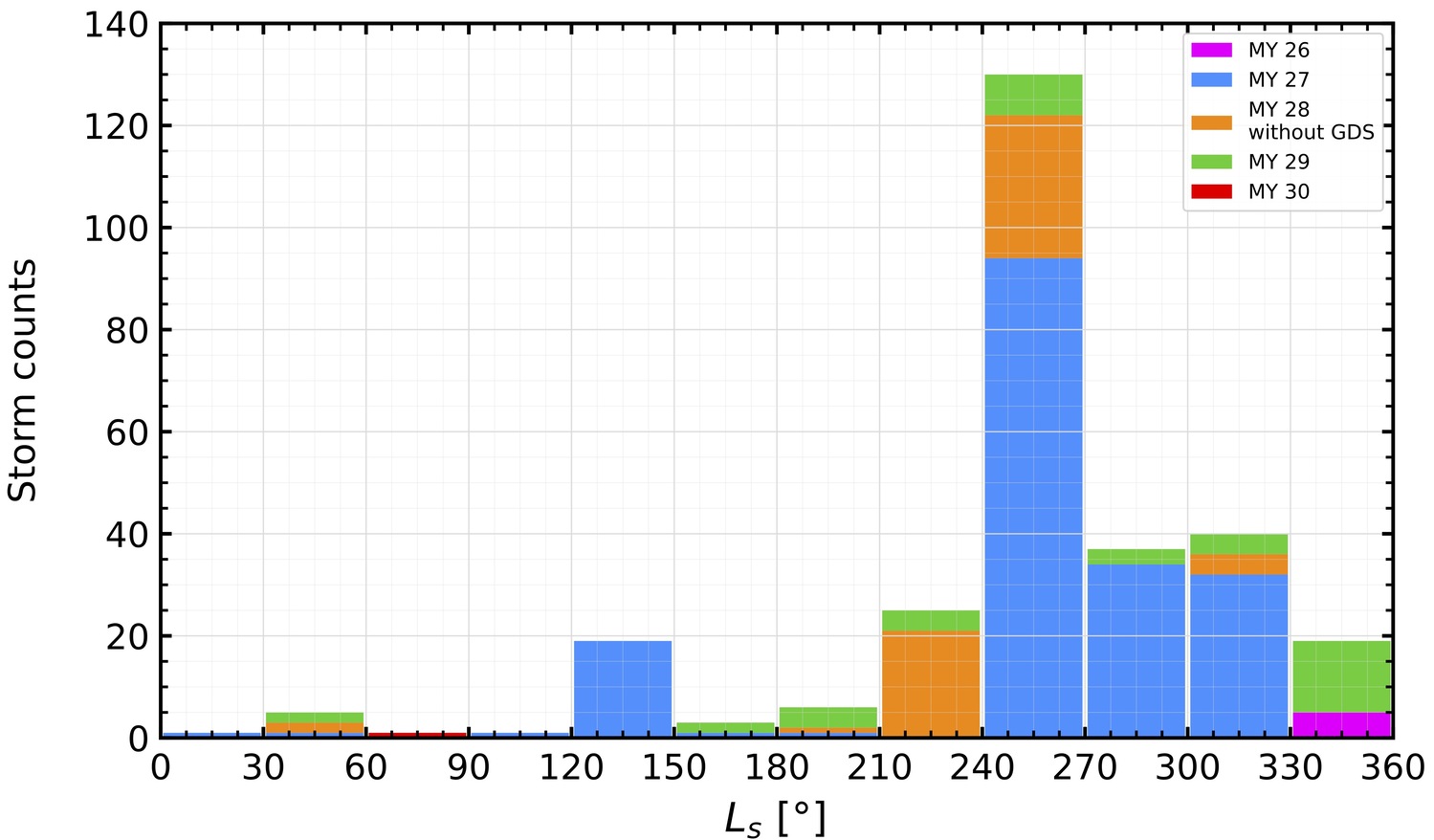
Figure 2: Seasonal distribution of the dust storms (local and regional) detected with OMEGA/MEx from late MY 26 to early MY 30 (without MY 28 GDS period).
We also worked on the MY 28 GDS onset, for which one doubt remains about the formation area, specifically, whether it originated in Noachis (southern hemisphere) or Chryse (northern hemisphere). More precisely, the question is whether the precursory storm observed in Noachis initiated the GDS independently, or whether it was dependent on the one in Chryse. The consecutive OMEGA observations of these two areas (during the storms) show high dust optical depth values for Noachis and Chryse, but separated from each other by low optical depths, which could be interpreted as two separate clouds, and therefore a GDS onset in Noachis. We are currently working to evaluate the dust altitude by comparing dust optical depth retrievals at different wavelengths [6].
References:
[1] Battalio M. & Wang H. (2021) Icarus, 354, 114059.
[2] Guha B. K. et al. (2024) JGR Planets, 129, e2023JE008156.
[3] Lombard T. & Montabone L. (2024), 10th International Conference on Mars, abstract #3041.
[4] Määttänen A. et al. (2009) Icarus, 201 Issue 2, 504-516.
[5] Leseigneur Y. and Vincendon M. (2023) Icarus, 392, 115366.
[6] Kazama A. (2025) EPSC-DPS2025, abstract #547.
How to cite: Leseigneur, Y., Bertrand, T., Gautier, T., and Spiga, A.: OMEGA/Mars Express dust storm catalogue: a local dust storm survey, EPSC-DPS Joint Meeting 2025, Helsinki, Finland, 7–12 Sep 2025, EPSC-DPS2025-1672, https://doi.org/10.5194/epsc-dps2025-1672, 2025.


