

- Korea Institute of Geoscience and Mineral Resources, Daejeon, Korea, Republic of (tak@kigam.re.kr)
This paper describes a Finite Difference Time Domain (FDTD) simulation of Juventas Radar (JuRa) observation of Dimorphos, the satellite of the asteroid 65803, Didymos. The simulation intends to assess JuRa observations under various conditions such as internal structure of Dimorphos, distance to the target, and attitude of JuRa as well as polarization of JuRa transmission paulse. It also intends to be utilized after completion of the mission for confirming/examining data interpretations.
FDTD, thanks to its simple algorithm, is a robust method to simulate propagation/scattering of electromagnetic waves though it is a resource consuming. Dimorphos is as large as 177 m (long axis) whereas the wave length of JuRa pulse at the center frequency is 5 m in vacuum. FDTD requires the grid size of simulation to be smaller than 1/20 of the wave length of concern so that error should be insignificant. Assuming that average relative permittivity of Dimorphos is ~3, the representative wave length of JuRa inside Dimorphos is estimated as ~2.9 m, of which 1/20 makes 14.5 cm. We defined the grid size of the simulation as 15 cm, and defined simulation space as large as 1280 x 1280 x 1280 [grids], or 192 x 192 x 192 [m]. As a result, the simulation needs memory space as much as ~360 GB.
Limit of memory resource prevents us from simulating radar pulse transmission of JuRa: we cannot put both Dimorphos and JuRa at the same time in a single FDTD simulation space. Instead, the transmission pulse of JuRa is modeled by a boundary condition: we define a virtual boundary surface (see Figure) on which in-coming electromagnetic field of the JuRa transmission pulse is given. The electromagnetic field of the JuRa pulse is modeled by the far field analytic solution of a small electric dipole which is excited by a differential Gaussian pulse. Actual JuRa employs coded pulse transmission system, but the JuRa in the simulation employs a simple single pulse transmission system, thus ignore signal to ratio issues of radar echoes.
Received radar echo of JuRa observation is approximated by the electromagnetic field at the JuRa position which is located out of the FDTD simulation space. The electromagnetic field at the JuRa position is given by performing or Stratton-Chu integral on a virtual boundary surface which is defined in a similar manner to that of the JuRa transmission pulse (see Figure).
The latest results of JuRa simulation are to be reported in the presentation.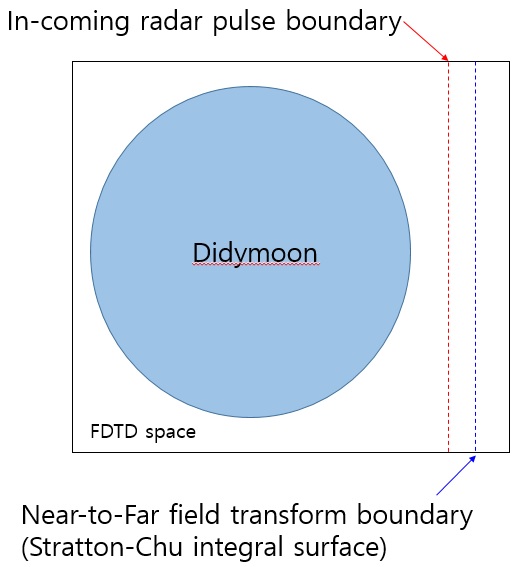
How to cite: Kobayashi, T.: Full scale FDTD simulation of JuRa observation, EPSC-DPS Joint Meeting 2025, Helsinki, Finland, 7–12 Sep 2025, EPSC-DPS2025-1673, https://doi.org/10.5194/epsc-dps2025-1673, 2025.


