
 ,,
,,- European Space Agency, Noordwijk, International organizations (e.g. UNO or IAEA) (elliot.sefton-nash@esa.int)
Introduction: Finding signs of life elsewhere is one of the most important scientific objectives of our time.
ExoMars was conceived to answer one question: Was there ever life on Mars? All project design decisions have focused and continue to centre on the achievement of this single scientific goal. The Rosalind Franklin Mission (RFM) is a re-establishment of the ExoMars 2022 mission [1]. In a new partnership with NASA, RFM is on schedule for launch in the latter part of 2028 and landing at Oxia Planum in 2030.
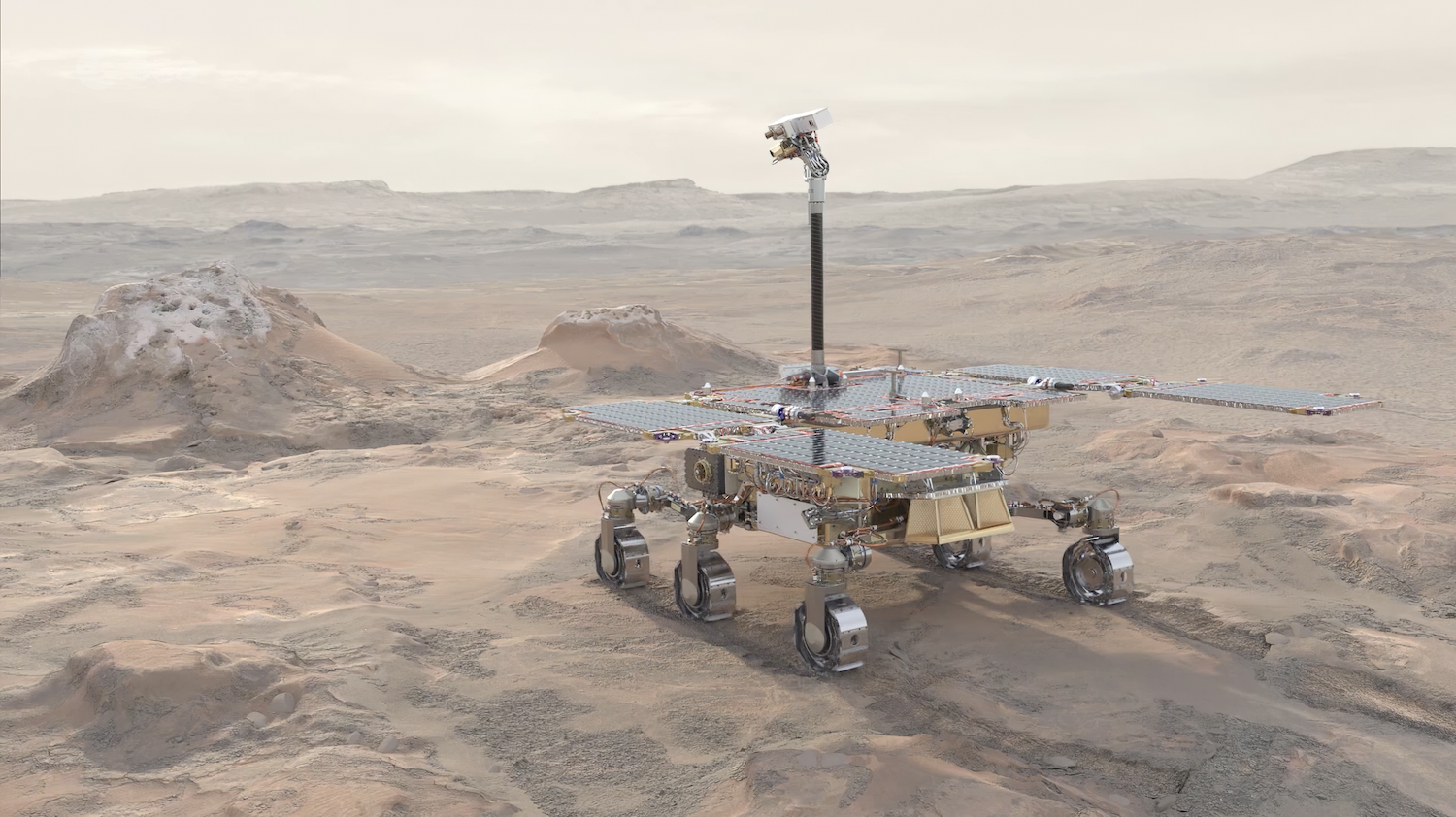
Figure 1: Artist’s view of the Rosalind Franklin Rover approaching hydrothermal mound remains (Credit: MLabSpace/ESA).
Pasteur Payload: The heart of the unique characterisation and analysis capabilities of the Rosalind Franklin Rover lies in its suite of complementary scientific instruments that comprise the Pasteur Payload. At macroscopic scales, the PanCam instrument [2], with its wide-angle multispectral camera (WAC), and narrow angle high-resolution camera (HRC), working together with NavCam and LocCam navigation cameras, constitutes the eyes of the rover. A newly developed infrared spectrometer ‘Enfys’ [3], recovering the analytical capabilities of the disembarked ISEM instrument, will reveal mineralogical signatures at targeted locations. The CLUPI instrument [4] serves as an advanced robotic version of a geologist’s hand-lens, allowing close-up characterization of surface lithologies. The WISDOM ground penetrating radar [5] will reveal sub-surface structures and survey potential drilling sites. Ma_Miss comprises an IR spectrometer head near the drill tip and will allow reconstruction of mineralogical stratigraphy in drilled boreholes [6]. In the rover’s Analytical Laboratory Drawer (ALD), the MicrOmega imaging IR spectrometer [7], Raman Laser Spectrometer (RLS) [8], and Mars Organic Molecule Analyser (MOMA) [9] (which combines gas-chromatography and laser desorption with a linear ion trap mass spectrometer), work together to analyse the mineralogy and organic chemistry of crushed samples.
Science Team Activities: The ExoMars Science Working Team (ESWT), ExoMars project, and industrial partners continue to be engaged in a programme of refurbishment of the rover and its instruments, and preservation of science team expertise and knowledge. The revised mission timeline provides great opportunity for further preparatory science, including of the Oxia Planum landing site and its analogues, by interpretation of orbital data, lab- and field-work, and numerical simulations.
The ExoMars Rover Science Operations Working Group (RSOWG), chartered in 2019 by the ESWT, is re-established for the 2028 mission and continues working at a sustainable pace to address specific needs serving to advance science readiness. The ‘Micro’ sub-group address topics regarding the spatial scale of the samples that will be extracted from down to 2 m by the rover’s drill, their terrestrial analogues, and plans for their analyses, including by the three ALD instruments MicrOmega [7], RLS [8] and MOMA [9]. Ongoing work regards a set of ‘Mission Reference Samples’ – a suite of analogue samples most relevant to the landing site and mission objectives, which are under characterization by ground models of rover instruments at PI and Science Team institutes.
Members of the ‘Macro’ sub-group continue geological interpretation of the landing site and have published the highest resolution geologic map of Oxia Planum [10], the culmination of a 4-year team effort [11]. In addition, a dedicated set of co-authors are preparing the Strategic Science Plan (SSP) of the mission, which traces mission science objectives, through to specific questions linked to hypotheses that are testable by the scientific instruments in the Pasteur Payload.
New Lander: A European Entry Descent and Landing Module (EDLM) that will deliver Rosalind Franklin to Oxia Planum is being developed. The module contains sensor packages that will support EDL and environmental characterisation at the surface for the time that the platform is operational after landing. Amongst them are the COMARS+ suite (installed on the heat shield), which contains sensors for pressure, thermal flux and radiometry; a set of 4 visible wavelength cameras for imaging the descent; and the Platform Atmospheric Characterisation Instrument Suite (PACIS), installed on the lander, which contains atmospheric pressure and temperature sensors, and a microphone. Telemetry from the Radar Doppler Altimeter (RDA) and Inertial Measurement Unit(s) (IMU), together with auxiliary information and data from the above packages, support the ExoMars Atmospheric Mars Entry and Landing Investigations and Analysis (AMELIA) team [12], which is renewed for the 2028 mission opportunity.
Continued Preparations for Operations: Dedicated efforts are underway to maintain, and update as needed, systems at the Rover Operations Control Centre (ROCC - Turin, Italy), which includes a dedicated Mars Terrain Simulator. A continued schedule of testing and simulations is underway at ROCC, providing regular opportunities to exercise Science and Control Team processes.
A special Science Knowledge Management Programme (SKP) dedicated to the Rosalind Franklin Mission continues to support key expertise within the science and instrument teams. SKP ensures that the valuable team knowledge and experience that was built in preparation for the 2022 mission opportunity [13] can be retained and developed.
This presentation will explain how ESA, supported by industry, payload teams, participating national agencies in ESA states and together with our NASA partners, is preparing the Rosalind Franklin Mission for a launch in 2028. We will present the current the level of advancement of the project, and highlight the main science objectives and overall strategic plan for the mission.
References: [1] Vago, J. L. et al. (2017) Astrobiology 17, 471–510. [2] Coates, A. J. et al. (2017) Astrobiology 17, 511–541. [3] Coates, A. et al. (2024) in Europlan. Sci. Cong., Abs. 927. [4] Josset, J.-L. et al. (2017) Astrobiology 17, 595–611. [5] Ciarletti, V. et al. (2017) Astrobiology 17, 565–584. [6] De Sanctis, M. C. et al. (2017) Astrobiology 17, 612–620. [7] Bibring, J.-P., et al. (2017) Astrobiology 17, 621–626. [8] Rull, F. et al. (2017) Astrobiology 17, 627–654. [9] Goesmann, F. et al. (2017) Astrobiology 17, 655–685. [10] Fawdon, P. and Orgel C. et al. (2024) J. of Maps 20. [11] Sefton-Nash, E. et al. (2021) in 52nd Lunar Plan. Sci. Conf. Abs. 1947. [12] Ferri, F. et al. (2019) Space Sci. Rev. 215. [13] Sefton-Nash, E. et al. (2022) in Lunar Plan. Sci. Conf., LPI Cont. 2678. Abs. 2109.
How to cite: Sefton-Nash, E., Vago, J. L., Joudrier, L., Ball, A. J., Tacconi, B., Favaro, E., and Ligeza, G.: ExoMars/Rosalind Franklin Mission Update, EPSC-DPS Joint Meeting 2025, Helsinki, Finland, 7–12 Sep 2025, EPSC-DPS2025-1678, https://doi.org/10.5194/epsc-dps2025-1678, 2025.


