
 1,2,4,3
- 1Mechanical and Civil Engineering Department, California Institute of Technology, Pasadena, CA, United States of America (adaca@caltech.edu)
- 2Department of Astronomy, University of Maryland, College Park, MD, United States of America (jdema@umd.edu)
- 3Jet Propulsion Laboratory, California Institute of Technology, Pasadena, CA, United States of America
- 4Univ. Grenoble Alpes, CNRS, CNES, IPAG, 38000 Grenoble, France
Coordinated use of modeling and in-situ radar data can advance our understanding of the internal structure of rubble-pile asteroids, providing insight into their formation and evolution mechanisms. Asteroid (99942) Apophis will fly by Earth within a distance of ~6 Earth radii on April 13, 2029. This event will be a rare opportunity to observe the reaction of a small, suspected rubble-pile body to planetary tidal forces. Caltech is leading a first-of-its-kind mission to rendezvous with Apophis before its Earth Closest Approach (ECA) and escort it through the approach. The mission consists of a spacecraft constellation comprised of a mothership and two CubeSats equipped with radar. The asteroid’s response to Earth’s gravity will be observed, and low-frequency (60 MHz) radar will be used to map its interior. The mission will perform both monostatic and bistatic radar (Fig. 1), mapping the asteroid’s internal structure at tens-of-meter scales and producing 3D backscatter and dielectric constant maps (Fig 2) to reveal Apophis's shape, density, internal block and void distribution, and spin state changes. These observations will offer groundbreaking insights into rubble-pile interiors, though methods for interpreting such data remain an open challenge.
To effectively simulate potential radar observations, realistic asteroid models are necessary. Previous work using the Discrete Element Method (DEM) has modeled Apophis as a lattice arrangement of uniform-sized spheres [1] or a collection of large aggregates of spheres [2]. We have developed an improved DEM model of Apophis using level sets [3] to represent realistic block shapes (Fig 3) and with size-frequency distributions of blocks ranging from meters to tens of meters in diameter, similar to those observed on the surfaces of analogous asteroids (e.g. Itokawa [4]) by previous missions. Simulated scenarios explore several internal configurations, such as uniform block spatial distributions, larger blocks near the core or surface, and contact binaries. These models are currently being used to predict Apophis’s response to its Earth flyby. They can also be used to generate simulated radar images to help define radar specifications and data volume requirements needed to determine whether the interior is homogeneous or heterogeneous at large scales and constrain the size-frequency distribution and spatial arrangement of interior boulders in greater detail.
This work underscores the synergy between modeling and radar tomography. We discuss how modeling can help define mission requirements and refine data interpretation methods, ensuring high scientific return from radar missions to Apophis or similar asteroids. In turn, radar tomography data can validate and improve models used to investigate the formation mechanisms and evolution processes of rubble-pile asteroids.
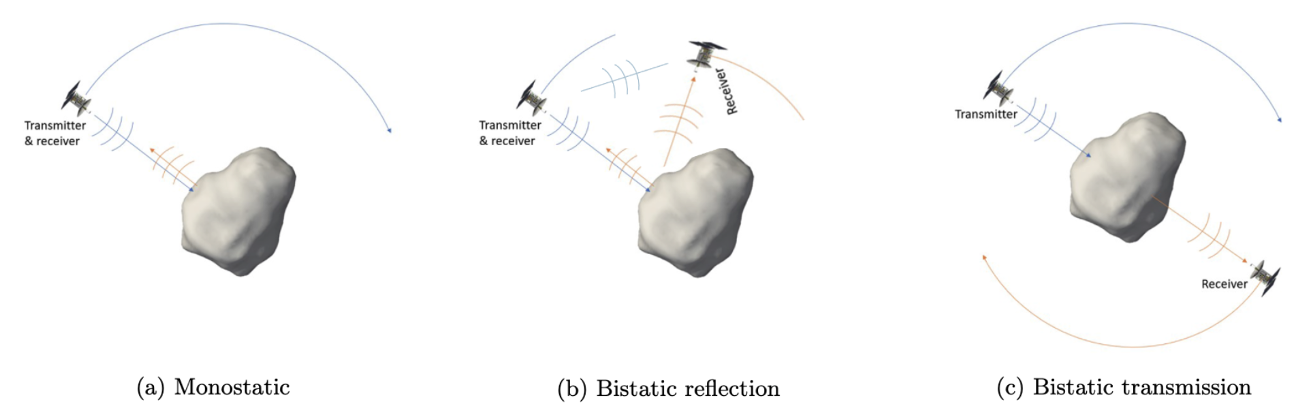
Fig 1. Radar modes implemented by the Caltech Mission to Apophis.
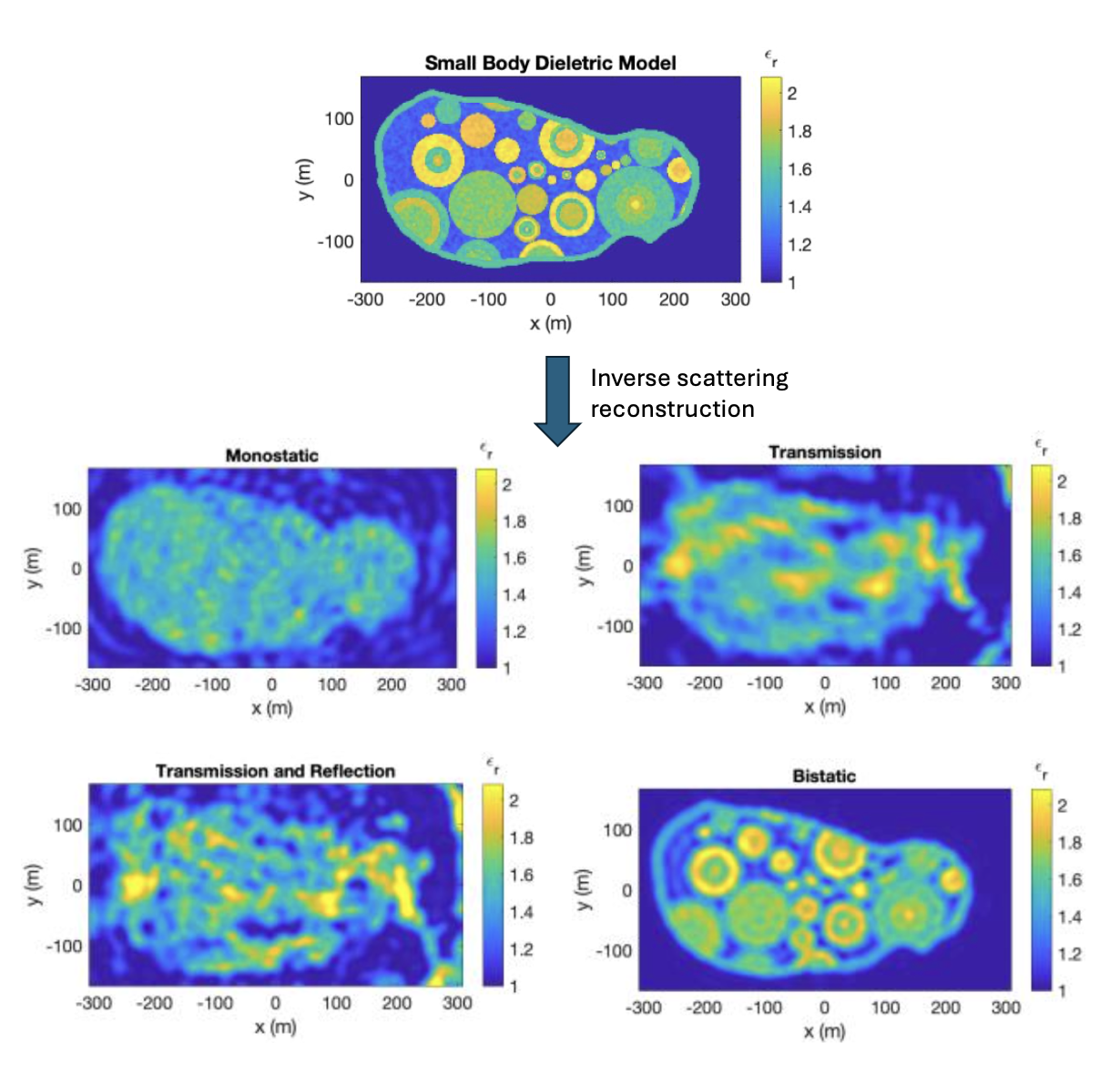
Fig 2. Single-frequency inverse scattering reconstructions of a 2D small body dielectric model (top) under four different sampling geometries (bottom) [5].
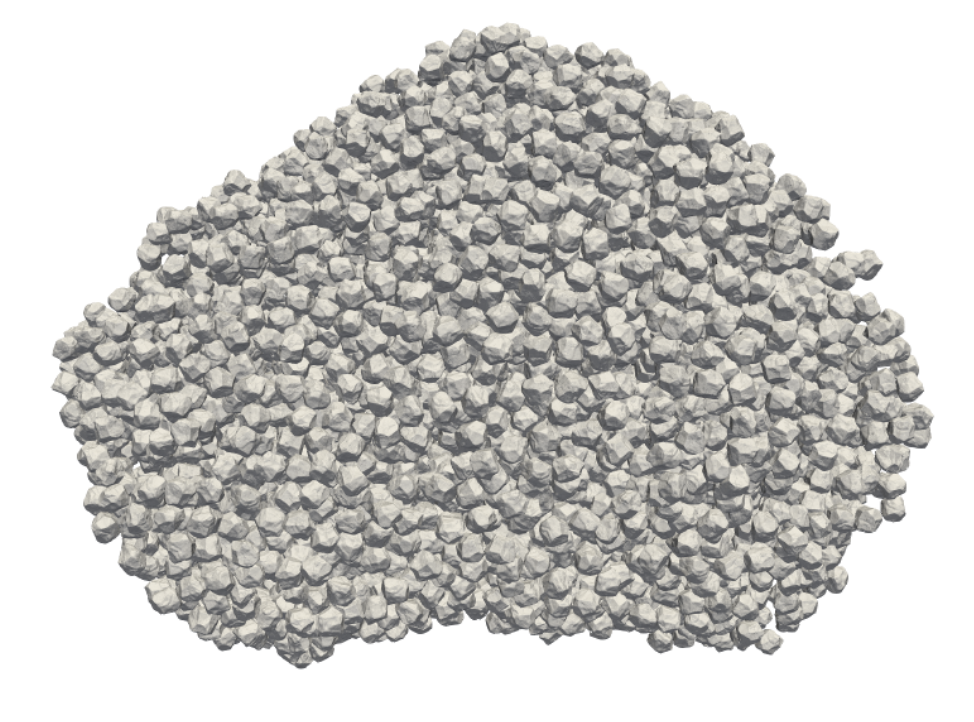
Fig 3. Example rubble pile model of Apophis with irregular particle shapes modeled by Level Set Discrete Element Method (LS-DEM).
References:
[1] DeMartini, Joseph V., et al. "Using a discrete element method to investigate seismic response and spin change of 99942 Apophis during its 2029 tidal encounter with Earth." Icarus 328 (2019): 93-103.
[2] Liu, P. Y., et al. "Tidal Effects on the Shape and Structure of Apophis during the Earth Flyby in 2029.", NEO-MAPP 2023.
[3] Kawamoto, Reid, et al. "All you need is shape: Predicting shear banding in sand with LS-DEM." Journal of the Mechanics and Physics of Solids 111 (2018): 375-392.
[4] Michikami, Tatsuhiro, et al. "Size-frequency statistics of boulders on global surface of asteroid 25143 Itokawa." Earth, planets and space 60 (2008): 13-20.
[5] Haynes, Mark, et al. "Small body radar inverse scattering in monostatic and bistatic geometries." Lunar and Planetary Science Conference. Vol. 2548. 2021.
How to cite: Daca, A., Andrade, J., DeMartini, J., Fesq, L., Haynes, M., Herique, A., and Raymond, C.: Synergy between Numerical Models and Radar Tomography Data from the Caltech Mission to Apophis, EPSC-DPS Joint Meeting 2025, Helsinki, Finland, 7–12 Sep 2025, EPSC-DPS2025-1686, https://doi.org/10.5194/epsc-dps2025-1686, 2025.


