
 ,
,- University of Bern, Physics Institute, Space Research and Planetary Sciences, Switzerland
Background
For decades, remote sensing has been the most important window to study the surfaces of planetary bodies. Inferring the physical properties like the composition, microstructure and topography of such surfaces based on photometric and spectroscopic observations remains a challenging problem to date.
Laboratory experiments, as well as analytical and numerical models, are used to enable this inversion. Analytical models based on the two-stream approximation in semi-infinite media (e.g. Hapke model) are widely used in the community to fit spectroscopic datasets and infer properties like grain sizes. This approach is at least partially empirical, and the applicability of such models to highly multiple-scattering media like icy regolith is debated.
Numerical models can be grouped into those that calculate the interactions of the light and the scattering media in the geometric optics (GO) regime and those that numerically solve the electromagnetic field equations to reproduce wave effects like diffraction and interference. While both numerical approaches are limited by computational performance, implementations in the GO limit for small systems of hundreds of particles can be solved with tens of CPU hours, while the latter requires high-performance parallel computing with a computational cost in the order of CPU years.
Methods
For simulations in the GO regime, the intersection of the photon path with complicated meshes is the most expensive computational problem. The demand for real-time ray-tracing-based rendering in computer vision and in the gaming industry led manufacturers of graphical processing units (GPU) to develop specialised hardware on the chips to accelerate this step.
We developed a ray-tracing simulation that uses this hardware acceleration and runs purely on the GPU. This allows us to push the boundaries of numerical simulations in the GO regime to laboratory-sized samples consisting of millions of particles and highly multiple scattering systems.
A triangular mesh represents the geometry of the scattering medium. Arbitrary grain shapes and surfaces can be modelled. The geometric optics limit gives the highest meaningful resolution of details at a few times the wavelength. The sample can consist of different materials. The optical properties of each material are given by its real and imaginary index of refraction. This allows the simulation of the interaction of light with regolith samples composed of millions of particles with arbitrary grain shapes, complex microstructures or layered systems without any further assumptions.
The ray-tracing algorithm launches tens of millions of parallel rays into the scene, with all of them having a Stokes vector that tracks the polarisation state. Absorption and scattering are handled probabilistically, the latter by solving the Fresnel equations and Snell’s law at every particle intersection. One ray can scatter many ten thousand times between or inside of particles until it is absorbed or escapes the sample.
The simulation outputs the position of the last intersection, the direction and the Stokes vector of all scattered rays. The location of absorption is saved for all rays that don’t escape the sample. This allows the calculation of the bidirectional reflectance function, the deposition depth of the absorbed energy and the polarisation state of the reflected light. If the simulation is run for a large grid of wavelengths, the reflectance spectrum of the sample can be calculated.
The simulation duration for 10’000’000 rays in a particulate medium consisting of millions of particles with hundreds of scattering interactions per ray is in the order of minutes on a high-end consumer GPU.
Results
As a first test, we modelled a particulate ice sample composed of spherical grains with a diameter of 70±30 µm. The grains were packed to a volume fraction ρ=0.5 (see Figure 1). This closely resembles the laboratory analogue sample produced by flash-freezing droplets in liquid nitrogen as described by the SPIPA-B protocol. We present results including the energy deposition depth in function of the incidence angle, the bidirectional reflectance distribution function and the reflectance spectra of this and other modelled samples.
Conclusions
We developed a GPU-accelerated ray-tracing code that simulates the interaction of light with planetary regolith. The efficiency of the code allows the simulation of laboratory-sized samples for a large group of conditions. Within the GO regime, it enables the study of a wide range of observables and effects, including the simulation of bidirectional reflectance function and reflectance spectra, the hemispherical albedo in function of incidence angle, the energy deposition depth in function of incidence angle, the effect of grain size, shape and bonds, the impact of surface roughness on different size scales and the mixing of different compositions.
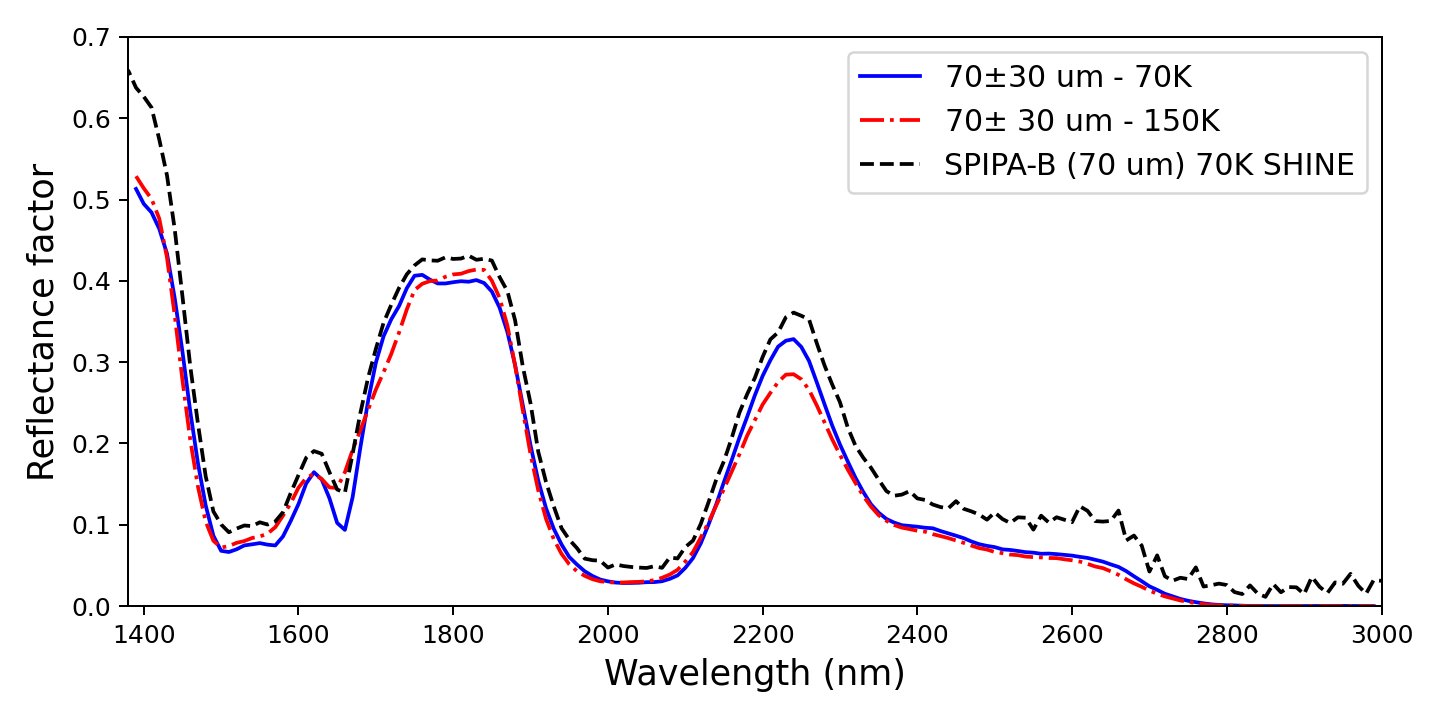
Figure 1: Two simulated reflectance spectra with 1’000’000 rays per wavelength. The incidence angle is 0°, the emission angle between 10-40°. The real and imaginary indices of refraction are from Mastrapa et al. 2008 (10.1016/j.icarus.2008.04.008). The sample consists of millions of spherical ice particles with a gaussian size distribution around 70 um that are packed to a volume fraction ρ=0.5. The simulation for the whole wavelengths range takes less than an hour on a single GPU. A laboratory reflectance spectrum of a SPIPA-B granular ice sample is shown in comparison.
Data reference for the laboratory spectrum:
Stephan, Katrin; Ciarniello, Mauro; Poch, Olivier; Haack, David; Raponi, Andrea (2019): Vis-NIR reflectance spectra of H2O ice with varying grain sizes (70-1060µm), shapes (spherical or irregular) and three mixtures, from 70 to 220 K. SSHADE/CSS (OSUG Data Center). Dataset/Spectral Data. https://doi.org/10.26302/SSHADE/EXPERIMENT_OP_20201223_001
How to cite: Ottersberg, R., Pommerol, A., and Thomas, N.: Modelling light scattering in icy planetary regolith using GPU accelerated ray-tracing, EPSC-DPS Joint Meeting 2025, Helsinki, Finland, 7–12 Sep 2025, EPSC-DPS2025-1688, https://doi.org/10.5194/epsc-dps2025-1688, 2025.


