
 2,1,5,2,1,6,7,8
- 1University of Helsinki, Department of Physics, Finland (eric.maclennan@helsinki.fi)
- 2Ondřejov Observatory, Ondřejov, Czechia
- 3European Space Agency, Near Earth Object Coordination Centre, Frascati, Italy
- 4Massachusetts Institute of Technology, Cambridge, MA, USA
- 5Max Planck Institute for extraterrestrial Physics, Garching, Germany
- 6Lowell Observatory, Flagstaff, AZ, USA
- 7Johns Hopkins University/Advanced Physics Laboratory, MD, USA
- 8Space Telescope Science Institute, Baltimore, MD, USA
- 9Luleå University of Technology, Kiruna, Sweden
The potentially hazardous asteroid 2024 YR4 (hereafter YR4) made a close approach to Earth in December 2024 through February 2025 coinciding with its discovery. During this time period, it was targeted by several ground-based telescopes and its impact probability increased above 3%, prompting action by the International Asteroid Warning Network (IAWN). As a result of this observational effort, we make use of several dense-in-time photometric lightcurves, as acquired by several ground-based observing facilities: ESO’s Very Large Telescope, the Lowell Discovery Telescope, Steward Observatory, the Danish 1.54 meter telescope, and the Nordic Optical Telescope. Photometry was acquired from these facilities using distinct astronomical filters, motivating the calculation of color transformations to a common wavelength.
In addition to ground-based efforts, YR4 was targeted on 08 March by the James Webb Space Telescope’s Near Infrared Camera (JWST/NIRCam) for which photometry was acquired in the wide F150W2 and F322W2 filters [1]. Thermal emission overcomes reflected light at longer wavelengths in the F322W2 filter and introduces complications for lightcurve interpretation, thus we use the relative photometry measured in the F150W2 filter.
The entire dataset constitutes high-quality measurements of YR4’s brightness over a roughly 3-month period (Figure 1). Using these lightcurves, we confirm the rotation period to be 0.324390 ± 0.000005 hours and search for plausible shape and spin state solutions. The initial efforts from a pole-scanning search using ellipsoids [2] reveals a few preferred and some unfavored regions. We use these regions in a convex shape inversion procedure to derive four candidate spin poles, with corresponding shapes, representing local best-fit solutions. We then use a MCMC routine [3] to generate a large set of viable shape and spin solutions that are consistent with our lightcurve dataset.
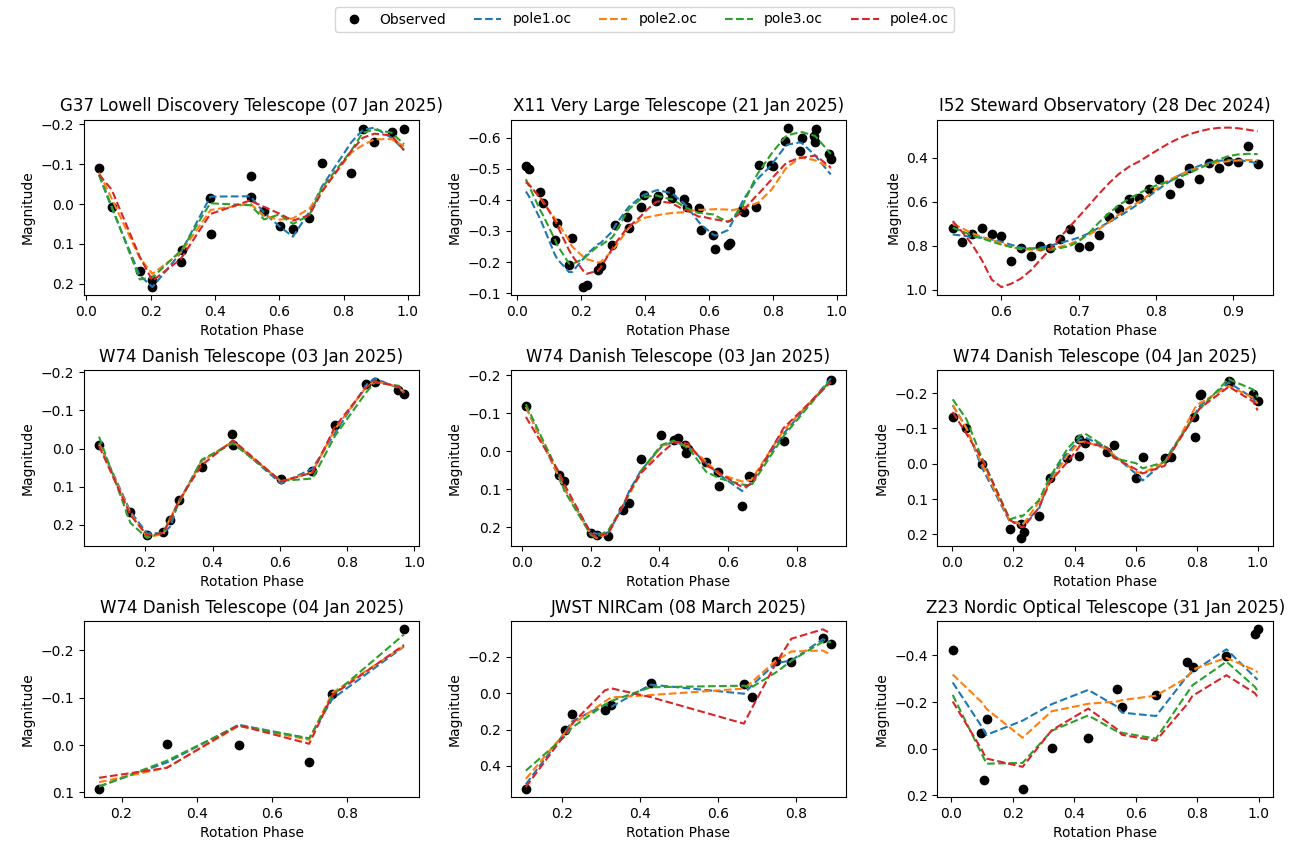
Figure 1. Model fits to our suite of optical lightcurves from various observatories over different dates.
Observations of YR4’s thermal emission with JWST’s Mid Infrared Imager (MIRI) taken on 26 March and 11 May will be used to discern between the potential shape and spin solutions. In turn, the shapes and spins will be used to constrain the size, albedo, and thermal properties of YR4. We will present the latest results at the conference, compare to other shape solutions [4], and discuss the broader implications on the origin of YR4 as well as for planetary defense strategies.
Acknowledgements:
The work at Ondřejov and the observations with the Danish 1.54-m telescope at La Silla were supported by "Praemium Academiae" award to P. Pravec by the Academy of Sciences of the Czech Republic, grant AP2401.
References:
[1] Rivkin et al. (2025) RNAAS 9, 70. [2] Muinonen et al. (2015) P&SS, 118, 227–241. [3] Muinonen et al. (2020) A&A 642, A138. [4] Bolin et al. (2025) ApJL 984 L25.
How to cite: MacLennan, E., Pravec, P., Devogele, M., Muinonen, K., Burdanov, A., de Wit, J., Müller, T., Hornoch, K., Fatka, P., Kušnirák, P., Gray, Z., Fedorets, G., Granvik, M., Moskovitz, N., Rivkin, A., and Holler, B.: Shape and Spin Properties of 2024 YR4 from Multi-filter Lightcurve Observations, EPSC-DPS Joint Meeting 2025, Helsinki, Finland, 7–12 Sep 2025, EPSC-DPS2025-1689, https://doi.org/10.5194/epsc-dps2025-1689, 2025.


