

- University of Edinburgh, Institute for Astronomy, Royal Observatory, Edinburgh, United Kingdom of Great Britain – England, Scotland, Wales (lea.ferellec@ed.ac.uk)
Comets are icy small bodies assumed to be mostly unaltered since their formation, making them key tracers of the early stages of the Solar System. Efforts have been deployed to establish classifications of comets in the hope of connecting the current populations to different formation and evolution histories. On the one hand, from a dynamical standpoint, it has been found that comets exist in two main reservoirs before being deflected towards the inner Solar System: the Oort Cloud and the Kuiper Belt. On the other hand, by quantifying the composition of the gas produced by comets, it has also been shown that some comets could be considered as carbon-depleted, displaying low C2/CN abundance ratios (e.g. [1],[2],[3]). This talk will present two surveys tackling current challenges in our understanding of dynamical and composition-based classifications of comets:
Probing the composition of comets via optical spectroscopy
While carbon-depletion is believed to be a primordial feature of depleted comets, there is no direct link between the dynamical origin of a comet and its carbon content, which is puzzling. Some studies (e.g. [4],[5]) have reported a decrease of the measured C2/CN ratio with the heliocentric distance of comets at the time of observation, suggesting that our understanding of C2 production in comae might be incomplete and that C2 based taxonomies could be biased. Since previous composition studies have typically covered short heliocentric distances (<2au) and different authors have used different sets of modelling parameters (in particular photodissociation scalelengths) to derive these abundance ratios, it is difficult to compare their findings and assess these effects.
I will present a survey of comet volatiles using optical long-slit spectroscopy, aiming to investigate trends and biases in observed compositions. Spectra were acquired for 35 comets using the Isaac Newton Telescope’s Intermediate Dispersion Spectrograph. Having produced a semi-automated pipeline to reduce and analyse this large volume of data, I calculated production rates and upper limits for the main volatile species visible in the near-UV/optical range: OH, NH, C2, CN, C3, CH.
From these production rates, derived from a Haser outgassing model and commonly used photodissociation scalelengths, I find C2/CN ratios consistent with a decreasing trend between 1 and 3.5au (Fig 1a). This effect compromises the validity of a universal depletion-threshold, as most comets observed beyond 2au fall into the depletion range. For a few comets such as 12P or C/2017 K2, I determined and modelled the spatial distributions of volatiles as seen along the slit. This analysis shows that a Haser model using literature scalelengths often does not reproduce the measured C2 profiles (e.g. Fig 1b), rendering C2 production rate measurements inaccurate.
A targeted search for Main Belt Comets
The recent discovery of comets hidden in the Main Asteroid Belt [6][7] blurs the traditional distinction between asteroids and comets. However, too few Main Belt Comets (MBCs) are currently known to understand the characteristics and origin of this third comet reservoir.
I will present an imaging survey looking for active asteroids in the hope of identifying more MBCs. Using the Isaac Newton Telescope’s Wide Field Camera, r-band observations of more than 500 asteroids were conducted. These were selected based on their closeness to perihelion and on a hypothesis from [8] that MBCs would more likely be found among objects with a longitude of perihelion close to that of Jupiter. After applying wedge photometry and point-spread function analysis methods adapted from [9] to detect activity features, I made one tentative tail detection on images of asteroid 2001 NL19 (279870) (Fig 2). From images acquired with the Liverpool Telescope at the asteroid’s following perihelion, I did not detect recurring activity.
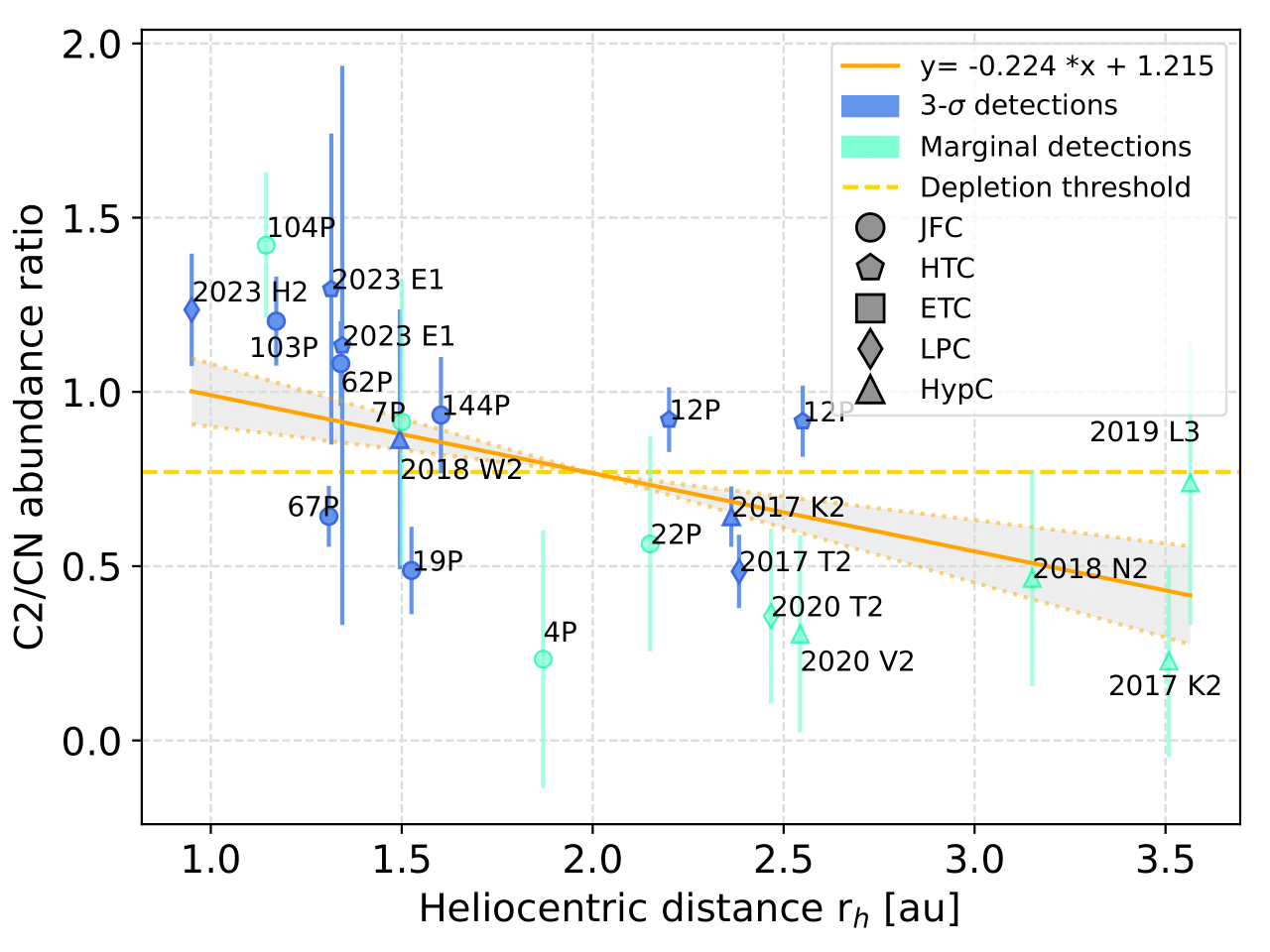
Fig 1a: Measured C2 to CN ratios vs. heliocentric distance over on our entire sample of comets. Different marker types represent different dynamical types of comets. JFC: Jupiter Family Comet; HTC: Halley-Type Comet; ETC: Encke-Type Comet; LPC: Long-Period Comet; HypC: Hyperbolic Comet. Dark and light blue markers indicate 3-σ measurements and marginal detections respectively. A yellow dashed line indicates the depletion threshold corresponding to the survey of [1].
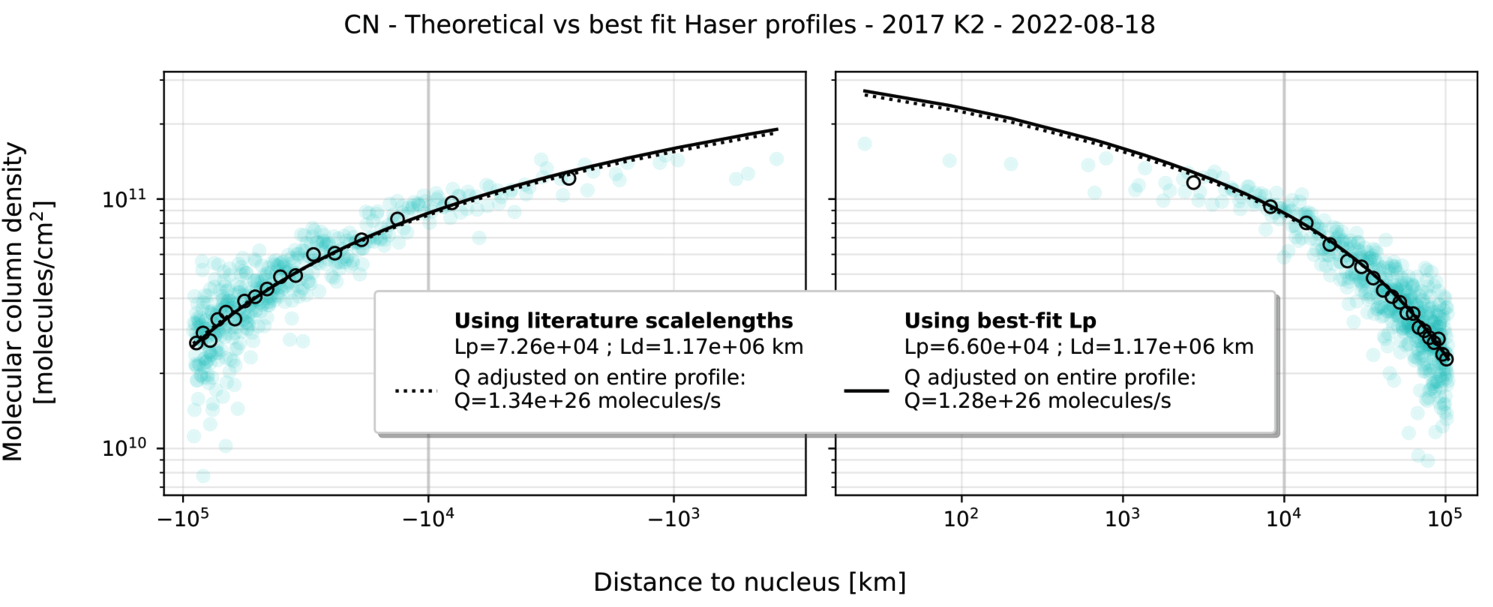
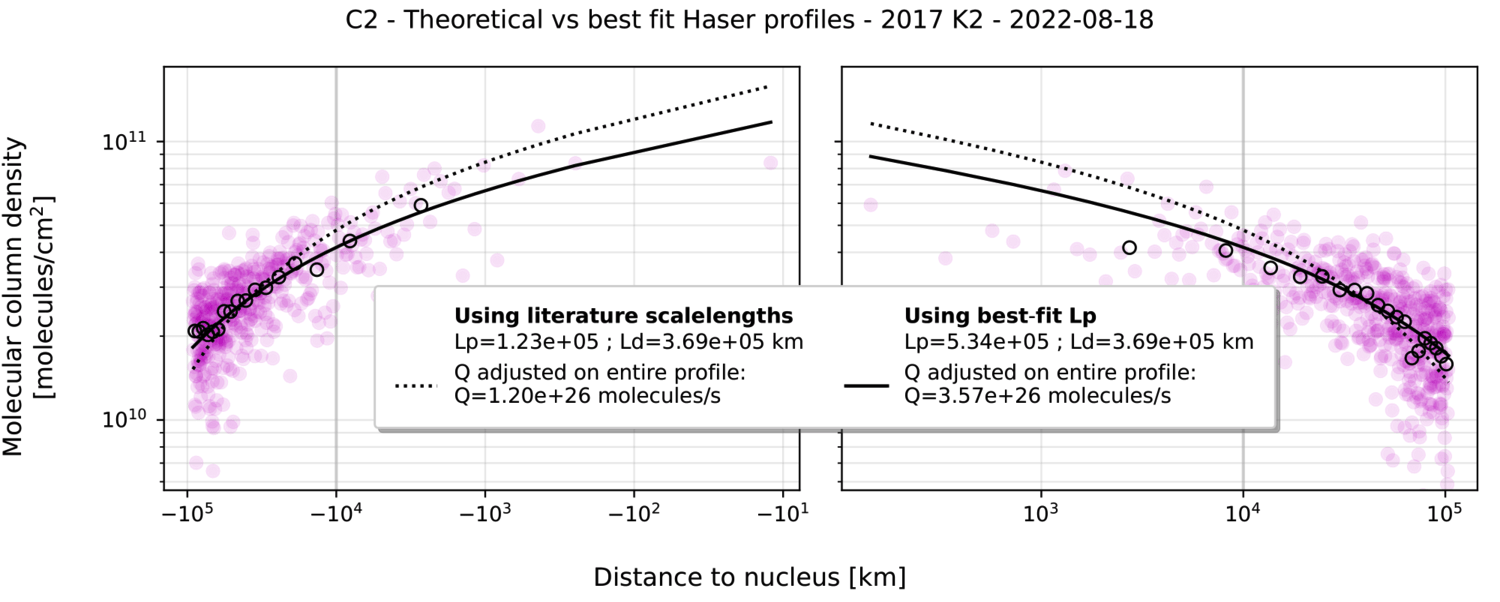
Fig 1b: Molecular density profiles of CN (top) and C2 (bottom) observed in C/2017 K2 along the slit of the spectrograph. Solid lines represent Haser model profiles with literature photodissociation scalelengths, modelling the expected distribution of a daughter species produced by the dissociation of a parent species coming from the nucleus. Dotted lines represent Haser model profiles with parent scalelengths adjusted to match the observed profiles, ultimately resulting in higher C2 to CN ratios.
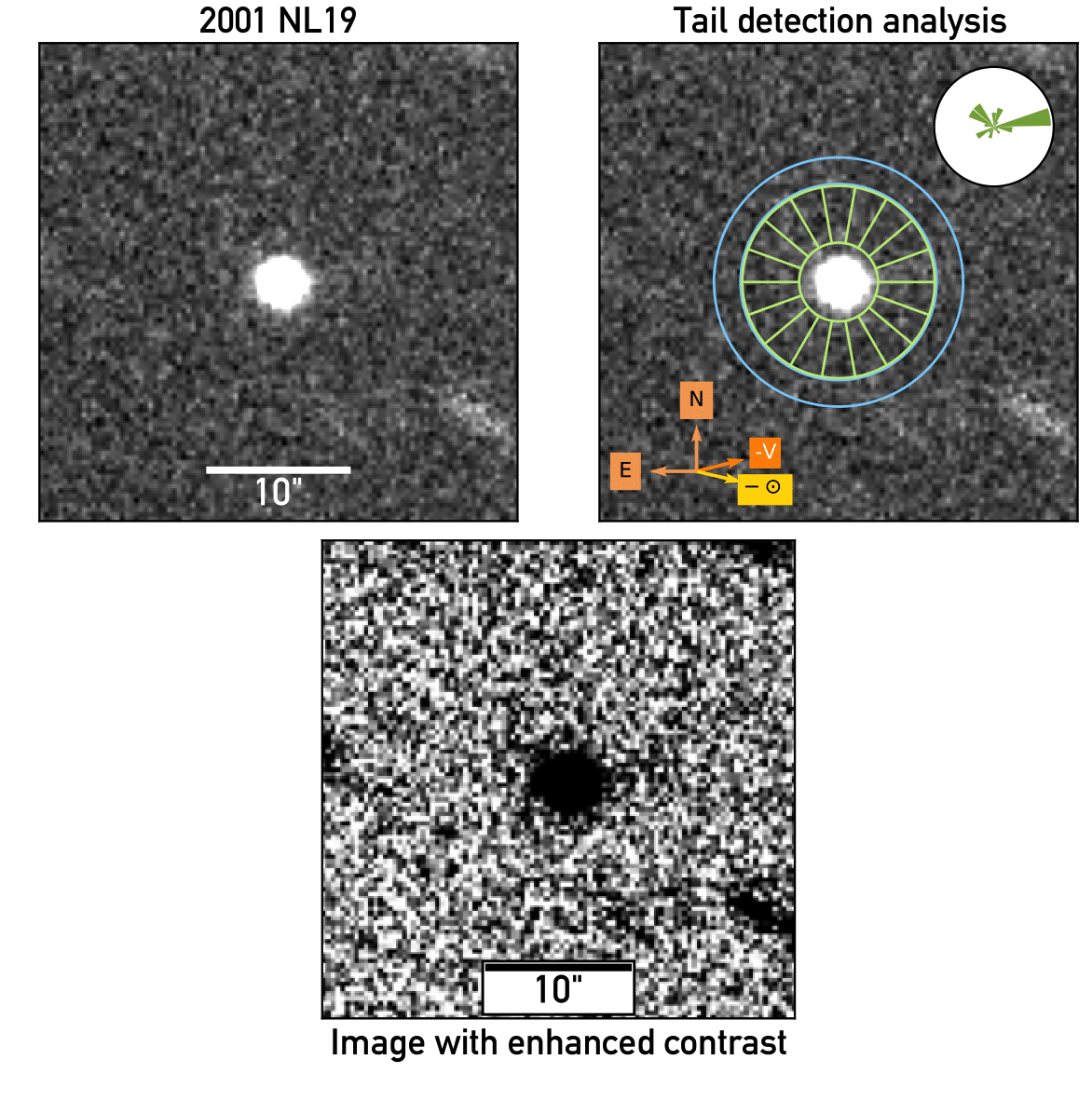
Fig 2: INT-WFC r-band image of asteroid 2001 NL19 (279870) observed on 2019 November 07. The circular plot in the top-right figure shows the relative brightness of different wedges around the object, showing a bright anomaly towards the West which was flagged as statistically significant compared to bright wedges found around reference stars on the same image. A faint tail like feature is visible in the West direction, consistent with the anti-solar and anti-velocity directions, and inconsistent with the trailing direction of a potential background star.
References:
[1] A’Hearn M. F., Millis R. C., Schleicher D. O., Osip D. J., Birch P. V., 1995, Icarus, 118, 223
[2] Fink U., 2009, Icarus, 201, 311
[3] Cochran A. L., Barker E. S., Gray C. L., 2012, Icarus, 218, 144
[4] Langland-Shula L. E., Smith G. H., 2011, Icarus, 213, 280
[5] Newburn R. L., Spinrad H., 1989, AJ, 97, 552
[6] Hsieh H. H., Jewitt D. C., Fernández Y. R., 2004, AJ, 127, 2997
[7] Kelley, M.S.P., Hsieh, H.H., Bodewits, D., Saki M., Villanueva G. L., Milam S. N., Hammel H. B., 2023, Nature, 619, 720–723
[8] Kim Y., JeongAhn Y., Hsieh H. H., 2018, AJ, 155, 142
[9] Sonnett S., Kleyna J., Jedicke R., Masiero J., 2011, Icarus, 215, 534
How to cite: Ferellec, L.: Searching for new insights into dynamical and composition-based comet taxonomies, EPSC-DPS Joint Meeting 2025, Helsinki, Finland, 7–12 Sep 2025, EPSC-DPS2025-1691, https://doi.org/10.5194/epsc-dps2025-1691, 2025.


