
 1,2,3,2,
- 1Centre for Mars Meteorology Monitoring, Paneureka, Le Bourget-du-Lac, France
- 2LMD/IPSL/CNRS/Sorbonne Universit´e, Paris, France
- 3Space Science Institute, Boulder, Colorado, USA
1 Introduction
This abstract is a continuation of Monitoring Dust in the Martian Atmosphere: Recent Advances and Applications in Column Dust Optical Depth Processing by Lombard et al. [8], and focuses on the temporal data conversion tool introduced therein and the current development in the dust map processing. The tool enables translation between various calendar systems used across different datasets, including the sol-based calendar described in Appendix A of Montabone et al. (2015) [1].
As noted in [8], more than 25 years of atmospheric observations on Mars have been compiled into CDOD (Column Dust Optical Depth) maps, which are categorized into two types: gridded maps and kriged maps. Given that these maps are produced on a daily basis, the standard method of time labeling using tropical dates—defined by the areocentric solar longitude (Ls) and the current tropical Martian year—is not ideal. A sol-based calendar was proposed in [1], using integer year lengths of either 668 or 669 sols, following a repeating 5-Martian-Year cycle. To make practical use of this sol-based calendar (SolCal), it was necessary to implement it within a dedicated conversion program, allowing for proper definition, testing, and evaluation of its structure and benefits. Such a tool facilitates the temporal synchronization of datasets that rely on different calendar systems. Additionally, SolCal’s structural resemblance to the Gregorian calendar makes it easier to intuitively represent time-based observations on Mars.
2 Calendar conversion tools
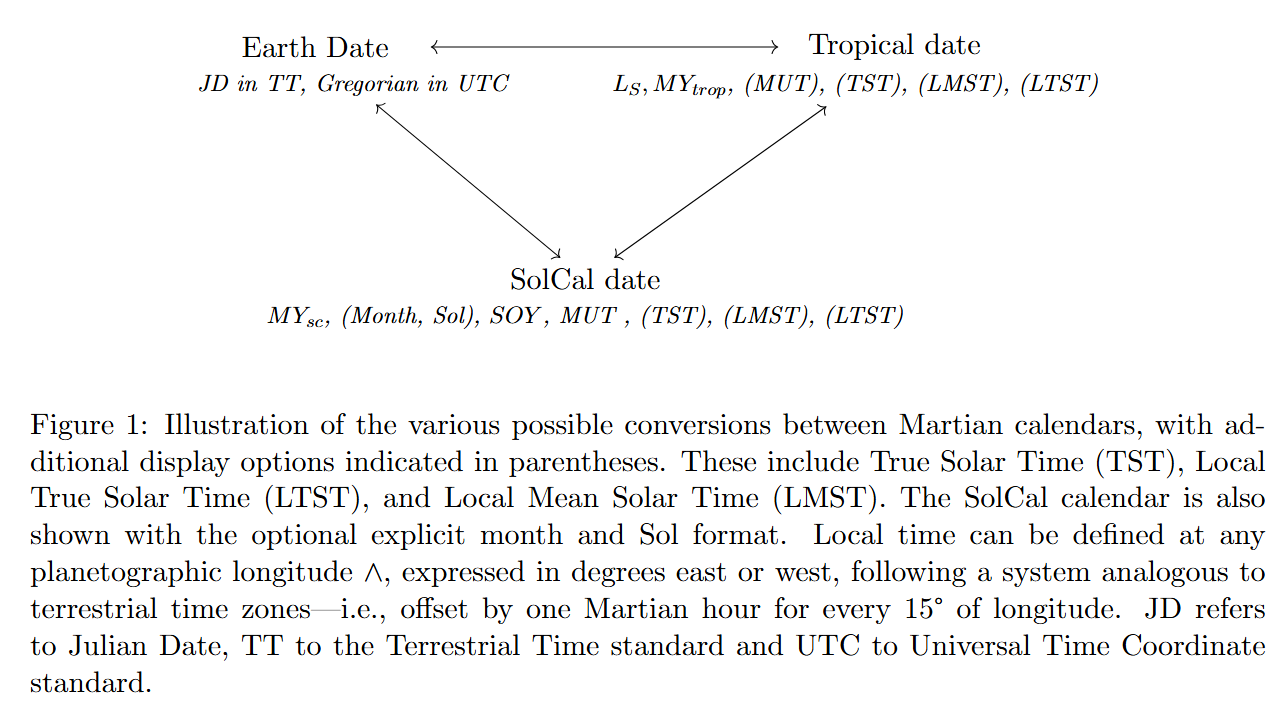
We developed a Python 3.11 program that enables precise and user-friendly conversion between various Earth and Martian calendars. Built using the astropy, datetime, and SciPy libraries, the algorithm supports transformations between the Gregorian calendar (UTC), Julian dates (including from epoch J2000), the Martian tropical calendar (defined by the areocentric solar longitude, and the tropical Martian year count, MY), and the sol-based Martian calendar, SolCal (see figure 1). The method is based on the Mars24 Sunclock algorithm, particularly its Ls computation, which we use to derive tropical dates from Earth dates [2]. Sol counting relies on the Martian Mean Solar Time at the prime meridian (Martian Universal Time, MUT), ensuring high accuracy across 134 Mars orbits—corresponding to Gregorian years 1874 to 2126—using well-fitted astronomical models. The MUT is expressed in fraction of sol to the hour (1 divided by 24) or to the microsecond (1 sol divided by 86400000000). The vernal equinoxes on Mars do not coincide with MUT midnights. To account for this, we introduce a distinct Martian Year count for the SolCal calendar, denoted MYsc, beginning at the MUT midnight nearest to the start of MY1 (as defined by Clancy et al., 2000 [7]) and lasting 668 or 669 sols. This convention emphasizes the slight offset between the beginning of the tropical year and that of the SolCal year. A SolCal date is defined by three fundamental elements: the current MYsc, the Sol of the Year (SOY), and the Martian Universal Time (MUT).
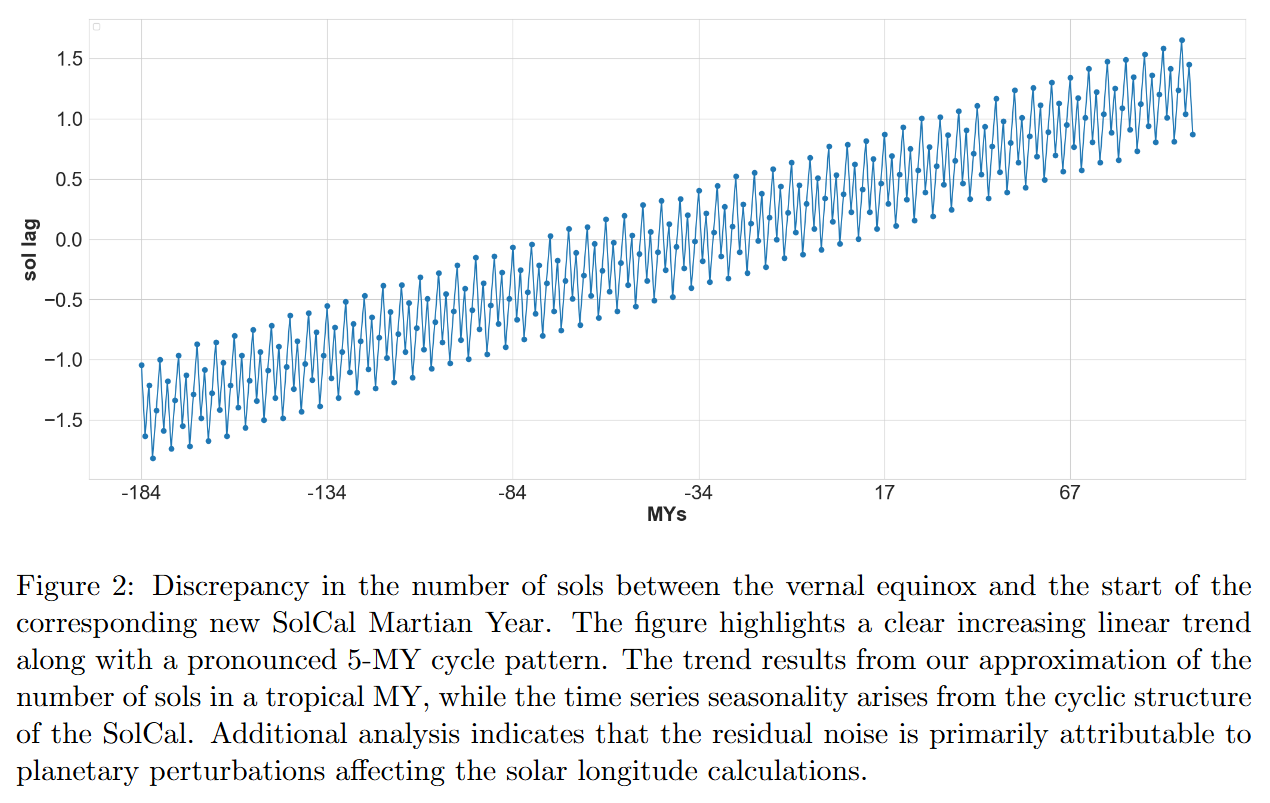
We included several options to enhance both the accuracy and usability of the calendar. For improved precision, users can opt to switch the equations calculating the Ls from Mars24 Sunclock to the one from Piqueux et al. (2015) [6], which refines the method used in the first [3]. To make the calendar more intuitive, we introduced an alternative representation of SolCal dates based on a twelve-month system, functioning as a distinct calendar format to which dates can be converted (see table 6 of [11]). Additionally, the program allows the display of both true and mean local solar time at any specified longitude on Mars. Our analysis of the offset between Mars’s vernal equinox and SolCal’s New Year reveals a linearly increasing discrepancy over time (see figure 2). To mitigate this drift, we implemented a calendar correction mechanism.
3 Future developments in CDOD processing
As previously described in [8], the CDOD maps are provided in both gridded and kriged forms, the latter being a weighted spatial interpolation of the former. The main limitation of the current method is that it relies solely on spatial interpolation and does not account for the temporal evolution of the CDOD. Our goal is to develop an interpolation approach that incorporates both spatial and temporal dimensions, while being grounded in the underlying dynamics of the system. To improve this data completion process in this direction, we are considering a simplified data assimilation scheme. More specifically, we are currently exploring a hybrid data assimilation approach inspired by the hybrid nudging–ensemble Kalman filter method proposed by Lilli Lei et al. (2012) [9], using simulations from the Mars Planetary Climate Model (PCM) [10] as background data. This approach aims to combine the strengths of the ensemble Kalman filter—such as improved error covariance representation—with the stabilizing effects of nudging, in order to reduce error spikes and spatial discontinuities.
4 Acknowledgment
VG, LM, and TL gratefully acknowledge the support provided by CNES and the ESA MCD project. We would like to thank Dr. Jorge Bernal for his assistance in providing NASA’s SPICE data to test our program, and Thomas Pierron for his valuable insights into the treatment of dust distribution in the atmosphere by the GCM. We also plan to make the time conversion algorithm publicly available in the near future.
References
[1] L. Montabone et al. Eight-year climatology of dust optical depth on Mars Icarus 251 65–95 2015.
[2] Allison, M., and M. McEwen A post-Pathfinder evaluation of aerocentric solar coordinates with improved timing recipes for Mars seasonal/diurnal climate studies Planet. Space Sci., 48, 215-235 2000
[3] NASA Goddard Institute for Space Studies Mars24 Sunclock — Time on Mars, Algorithm and Worked Examples https://www.giss.nasa.gov/tools/mars24/help/algorithm. html 2023
[4] Michael Allison, Robert Schmunk Technical Notes on Mars Solar Time as Adopted by the Mars24 Sunclock https://www.giss.nasa.gov/tools/mars24/help/notes.html 2023
[5] NASA GISS Mars24 Sunclock — Time on Mars https://www.giss.nasa.gov/tools/ mars24/ 2023
[6] Piqueux et al. Enumeration of Mars years and seasons since the beginning of telescopic exploration Icarus 251 332–338 2015
[7] Clancy et al. An intercomparison of ground-based millimeter, MGS TES, and Viking at- mospheric temperature measurements: Seasonal and interannual variability of temperatures and dust loading in the global Mars atmosphere J.Geophys. Res. 105, 9553–9571. 2000
[8] T.Lombard et al. Monitoring Dust in the Martian Atmosphere: Recent Advances and Appli- cations in Column Dust Optical Depth Processing EPSC-DPS2025-1765 2025
[9] Lili Lei et al. A hybrid nudging-ensemble Kalman filter approach to data assimilation. Part I: application in the Lorenz system 2012
[10] F. Forget et al. Challenges in mars climate modelling with the LMD mars global climate model, now called the mars “planetary climate model” (PCM) 2022
[11] L. Montabone et al. Mars Global Surveyor/Thermal Emission Spectrometer Atmospheric Column Dust and Water Ice Optical Depth Planetary Data System Bundle User’s guide 2023
How to cite: Guyon, V., Montabone, L., Lombard, T., Forget, F., Millour, E., Hernández Bernal, J., and Pierron, T.: Monitoring Dust in the Martian Atmosphere : Tools and Future developments in Column Dust Optical Depth Processing, EPSC-DPS Joint Meeting 2025, Helsinki, Finland, 7–12 Sep 2025, EPSC-DPS2025-1694, https://doi.org/10.5194/epsc-dps2025-1694, 2025.


