
 1,2,5
1,2,5- 1Observatoire de la Côte d’Azur, Nice, France (raphael.marschall@oca.eu)
- 2International Space Science Institute (ISSI), Hallerstrasse 6, 3012 Bern, Switzerland
- 3Collège de France, Centre National de la Recherche Scientifique, Université Paris Sciences et Lettres, Sorbonne Université, 75014 Paris, France
- 4Université de Lorraine, CNRS, CRPG, UMR 7358, 54000 Nancy, France
- 5Max Planck Institute for Solar System Research, Justus-von-Liebig-Weg 3, 37077 Göttingen, Germany
Comets, asteroids, and other small bodies are thought to be remnants of the original planetesimal population of the Solar System. As such, their physical, chemical, and isotopic properties hold crucial details on how and where they formed and how they evolved. Yet, placing precise constraints on the formation region of these bodies has been challenging. Data from spacecraft missions has a particularly high potential of addressing the question of the origin of the visited bodies. ESA’s Rosetta mission to comet 67P/Churyumov-Gerasimenko returned data from the comet for two years on its journey around the Sun. This extensive data set has revolutionised our view of comets and still holds unsolved problems. Here we present the elemental composition of 67P [Fig. 1]. We constrain the refractory-to-ice ratio to 0.5 < χ < 1.7, and present the bulk elemental abundances for 67P of H, C, N, O, Na, Mg, Al, S, K, Ar, Ca, Cr, Mn, Fe, Kr, and Xe [Marschall, Morbidelli, and Marrocchi 2025]. We find the noble gas xenon in near-solar elemental abundance in comet 67P. This is notable because the cometary xenon has a non-solar isotopic composition [Marty et al. 2017]. The fact that comets have xenon in solar elemental abundance but not in solar isotopic composition does not fit into the current scheme for the formation and evolution of the proto-solar disk [Nanne et al. 2019]. That cometary xenon is depleted in r-process isotopes, which is usually associated with non-carbonatious material, is puzzling. By modifying the Nanne scheme, we will present a new model that can reconcile these constraints from comet 67P.
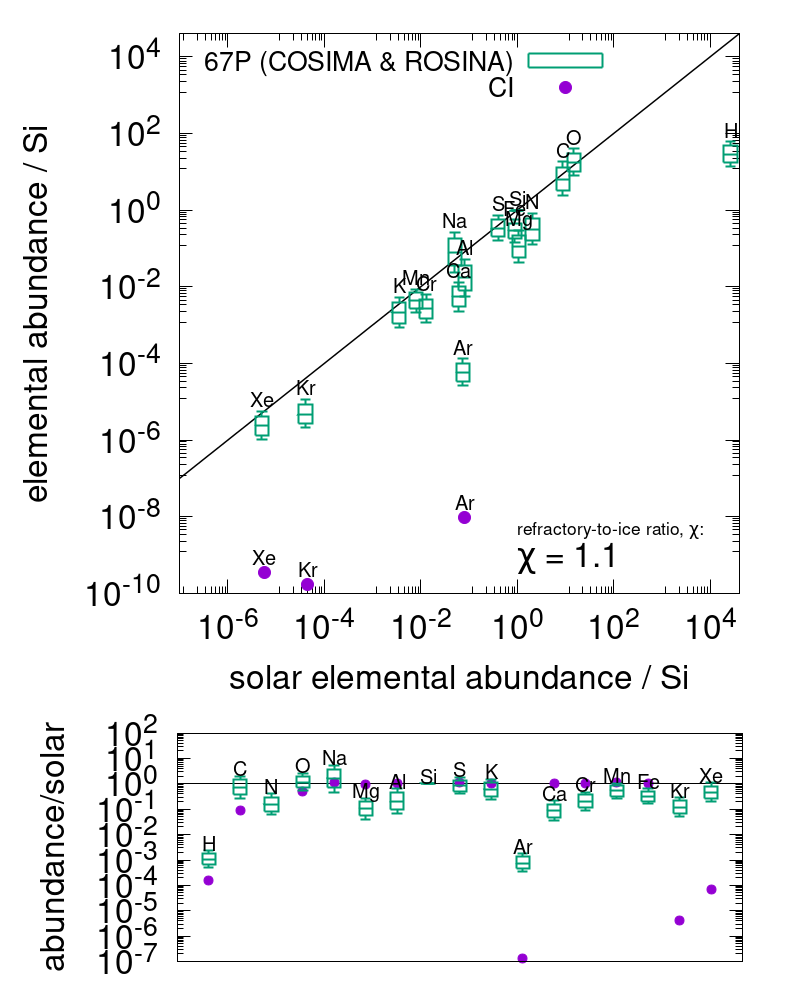
Figure 1: The elemental abundane of comet 67P using Rosetta/ROSINA and Rosetta/COSIMA data for a refractory-to-ice ratio to χ = 1.1 . The figure is adapted from Marschall, Morbidelli, and Marrocchi 2025.
How to cite: Marschall, R., Morbidelli, A., Marrocchi, Y., and Kleine, T.: A modified formation scenario of the proto-solar disk constrained by comets, EPSC-DPS Joint Meeting 2025, Helsinki, Finland, 7–12 Sep 2025, EPSC-DPS2025-1696, https://doi.org/10.5194/epsc-dps2025-1696, 2025.


