
 1,2,1,3,2,2
- 1Freie Universität Berlin, Institute of Geological Sciences, Department of Earth Sciences, Berlin, Germany (ankita.das@fu-berlin.de)
- 2Instituts für Weltraumforschung , German Aerospace Center (DLR), Rutherfordstrasse 2, 12489 Berlin, Germany
- 3Remote Sensing Technology Institute, German Aerospace Center (DLR), Oberpfaffenhofen, -82234 Wessling
Introduction
Obtaining data from Venus’ atmosphere and surface is a unique challenge. Measurements in these spectral regions as shown in Figure 1 can be utilized to constrain surface emissivity, water vapor abundance in lower atmosphere, and cloud properties thus paving way for surface and near-surface atmosphere studies. In order to process the data from these missions once they are available, Atmosphere Radiative Transfer Modelling (ARTM) of the Venusian atmosphere is a necessary first step. Here we present on-going work on our Venus ARTM which will be relevant for interpreting future data.
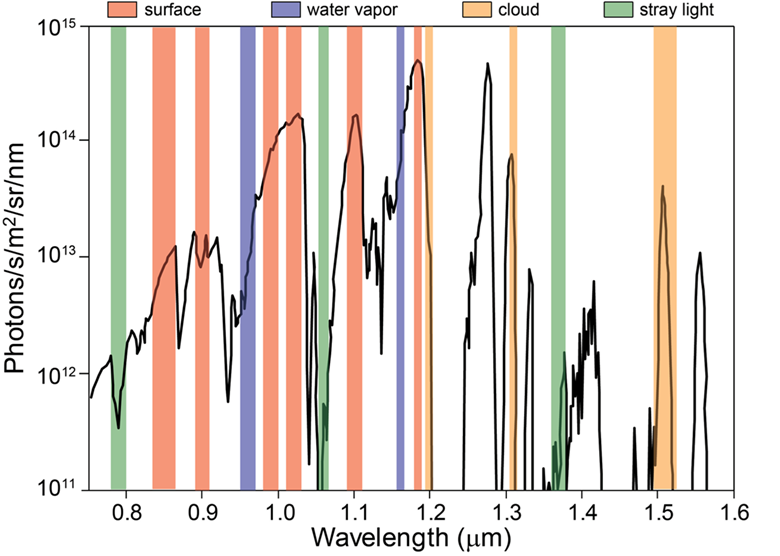
Figure 1: Example of simulated Venus nightside emission spectrum overl-ayed with spectral regions intended for data preprocessing and determination of surface and atmosphere properties [3]
SPICAV dataset from Venus Express:
The Spectroscopy for the Investigation of the Characteristics of the Atmosphere of Venus (SPICAV) suite on board Venus Express (VEX) made relatively high-resolution observations of Venus’ nightside in the spectral range of 0.65–1.7 um. The synthetic radiance generated by our ARTM is compared to SPICAV IR night-side observations on orbit 34 (Latitude=27.01o, longitude=342.37o, Local time=2.17 h, emission angle=33.27o) ([9]; additional processing by [17]).
Comparison of line databases
One important aspect of the model is absorption by gases. In the Venusian atmosphere, absorption features are dominated by CO2 and H2O lines. Modeled absorption cross-sections are governed by the line list chosen. Accurate line lists are essential for high temperature atmospheres like Venus. The high-resolution transmission molecular absorption database (HITRAN) is a frequently used line database in radiative transfer modelling [4] . Several Venus atmospheric studies (e.g. [5]), however, have relied on the database of Pollack et al. 1993 for CO2 lines, referred to as “Hot CO2” from here on. Newer line databases have been developed for high temperature atmospheres such as high temperature molecular spectroscopic database (HITEMP 2024) [11]. These are yet to be applied to Venusian atmospheric studies. As part of this work we compare absorption cross sections generated by using different line databases for relevant species present in the Venusian atmosphere: HITRAN 2020, HITEMP 2010, Hot CO2, HITEMP 2024 ([4]; [7]; [6] and [11]). Comparison studies for CO2 absorption using different line databases (Figure 2) show that HITEMP 2024 has the highest absorption cross-section in the water vapor sensitive bands (1.1 and 1.18 microns). This indicates that HITEMP 2024 database might be more accurate, considering weak absorption lines, and is hence more appropriate for modelling Venus night-side thermal emission.
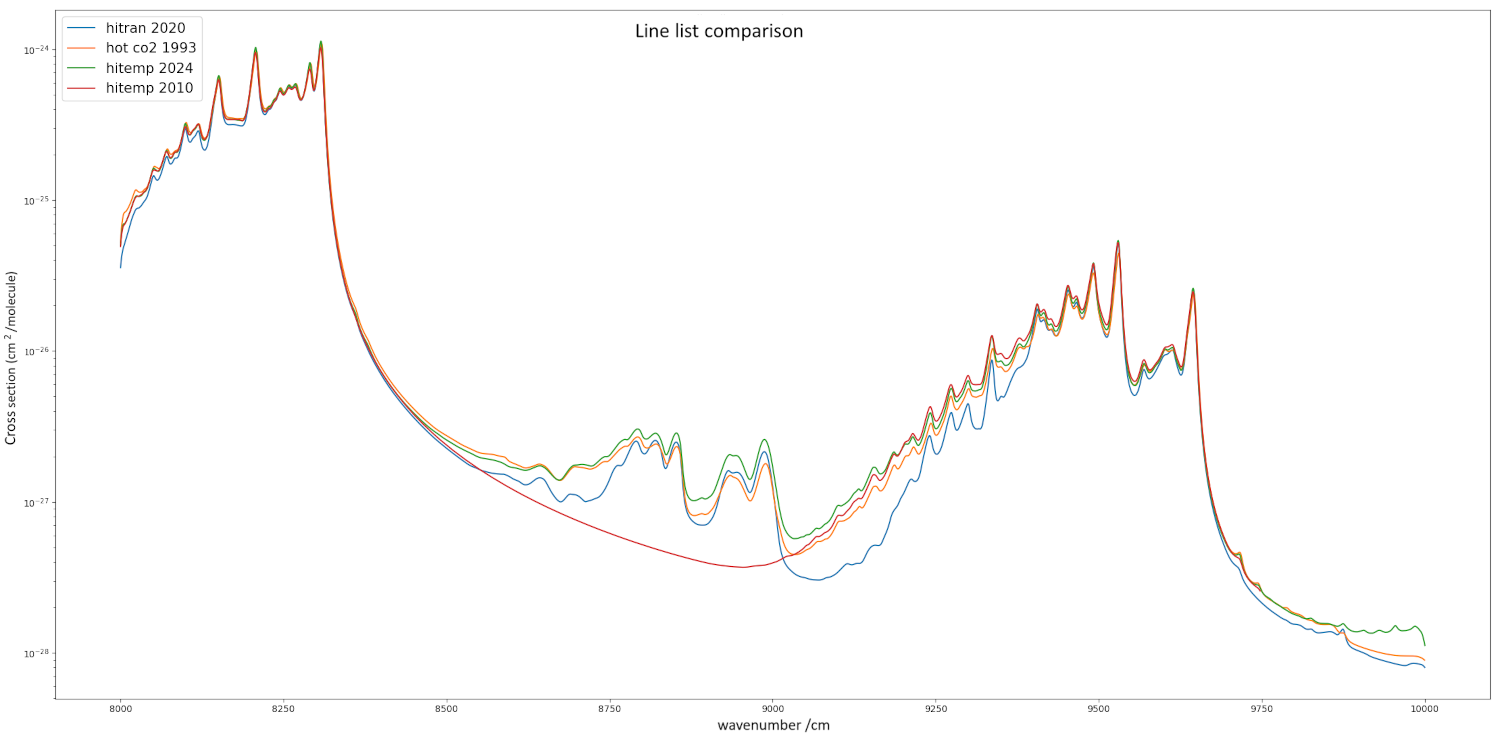
Figure 2: Comparison of CO2 absorption lines from several line databases (Hot CO2, HITEMP 2010, HITRAN 2020, HITEMP 2024) using the Voigt line shape [6, 7, 4, 11]
Radiative Transfer Model
Our constructed ARTM is a combination of Py4CATS [8] and Helios-k [15] for producing gaseous absorption coefficients with sub-Lorentzian line shape [5] and the DISORT algorithm [10] for generating radiance. Additionally, we consider 75% mono-dispersed H2SO4 clouds [18] [16]. Our ARTM was validated against the Planetary Spectrum Generator (PSG) [19]. Through our work we aim to test our ARTM for the following scenarios in comparison to the SPICAV IR data:
- Temperature profiles - General Circulation Models (GCMs) near the planetary boundary layer [14] indicate deviations in the temperature profile from the VIRA model [12] which has been used in previous studies. Lebonnois and Schubert (2017) propose that the apparently super-adiabatic lapse rate observed by VeGa 2 may be real and could be explained by a gradient of molecular density of the atmosphere.
- Continuum absorption in different windows
- Water vapor gradient in lower atmosphere - Water vapor abundance near the surface can point to local sources such as volcanic outgassing and can lead to exciting science.
Preliminary results and Summary
We modelled Venus night-side radiances for near nadir geometry and 0.5-micron mono-dispersed H2SO4 aerosols (mode 2 clouds) [19]. The continuum opacities have been fitted at each spectral window and the cloud opacities have been scaled in order to reproduce radiances found in the SPICAV IR dataset as shown in Figure 3. Here we assume an emissivity of 1.0 and zero surface elevation.
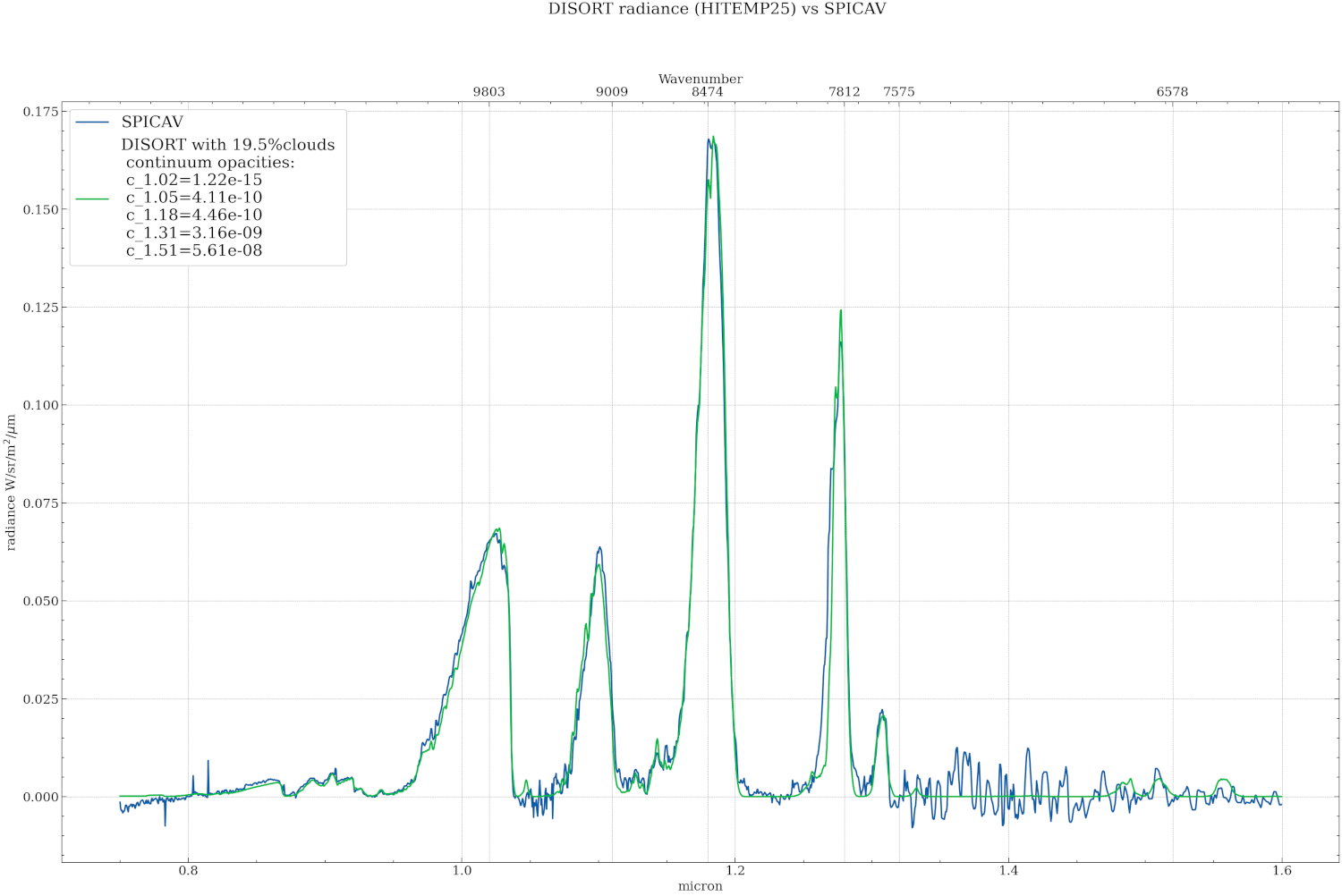
Figure 3: Venus night-side NIR radiances produced by our ARTM compared with SPICAV radiances We use a cloud factor of 19.5% relative to cloud profile in [18]; continuum opacities for individual windows are in cm-1/am2
Our current ARTM produces a good fit to the SPICAV spectrum using the HITEMP 2024 database. We aim to further improve our model to achieve a better estimate of continuum opacity and near surface properties.
Bibliography
[1] Smrekar S. et al. (2022) IEEE Aerospace Conference (AERO) pp. 1-20
[2] Allen D. A. et al. (1984) Nature, 307, 222–224
[3] Helbert et al., (2021) Planetary Science and Astrobiology Decadal Survey 2023-2032
[4] Gordon I. E. et al. (2022) J. Quant. Spectrosc. Radiat. Transfer, 277, 107949
[5] Bézard B. et al. (2011) Icarus, 216(1), 173–83
[6] Pollack J. B. et al. (1993) Icarus, 103, 1–42
[7] Rothman L. S. et al. (2010) J. Quant. Spectrosc. & Radiat. Transfer, 111(12-13), 2139–2150
[8] Schreier F. et al. (2019) Atmosphere, 10(5), 262
[9] Korablev O. et al. (2006) J. Geophys. Res. 111(E9)
[10] Stamnes et al. (1988) Applied Optics, 27(12), 2502-2509
[11] Hargreaves R. J et al. (2025) J. Quant. Spectrosc. Radiat. Transfer 333
[12] Seiff A. et al. (1985) Advances in Space Research, 5(11):3–58
[13] Lebonnois S. and Schubert, G. (2017) Nature Geoscience, 10(7):473–477
[14] Lebonnois S. et al. (2018) Icarus, 14 314:149–158
[15] Grimm J. S. and Heng, K. (2015) ApJ 808 182
[16] Palmer K. F. and Williams, (1975) Appl. Opt., 14 pp. 208-219
[17] Kappel D. et al. (2016) EGU General Assembly Vol. 18, EGU2016-7578-1
[18] Bierson J. C and Zhang X. (2019) EPSC-DPS Vol. 13, EPSC-DPS2019-853-1
[19] Villanueva G. L. et al. (2018) J. Quant. Spectrosc. & Radiat. Transfer, 217, 86 – 104
How to cite: Das, A., Müller, N., Kappel, D., Schreier, F., Grenfell, J. L., Rauer, H., Plesa, A.-C., and Alemanno, G.: An Atmospheric Radiative Transfer Model to Constrain Lower-Atmospheric Characteristics of the Venusian Atmosphere, EPSC-DPS Joint Meeting 2025, Helsinki, Finland, 7–12 Sep 2025, EPSC-DPS2025-1707, https://doi.org/10.5194/epsc-dps2025-1707, 2025.


