
 3,2,
3,2,- 1Cadi Ayyad University, UCA, Faculty of Sciences Semlalia, High Energy physics and Astrophysics laboratory, Av. Prince My Abdellah, BP 2390, 40000 Marrakech, Morocco
- 2Space sciences, Technologies & Astrophysics Research (STAR) Institute, Université de Liège, Liège, Belgium
- 3Florida Space Institute, University of Central Florida, 12354 Research Parkway, Partnership 1 building, Orlando, FL, 32828, USA
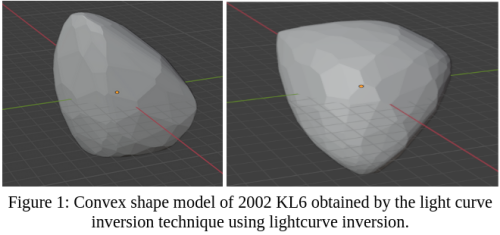
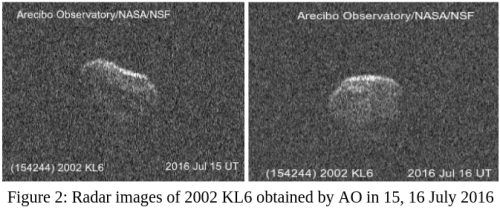
The shape modeling of near-Earth asteroids (NEAs) has gained significant attention in recent years due to its critical role in understanding the physical properties and dynamical evolution of potentially hazardous objects. NEA (154244) 2002 KL6 is particularly intriguing because of its reported negative YORP effect [1], implying that its rotation is decelerating contrary to other asteroids which were observed to be under the YORP effect. In this study, we present an updated and more detailed shape model of 2002 KL6, derived from a combination of delay-Doppler radar imaging and optical light curves. Our optical dataset includes dense photometric observations spanning 16 years, primarily from TRAPPIST [2], supplemented by additional observatories. Optical observations are used with radar data by providing extended temporal coverage and a wider range of phase angles, both essential for accurate spin-axis determination and shape modeling. Using the DAMIT inversion code [3], we performed a period search in the interval 4.2 to 5.2 hours, yielding a best-fitting period of 4.6102 +/- 0.0003 hours. With this period, a pole search revealed a unique solution at (λ= 148.3°, β = -88.8° ecliptic coordinates), in agreement to recently published results. Our extensive and dense dataset allowed us to reject the mirror solution for the pole. The derived pole orientation also implies a retrograde rotation. With the derived spin-state parameters, we performed a convex shape inversion[5], resulting in an elongated shape (Figure 1), consistent with the radar images obtained by the Goldstone Observatory (Figure 2).
Our analysis is supported by archival radar data from both the Arecibo Observatory (AO) and Goldstone Observatory (GO). AO observations were conducted between July 7 and 16, 2016, and GO observations occurred from July 17 to 25, 2016, and again from July 30 to August 18, 2023. The closest approach during these intervals was approximately 0.06 au. Using the SHAPE modeling software[4] and the convex inversion model as initial input, we will derive a refined 3D shape model and spin-state solution for the asteroid. The radar-based model will reveal surface features visible in the radar images, offering greater detail than achievable with light curves alone. This work emphasizes also the importance of integrating multiple observational techniques in advancing our understanding of NEA evolution and contributes to ongoing efforts in planetary defense.
[1] Rodríguez Rodríguez, Javier, et al. "Light-curve analysis and shape models of NEAs 7335, 7822, 154244, and 159402." Monthly Notices of the Royal Astronomical Society 533.4 (2024): 4160-4187.
[2] Jehin, Emmanuël, et al. "TRAPPIST: TRAnsiting planets and PlanetesImals small telescope." The Messenger 145.2 (2011).
[3] Ďurech, J., V. Sidorin, and Mikko Kaasalainen. "DAMIT: a database of asteroid models." Astronomy & Astrophysics 513 (2010): A46.
[4] Magri, C., Ostro, S., Scheeres, D., et al.: Radar observations and a physical model of Asteroid 1580 Betulia, Icarus, vol. 186, issue 1, pp. 152-177, 2007.
[5] Kaasalainen, Mikko, and Johanna Torppa. "Optimization methods for asteroid lightcurve inversion: I. shape determination." Icarus 153.1 (2001): 24-36.
How to cite: Miftah, M. A., Ferrais, M., Jehin, E., Marshall, S. E., Jabiri, A., and Benkhaldoun, Z.: Combined shape modeling of Near-Earth asteroid (154244) 2002 KL6 from Radar and optical observations, EPSC-DPS Joint Meeting 2025, Helsinki, Finland, 7–12 Sep 2025, EPSC-DPS2025-1712, https://doi.org/10.5194/epsc-dps2025-1712, 2025.


