
 1,1,2
1,1,2- 1Adam Mickiewicz University, Institute Astronomical Observatory, Faculty of Physics and Astronomy, Poznań, Poland (tkastr@vesta.astro.amu.edu.pl)
- 2National Research Institute of Astronomy and Geophysics (NRIAG), El-Marsed St. 11421 -Helwan, Cairo, Egypt
Very small asteroids with diameters smaller than around 200 m, although they constitute the majority of objects in the immediate vicinity of the Earth, we still know little about their mineralogical composition (important for assessing impact hazards and better understanding larger asteroids - rubble piles as their potential building blocks) and the behaviour of their rotation axes (being small and relatively close to the Sun, they are good candidates for testing theories of non-gravitational effects such as the YORP and Yarkovsky effects).
Since 2015, we have been conducting campaigns of photometric observations of very small near-Earth asteroids, especially with a very long observation arc in order to determine their physical properties from a single near-Earth flyby. We determine the rotation periods, colour indices, taxonomic types, absolute brightnesses from the phase curves, effective diameters, and spin axis. Examples of our results:[1],[2],[3].
Between 2024-10-01 and 2024-10-12 we observed a very small asteroid 2020~WG (H=21.64 +/- 0.40 mag [4]). The work is still in progress. Here we want to present some of the preliminary results.
We used observations in griz filters to determine the taxonomic type.
The first such observations were made by the 0.6-m REM telescope in La Silla (Chile). It is one of the few telescopes that can simultaneously observe in 4 filters. Comparison of brightnesses made simultaneously eliminates the influence of rotation and change of observation geometry on the colour index results. Unfortunately, we obtain only a few useful observation points, hence the relatively high measurement uncertainty, see Table 1.
Our main instrument, the 0.7-m RBT telescope in Arizona, made 30-s exposures. Observations were divided into 3 blocks to determine g-r, g-i, and g-z, respectively. In each block, exposures were alternately made in the g filter and one of the other filters. This technique minimizes the influence of rotation and changes in the observation geometry on the obtained results. We obtained the shifts of the lightcurves in the different bands by compositing the lightcurves using the PerFit program[5]. For an example of a composite lightcurve, see Fig.1.
We also collected data from the 1.88-meter telescope of the Kottamia Astronomical Observatory (KAO) in Egypt. Since we did not have the possibility of rapid alternating filter changes, we used 5-s exposures in 15-min blocks. Block sequence: g,z,g,z,g,z,g,i,g,i,g,r,g,r,g. We determined the color indices in the same way as for the RBT data.
The SDSS colour indices for each data set are presented in Table 1. We assumed the mean value of the colour indices to be a weighted average, where the weights were the inverse squares of the uncertainties.
Following the publication by [6], we converted the colour indices to reflectance values and then compared them with the reflectance values for the taxonomic classes. In this case, the taxonomic class cannot be determined unambiguously. Fig. 2 shows three probable taxonomic classes compared to our results: Xe, K, Cg. We consider Xe as the most probable for which albedo pv=0.15 +/- 0.041 [7]. With this albedo value and H=21.64 +/- 0.40 mag [4], the asteroid's effective diameter is D=0.161 +/- 0.036 km. Due to the very similar albedo for K class (pv=0.14 +/- 0.02) [6], the diameter D=0.167 +/- 0.032 km, is essentially the same within uncertainty. It should be noted that for the Cg type, the asteroid may be larger (pv=0.076 +/- 0.034) [7], D= 0.227 +/- 0.064.
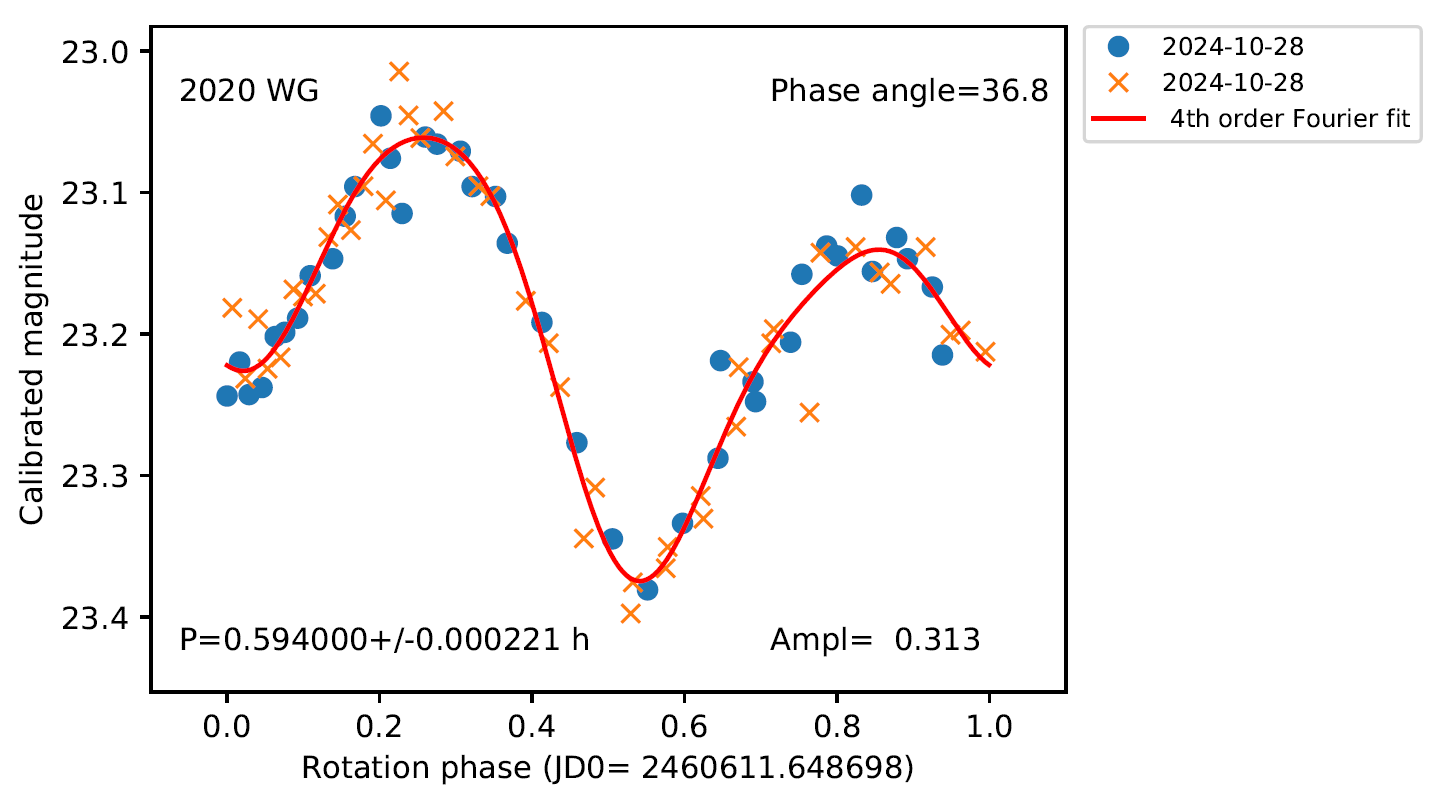
Fig. 1. Example of composite lightcurve. Data from RBT telescope, 2024-10-28. Blue dots - observation in g band, orange crosess - i band. The lightcurve in i band was shifted to the lightcurve in the g band. The synodical rotation period P is 35.64 +/- 0.01 minutes.
| UTC date, telescope | g-r | g-i | g-z |
| 2024-10-26 REM | 0.572 +/- 0.054 | 0.702 +/- 0.068 | 0.684 +/- 0.061 |
| 2024-10-28 RBT | 0.560 +/- 0.009 | 0.704 +/- 0.009 | 0.699 +/- 0.012 |
| 2024-10-29 RBT | 0.567 +/- 0.009 | 0.701 +/- 0.087 | 0.705 +/- 0.013 |
| 2024-10-29 KAO | 0.577 +/- 0.008 | 0.729 +/- 0.010 | 0.718 +/- 0.012 |
| average | 0.569 +/- 0.005 | 0.715 +/- 0.007 | 0.707 +/- 0.007 |
Tab. 1. Colour indices in SDSS bands


Fig. 2. Reflectance values obtained from the colour indices of asteroid 2020 WG compared to the three most probable taxonomic classes. Data for taxonomic
types from [6].
Acknowledgements
This research was funded in whole or in part by the National Science Centre, Poland, Grant No. 2021/41/N/ST9/04259. These results are part of a project that has received funding from the European Union’s Horizon 2020 research and innovation programme under grant agreement No 101004719. We would like to thank the REM telescope team for their help in observations.
References
[1] Kwiatkowski et al. (2021) A&A 656, A126
[2] Koleńczuk et al. (2022) Colours and taxonomy of 2022 AB: a super fast rotating near-Earth asteroid, EPSC 2022, held 18–23 September 2022 in Granada, Spain
[3] Koleńczuk et al. (2022) Colour Indices and Taxonomy of Super-Fast Rotating Very Small Near-Earth Asteroid 2015 RN35, ACM 2023, held 18-23 June 2023 in Flagstaff, USA
[4] https://ssd.jpl.nasa.gov/
[5] Kwiatkowski et al. (2009) A&A 495, 967–974
[6] DeMeo & Carry (2013), Icarus, 226, 723
[7] Warner et al. (2009) Icarus 202, 134
How to cite: Koleńczuk, P., Kwiatkowski, T., Kamińska, M., Kamiński, K., and Abdelaziz Moursi, A. M.: Physical Properties of the Very Small Near-Earth Asteroid 2020 WG, EPSC-DPS Joint Meeting 2025, Helsinki, Finland, 7–12 Sep 2025, EPSC-DPS2025-1716, https://doi.org/10.5194/epsc-dps2025-1716, 2025.


