
 1,4,
1,4,- 1INAF-IAPS, Rome, Italy (ernesto.palomba@inaf.it)
- 2CNR-IIA, Rome, Italy
- 3Politecnico di Milano, Polo Territoriale di Lecco, Italy
- 4Università di Padova, Italy
- 5Tyvak International, Torino, Italy
The ESA Hera mission, successfully launched on 7 October 2024, is a Planetary Defence Mission in combination with NASA DART (Double Asteroid Redirection Test) Mission, a mission kinetic impactor test, that impacted Dimorphos, i.e., the smallest body of the Didymos binary system, in September 2022.
Hera aims at demonstrating new technologies, from autonomous navigation around an asteroid to low gravity proximity operations, and at investigating the Didymos binary system, including the assessment of its internal properties and its geophysics characterization [1]. In addition to the remote sensing suite of instruments, Hera also carries two CubeSats, Juventas and Milani [2], that will be deployed in the vicinity of the asteroid system, providing unique scientific measurements.
One of the payload onboard Milani CubeSat is VISTA (Volatile In-Situ Thermogravimeter Analyser), a QCM-based device (Quartz Crystal Microbalance), whose scientific goals are the characterization of the dust environment of Didymos binary system, the detection of dust particle smaller than 5 µm, volatiles and light organics and the assessment of onboard contamination during the mission. VISTA is composed of three different units: two quartz crystals mounted in a sandwich-like configuration; the Proximity Electronics and the Thermal Control System (TCS), i.e., the customized resistors and a Thermo-Electric Cooler (TEC) to facilitate the particles deposition.
Thanks to its customized subsystem design, VISTA is capable of monitoring deposition and desorption/sublimation processes in space and molecular contamination, and performing Thermo-Gravimetric Analysis (TGA) on the collected materials [4], [5].
VISTA Flight Model is shown in Figure 1.
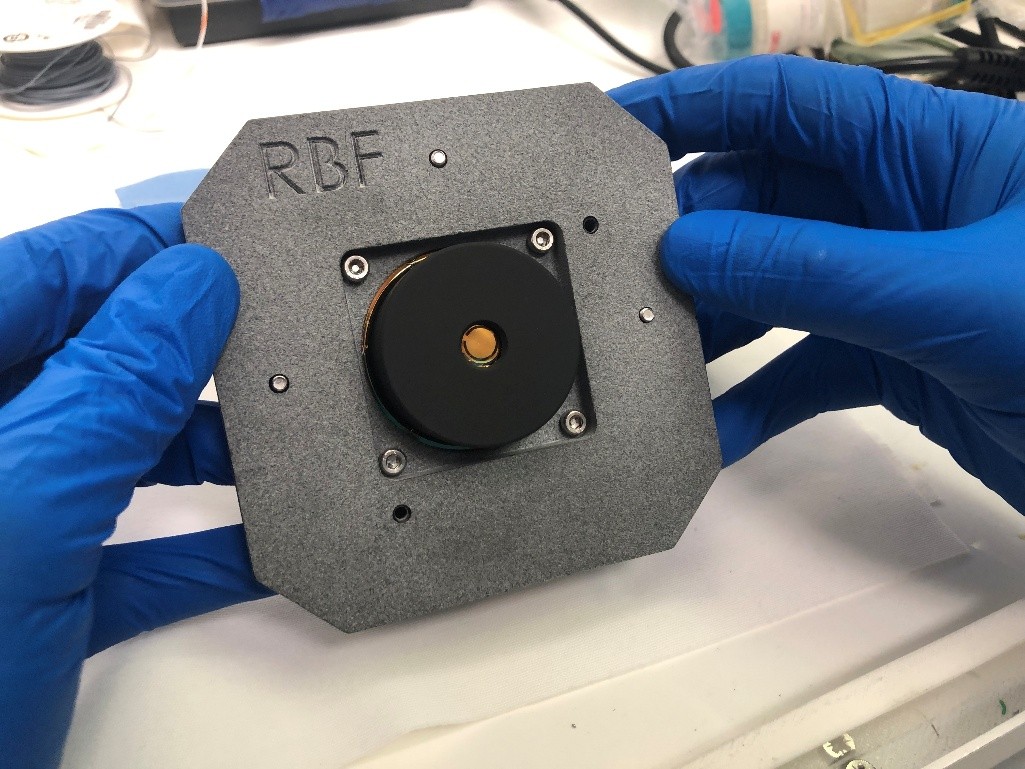
Figure 1. VISTA Flight Model mounted in its transport container.
VISTA was developed by an Italian Consortium led by INAF-IAPS (Istituto Nazionale di AstroFisica-Istituto di Astrofisica e Planetologia Spaziali), in collaboration with CNR-IIA (Consiglio Nazionale delle Ricerche-Istituto sull’Inquinamento Atmosferico) and Politecnico di Milano-MetroSpace Lab. The instrument is based on the heritage of different ITT-Emits ESA Projects: CAM (Contamination Assessment Microbalance), developed for “Evaluation of an in-situ Molecular Contamination Sensor for space use” (2014-2016); CAMLAB (Contamination Assessment Microbalance for LABoratory) developed for “Development of a European Quartz Crystal Microbalance” (2017-2019), and CAMLAB 2.0 developed for “European QCM: Bridging from Technical Development to Commercialisation” (2021-2024).
VISTA payload, including 1 Engineering Qualification Model (EQM), 1 Flight Model (FM) and 1 Flight Spare (FS) was developed in less than three years starting from late 2020. During this time, the instrument was also tested (Qualification and Acceptance tests on VISTA EQM, FM and FS were performed at INAF-IAPS and Politecnico di Milano-MetroSpace Lab) in vacuum and cryogenic environment to monitor absorption/desorption and deposition/sublimation processes to monitor the mass particles deposition lower than 5µm and sub-µm particles [5,6].
Figure 2 shows an example of a deposition test: an organic compund is heated in the Field Of View (FOV) of the instrument. The plot on the left shows the increase of frequency (black curve) with the heating steps of the organic component. In the second plot, a TGA test is shown: the crystals are heated by the built-in heaters after the depositon test to regenerate the crystals and characterize the organic compund by evaluating the sublimation temperature and the entalpy of sublimation.

Figure 2. Deposition test and TGA in vacuum.
Following the deployment of Milani in early 2027, the experimental phase will begin. VISTA will operate in Accumulation Mode (i.e., passive accumulation of dust and volatiles) and Active Modes (i.e., by using TEC and/or integrated µ-heaters) to promote the volatiles/compounds deposition and to characterize their desorption through Thermogravimetric Analysis, respectively. After the first in-orbit commissioning, VISTA behaviour was reported nominal.
References:
[1] Michel P. et al., “The ESA Hera Mission: detailed characterization of the DART impact outcome and of the Binary Asteroid (65803)”, Didymos” 2022 Planetary Science Journal 3:160
[2] Cardi M. et al., “The Hera Milani Mission”, Space Science Review 2024 (under review)
[3] Palomba E. et al., “VISTA: dust and volatile sensor for the ESA Hera mission”, Space Science Review 2024 (under review)
[4] Dirri F. 2016, AMT, 9, 655-668
[5] Dirri F. 2018, IEEE Xplore Digital Library, pp. 150-154, doi: 10.1109/MetroAeroSpace.2018, 8453532
[6] Zampetti, E. 2023, Sensors 2023, 23, 5682
How to cite: Palomba, E., Dirri, F., Gisellu, C., Longobardo, A., Nardi, E., Zampetti, E., Saccabarozzi, D., Corti, M. G., Saggin, B., and Cardi, M.: VISTA, a dust sensor for the ESA Hera mission, EPSC-DPS Joint Meeting 2025, Helsinki, Finland, 7–13 Sep 2025, EPSC-DPS2025-1719, https://doi.org/10.5194/epsc-dps2025-1719, 2025.


