
 4,5,6
4,5,6- 1Department of Earth, Environmental and Planetary Sciences, Brown University, Providence, RI, USA
- 2Department of Earth Science and Engineering, Imperial College London, London, UK
- 3University of Bern, Bern, Switzerland
- 4The Open University, Milton Keynes, UK
- 5Natural History Museum, London, UK
- 6Université de Nantes, France
Introduction. Rockfalls occur when a boulder moves downhill and its trajectory leaves an imprint in the substrate observed in orbital imagery. Rockfalls were observed on Mars [e.g. 1], but because they appear as small features even in the highest-resolution images which additionally only cover only a few percent of the planet, they are one of the most understudied mass wasting processes. An important example is the area of Oxia Planum, the future landing site of the European Space Agency’s ExoMars Rosalind Franklin rover, which has been thoroughly searched for isolated boulders [2] but no rockfalls have ever been found. Here, we report on the discovery of rockfalls in various areas of Oxia Planum. We also address the following questions: 1) What drives these rockfalls? 2) What can we learn from them about the geotechnical properties of the shallow subsurface of Oxia Planum? 3) Do they pose any threats / constitute exciting exploration opportunities to the upcoming ESA ExoMars Rosalind Franklin Rover?
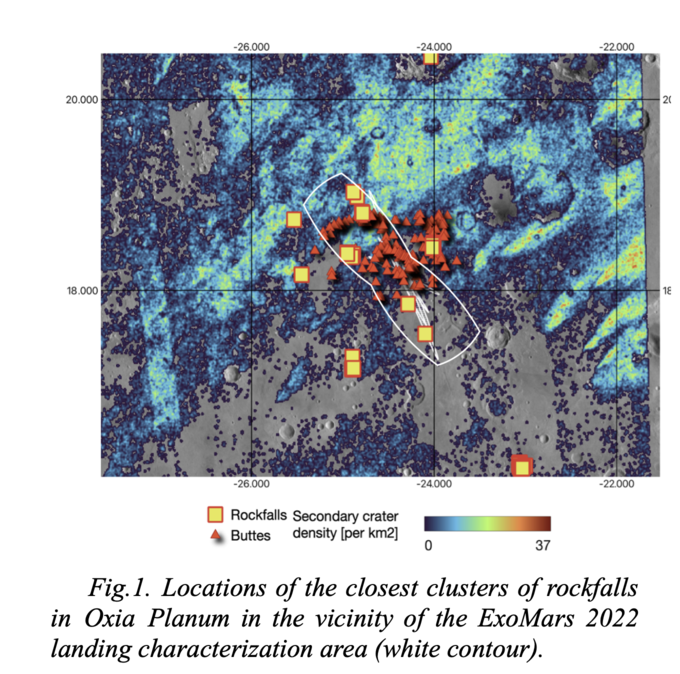
Observations & analysis. The search region covers a large area around the ExoMars 2022 landing characterization envelope (white contour in Fig.1), namely [13-23oN, 330-340oE]. The highest resolution (max. 0.25m/px) HiRISE dataset [3] is required to detect a rockfall. The same semi-automatic method (i.e. deep learning followed by a human review), which resulted in the first global rockfall catalog recently published by our team [4], was used to produce additional 3862 candidates at a lower confidence. We reviewed them to identify the first 48 rockfalls and then manually searched 14 HiRISE images, which expanded the dataset to 258 rockfalls. Rockfall mapping and geospatial measurements of clasts and tracks were done with QGIS [5]. Those feed the modeling of bearing capacity with Terzaghi equations for spherical loads [6]. In order to assess the scale of fragmentation due to cratering, we also use the results of iSALE shock physics code simulations of 50 m diameter craters [7].
Rockfall characteristics. Most boulders are < 2.5 m in diameter (the largest we found: 8 m dia.) and leave tracks <0.5 km long. For a small subset of rockfalls with discernable shadows (11) we were able to estimate track depths with a shadow length method. Qualitatively, track depths similar to boulder sizes are the evidence of rockfall freshness and geological youth.
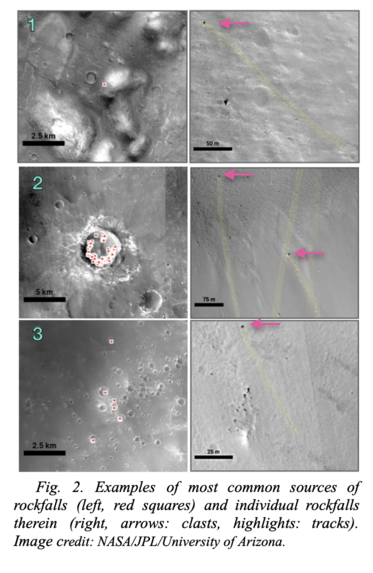
Locations. The locations of rockfalls in the proximity to the landing characterization area are shown in Figure 1. We identify 48 sources of rockfalls: large primary craters (5), secondary crater clusters (33), mounds (3) and other landforms with slopes (2) (see examples in Figure 2). Of particular interest is the observation of a high abundance of primary/secondary craters [8] and mounds [9] which have already been mapped in the region (Figure 1).
Drivers. Various preparatory and triggering factors can be driving rockfall activity. Source locations reveal that cratering certainly promotes rockfall formation in the region. Craters are 3.3 times more abundant in the north of the study region than in the south, and their sizes peak at 25-50 m diameter. Recent impact simulations producing 50 m diameter craters show target fragmentation to as far as 2-4 crater radii [7]. We estimate the density of fragmentation networks and infer that they could prepare clasts for mass wasting. Other factors such as hydraulic deformation, thermal stresses, tectonic features, new impacts, and marsquakes will also be discussed at the meeting.
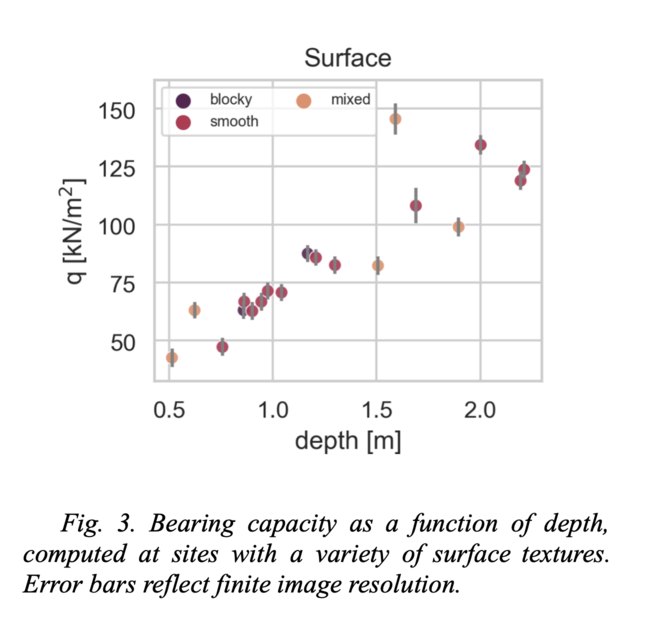
Geotechnical properties. We use our geospatial measurements of rockfalls to model bearing capacity in the region, which depends on gravity, track depth, boulder diameter, and regolith properties such as density, cohesion and angle of friction. We assume the values for the latter to be analogical to the Gale crater [10], and show how bearing capacity changes with depth in Figure 3. The estimates range from 50-150 kPa.
Implications for the mission. It is very likely that numerous rockfalls have yet to be found in the landing characterization area and that they could coincide with the trajectory of exploration of the rover. The data collected by a rover at rockfall sites could open up new types of investigations. For example, rockfalls can increase sample diversity to units that would otherwise require a steep climb. Rockfalls also excavate material partly shielded from radiation from the 1-2 m depths. Moreover, the rover could test assumptions that are widely used to extract geotechnical properties of soil from rockfall characteristics observed by spacecraft. Our estimates of those properties indicate that rover wheels, which exert contact pressure of 11 kPa, can safely operate in Oxia Planum.
References. [1] Roberts et al. (2012), JGR, 117, E02009.[2] Masterpietro et al. (2020), 10.1134/S0038094620060040 [3] McEwen et al. (2007). JGR, 112, E05S02. [4] Bickel et al. (2024), 10.1029/2024GL110674 [5] www.QGIS.org [6] Terzaghi (1943), 10.1002/9780470172766.ch8 [7] Sokołowska et al. (2025), 10.1029/2024JE008561 [8] Grindrod et al. (2025), this meeting. [9] McNeil et al. (2022), 10.1029/2022JE007246 [10] Arvidson et al. (2014), 10.1002/2013JE004605.
Acknowledgements. This work was funded by the NASA MDAP grant #80NSSC22K1086. Special thanks to E. Sefton-Nash.
How to cite: Sokolowska, A., Daubar, I., Bonab, A., Haut, I., Bickel, V., Fawdon, P., Grindrod, P., and Conway, S.: Will Rosalind Franklin See The Rolling Stones?, EPSC-DPS Joint Meeting 2025, Helsinki, Finland, 7–12 Sep 2025, EPSC-DPS2025-1727, https://doi.org/10.5194/epsc-dps2025-1727, 2025.


