
 1,3,4,5,
- 1Sabadell Astronomical Society, Sabadell, Spain (florence.libotte.office@gmail.com)
- 2Groupe Européen d'Observations Stellaires (GEOS), Bailleau l'Eveque, France
- 3Institut d’Estudis Espacials de Catalunya, Carrer Gran Capita, 2-4, Ed. Nexus 201, 08034 Barcelona, Spain
- 4School of Physical Sciences, The Open University, Walton Hall, Milton Keynes MK7 6AA, UK
- 5Observatori Astronomic Albanya, Cami de Bassegoda S/N, Albanya 17733, Girona, Spain
- 6Astrobiology Research Unit, Universite de Liege, Allee du 6 Aout, 19C, 4000 Liege, Belgium
- 7Department of Earth, Atmospheric and Planetary Science, Massachusetts Institute of Technology, 77 Massachusetts Avenue, Cambridge, MA 02139, USA
- 8Instituto de Astrofisica de Canarias (IAC), Calle Via Lactea s/n, 38200, La Laguna, Tenerife, Spain
Introduction
A group of amateur astronomers from the Sabadell Astronomical Society is using small professional telescopes to obtain exoplanets transits photometry for the ExoClock project and ARIEL mission.
Through this collaboration, we have faced cases like CoRoT-10b where the transit occurs more than four hours ahead of schedule. What does this mean?
TTV transit timing variation in multiplanetary systems
TTV in multiplanetary systems helps determining the masses of small exoplanets, that cannot be determined by radial velocities, like in the TRAPPIST system, where the mass of the 7 rocky planets, in resonance, have been determined thanks to TTV. Some times, a single planet showing TTV can be a clue to the existence of another planet, that does not transit, case of TOI 2015b and TOI 2015c.
TTV, orbital decay, nodal precession
Orbital decay has been reported in very few cases. The planet, like WASP-12b, is falling on its hosting star, and so show a small variation in its period. It needs long time of observations and scientist are searching for them actively.
Finally, the strange case of nodal precession, where the exoplanet transits only a part of its nodal precession cycle because of the inclination of its orbital plane. There are only four cases reported at the moment: WASP-33b, Kepler-13Ab, KELT-9b, TOI-1518b.
In this presentation we will focus on CoRoT-10b and TOI-2015b, both with several hours TTV, one still needs more observation, the second has proven the TOI-2015c existence.
CoRoT-10b, a study in process
The exoplanet CoRoT-10b has been observed by our Sabadell Group several times, not always with success as it is a very difficult target. The star has a magnitud of 15.5 in R and the depth 15.3 mmag, and because of its coordinates, it remains visible few months in our latitudes, and the frequence of ideal transits is low. The orbital period is 13. 24 days, the eccentricity is 0.53, the transit duration 3.02 hours. Until this year, there are no other published transit than ours. The last observations were published finally on ExoClock webpage. First, half a transit 17/7/2024, with a TTV of -235.15 minutes. Then on the 8/9/2024, the exoplanet shows a TTV of -262 minutes.
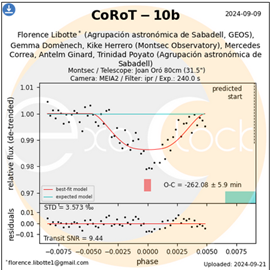
What can cause this long TTV?
The TTV is a gravitational phenomenon. It depends on the relation of the exoplanets masses and the stellar mass. But also on many other factors like the distances, the eccentricities, apsidal precession, the existence of another planet that does not transit… Or maybe new calculation of period or eccentricity is needed. These few observed transits are not sufficient to arrive at any conclusion. So CoRoT-10b remains a key target of our group and we plan to observe it when scheduled.
A resolved case: discovery of a non-transiting exoplanet thanks to TTV, TOI-2015 b and c.
Paper: Ref. Khalid Barkaoui, October 19, 2024, TOI-2015b: a mini-Neptune in strong gravitational interaction with an outer non-transiting planet.
TOI-2015b TTV varies from -2 hours to + 2 hours as we see in this figure

This investigation produced an improvement of TOI-2015b data, especially of its mass: 3.311+/- 0.012 R Earth à determination of average density: 1.5 g/cm3 so we face a Neptune type planet.
TOI-2015b is compatible with 70% water planet, could have atmosphere between 5-10% of its mass.
Discovery of TOI-2015c
The TTVs of TOI-2015b make it possible to identify a companion, TOI-2015c which does not transit, in a resonance ratio close to 5:3, although other scenarios are not ruled out. Orbital period: 5.582904d +/- 0.0004 d, its mass: 9.52+/- 0.42 Earth Mass; temperature: 450ºK, the radium is not known
The conclusion in this case is that the perturbation comes from the existence of a second exoplanet, that does not transit.
How to cite: Libotte, F., Correa, M., Ginard, A., Domènech, G., and Barkaoui, K.: Exoplanet observations and TTV, transit timing variation interesting cases, EPSC-DPS Joint Meeting 2025, Helsinki, Finland, 7–12 Sep 2025, EPSC-DPS2025-173, https://doi.org/10.5194/epsc-dps2025-173, 2025.


