
 1,1,3,2,3,2,4,5,6,6,3,3
- 1LATMOS, UVSQ Université Paris-Saclay, Sorbonne Université, CNRS, Guyancourt, France (yann.leseigneur@latmos.ipsl.fr)
- 2IRAP, CNES, Université Toulouse III Paul Sabatier, CNRS, Toulouse, France
- 3LIRA, Observatoire de Paris, Université PSL, CNRS, Sorbonne Université, Université Paris-Cité, Meudon, France
- 4Centre National d'Etudes Spatiales (CNES), France
- 5Graduate School of Science, Tohoku University, Japan
- 6Graduate School of Frontier Sciences, University of Tokyo, Japan
MIRS (MMX InfraRed Spectrometer) is the imaging spectrometer (0.9-3.6 µm) [1] of the JAXA MMX (Martian Moons eXploration) mission [2]. The mission will be launched in 2026 to the Martian system, with an arrival planned in 2027. The mission's main objective is to study the two Martian moons, Phobos and Deimos, to collect samples of Phobos and bring them back to Earth in 2031. Another major aim of the mission [3] and the MIRS instrument [1] is to answer key science questions regarding the transport processes of dust and water in the Martian atmosphere [3], such as: how do local and regional dust storms form, grow and evolve? What is the diurnal behaviour of water ice clouds (formation, transport, dynamics)?
The MMX probe will be injected into a quasi-circular equatorial orbit around Mars at an altitude of about 6000 km. From this particular orbit, four different observation modes of MIRS are expected for Mars observations (see Figure 1): the so-called nominal mode that maximises the longitudinal overlap, global mapping mode that covers all the illuminated Martian disk up to medium-high latitudes (+/- 60°), region of interest mode that provides temporal resolution (down to 15 minutes) above a limited area, and the limb mode. Each mode will be useful to study the spatial and temporal variations of aerosols (atmospheric dust, water and CO2 ices), and their fine diurnal variations. Indeed, the particular orbit of MMX (the second probe after Hope to be in equatorial orbit) will get us access to observations at very different local times with high spatial resolution, which will certainly provide some answers to the question addressed above.
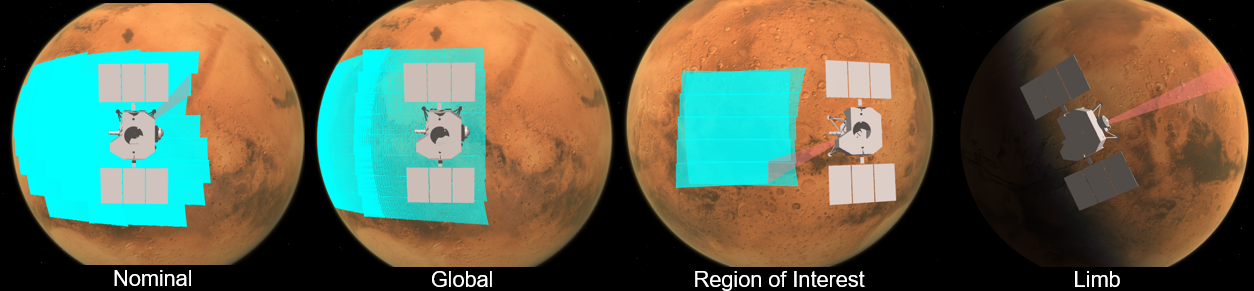
Figure 1: Illustration of the four observation modes of MIRS. The red swath represents the MIRS angle of view. The blue swath corresponds to the observation footprints acquired during a sequence of each observation mode, thanks to MIRS scanning capability (scanner mirror) and spacecraft maneuvers. Credits: CNES.
To prepare for future MIRS observations, we use the DISORT (DIScrete-Ordinate-method Radiative Transfer) code [4, 5] through the pyRT_DISORT Python module [6] to simulate the expected radiance of the Martian atmosphere that MIRS will measure. The idea is to produce a look-up table (simulated spectra bank) to retrieve the aerosol properties in the flight data, which allows a faster retrieval as soon as the data are downlinked. First, we will present the parameter space exploration of the radiative transfer model done to quantify the impact of each physical parameter (e.g., observation angles, surface albedo) on the generated spectra. Then, we will discuss the look-up table parameter ranges and steps, which impact the size, as well as the computation time to create the look-up table and the time to search in it. Finally, we will show MIRS images simulated with DISORT in real conditions of the MMX probe arrival, for different atmospheric conditions (dust storms, ice clouds, clear atmosphere) and considering a simulated representative instrument transfer function [7].
Acknowledgments:
We thank the MMX JAXA teams for their efforts and CNES for the financial support and collaboration to build the MIRS instrument.
References:
[1] Barucci M. A. et al. (2021) Earth, Plan. and Space, 73, 211.
[2] Kuramoto K. et al. (2022) Earth, Plan. and Space, 74, 12.
[3] Ogohara K. et al. (2021) Earth, Plan. and Space, 74, 1.
[4] Stammes K. et al. (1988) Applied Optics, 27, 2502-2509.
[5] Stammes K. et al. (2017) Astrophys. Source Code Library, 1708.006.
[6] Connour K. & Wolff M. (2023) GitHub repository, pyRT_DISORT.
[7] Théret N. et al (2023), LPSC 2023, abstract #1142.
How to cite: Leseigneur, Y., Le Bail, G., Gautier, T., Lasue, J., Bertrand, T., Fourgeaud, L., Stcherbinine, A., Sawyer, E., Jouquey, M., Théret, N., Kazama, A., Aoki, S., Doressoundiram, A., Nakagawa, H., and Barucci, A.: MIRS/MMX: an imaging spectrometer to observe the Martian aerosols, EPSC-DPS Joint Meeting 2025, Helsinki, Finland, 7–12 Sep 2025, EPSC-DPS2025-1731, https://doi.org/10.5194/epsc-dps2025-1731, 2025.


