
 1,2,2,
- 1Institute for Space, University of Leicester (jac112@leicester.ac.uk)
- 2School of Physics and Astronomy, University of Leicester
- 3School of Geography, Geology and the Environment, University of Leicester
As the smallest and least explored terrestrial planet, Mercury’s surface composition, partially characterised following the successful NASA MESSENGER mission (2011-2015) (e.g. [1]), represents a geochemical conundrum. As the closest planet to the Sun, Mercury has experienced high temperatures in its past, which should have stripped away any/all volatiles and leaving behind stable refractory elements. However, MESSENGER data revealed unexpected surface compositional variability, with evidence for distinct geologic terranes alongside evidence for unusual regions enriched in moderately volatile elements [2-4]. There were also clues that suggested formation under reducing conditions in the form of low iron concentrations coupled with high sulphur and carbon contents (e.g., [5]), alongside evidence for explosive volcanism [6]. The ESA/JAXA BepiColombo mission, scheduled to arrive at Mercury in 2026, features a suite of instrumentation that has the potential to obtain improved compositional data for the surface. Specifically, the Mercury Imaging X-ray Spectrometer (MIXS), designed and built at the University of Leicester (UoL), has the capability to acquire higher resolution surface elemental composition data (max. achievable resolution ~ 10 km vs. ~ 200 km non-imaging field of view for MESSENGER XRS [1]). MIXS uses X-Ray Fluorescence (XRF) with solar-coronal X-rays and charged particles as the excitation source, which subsequently interact with the Mercurian regolith, releasing X-rays characteristic of elemental compositions [7]. Importantly, the MIXS instrument features new technology including optics and a novel depleted p-channel field effect transistor (DEPFET) detector [7]. To gain the highest science output, ground-truthing the spectra gathered by MIXS with spectra gathered in the lab will allow for the best interpretation of Mercurian terranes and features.
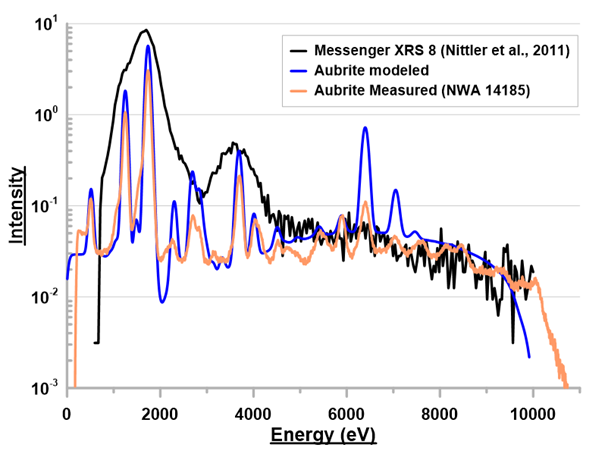
We are using the MIXS Ground Reference Facility (GREF) based at UoL, which is equipped with flight-like MIXS instrumentation including a flight spare DEPFET detector and an X-ray source, where the facility can be run under vacuum and cooled to mimic the space environment [8]. With GREF, we are applying XRF to Mercurian analogues including meteorites (e.g., aubrites, enstatite chondrites), terrestrial samples (e.g., boninites, komatiites) alongside synthesised materials that share properties with Mercury (e.g., the Mercury-Y blind sample [9]), or that can be used to establish measurement sensitivity (e.g., [10]), to establish a sample library to allow for direct comparison with incoming mission data from MIXS. In particular, we are looking to explore the volatile enrichments on the surface, while also establishing the effects of topography and space weathering. Our preliminary results confirm the higher resolution capabilities of MIXS compared to MESSENGER [11] and successful forward modelling of appropriate compositions including aubrite Northwest Africa (NWA) 14185 (Fig. 1). We are continuing to analyse a range of materials, to help establish a sample library for comparison with MIXS data while maximising the science-returns of the BepiColombo mission to understand Mercury’s history.
[1] Solomon S. C., Nittler, L. R., Anderson B. J. (2018) Mercury: The View after MESSENGER (Book). [2] Peplowski P. N. & Stockstill-Cahill, K. (2019) JGR:Planets 124:9:2414-2429. [3] Vander Kaaden K. E., & McCubbin F.M. (2016) GCA 173:246-263. [4] Weider S. Z. et al., (2015) EPSL 416:109-120. [5] Namur O. & Charlier B. (2017) Nature Geoscience 1:9-13. [6] Pegg D. L. et al., (2021) Icarus 365:114510. [7] Bunce E. J. et al., (2020) Space Science Reviews 216:8:126. [8] Cartwright J. A., et al., (In Prep) RASTI. [9] Barraud O. et al., (2025) EPSC. [10] Fox A. J. D. et al., (2025) EPSC. [11] Nittler L. R. et al., (2011) Science 333:6051:1847-1850. [12] Keil K. (2010) Geochemistry 70:4:295-317.
|
Figure 1: Plot showing diagnostic X-ray energy vs. Intensity. Example MESSENGER data [11], Aubrite modelled data based on overall compositions [12] on GREF, Aubrite measured for NWA 14185 on GREF. |
How to cite: Cartwright, J., Lindsay, S., Barry, T., Hall, G., Fox, A., Martindale, A., and Bunce, E.: Exploring Mercury’s Surface Compositions through the Mercury Imaging X-ray Spectrometer (MIXS) Ground Reference Facility (GREF), EPSC-DPS Joint Meeting 2025, Helsinki, Finland, 7–12 Sep 2025, EPSC-DPS2025-1742, https://doi.org/10.5194/epsc-dps2025-1742, 2025.


