
 1,2,3,5
- 1University of Helsinki, Faculty of Science, Helsinki University, Finland (tomas.kohout@helsinki.fi)
- 2Institute of Geology of the Czech Academy of Sciences, Czech Republic
- 3School of Electrical Engineering, Aalto University, Finland
- 4Finnish Museum of Natural History, University of Helsinki
- 5Institut Supérieur de l'Aéronautique et de l'Espace
Impact fragment size distribution is a vital factor in understanding impact processes and evaluate impact consequences. Thousands of meteoroids enter the Earth's atmosphere, but most of them burn up due to frictional heat, yet a small fraction survive to reach the ground as meteorites. The Bjurböle meteorite presents a valuable research opportunity as one of the few meteorites that remained significantly fragmented after impact. This approximately 400 kg L/LL ordinary chondrite meteorite's impact on sea ice resulted in catastrophic disruption, producing numerous centimeter to decimeter-sized fragments. This size range is underrepresented in both impact experiments and asteroid boulder studies and is often subject to observational bias in asteroid boulder studies. Consequently, the fate of centimeter to decimeter-sized particles from impact disruption remains poorly understood, while comprehensive 3D analyses of asteroid boulder morphology, examining both shape and size distribution concurrently, remain limited. To address this deficiency, we examined digital shape models of Bjurböle fragments weighing between 0.01 and 1 kg. The resulting 3D models were subsequently analysed for shape characteristics and morphology using a MATLAB-based analytical pipeline. Detailed 3D morphological parameters were studied, including bounding box dimensions (a, b, c), aspect ratios (b/a, c/a, c/b), equivalent diameter, circle ratio sphericity, degree of true sphericity, and solidity. Additionally, we compared 2D and 3D morphological analyses on the same fragment models to understand analytical variations between the approaches. Notably, the 3D analysis revealed more pronounced irregularities compared to 2D analysis because it comprehensively accounts for all surfaces in morphological determination, providing a more complete and comprehensive representation of the fragments' true geometric complexity. Results indicated mean fragment aspect ratios (b/a: 0.85 ± 0.09; c/a: 0.67 ± 0.13) indicating relatively equidimensional shapes, especially in the a-b plane. 3D morphological parameters such as degree of true sphericity (equivalent to circularity in 2D), as a large-scale roughness indicator, was determined to be 0.83 ± 0.04. Similarly, solidity, an indicator of small-scale roughness, was determined to be 0.88 ± 0.02, suggesting that Bjurböle meteorite fragments are generally exhibit convex shapes with noticeable concavities. Smaller fragments displayed reduced roughness with fewer concavities, while bigger fragments exhibited increased surface roughness with more prominent convex hulls, characteristics potentially attributable to fusion crust and erosion processes.
References: Kohout et al. (2024) DOI https://doi.org/10.3847/PSJ/ad4266

Fig. 1. Histograms of dimension ratios b/a, c/a, and c/b of studied fragments from the Bjurböle meteorite, comparing size fractions below 450g (right) and between 450g and 1kg (left).
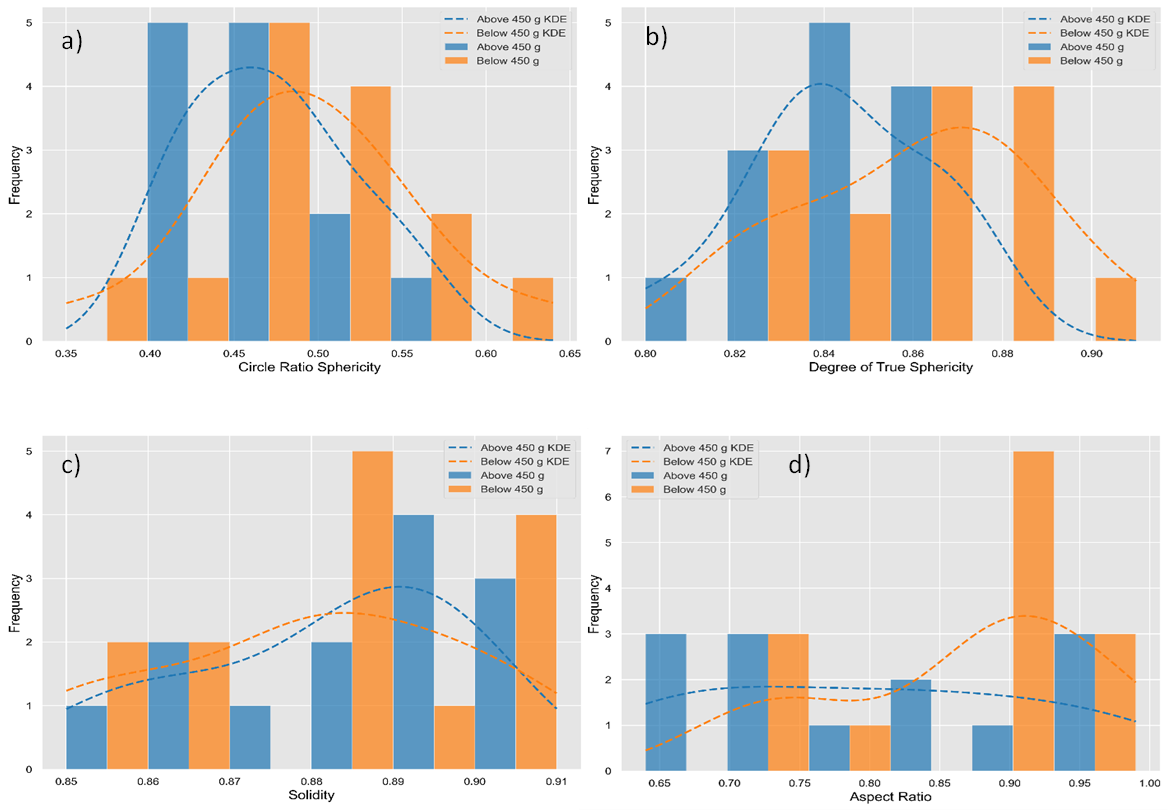
Fig. 2. Histograms with Kernal density estimation of a) circle ratio sphericity, b) degree of true sphericity, c) solidity and d) aspect ratio obtained using 3D morphological analysis for Bjurböle meteorite fragments weighing below 1 kg. Blue: Above 450 g size fraction, orange: below 450 g size fraction, dash lines: Kernal density estimations.
How to cite: Kohout, T., Seemantha Arachchi, R., Luttinen, A., and Duchene, A.: 3D shape and size distribution of Bjurböle chondritic meteorite fragments from a catastrophic impact event, EPSC-DPS Joint Meeting 2025, Helsinki, Finland, 7–13 Sep 2025, EPSC-DPS2025-1744, https://doi.org/10.5194/epsc-dps2025-1744, 2025.


