
 4,5,1,6,7,2,2,7,8,
- 1Instituto de Astrofísica de Andalucía / CSIC, Departamento Sistema Solar, Granada, Spain (valverde@iaa.es)
- 2Laboratory for Atmospheric and Space Physics, University of Colorado, Boulder, USA
- 3School of Physical Sciences, The Open University, Milton Keynes, United Kingdom
- 4Computational Physics Incorporated, Springfield, Virginia, USA
- 5NASA Goddard Space Flight Center, Maryland, USA
- 6Space Research Institute (IKI), Moscow, Russia
- 7Royal Belgian Institute for Space Aeronomy, Brussels, Belgium
- 8Laboratoire de Meterologie Dynamique, LMD/IPSL, Paris, France
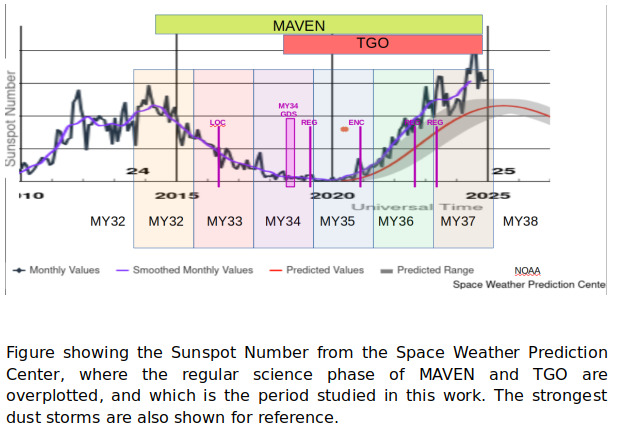
The upper atmosphere of Mars, including the mesosphere (60-120 km) and thermosphere (120 up to the exobase, around 180-230 km), is no doubt the less explored region of the red planet. Two recent and on-going missions to Mars are investigating these altitudes with new instrumentation and unprecedented detail: (1) the NASA Mars Atmosphere and Volatile EvolutioN (MAVEN), entirely devoted to the uppermost layers and the escape to space, started its science measurements in 2014; and (2) the ESA-Roscosmos Trace Gas Orbiter (TGO), which started its routine science operations in 2018 after a long period of aerobraking, and which contains two solar occultation instruments, NOMAD and ACS, which permit sounding from the ground up to upper thermosphere, about 180 km.
This work is devoted to the ambitious goal of combining datasets from diverse instruments on board these two missions, of exploiting the sinergy and complemetariety between them, and of obtaining a joint picture of the thermal structure of the whole Martian atmosphere, from the ground up to the exobase. This is part of an ISSI project entitled “A multi-mission approach to close the gaps in understanding of the structure and variability in the Mars upper atmosphere”. We will present the results of a broad team of scientists working for the past two years on this project, with focus on the global, planet encircling climatology of the Mars thermal structure (temperature and CO2 densities), and also its variability. The combination of MAVEN and TGO data permits to obtain the regular patterns of the Martian temperature profiles and how these vary with season, latitude, longitude and local time at different altitudes. Also we can combine the two missions’ datasets to explore year-to-year variations, dust storm impacts and solar-rotation effects at such a wide range of altitudes as those covered jointly by MAVEN and TGO, for the first time.
This work combining MAVEN and TGO is also very informative for the validation of Mars Global Climate Models, given the complementariety of the two missions from the observational point of view, with very different coverage and sampling in the key magnitudes like local time, longitude, latitude and season. A small number of other companion contributions to this conference tackle some of these specific aspects.
How to cite: Lopez-Valverde, M. A., Thiemann, E., Alday, J., Jones, N., Evans, S., Stone, S. W., Gonzalez-Galindo, F., Belyaev, D. A., Fedorova, A. A., Trompet, L., Jain, S., Gupta, S., Pillinski, M., Neary, L., MIllour, E., and Forget, F.: The Martian upper atmosphere’ thermal structure and variability as revealed by Maven & TGO combined datasets, EPSC-DPS Joint Meeting 2025, Helsinki, Finland, 7–12 Sep 2025, EPSC-DPS2025-1746, https://doi.org/10.5194/epsc-dps2025-1746, 2025.


