
 1,2,
1,2,- 1Center for Space and Habitability, University of Bern, Switzerland
- 2Institute for Particle Physics and Astrophysics, ETH Zürich, Switzerland
- 3Division of Space Research and Planetary Sciences, Physics Institute, University of Bern, Switzerland
- 4ARTORG Center for Biomedical Engineering Research, University of Bern, Switzerland
TOI-270 d, a sub-Neptune (Rp ≈ 2.2 R⊕, Teq ≈ 340 K) orbiting a nearby M3V star, offers an exceptional opportunity for atmospheric characterization of a temperate sub-Neptune with the James Webb Space Telescope (JWST). Recent analyses of transit data from NIRSpec and NIRISS have yielded conflicting interpretations of the planet’s atmosphere: a high-metallicity, miscible envelope (Benneke et al. 2024) versus a lower metallicity ”hycean” world (Holmberg &
Madhusudhan 2024). To resolve this discrepancy, we conducted an independent data reduction and retrieval analysis and find evidence for a more complex sulfur-chemistry in TOI-270 d’s atmosphere.
Using JWST’s NIRSpec/BOTS G395H and NIRISS/SOSS GR700XD modes (spanning 0.8–5.2 μm), we produce transit spectra at the native instrument resolution, preserving the maximal amount of information obtained from the observations. We perform atmospheric retrievals over a grid of binsizes, showing that retrievals at native spectral resolution and small binsizes (<16 pixels) are only reliable if the instrument-specific line-spread functions are accounted for.
Our fiducial retrieval results reveal a high-metallicity atmosphere (M/H ≈ 160× solar) with an elevated mean molecular weight (μ ≈ 5.6 amu), confidently detecting CH4 and CO2. But we also find that the Bayes Factor in favor of the inclusion of CS2 and NH3 are highly dependent on the deployed spectral resolution, varying between 3-78 and even reaching 30’000 in one case. We therefore demonstrate that coarse spectral binning introduces biases, particularly for molecules that do not dominate the shape of the spectrum.
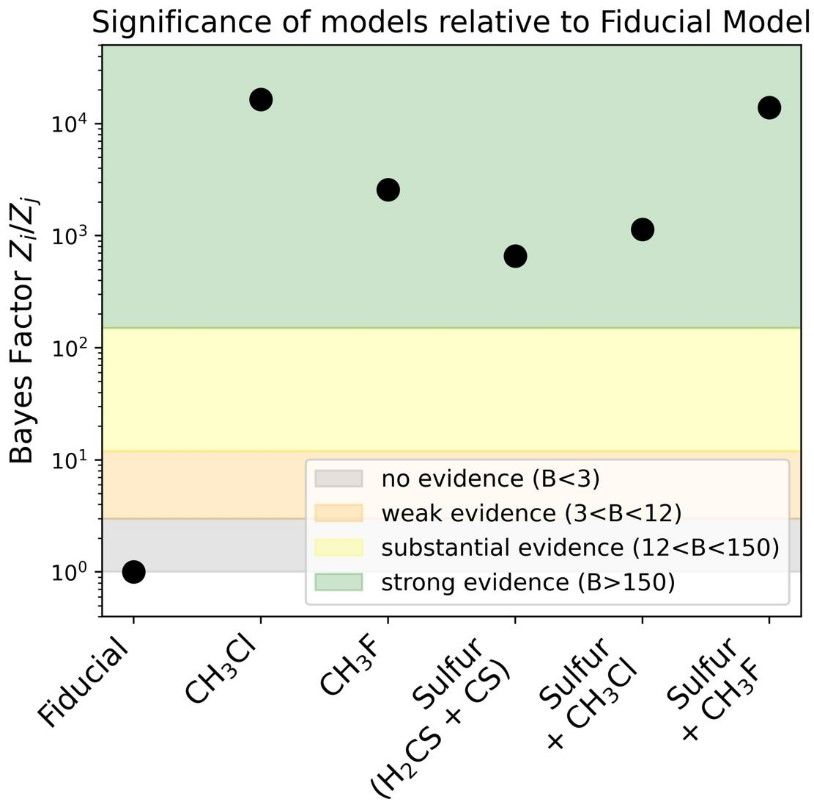
Figure 1: The Bayes Factor for the favored model extensions relative to the fiducial model. All mentioned additions are favored with a Bayes Factor >600 indicating strong evidence for their preference over the fiducial model.
Equipped with a solid baseline atmosphere model, we test for the potential presence of various other molecules. We identify multiple majorly favored configurations (Bayes Factor 600-16000, see FIgure 1). Most plausibly, we find a rich sulfur chemistry containing both H2CS and CS at well restricted abundances, potentially providing chemical pathways that could explain the large abundance >0.1% of CS2 found across all retrievals. Alternatively, the inclusion of CH3Cl or CH3F, retrieved at abundances of > 100 ppm, leads to similar improvements in the Bayesian evidence, as does any combination of these molecules and the aforementioned sulfur model. The data alone does not allow us to identify a preferred model, due to the fact that the opacities of CH3Cl, CH3F and H2CS are almost identical in our probed spectral range (see Figure 2).
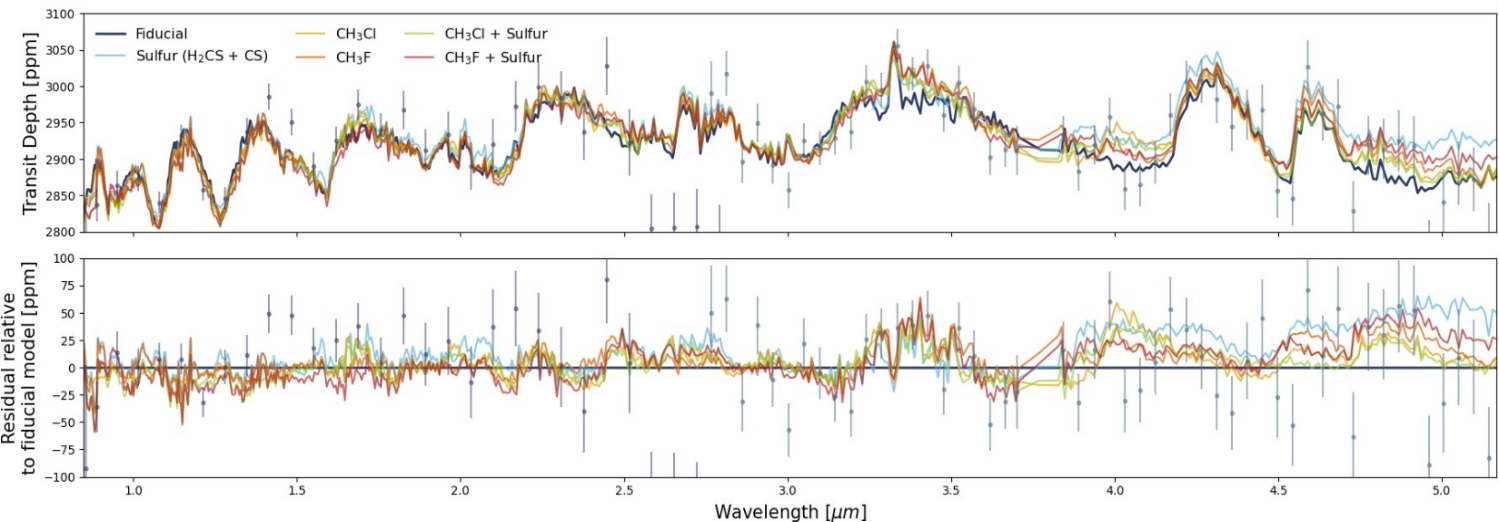
Figure 2: The model spectra of the fiducial model as well as the favored model extensions. We show a binned down version of our transmission spectrum for visual clarity. The fit to the data is improved mainly around 3.4 μm and we can clearly see that the model extensions are almost identical across the spectrum.
Our results highlight critical challenges in characterizing temperate sub-Neptunes. The degeneracy between biosignature gases (e.g., CH3Cl and CH3F) and abiotic sulfur compounds, like H2CS, underscores the need for the detailed exploration of sulfur-chemistry in the temperature regime of planets like TOI-270 d. Furthermore, we demonstrate that large Bayes Factors can be achieved at higher spectral resolutions, even for species lacking isolated absorption features, emphasizing the importance of carefully selecting spectral resolution and accounting for its impact when analyzing transmission spectroscopy data.
How to cite: Felix, L., Kitzmann, D., Demory, B.-O., and Mordasini, C.: Evidence for sulfur-chemistry in the sub-Neptune TOI-270 d, EPSC-DPS Joint Meeting 2025, Helsinki, Finland, 7–12 Sep 2025, EPSC-DPS2025-1750, https://doi.org/10.5194/epsc-dps2025-1750, 2025.


