EPSC Abstracts
Vol. 18, EPSC-DPS2025-1755, 2025, updated on 09 Jul 2025
https://doi.org/10.5194/epsc-dps2025-1755
EPSC-DPS Joint Meeting 2025
© Author(s) 2025. This work is distributed under the Creative Commons Attribution 4.0 License.

Effects of observation uncertainty on interior parameters precision
 1
1- 1Department of Physics, University of Toronto, Toronto, Canada
- 2Department of Physical & Environmental Sciences, University of Toronto at Scarborough, Toronto, Canada
- 3Department of Astronomy & Astrophysics, University of Toronto, Toronto, Canada
Over the years, improvements in instrument technology and data analysis have led to major advances in exoplanet sciences. Low-mass exoplanets, both super-Earths and mini-Neptunes, are now routinely detected and their radius and mass are commonly being measured despite their small sizes. These discoveries often challenge the preconceived notions derived from studies about the Solar System, especially regarding planet formation, evolutionary processes, system architectures and the diversity of planetary compositions. Consequently, a key focus has become identifying universal trends within the surveyed planetary demographics, prioritizing population-level analyses rather than isolated individual cases. However, due to considerable overlap between super-Earths and mini-Neptunes in mass-radius space, the first task of characterizing these planets is to obtain their bulk composition, which entails inferring their bulk chemical inventory and determining whether a planet is rocky, ocean, gaseous or a complex hybrid.
We will quantify how uncertainties in mass, radius and model assumptions propagate into errors in inferred compositions of rocky planets, water worlds or mini-Neptunes. These results can quickly guide observing strategies to maximize insights into small exoplanet compositions while avoiding over-observing. Since a strategy that improves the precision of one of the parameters, such as radius, without improving the other (i.e. mass) will not guarantee a better estimate of the planetary composition. For example, consider purely rocky planets constraints on iron-mass fraction/core-mass fraction (Fe-mf/cmf). We choose a 5M⊕ mass planet as our nominal case and consider different mass and radius errors. Thus, to constrain the Fe-mf error to 8 wt% (10% in cmf) with σR/R=2\% the mass uncertainty has to be 5\% for an Earth-like planet (cmf=33 ±10 wt%) and 11\% for a Mercury-like planet (cmf=74 ±10 wt%). Observing this example planet for longer to improve the mass will provide minimal gains at too high an observational cost as the radius uncertainty will limit any inferences. That is, for a given radius uncertainty (σR/R), there is a mass uncertainty (σM/M) below which it is not prudent to keep observing. The figure below demonstrates the improvements in Fe-mf/cmf error due to changes in mass uncertainty given a fixed radius uncertainty and vice versa.
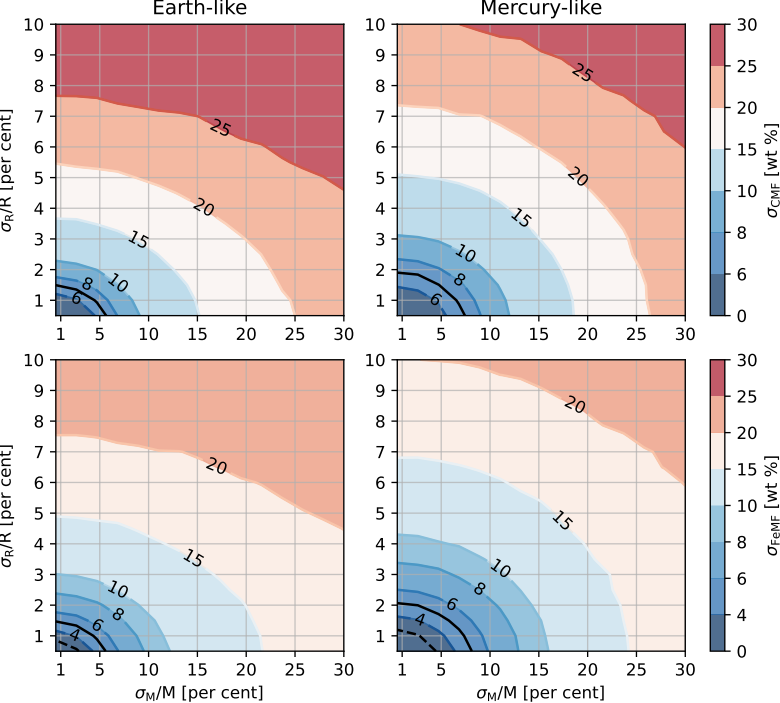
Additionally, we present parallel analyses for water worlds and mini-Neptunes, illustrating how uncertainties in mass-radius measurements and model assumptions similarly propagate into compositional errors. Lastly, when examining Earth as an exoplanet analog, we identify inherent uncertainty floors of approximately ±5 wt% in Fe-mf and ±7 wt% in cmf, attributable to gaps in our understanding of interior mineralogy. These findings provide essential guidance for future observational campaigns and highlight the necessity for balanced precision across planetary parameters to optimize compositional insights.
How to cite: Plotnykov, M. and Valencia, D.: Effects of observation uncertainty on interior parameters precision , EPSC-DPS Joint Meeting 2025, Helsinki, Finland, 7–12 Sep 2025, EPSC-DPS2025-1755, https://doi.org/10.5194/epsc-dps2025-1755, 2025.


