
 1,2,3,2,2,4,7,8,3
- 1Centre for Mars Meteorology Monitoring, Paneureka, Le Bourget-du-Lac, France (timotelombard@gmail.com)
- 2LMD/IPSL/CNRS/Sorbonne Université , Paris, France
- 3Space Science Institute, Boulder, CO, USA
- 4Department of Earth and Planetary Sciences, Yale University, New Haven, CT, USA
- 5Department of Astronomy and Planetary Science, Northern Arizona University, Flagstaff, AZ, USA
- 6Jet Propulsion Laboratory/California Institute of Technology, Pasadena, CA, USA
- 7National Space Science & Technology Center, UAE University, Al Ain, UAE
- 8NASA Goddard Space Flight Center, Greenbelt, MD, USA
Introduction: We have captured Martian dust and weather over 25 years of continuous satellite observations. Using thermal infrared (IR) data from instruments like TES (Mars Global Surveyor), THEMIS (Mars Odyssey), MCS (Mars Reconnaissance Orbiter), and EMIRS (Emirates Mars Mission), we have produced diurnal maps of column dust optical depth (CDOD) covering 13 Martian years (MY 24–37) [1–5]. Two types of maps are available: gridded maps (incomplete) and kriged maps (complete). These maps, normalized to 610 Pa or expressed as total CDOD, are mainly used as “dust scenarios” in the Mars Climate Database [6] and are publicly available (see the links to the datasets in the acknowledgments section). While they have helped study dust seasonality and large-scale storms, their use in multi-annual and daily-scale analyses remains limited.
Latest advances: Starting from retrievals provided by the TES, MCS, and EMIRS science teams, we use two processing chains (gridding and kriging) to produce daily quasi-complete gridded CDOD maps and fully complete kriged CDOD maps. These chains were technically improved and scientifically enhanced with the following changes:
1. We have used a new tool for Earth – Mars datetime conversion [13] to define a sol of the year for each daily map using a sol-based Mars calendar, as described in [1, Appendix A].
2. We have changed the computation of the total CDOD (defined in [1]) by using a lookup table of surface pressure extracted from the MCD v5.3, interpolated at the required time and location.
3. We have improved the gridding of retrievals by implementing an automatic method to detect data gaps (when instruments are inactive for several sols or weeks) and dynamically extend the time window (see [1] for details about the time window). This enables continuous generation of daily maps, even if sparse – essential inputs for the kriging process.
4. We have used data from the Compact Reconnaissance Imaging Spectrometer for Mars (CRISM, onboard Mars Reconnaissance Orbiter) to validate CDOD maps together with rover/lander data as in [1]. This might correct a recurring bias, especially during the Low Dust Loading Season (LS = 10°-140°; see [14]), where earlier CDOD maps underestimate dust opacity level. This also might aid in merging data from different instruments.
5. We have analyzed the differences between MCS- and EMIRS-based maps, as both instruments observed Mars quasi-simultaneously during MY 36 and 37 – except for a few periods when one of the instruments was not functioning nominally. Despite differences in spatial and temporal coverage, we have attempted to properly integrate CDOD data from MCS and EMIRS to produce combined daily maps for MY 36 and 37 and to deliver a single dataset for each year that reflects the contributions of one or more instruments.
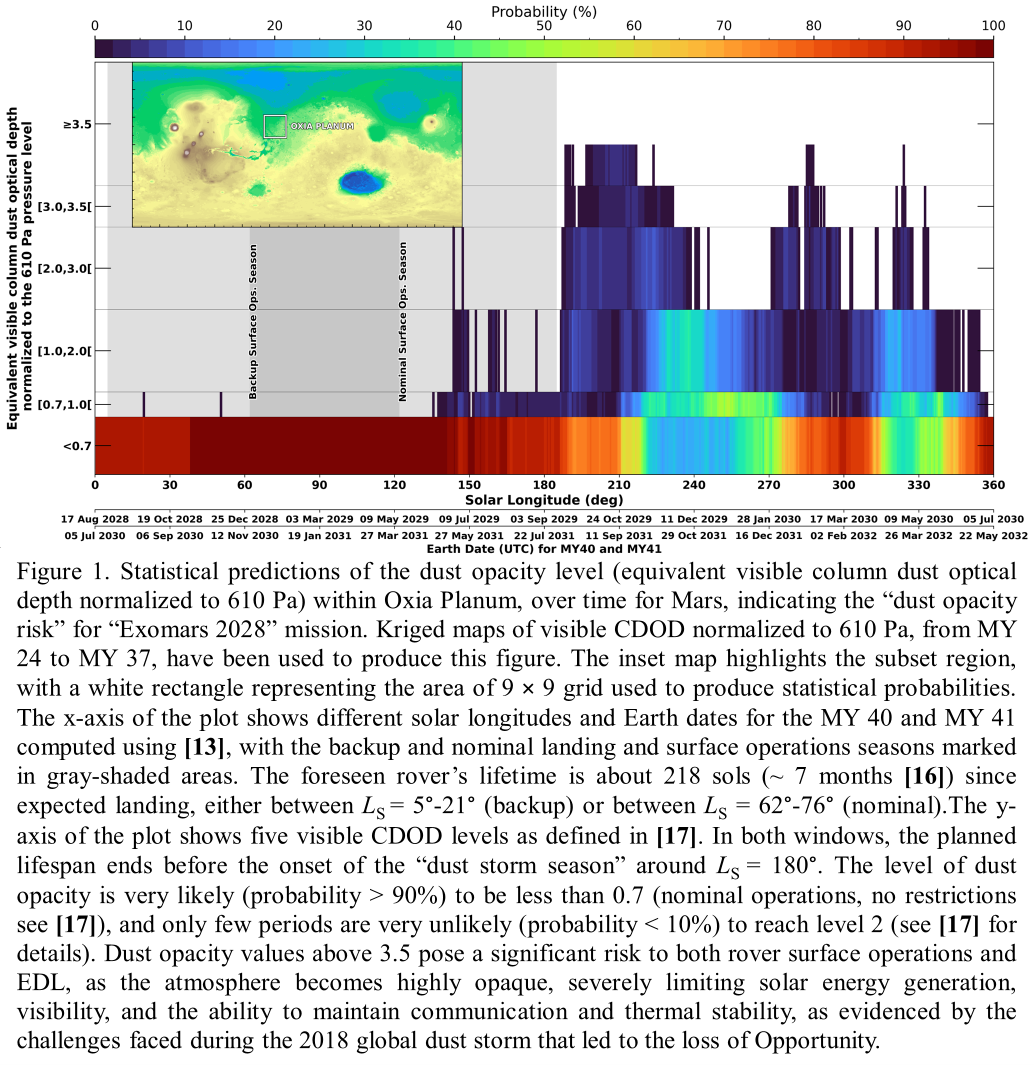
Applications: To support characterization of the Martian atmosphere for the ExoMars rover’s Entry, Descent, and Landing (EDL), we have used daily CDOD maps to assess dust opacity risks. Figure 1 presents predicted dust opacity levels for both EDL and surface operations during the nominal (LS = 62°-76°) and backup (LS = 5°-21°) seasons, based on criteria from [17].
From daily CDOD maps, it is also possible to identify large-scale dust events (“storms”) that reach regional or planetary scales, track their evolution and key characteristics (trajectory, area, optical depth), and build statistics comparable to dust storm statistics from visible images (e.g. [12, 15]), which are also useful for CDOD maps validation. Due to the volume of daily maps and the lack of prior systematic CDOD maps analysis, a new method is in development to detect and track large-scale dust events using unsupervised machine learning algorithms [9]. A key outcome is the production of a catalog of historic large-scale dust events, which can be routinely updated with new events as new dust maps become available.
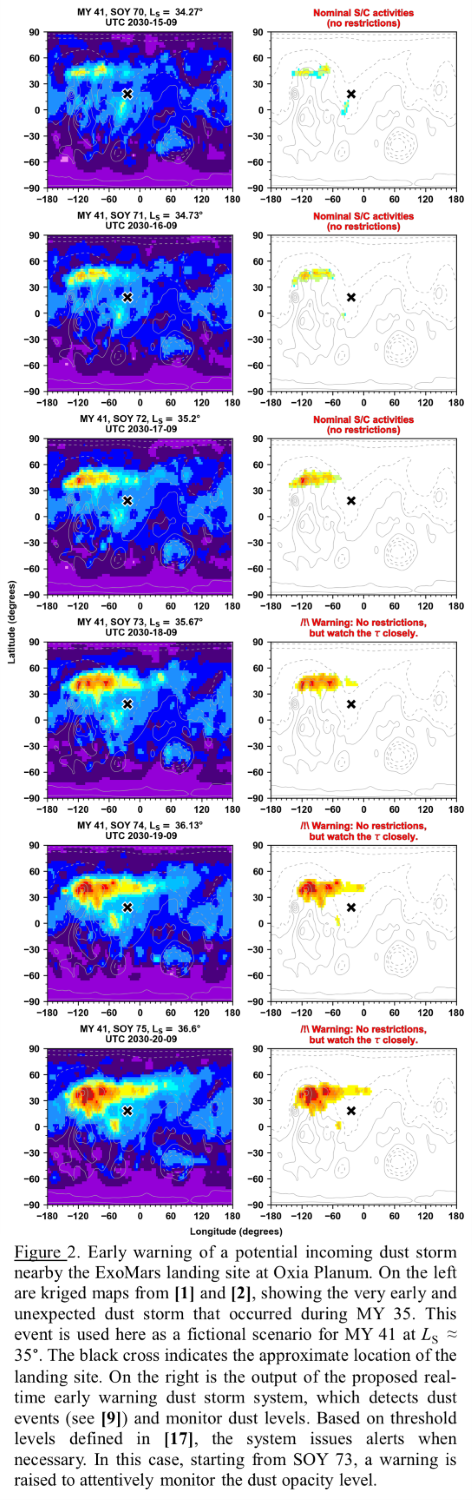
Finally, the mid-term to long-term objective is to establish a real-time processing chain that spans from receiving the retrievals to producing and processing CDOD maps. Real-time capability is currently hindered by the time required for data downlink and the availability of quasi real-time retrievals. The goal is to develop an early warning meteorological tool capable of daily monitoring of atmospheric dust and issuing alerts if dust levels are rising, potentially signaling the onset of a dust storm. We consider, as an illustrative case, the unexpected early dust storm during MY 35 around LS ≈ 35°. Let us assume that daily data acquisition and processing are feasible between SOY 70 and 75. In this context, if we imagine that ExoMars has successfully landed at Oxia Planum during MY 41, LS ≈ 35°, we could then monitor the daily dust levels near the landing site and issue warnings if a large-scale or regional dust storm emerges nearby (see Figure 2). Following this example, from SOY 73, a warning would have been raised because the mean of the dust core (see [9]) exceeds 0.7 (see [17]). This would allow the mission operations team to take appropriate actions such as suspending scientific activities or entering safe mode (see [17]).
Acknowledgments: TM, LM, and VG acknowledge support from CNES and ESA MCD project. BKG was supported by UAE University Grant G00003407. Work at the Jet Propulsion Laboratory, California Institute of Technology, is supported by NASA. The multi-annual dataset of daily gridded and kriged maps v2.x for MY24 through MY36 is available on the MCD webpage (NetCDF format) at https://www-mars.lmd.jussieu.fr/mars/dust_climatology/ and on the VESPA repository (FITS format) at https://bit.ly/3QMFfIf (shortened link). The latest v3.0 of the daily gridded maps for MY24 through part of MY27, together with corresponding TES CDOD retrievals in the infrared and in the visible, are available on the NASA PDS (atmosphere node) at: https://atmos.nmsu.edu/data_and_services/atmospheres_data/MARS/montabone.html
References: [1] Montabone et al., 2015, doi: 10.1016/j.icarus.2014.12.034. [2] Montabone et al., 2020, doi: 10.1029/2019JE006111. [3] Smith, 2009, doi: 10.1016/j.icarus.2009.03.027. [4] Smith, 2004, doi: 10.1016/j.icarus.2003.09.010. [5] Kleinboehl et al., 2009, doi: 10.1029/2009JE003358. [6] Millour et al., 2022, EPSC2022-786, https://doi.org/10.5194/epsc2022-786. [7] Smith et al, 2022, doi : 10.1029/2022GL099636. [8] Guha et al., 2023, doi: 10.1029/2023JE008156. [9] Lombard & Montabone, 2024, EPSC2024-1334, https://doi.org/10.5194/epsc2024-1334. [10] Allison, 1997, doi:10.1029/97GL01950. [11] Allison and McEwen, 2000, doi:10.1016/S0032-0633(99)00092-6. [12] Battalio and Wang, 2019, https://doi.org/10.7910/DVN/F8R2JX. [13] Guyon et al., 2025, EPSC-DPS2025-1694. [14] Forget & Montabone, 2017, http://hdl.handle.net/2346/72982. [15] Guha et al., 2024, https://doi.org/10.1029/2023JE008156. [16] Vago et al., 2017, https://doi.org/10.1089/ast.2016.1533. [17] Staab et al., 2020, doi: 10.1109/AERO47225.2020.9172528.
How to cite: Lombard, T., Montabone, L., Guyon, V., Millour, E., Forget, F., Battalio, M. J., Edwards, C. S., Kass, D. M., Kleinboehl, A., Guha, B. K., Smith, M. D., and Wolff, M. J.: Monitoring Dust in the Martian Atmosphere: Recent Advances and Applications in Column Dust Optical Depth Processing, EPSC-DPS Joint Meeting 2025, Helsinki, Finland, 7–12 Sep 2025, EPSC-DPS2025-1765, https://doi.org/10.5194/epsc-dps2025-1765, 2025.


