
 1,2,2,1,1
- 1DLR, Institute of Planetary Research, Planetary Geology, Berlin, Germany (isuyazici@gmail.com)
- 2Institut für Geo- und Umweltnaturwissenschaften – Geologie, Albert-Ludwigs-Universität Freiburg, Albertstraße 23-B, D-79104 Freiburg, Germany
Introduction
Fault scaling relationships are essential for understanding tectonic deformation [1] and seismic potential [2], particularly on planetary bodies where direct geophysical data are scarce. Following the InSight mission’s detection of marsquakes at Cerberus Fossae [3], a regional set of extensional fractures, interest in Martian tectonics has grown. Memnonia Fossae, a region with similar structural characteristics but much older tectonic history, provides a valuable opportunity to explore the long-term evolution of fault systems on Mars. A thorough analysis of fault geometry can reveal important information about how fault systems develop over time and how they respond to mechanical forces [4,5]. However, fault scaling studies on Mars are still limited due to the challenges of obtaining high-resolution topographic data [6]. To overcome this, we use the Reykjanes Peninsula in Iceland as a terrestrial analogue, where active tectonic processes in basaltic terrains mirror those believed to occur on Mars. Studying fault scaling in Reykjanes enhances our understanding of fault dynamics that can be applied to planetary systems.
Methods
In a previous study, we analyzed fault scaling in Memnonia Fossae using remote sensing data from 100 normal faults, obtaining a maximum displacement-to-length (Dmax/L) ratio of 0.007. For the present study, we focused on the Reykjanes Peninsula as an Earth analogue. During fieldwork, we collected structural measurements from 74 faults and fractures across 180 locations, recording parameters such as strike, dip, opening, throw, shear, and extension vectors. In addition, the Arctic DEM and drone imagery were employed to enhance the resolution of topographic data. This combination of field measurements, remote sensing, and drone data allowed for a detailed characterization of fault geometries and displacement.
Results
Analysis of the Icelandic data yielded a Dmax/L ratio of 0.006, which is very close to the values previously derived for Memnonia Fossae and aligns with reported fault scaling results for basaltic terrains on Earth. The integration of drone-derived topography was crucial in refining displacement estimates and allowed for a stronger comparison between Martian and terrestrial fault systems.
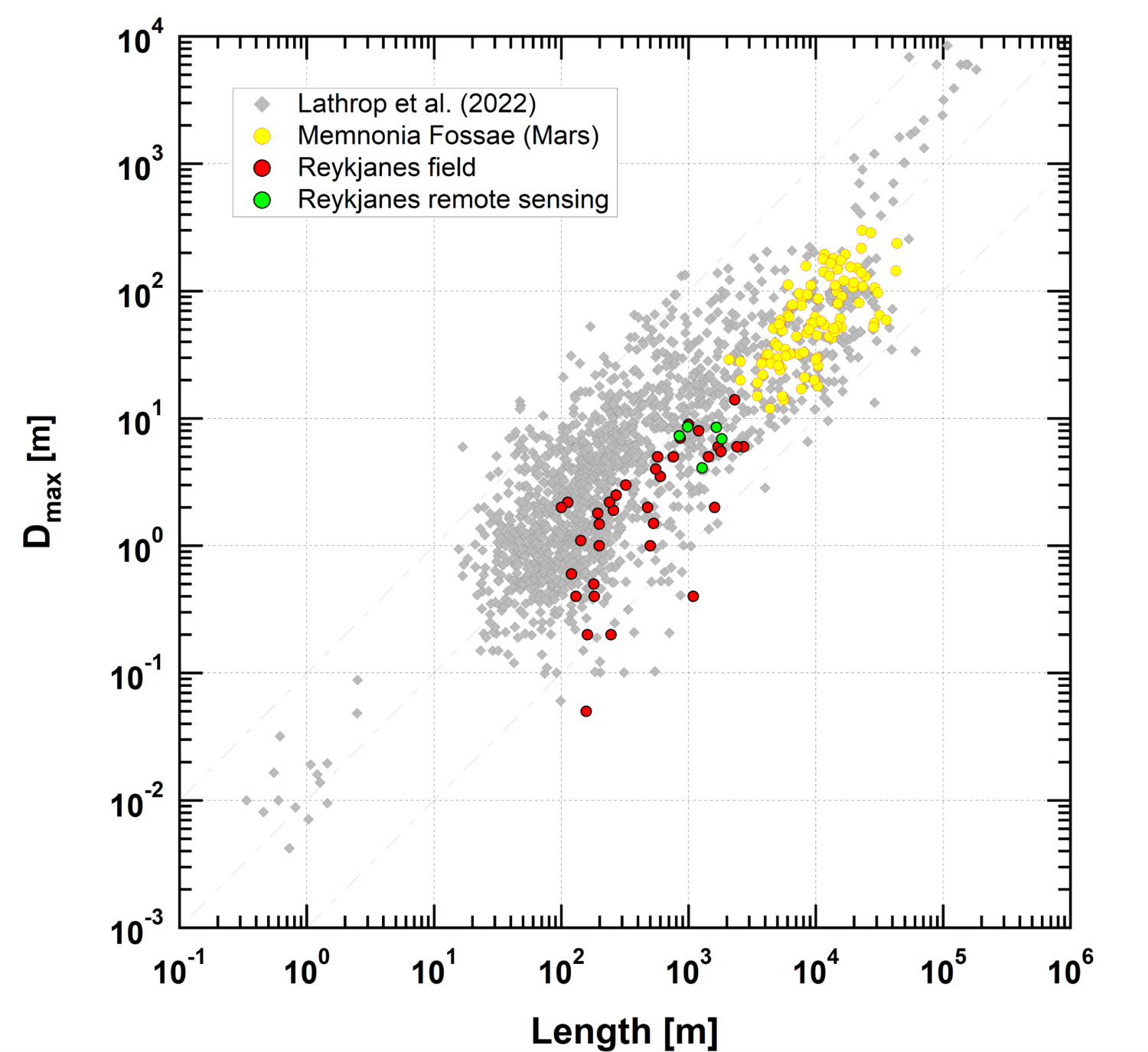
Figure 1: Dmax/L ratio comparisons of Memnonia Fossae, Reykjanes, and volcanic rocks on Earth [7].
Conclusion
This study demonstrates the value of combining field measurements, remote sensing, and drone data to improve the understanding of fault scaling on both Earth and Mars. The similarities observed between faults in Reykjanes and Memnonia Fossae suggest that similar fault growth mechanisms may operate in both regions, despite their different origin and ages. The geologically recent Reykjanes faults are associated to a rift zone along the plate boundary on Earth, whereas the Memnonia faults are formed in the ancient crust of a one-plate planet. By examining older fault systems like Memnonia Fossae alongside more active regions such as Cerberus Fossae, we gain valuable insights into the tectonic evolution of Mars. The findings highlight the importance of multi-source Earth-based datasets in advancing planetary fault research, particularly in the absence of direct geophysical data from Mars.
Acknowledgment
This work was supported by Europlanet Transnational Access Iceland funding.
References
[1] Schultz, R.A. et al. (2010) J. Struct. Geol., 32, 855-875. [2] Wells, D.L. and Coppersmith, K.J. (1994) Bull. Seismol. Soc. Amer., 84, 974-1002. [3] [11] Drilleau, M., et al., (2021) EGU General Assembly. Conf. 14998. [4] Cartwright, J. A., et al., (1995) J. Struct. Geol. 17, 1319-1326. [5] Cowie, P.A. and Scholz, C.H., (1992) J. Struct. Geol. 14, 1133-1148. [6] Gwinner, K. et al., (2010) Earth Planet. Sci. Lett. 294, 506-519. [7] Lathrop, B. A., et al., (2022) Frontiers in Earth Science, 10, 907543.
How to cite: Yazıcı, I. S., Kenkmann, T., Sturm, S., Karagoz, O., Hauber, E., and Tirsch, D.: Fault Scaling and Tectonic Insights from Reykjanes Peninsula: An Earth Analogue for Martian Extensional Faults, EPSC-DPS Joint Meeting 2025, Helsinki, Finland, 7–12 Sep 2025, EPSC-DPS2025-1778, https://doi.org/10.5194/epsc-dps2025-1778, 2025.


